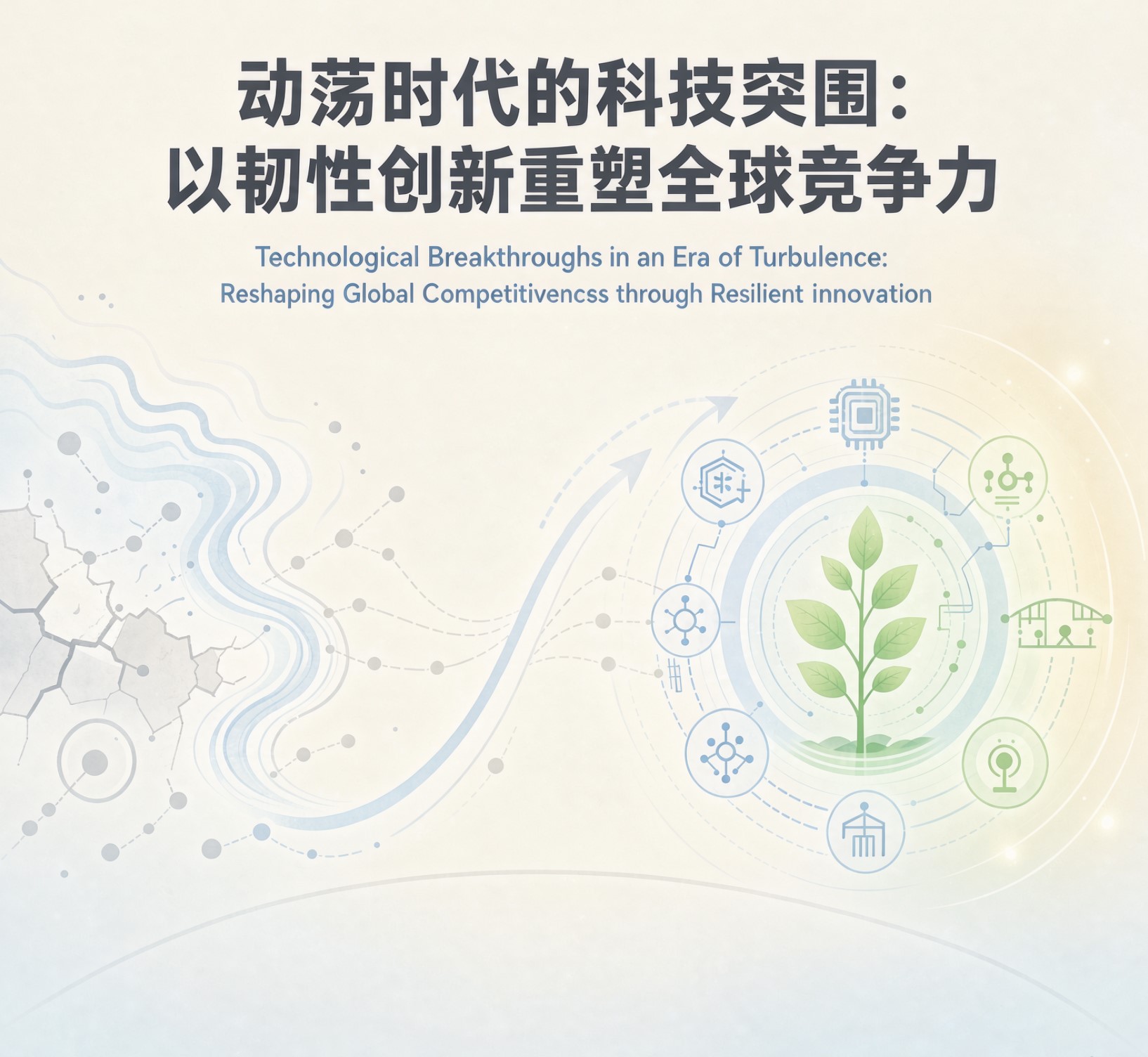
动荡时代的科技突围:以韧性创新重塑全球竞争力
Technological Breakthroughs in an Era of Turbulence: Reshaping Global Competitiveness through Resilient Innovation
摘要 | Abstract
全球正经历地缘政治裂痕加深、供应链碎片化及气候危机加剧的“动荡时代”。传统的线性创新模式面临严峻挑战。本文认为,未来的科技竞争核心将从单纯的“效率优先”转向“安全与韧性优先”。通过构建“可控创新”体系、投资抗脆弱基础研究、实施分层开放策略,各国和企业方能在大变局中立于不败之地。
The world is entering a "turbulent era" marked by deepening geopolitical fissures, fragmented supply chains, and intensifying climate crises. Traditional linear innovation models are facing severe challenges. This paper argues that the core of future technological competition will shift from mere "efficiency-first" to "security and resilience-first." By constructing a system of "controlled innovation," investing in antifragile basic research, and implementing tiered openness strategies, nations and corporations can secure their positions amidst great transformation.
一、 引言:旧范式的终结
I. Introduction: The End of the Old Paradigm
过去三十年,全球科技创新遵循着“超级全球化”的逻辑:分工极致细化、供应链即时交付(Just-in-Time)、技术标准全球统一。然而,近年来的一系列黑天鹅事件——从新冠疫情到地缘冲突——暴露了这一模式的脆弱性。关键技术“断供”、核心数据“出境”引发的安全焦虑,迫使决策者重新思考:在动荡背景下,科技创新的关键究竟是什么?
For the past three decades, global technological innovation followed the logic of "hyper-globalization": extreme specialization of labor, just-in-time supply chains, and unified technical standards. However, recent black swan events—from the COVID-19 pandemic to geopolitical conflicts—have exposed the fragility of this model. The anxiety triggered by "supply cut-offs" of critical technologies and the "outflow" of core data forces policymakers to reconsider: what exactly is the key to technological innovation in a turbulent context?
答案不再是单纯的“更快、更便宜”,而是“更安全、更具韧性”。
The answer is no longer simply "faster and cheaper," but "safer and more resilient."
二、 关键一:供应链与技术主权的“可控创新”
II. Key 1: Controlled Innovation in Supply Chains and Technological Sovereignty
在动荡时期,最致命的打击往往来自关键节点的“卡脖子”。科技创新的首要任务是建立“非对称自主”能力。
In turbulent times, the most fatal blow often comes from a "stranglehold" on critical nodes. The primary task of technological innovation is to establish capabilities for "asymmetric autonomy."
1. 精准识别与冗余设计
1. Precision Identification and Redundancy Design
并非所有技术都需要100%国产化。资源有限的情况下,必须锁定那些“不可替代”的环节——如高端EDA软件、极紫外光刻技术、特种稀有材料以及底层算法框架。对于这些核心环节,需要实施“冗余设计”:在同一功能上保留至少两条独立的技术路线(例如RISC-V与Arm架构并行,后量子密码与传统加密备份)。这种“双轨制”虽然短期内增加了成本,但在断供危机下构成了生存的防火墙。
Not all technologies require 100% domestic production. Given limited resources, it is essential to lock down "irreplaceable" links—such as high-end EDA software, EUV lithography, specialty rare materials, and foundational algorithm frameworks. For these core areas, "redundancy design" must be implemented: maintaining at least two independent technical routes for the same function (e.g., parallel development of RISC-V and Arm architectures, or post-quantum cryptography alongside traditional encryption backups). While this dual-track approach increases short-term costs, it serves as a firewall for survival during supply disruptions.
2. 近岸外包与友岸研发
2. Nearshoring and "Friend-shoring" R&D
为了降低跨境物流和政治风险,将部分中试、封装测试和数据标注环节转移至政治风险较低的邻近区域,成为保障产业链连续性的务实选择。这不仅是企业的成本控制策略,更是国家层面的供应链韧性布局。
To mitigate cross-border logistics and political risks, relocating parts of pilot testing, packaging, testing, and data annotation to nearby regions with lower political risk has become a pragmatic choice for ensuring industrial chain continuity. This is not merely a corporate cost-control strategy but a national-level layout for supply chain resilience.
三、 关键二:以“抗脆弱”为目标的基础研究
III. Key 2: Antifragile Basic Research
纳西姆·塔勒布提出的“反脆弱”概念,在科技领域尤为重要。动荡环境下,基础研究不能仅追求“从0到1”的突破,更要追求“从1到N”的生态适应力。
The concept of "antifragility" proposed by Nassim Taleb is particularly crucial in the technology sector. In turbulent environments, basic research must not only pursue breakthroughs from "0 to 1" but also strive for ecological adaptability from "1 to N."
1. 交叉学科的托底作用
1. The Backstop Role of Interdisciplinary Science
单一学科的创新容易触及天花板,而交叉融合则孕育着新的生命力。材料科学与人工智能的结合(AI for Science)正在加速新合金和催化剂的发现;生物技术与信息技术的融合(BT-IT)推动了合成生物学的发展。这些交叉领域具有更强的鲁棒性,即使某一细分领域受限,整体系统仍能通过其他路径寻找出路。
Innovation in single disciplines easily hits ceilings, whereas interdisciplinary convergence fosters new vitality. The combination of materials science and artificial intelligence (AI for Science) is accelerating the discovery of new alloys and catalysts; the fusion of biotechnology and information technology (BT-IT) is driving advances in synthetic biology. These interdisciplinary fields exhibit greater robustness; even if one niche area faces restrictions, the overall system can still find alternative pathways.
2. 公共品属性的回归
2. The Return of Public Goods Attributes
在资本避险情绪浓厚的当下,纯粹依赖市场资金的基础研究可能面临萎缩。因此,基础大模型、科学数据集、开源EDA库等应被视为“国家战略公共品”,由国家实验室或产业联盟托管,防止商业资本的短期逐利行为导致基础生态的崩塌。
Amid heightened capital risk aversion, basic research relying purely on market funding may face contraction. Therefore, foundational large models, scientific datasets, and open-source EDA libraries should be treated as "national strategic public goods," managed by national laboratories or industry alliances to prevent the collapse of foundational ecosystems due to short-term profit-seeking by commercial capital.
四、 关键三:AI与数据的“嵌入式治理”
IV. Key 3: Embedded Governance of AI and Data
人工智能是动荡期最大的变量。它既是提升生产力的引擎,也是国家安全的新疆域。
Artificial Intelligence is the most significant variable in this turbulent period. It is both an engine for productivity growth and a new frontier for national security.
1. 从“事后补救”到“原生可信”
1. From "Ex-post Remediation" to "Native Trustworthiness"
以往,安全往往是技术上线后的“补丁”。在未来,可信AI必须是“原生设计”。这意味着在模型训练之初就引入数据清洗、价值观对齐(Alignment)、可解释性机制和数字水印技术。只有内嵌了安全基因的技术,才能在动荡的国际环境中获得信任和许可。
Previously, security was often a "patch" applied after technology deployment. In the future, trustworthy AI must be "secure-by-design." This means integrating data cleaning, value alignment, explainability mechanisms, and digital watermarking from the very inception of model training. Only technologies with embedded security genes can earn trust and permission in a volatile international environment.
2. 数据主权的平衡术
2. Balancing Data Sovereignty
数据既要流通以产生价值,又要守住安全底线。隐私计算、联邦学习等技术使得数据“可用不可见”成为可能。各国正在探索“数据保税区”或“数据跨境白名单”机制,在保障国家安全的前提下,维持全球数字经济的连接。
Data must flow to generate value while adhering to security bottom lines. Technologies like privacy-preserving computing and federated learning make "usable but invisible" data a reality. Nations are exploring mechanisms such as "data bonded zones" or "cross-border data whitelists" to maintain connectivity in the global digital economy while safeguarding national security.

五、 关键四:绿色科技作为“硬通货”
V. Key 4: Green Technology as "Hard Currency"
能源安全和气候危机的双重压力,使得绿色低碳技术从“道德高地”转变为“生存刚需”。
The dual pressures of energy security and climate crisis have transformed green and low-carbon technologies from "moral high ground" to "survival imperatives."
1. 能源与数字的耦合
1. Energy-Digital Coupling
光伏、风能等可再生能源具有间歇性和波动性,必须与AI智能调度、长时储能技术相结合,才能形成稳定可靠的能源底座。这种“能源-数字”耦合系统,是抵御外部能源断供的最强盾牌。
Renewable energy sources like photovoltaics and wind power are intermittent and volatile; they must be integrated with AI-driven smart dispatch and long-duration energy storage technologies to form a stable and reliable energy foundation. This "energy-digital" coupling system is the strongest shield against external energy supply disruptions.
2. 循环制造与资源自主
2. Circular Manufacturing and Resource Autonomy
通过发展城市矿山(回收电子废弃物提取金属)、废塑料化学回收、钢铁短流程冶炼等技术,可以大幅降低对海外矿产资源的依赖度。在贸易壁垒高筑的时代,循环利用能力就是资源自主权。
By advancing technologies such as "urban mining" (recovering metals from e-waste), chemical recycling of waste plastics, and short-process steel smelting, dependence on overseas mineral resources can be significantly reduced. In an era of rising trade barriers, circularity capability equates to resource sovereignty.
六、 关键五:分层开放与南南技术走廊
VI. Key 5: Tiered Openness and South-South Technology Corridors
完全的脱钩不现实,完全的敞开不安全。解决之道在于“分层开放”。
Complete decoupling is unrealistic, yet complete openness is insecure. The solution lies in "tiered openness."
1. 协议层开放,价值层管控
1. Openness at the Protocol Layer, Control at the Value Layer
在协议和标准层面(如TCP/IP、RISC-V指令集、POSIX标准),继续坚持全球互联互通,确保技术生态的兼容性。而在涉及军事、人口、地理信息等敏感数据的价值层面,设立严格的负面清单。这种“一松一紧”的策略,既保全了效率,又守住了底线。
At the protocol and standard level (e.g., TCP/IP, RISC-V instruction sets, POSIX standards), continued adherence to global interconnection ensures compatibility within the technological ecosystem. At the value layer involving sensitive data related to military, demographics, and geographic information, strict negative lists are established. This "loose-tight" strategy preserves efficiency while upholding red lines.
2. 构建“全球南方”技术同盟
2. Building Technology Alliances across the "Global South"
面对西方的技术封锁,发展中国家之间的技术合作显得尤为重要。通过在东南亚、非洲、拉美建立联合实验室和技术转移中心,不仅可以输出中国的工程能力,还能构建一个去政治化的技术互助网络,对冲单边制裁的风险。
Confronted with Western technological blockades, technological cooperation among developing countries becomes paramount. By establishing joint laboratories and technology transfer centers in Southeast Asia, Africa, and Latin America, China can not only export its engineering capabilities but also construct a depoliticized network of technological mutual assistance, hedging against the risks of unilateral sanctions.
七、 结论:以韧性换空间
VII. Conclusion: Trading Resilience for Strategic Space
全球动荡背景下,科技创新的逻辑已经重构。我们必须接受“慢就是快”的哲学,将“不被打断的能力”(韧性)置于“跑得更快的能力”(效率)之前。
Against the backdrop of global turbulence, the logic of technological innovation has been restructured. We must embrace the philosophy that "slow is fast," prioritizing the capacity to avoid disruption (resilience) over the capacity to move faster (efficiency).
通过可控的创新体系、抗脆弱的基础研究、嵌入式的安全治理以及分层开放的国际合作,我们有望在不确定的世界中,构筑起确定性的科技护城河。这不仅是技术的胜利,更是战略智慧的体现。
Through controlled innovation systems, antifragile basic research, embedded security governance, and tiered international cooperation, we can hope to build a deterministic moat of technological protection in an uncertain world. This represents not just a victory of technology, but an embodiment of strategic wisdom.
此文由 怡心湖 编辑,若您觉得有益,欢迎分享转发!:首页 > 观·世界 » 动荡时代的科技突围:以韧性创新重塑全球竞争力 Technological Breakthroughs in an Era of Turbulence: Reshaping Global Competi
 周期调整,还是全球化解体?——2026–
 波罗的海之锁:拉脱维亚的战略地位与
 从两极到战国:双线热战背景下的全球
 世界公民:后全球化时代的身份重构与
 弹壳下的东亚密码:乌克兰拆解俄导弹
 亚洲水塔的黄昏:冰川拐点、气候危机