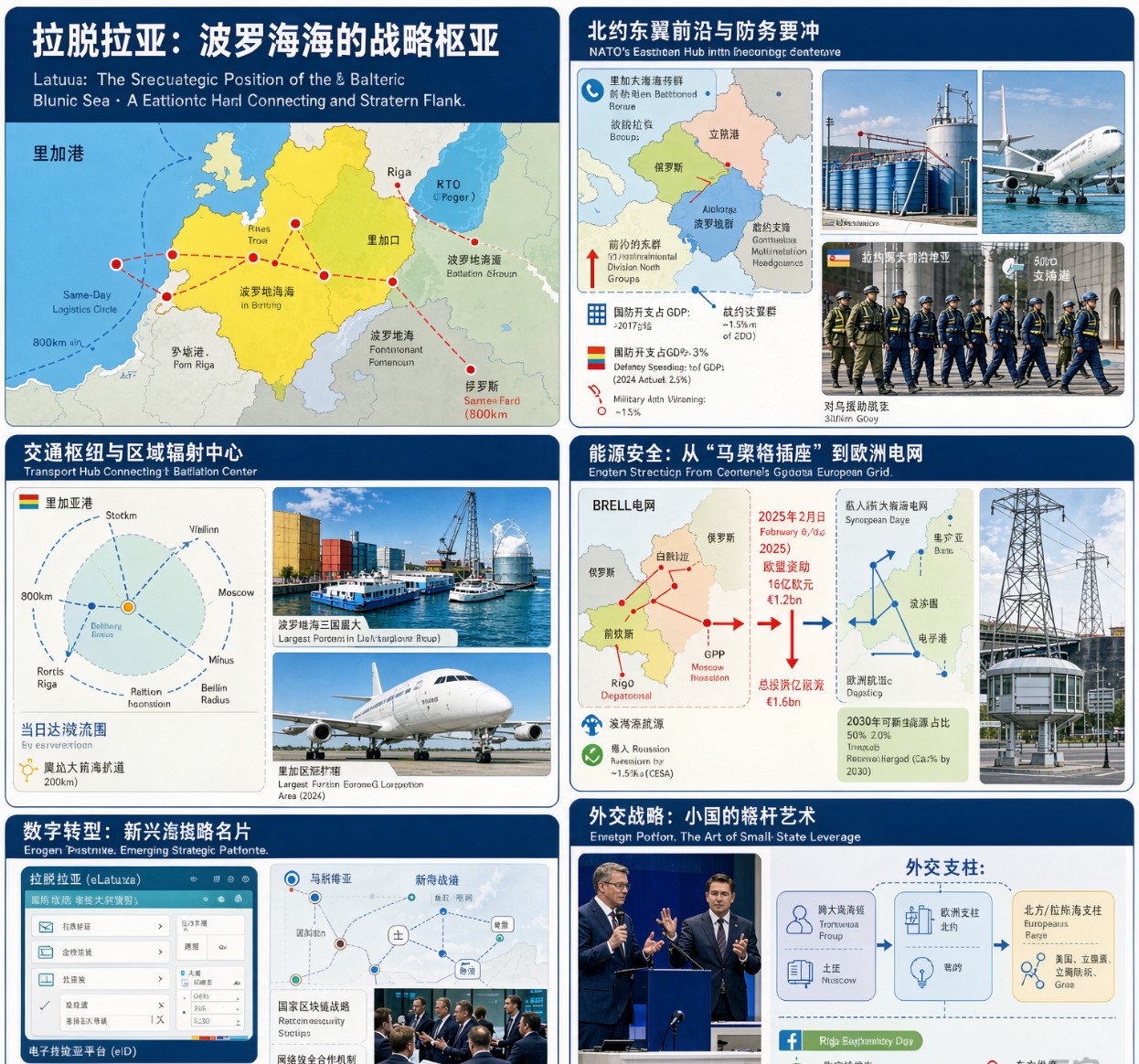
波罗的海之锁:拉脱维亚的战略地位与地缘政治博弈
The Baltic Lock: Latvia's Strategic Position and Geopolitical Game
引言
在东欧平原的西缘、波罗的海的东岸,一个面积仅6.45万平方公里、人口不足190万的国家,却在地缘政治的棋盘上占据着与其体量极不相称的重要位置。这就是拉脱维亚——波罗的海三国之一,北约东翼的前沿哨所,欧盟能源独立的试金石,以及东西方文明交汇的千年十字路口。
自1991年恢复独立以来,拉脱维亚经历了从苏联加盟共和国到北约与欧盟成员国的身份转换。2014年克里米亚危机和2022年俄乌冲突爆发后,这个国家的战略价值被前所未有地放大。它不再仅仅是地图上的一个小点,而是理解当代欧洲安全格局的一把钥匙。
本文将从交通枢纽、军事防务、能源安全、数字转型与外交战略五个维度,系统剖析拉脱维亚的战略地位,并探讨其在大国博弈中的机遇与挑战。
一、地理禀赋:天生的"夹心通道国"
1.1 区位优势与交通网络
拉脱维亚的核心地理特征可以用三个关键词概括:临海、居中、通达。
西临波罗的海,使其天然拥有出海口;位于波罗的海三国之中(北接爱沙尼亚、南邻立陶宛),使其在三国内具有地理上的"枢纽"属性;而向东深入东欧平原腹地,向西通过海路连接整个西北欧,则构成了横贯欧亚大陆的陆桥通道。
首都里加(Riga)是这一优势的集中体现。以里加为圆心,800公里半径覆盖了斯德哥尔摩、赫尔辛基、华沙、柏林、明斯克、莫斯科等十余个重要政治经济中心,形成了一个天然的"当日达"经济圈。这意味着从里加出发的货物和人员在一天之内即可抵达这些城市,为物流、商务和人流提供了极大的便利。
Latvia's geographic endowment can be summarized in three words: maritime access, central location, and connectivity. Situated on the eastern shore of the Baltic Sea, bordering Estonia to the north and Lithuania to the south, and opening eastward into the vast East European Plain, Latvia forms a natural land bridge between Eurasia and Northwestern Europe. Riga, its capital, sits at the heart of a logistics ecosystem where goods and people can reach over ten major political and economic centers—including Stockholm, Helsinki, Warsaw, Berlin, Minsk, and Moscow—within an 800 km radius in a single day.
1.2 里加港:波罗的海的不冻门户
里加港是波罗的海三国中最大、最繁忙的港口,也是少数在冬季无需破冰船辅助即可通航的不冻港之一。这一自然禀赋使其在区域贸易中具有不可替代的地位。
历史上,里加港曾是俄罗斯出口石油产品和煤炭的重要转运枢纽。尽管近年来受地缘政治影响,俄方货物过境量大幅下降,但拉脱维亚正积极推动港口功能转型——从传统的散货中转向集装箱物流、液化天然气(LNG)接收和高附加值制造业靠拢。2024年,里加港启动了深水航道扩建工程,旨在吸引更多来自中亚和中国的过境货物。
The Port of Riga stands as the largest and busiest harbor among the Baltic trio, and one of the few ice-free ports in the region. Historically a critical transit hub for Russian oil products and coal, the port has faced declining Russian cargo volumes amid geopolitical tensions since 2022. However, Riga is undergoing a strategic pivot—shifting from bulk commodity transshipment toward containerized logistics, LNG import terminals, and high-value manufacturing. The deep-water channel expansion launched in 2024 aims to capture transit flows from Central Asia and China, repositioning the port as a key node in the Trans-Caspian International Transport Route (the "Middle Corridor").
1.3 航空枢纽:北欧与东欧之间的空中桥梁
里加国际机场(RIX)是波罗的海地区最大的航空枢纽,也是拉脱维亚国家航空公司airBaltic的基地。该机场年旅客吞吐量超过700万人次(疫情前峰值接近800万),航线网络覆盖欧洲主要城市及部分独联体和中东目的地。
更重要的是,airBaltic以里加为中转点,构建了连接北欧与东欧、西欧与独联体国家的独特航线矩阵。这种"点对点+中转"模式使里加在一定程度上扮演了类似迪拜或伊斯坦布尔的区域航空枢纽角色——只不过其辐射范围是波罗的海盆地及其周边。
Riga International Airport (RIX) serves as the Baltic region's largest aviation hub, handling over 7 million passengers annually at its pre-pandemic peak. Home to airBaltic, the airport's route network spans major European cities and select CIS and Middle Eastern destinations. More strategically, airBaltic leverages Riga as a transfer point to connect Nordic and Eastern European markets, as well as Western Europe with CIS countries—positioning Riga as a regional air bridge analogous to Dubai or Istanbul, albeit on a Baltic Basin scale.
二、军事防务:北约东翼的"铁壁前哨"
2.1 地缘现实:缺乏战略纵深的脆弱性
拉脱维亚的国防安全面临一个根本性的结构性困境:国土狭长、无天然屏障、战略纵深几乎为零。
全境平均海拔仅87米,地形以平原和低矮丘陵为主,非常适合机械化部队的快速推进。东部与俄罗斯接壤的边境线长约214公里,东南部与白俄罗斯接壤约161公里。更为敏感的是,拉脱维亚南部距离俄罗斯战略飞地加里宁格勒(Kaliningrad)仅约300公里——这段距离对于现代导弹而言不过数分钟航程。
这种地缘现实意味着,一旦爆发大规模军事冲突,拉脱维亚几乎没有"缓冲空间"可言。因此,其国家安全战略的核心逻辑不是"独自防御",而是"集体防御"——即通过深度嵌入北约体系,将自身安全与整个联盟的命运绑定。
Latvia's defense posture is defined by a structural vulnerability: a long, narrow territory with no natural barriers and virtually zero strategic depth. With an average elevation of just 87 meters across predominantly flat terrain ideal for mechanized advances, Latvia shares a 214 km border with Russia and a 161 km border with Belarus. Most critically, its southern frontier lies merely ~300 km from Russia's Kaliningrad exclave—a distance traversable by modern missiles in minutes. This geographic reality dictates that Latvia's national security strategy cannot rely on self-defense alone; instead, it must anchor itself in NATO's collective defense framework, binding its fate to the Alliance as a whole.
2.2 北约东翼增强态势(eFP)
2017年起,北约在波罗的海三国和波兰部署了"增强前沿存在"(enhanced Forward Presence, eFP)战斗群。其中,加拿大领导的多国战斗群驻扎在拉脱维亚,兵力规模约1500–2000人,包含来自阿尔巴尼亚、捷克、黑山、北马其顿、斯洛伐克、西班牙和意大利等国的部队。
2022年俄乌冲突爆发后,北约进一步强化了东翼部署。马德里峰会(2022年6月)决定将eFP战斗群的防御态势从"威慑"升级为"防御与阻遏",并将拉脱维亚方向的驻军规模扩大至旅级(约3000人以上)。同时,北约在拉脱维亚设立了第3师前进指挥所(Multinational Division North Headquarters),提升了区域联合作战指挥能力。
Since 2017, NATO has deployed enhanced Forward Presence (eFP) battlegroups in the Baltic states and Poland. The multinational battlegroup in Latvia, led by Canada, comprises approximately 1,500–2,000 troops, contributed by Albania, the Czech Republic, Montenegro, North Macedonia, Slovakia, Spain, and Italy. Following Russia's full-scale invasion of Ukraine in February 2022, NATO's Madrid Summit (June 2022) elevated the eFP posture from deterrence to defense and deterrence, expanding the Latvia-based force to brigade-level (3,000+ troops). Additionally, NATO established the Multinational Division North Headquarters in Latvia, enhancing joint operational command capabilities in the region.
2.3 自主防务能力建设
尽管依赖北约集体防御,拉脱维亚并未放弃自主防务能力的建设。2023年,拉脱维亚政府批准了新的国防长期发展计划,将国防开支目标设定为GDP的3%(高于北约2%的标准),并在2024年实际达到约2.9%。
具体举措包括:
-
采购中远程防空系统:2023年与爱沙尼亚联合签署协议,采购IRIS-T SLM中程防空系统,以增强对空域的保护。
-
反坦克与无人机能力:大量采购便携式反坦克导弹(如AT4、"标枪")和小型战术无人机,适应现代混合战争的需求。
-
国土防卫力量(Zemessardze):这是一支志愿性质的民兵组织,战时可作为正规军的补充力量,平时承担边境巡逻和民防任务。目前约有1.1万名成员。
While relying on NATO's collective defense, Latvia has concurrently pursued autonomous military modernization. In 2023, the government approved a new long-term defense plan targeting defense spending at 3% of GDP—exceeding NATO's 2% guideline—with actual expenditure reaching approximately 2.9% in 2024. Key initiatives include: joint procurement with Estonia of IRIS-T SLM medium-range air defense systems; large-scale acquisition of anti-tank guided missiles (AT4, Javelin) and tactical drones suited for hybrid warfare; and the maintenance of the Zemessardze (National Guard), a volunteer militia of ~11,000 members that supplements regular forces during wartime and conducts border patrols and civil defense in peacetime.
2.4 对乌援助:以援乌促自保
拉脱维亚对乌克兰的军事援助力度在其国力面前堪称惊人。截至2024年底,拉脱维亚对乌援助总额已超过其GDP的1.5%,在人均援助排名中位列欧洲前列。援助内容包括"标枪"反坦克导弹、"毒刺"防空导弹、火炮弹药、无人机、直升机以及训练乌军士兵等。
拉脱维亚的战略逻辑很明确:在乌克兰消耗俄罗斯的军事实力,就是在拉脱维亚边境之外筑起一道"防火墙"。这种"以援乌促自保"的思路,使得拉脱维亚成为东欧地区对俄态度最强硬的国家之一。
Latvia's military aid to Ukraine has been remarkable relative to its size. By late 2024, cumulative assistance exceeded 1.5% of its GDP, ranking among the highest per capita in Europe. Deliveries include Javelin and Stinger missiles, artillery ammunition, drones, helicopters, and training programs for Ukrainian troops. Riga's strategic calculus is clear: every Russian tank destroyed in Ukraine is one less that could threaten Latvian soil. This "aid Ukraine to protect oneself" doctrine makes Latvia one of the most hawkish voices on Russia policy in Eastern Europe.

三、能源安全:从"莫斯科插座"到欧洲电网
3.1 BRELL系统的历史遗产
苏联时期建立的BRELL环形电网(以白俄罗斯、俄罗斯、爱沙尼亚、拉脱维亚、立陶宛首字母命名),将波罗的海三国与俄罗斯和白俄罗斯的电力系统物理连接在一起。三国不仅从俄罗斯进口电力(尤其在高峰时段),更重要的是,其电网频率由位于莫斯科的调度中心统一控制——这意味着,即使不进口一度电,波罗的海三国的电网运行本身也受制于莫斯科。
这种结构性依赖一直是拉脱维亚等国的"心头之患"。自2007年起,三国就开始筹划与俄罗斯电网解绑,但由于技术复杂度高、成本巨大以及政治意愿不足,进展缓慢。直到2014年克里米亚危机后,脱钩进程才真正提速。
The Soviet-era BRELL ring (Belarus-Russia-Estonia-Latvia-Lithuania) physically integrated the Baltic states' power grids with those of Russia and Belarus. Beyond importing electricity from Russia during peak demand, the three Baltic nations had their grid frequency synchronized to and controlled by dispatch centers in Moscow—meaning that even without importing a single kilowatt-hour, their grid operations were structurally dependent on Russian coordination. This dependency was long viewed as an existential vulnerability. Planning for desynchronization began in 2007 but gained real momentum only after Russia's annexation of Crimea in 2014.
3.2 历史性脱钩:2025年2月的"断电时刻"
经过十余年的筹备、耗资约16亿欧元(欧盟资助约12亿欧元),波罗的海三国终于在2025年2月8日正式切断与俄罗斯BRELL电网的连接,同步接入欧洲大陆电网(Continental Europe Synchronous Area, CESA)。
这一转变的技术路径是:通过新建和升级与波兰之间的高压输电互联线路(Harmony Link等项目),将波罗的海电网与欧洲大陆电网的物理连接从"薄弱"变为"强韧",从而实现频率控制的平稳过渡。
对拉脱维亚而言,这不仅是能源基础设施的切换,更是主权的象征性宣示——从此,拉脱维亚的灯光不再由莫斯科的频率决定。
After over a decade of preparation and €1.6 billion in investment (with ~€1.2 billion EU co-funding), the Baltic states officially disconnected from the Russian-controlled BRELL grid on February 8, 2025, synchronizing with the Continental Europe Synchronous Area (CESA). The technical pathway involved constructing and upgrading high-voltage interconnections with Poland (notably the Harmony Link project), transforming the physical link between the Baltic grids and continental Europe from tenuous to robust, enabling a seamless transition of frequency control. For Latvia, this was not merely an infrastructure switch—it was a sovereign declaration that its lights would no longer flicker at Moscow's frequency.
3.3 能源转型与多元化
除电网脱钩外,拉脱维亚还在积极推进能源结构的多元化:
|
领域 |
现状与目标 |
|---|---|
|
天然气 |
2022年已全面停止进口俄罗斯管道气;通过Klaipėda LNG终端(立陶宛)和Inčukalns地下储气库保障供应 |
|
可再生能源 |
目标2030年可再生能源占比达50%;重点发展风能(波罗的海海上风电潜力巨大)和生物质能 |
|
核能 |
虽未自建核电站,但通过区域合作参与东欧核电布局的讨论 |
Beyond grid synchronization, Latvia is actively diversifying its energy matrix:
Sector
Status & Targets
Natural Gas
Fully ceased imports of Russian pipeline gas since 2022; supply secured via Lithuania's Klaipėda LNG terminal and the Inčukalns underground gas storage facility
Renewables
Target: 50% renewable share by 2030; focus on wind power (significant offshore potential in the Baltic Sea) and biomass
Nuclear
No domestic nuclear plants planned, but participates in regional discussions on Eastern European nuclear energy cooperation
四、数字转型:"波罗的海之虎"的新赛道
4.1 e-Governance的先行者
如果说地理位置和军事防务是拉脱维亚的"传统战略资产",那么数字治理就是其"新兴战略名片"。
拉脱维亚是最早全面推行电子政务的中东欧国家之一。其"电子拉脱维亚"(eLatvia)平台整合了税收申报、企业注册、不动产登记、医疗预约、电子处方等几乎所有公共服务。公民只需一张电子身份证(eID),即可在线完成绝大多数与政府的交互。
更值得关注的是,拉脱维亚于2023年启动了"国家区块链战略",探索将区块链技术应用于土地登记、供应链追溯和数字身份认证等领域,力求在下一代互联网基础设施中占据先机。
If geography and defense are Latvia's traditional strategic assets, digital governance is its emerging strategic calling card. Among the first in Central and Eastern Europe to roll out comprehensive e-governance, Latvia's "eLatvia" platform integrates tax filing, business registration, property records, medical appointments, e-prescriptions, and nearly all public services. A single eID card enables citizens to complete most government interactions online. Notably, in 2023 Latvia launched a National Blockchain Strategy, exploring distributed ledger technology for land registries, supply chain traceability, and digital identity—positioning itself at the forefront of next-generation internet infrastructure.
4.2 网络安全:从防御到输出
鉴于自身频繁遭受网络攻击(尤其是来自俄罗斯的APT攻击),拉脱维亚将网络安全视为国家安全的核心支柱。2023年,拉脱维亚成立了专门的网络安全局(CERT.LV升级为国家机构),并与爱沙尼亚、立陶宛共同建立了波罗的海网络安全合作机制。
与此同时,拉脱维亚的网络安全产业正在崛起。里加已成为区域性网络安全会议(如Riga Cybersecurity Days)的举办地,吸引了NATO Cooperative Cyber Defence Centre of Excellence(设在爱沙尼亚塔林)等机构的密切合作。
Given its frequent exposure to cyberattacks—particularly Russian APT campaigns—Latvia treats cybersecurity as a core pillar of national security. In 2023, it upgraded CERT.LV to a national cybersecurity authority and, together with Estonia and Lithuania, established the Baltic Cybersecurity Cooperation Mechanism. Concurrently, Latvia's cybersecurity industry is gaining traction. Riga now hosts regional conferences such as Riga Cybersecurity Days, fostering close collaboration with institutions like NATO's Cooperative Cyber Defence Centre of Excellence (based in Tallinn, Estonia).
五、外交战略:小国的"杠杆艺术"
5.1 三支柱外交框架
拉脱维亚的外交政策可以概括为"三支柱"框架:
-
跨大西洋支柱(与美国及北约的关系)——安全保障的根本;
-
欧洲支柱(与欧盟的关系)——经济繁荣与制度认同的基础;
-
北方/波罗的海支柱(与北欧国家和波罗的海邻国的关系)——区域协作的平台。
在这三大支柱之上,拉脱维亚还发展了一条"东方维度"——即通过欧盟的"东部伙伴关系"(Eastern Partnership)框架,支持格鲁吉亚、摩尔多瓦、乌克兰等国的欧洲一体化进程。这既是价值观外交的体现,也是拉脱维亚"以周边稳定换自身安全"的现实考量。
Latvia's foreign policy rests on a "three-pillar" framework:
Transatlantic Pillar (relations with the US and NATO)—the foundation of security guarantees;
European Pillar (relations with the EU)—the basis of economic prosperity and institutional alignment;
Northern/Baltic Pillar (relations with Nordic countries and Baltic neighbors)—a platform for regional cooperation.
Upon these pillars, Latvia has developed an "Eastern Dimension"—supporting the European integration of Georgia, Moldova, and Ukraine through the EU's Eastern Partnership framework. This reflects both value-driven diplomacy and a pragmatic calculation: regional stability on its eastern flank directly enhances Latvia's own security.
5.2 对华关系:务实与谨慎的平衡
拉脱维亚是首批与中国签署"一带一路"合作谅解备忘录的欧盟国家之一(2016年)。里加港曾被视为中国货物进入北欧市场的重要门户,"中欧班列"也曾讨论过经拉脱维亚的北线方案。
然而,近年来受地缘政治大环境影响,拉脱维亚在对华政策上趋于谨慎。2023年,拉脱维亚宣布退出中国—中东欧国家合作机制("17+1"),理由是认为该机制未能带来预期的经济收益,且与中国的关系应纳入更广泛的欧盟对华框架之下。尽管如此,双边贸易依然保持一定规模,拉脱维亚的木材、农产品和物流服务仍对中国市场有出口兴趣。
Latvia was among the first EU countries to sign a Belt and Road Initiative MoU with China (2016). The Port of Riga was once envisioned as a key gateway for Chinese goods entering Nordic markets, and northern routes for China-Europe rail freight were discussed. However, influenced by broader geopolitical shifts, Latvia has grown more cautious in its China policy. In 2023, it announced its withdrawal from the China-CEEC cooperation format ("17+1"), citing limited economic returns and the need to align China policy within the broader EU framework. Nevertheless, bilateral trade persists, with Latvian timber, agricultural products, and logistics services maintaining export interest in the Chinese market.
5.3 多边舞台上的"大声量小国"
拉脱维亚深谙小国外交的艺术:在多边平台上发出超比例的声音。无论是联合国大会、OSCE还是北约峰会,拉脱维亚代表团总是最积极发言的群体之一,议题从乌克兰危机到网络安全、从能源独立到民主韧性,覆盖面极广。
这种策略的核心在于:通过高频次、高质量的议题设置,让国际社会持续关注波罗的海地区的安全需求,从而将自身利益转化为联盟议程的一部分。
Latvia exemplifies the art of small-state diplomacy: projecting disproportionate voice on multilateral stages. Whether at the UN General Assembly, OSCE, or NATO summits, Latvian delegations rank among the most vocal, addressing topics from the Ukraine crisis to cybersecurity, energy independence, and democratic resilience. The core strategy: sustained, high-quality agenda-setting keeps international attention focused on Baltic security needs, translating national interests into alliance priorities.
六、挑战与前景
6.1 人口危机:最大的"灰犀牛"
在所有战略挑战中,人口问题或许是最被低估但最致命的。拉脱维亚人口从1990年的约270万降至目前的不足190万,且仍在以每年约0.5%的速度下降。老龄化加剧、青年外流(主要流向英国、德国、北欧)、出生率低迷,构成了三重压力。
人口萎缩不仅意味着兵源减少和经济活力下降,更从根本上侵蚀了国家的战略韧性。一个只有180万人的国家,无论其武器多么先进、盟友多么强大,其持久战能力和内部动员潜力都受到天然限制。
Among all strategic challenges, demography may be the most underestimated yet most lethal. Latvia's population has shrunk from ~2.7 million in 1990 to under 1.9 million today, declining at roughly 0.5% annually. Aging, youth emigration (primarily to the UK, Germany, and Nordics), and low birth rates create a triple pressure. Population decline reduces both the recruitment pool and economic vitality, fundamentally eroding national strategic resilience. A nation of 1.8 million—regardless of weapons sophistication or allied strength—faces inherent limits in protracted conflict scenarios and internal mobilization capacity.
6.2 经济脆弱性:小国的宿命?
拉脱维亚经济高度开放(外贸依存度超过GDP的100%),使其极易受到外部冲击。2022年俄乌冲突导致的能源价格飙升、通胀高企(2022年CPI一度超过21%)和供应链中断,给拉脱维亚经济带来了严重冲击。
此外,银行业曾是拉脱维亚的支柱产业之一,但因反洗钱监管不力、牵涉俄罗斯资金洗钱丑闻(如ABLV银行事件),2018年后遭遇重创。拉脱维亚被迫对金融部门进行深度重组,转向更加审慎的监管模式。
With a trade-to-GDP ratio exceeding 100%, Latvia's highly open economy is acutely vulnerable to external shocks. The 2022 energy price surge, inflation (peaking above 21% CPI), and supply chain disruptions inflicted severe damage. Furthermore, its banking sector—once a pillar industry—was crippled by anti-money-laundering failures and Russian money laundering scandals (notably the ABLV Bank case), forcing a deep restructuring toward a more conservative regulatory model post-2018.
6.3 俄罗斯因素:挥之不去的阴影
无论拉脱维亚如何努力融入西方体系,一个无法改变的事实是:它与俄罗斯共享214公里的陆地边界,且境内有约25%的俄语人口(主要集中在首都里加和东部边境地区)。
这部分俄语人口的忠诚度问题,始终是拉脱维亚国家安全的心病。俄罗斯也从未放弃利用"保护俄语同胞"的叙事作为施压工具。如何在维护国家认同的同时,避免制造内部族群对立,是拉脱维亚社会治理的长期难题。
No matter how deeply Latvia integrates into Western structures, it cannot change two facts: a 214 km shared border with Russia, and a ~25% ethnic Russian-speaking population (concentrated in Riga and eastern border regions). The loyalty of this demographic remains a national security concern, and Moscow has never abandoned the narrative of "protecting Russian compatriots abroad" as a pressure tool. Balancing national identity consolidation with avoidance of internal ethnic polarization is a perennial challenge for Latvian governance.
结语
拉脱维亚的故事,是一个关于小国如何在夹缝中求生存、在大国博弈中谋主动的经典案例。它没有瑞士那样的中立传统,也没有芬兰那样的强大国防工业基础,但它找到了自己的道路:以集体安全替代单独防御,以能源独立巩固政治主权,以数字创新弥补体量劣势,以多边发声放大战略存在。
2025年2月,当拉脱维亚的电网最后一次与莫斯科的频率同步时,那或许是一个时代的终结。而当它的灯光在那一刻之后继续亮起——这一次,由欧洲大陆的电网驱动——那将是另一个时代的开始。
对于关注全球地缘政治的观察者而言,拉脱维亚不是一个可以被忽略的注脚。它是理解北约东扩逻辑、欧盟能源转型、俄罗斯安全焦虑以及小国外交智慧的一个关键样本。在这个意义上,波罗的海之锁虽小,却能扣住整个欧洲安全的门环。
Latvia's story is a classic case study in how a small state survives in the cracks and acts proactively in great-power competition. It lacks Switzerland's neutrality tradition and Finland's robust defense industrial base, yet it has found its own path: substituting collective security for solo defense, consolidating political sovereignty through energy independence, compensating for size disadvantages via digital innovation, and amplifying strategic presence through multilateral voice.
When Latvia's grid synchronized with Moscow's frequency for the last time in February 2025, it marked the end of an era. When its lights stayed on—powered by the Continental European grid—it signaled the beginning of another.
For observers of global geopolitics, Latvia is not a footnote to be skipped. It is a key specimen for understanding NATO enlargement logic, EU energy transition, Russian security anxieties, and the diplomatic wisdom of small states. In this sense, the Baltic lock, though small, secures the door of European security.
此文由 怡心湖 编辑,若您觉得有益,欢迎分享转发!:首页 > 观·世界 » 波罗的海之锁:拉脱维亚的战略地位与地缘政治博弈
 “飞车将军”德拉帕蒂:乌克兰最高指
 精确制导与光电防务:大国博弈底线的
 风暴眼中的扎波罗热:从苏联能源支柱
 云端“末日堡垒”:全球特种空中指挥
 欧洲防务自主与战场工业化的交汇:乌
 伊朗会被摧毁吗?——基于地缘、军事
 弹壳下的东亚密码:乌克兰拆解俄导弹
 烽火欧陆,震荡东海:乌克兰战场升级对