
The Twilight of the Asian Water Tower: Glacial Tipping Points, Climate Crisis, and Forward-Looking Strategies for China’s Water Security
引言:静默的危机
Introduction: The Silent Crisis
在青藏高原及其周边巨大的山脉群中,封存着全球除极地以外最大规模的淡水资源。这片被称为“亚洲水塔”的区域,面积约400万平方公里,海拔多在2500米以上,拥有超过10万条冰川,总面积约9.8万平方公里,冰储量高达10100立方千米。这些冰川不仅是长江、黄河、恒河、印度河等十大亚洲大河的源头,更是维系近20亿人口生存发展的“固体水库”。然而,在全球变暖与厄尔尼诺现象的双重夹击下,这座水塔正在发生结构性的异化。昆仑山脉等关键区域的冰川加速融化,并非单纯的生态问题,而是正在重塑地缘政治版图、挑战国家安全底线的战略性变量。
Across the vast expanse of the Qinghai-Tibet Plateau and its surrounding colossal mountain ranges lies the largest reserve of freshwater outside the polar regions. Known as the "Asian Water Tower," this region spans approximately 4 million square kilometers, mostly above 2,500 meters in elevation. It hosts over 100,000 glaciers covering some 98,000 square kilometers, with an ice storage volume estimated at 10,100 cubic kilometers. These glaciers are not merely the source of ten major Asian rivers—including the Yangtze, Yellow, Ganges, and Indus—but also serve as a "solid reservoir" sustaining nearly 2 billion people. Yet, under the dual pressures of global warming and intensified El Niño events, this water tower is undergoing structural transformation. In critical areas such as the Kunlun Mountains, accelerated glacial melt is no longer just an ecological concern; it has become a strategic variable reshaping geopolitical landscapes and challenging national security red lines.
一、物理机制的质变:从“稳态水塔”到“透支账户”
I. Qualitative Shifts in Physical Mechanisms: From a "Stable Water Tower" to an "Overdrawn Account"
长期以来,亚洲水塔被视为一个相对稳定的自然调节器。但最新的科学证据表明,该系统已进入“非稳态”运行模式。
For decades, the Asian Water Tower was regarded as a relatively stable natural regulator. However, recent scientific evidence indicates that the system has entered a "non-steady state."
首先,冰川消融正在触发“反照率正反馈”。随着昆仑山等高海拔地区冰川退缩,深色的裸岩和冰碛物暴露出来,吸收了更多的太阳辐射,进而加速了周边冰川的融化。这种自我强化的循环使得消融过程难以逆转。
First, glacial retreat is triggering an albedo-positive feedback loop. As glaciers recede in high-altitude areas such as the Kunlun Mountains, dark exposed bedrock and moraine deposits absorb significantly more solar radiation, thereby accelerating the melting of adjacent ice. This self-reinforcing cycle renders the melting process increasingly difficult to reverse.
其次,多年冻土层作为天然的“隔水层”,正在大规模退化。这不仅导致地下水资源的“跑冒滴漏”,引发高原湖泊(如色林错、纳木错)的异常扩张,更直接威胁青藏铁路、输油管线等战略基础设施的地基稳定性。
Second, permafrost—acting as a natural impermeable barrier—is degrading on a massive scale. This not only leads to leakage and loss of groundwater resources but also drives abnormal expansion of plateau lakes (e.g., Siling Co, Nam Co). More critically, it undermines the foundational stability of strategic infrastructure such as the Qinghai–Tibet Railway and oil pipelines.
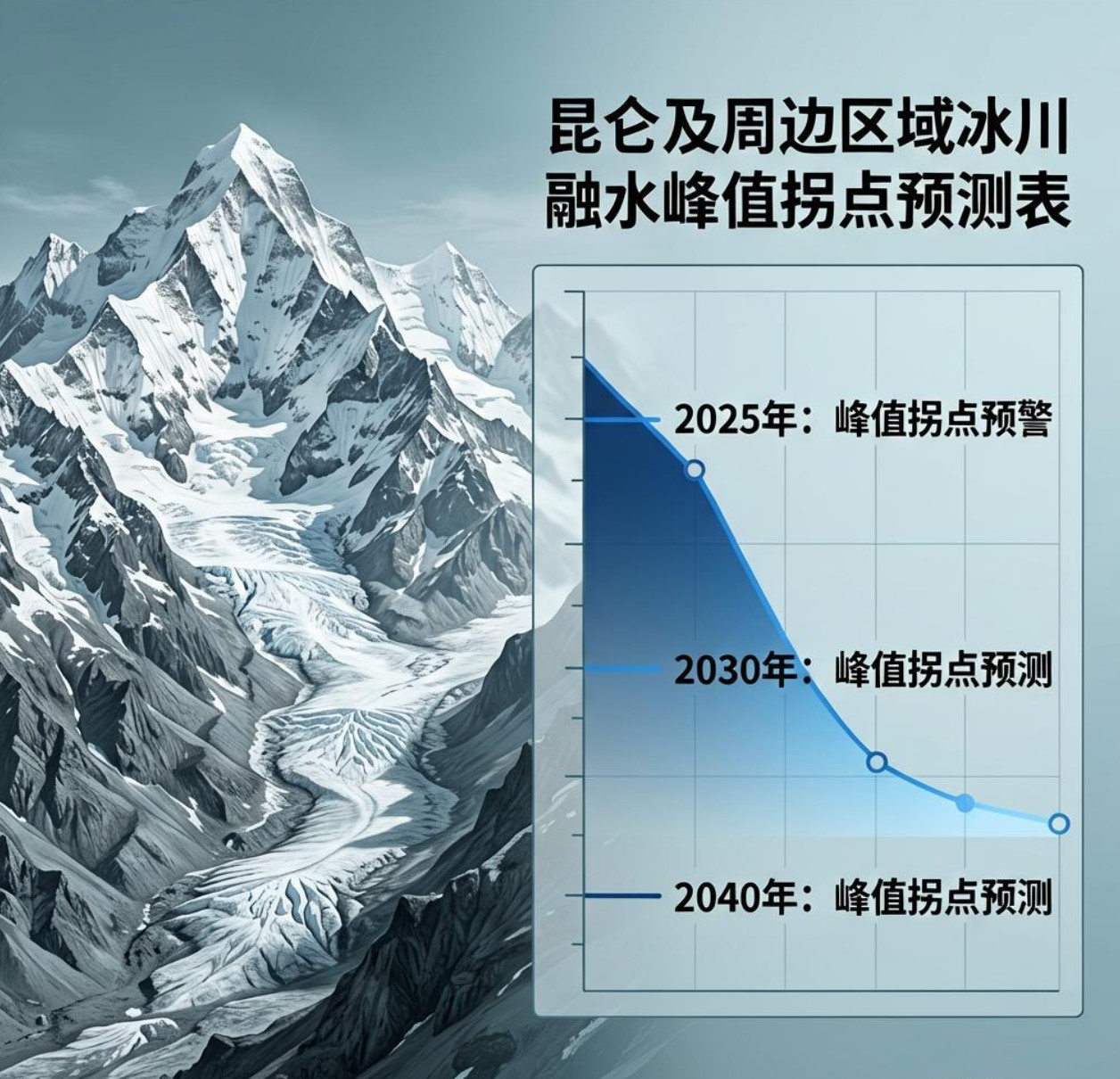
最为关键的是,我们正在目睹“峰值水”(Peak Water)现象的出现。根据模型预测,昆仑山西段及叶尔羌河流域的冰川融水将在2050年至2070年间达到历史峰值,随后进入不可逆的衰减期。这意味着,当前因融水增加而出现的“虚假丰水”表象,实际上是在透支子孙后代的水资源本金。
Most critically, we are witnessing the emergence of "Peak Water." Model projections indicate that glacial meltwater in the western Kunlun Mountains and the Yarkant River Basin will reach historically unprecedented levels between 2050 and 2070 before entering an irreversible decline. This implies that the current illusion of abundance—driven by increased meltwater—is effectively an overdraft on future generations' water capital.
二、地缘战略的外溢:跨境河流与国际博弈
II. Geostrategic Spillover: Transboundary Rivers and International Rivalries
昆仑冰川融水的变化,通过叶尔羌河、印度河、阿姆河等跨境水系,将气候危机传导至南亚与中亚,引发了复杂的地缘政治涟漪效应。
Changes in glacial melt from the Kunlun Mountains transmit climate risks southward and westward via transboundary river systems—such as the Yarkant, Indus, and Amu Darya—generating complex geopolitical ripple effects across South and Central Asia.
在南亚,印度河上游近40%的水量依赖喀喇昆仑与西昆仑的冰川补给。随着融水拐点的临近,印巴两国基于1960年《印度河水条约》的水量分配机制正面临前所未有的挑战。短期内的混合型洪水与长期的枯水预期,正在加剧两国在水资源问题上的互不信任。2025年印度暂停履行条约义务的举动,预示着“水冲突”可能取代传统的领土争端,成为地区安全的新爆点。
In South Asia, the upper Indus River relies on glacial melt from the Karakoram and western Kunlun for nearly 40% of its flow. As the Peak Water tipping point approaches, the Indus Waters Treaty of 1960—the cornerstone of bilateral water allocation—faces unprecedented strain. Short-term compound flooding coupled with long-term projections of scarcity are exacerbating mutual distrust between India and Pakistan. India's suspension of treaty obligations in 2025 signals that "water conflict" may eclipse traditional territorial disputes as a new flashpoint for regional insecurity.
在中亚,阿姆河与锡尔河的径流量变异,正在激化“上游发电”与“下游灌溉”的结构性矛盾。咸海的生态灾难尚未终结,冰川融水的不稳定又给中亚各国的农业安全和国内稳定蒙上了阴影。中国作为上游国家,如何在保障自身南疆水资源安全的同时,通过数据分享与技术援助参与中亚水治理,将成为“一带一路”倡议纵深推进的关键一环。
In Central Asia, hydrological variability in the Amu Darya and Syr Darya rivers is intensifying the structural conflict between upstream hydropower generation and downstream agricultural irrigation. While the Aral Sea ecological catastrophe remains unresolved, unstable glacial meltwater now casts a shadow over agricultural security and domestic stability across Central Asian states. As an upstream nation, China must balance safeguarding water security in southern Xinjiang with proactive engagement in regional water governance through data sharing and technical assistance—a pivotal component for deepening the Belt and Road Initiative.
三、前瞻性战略:从被动适应到主动塑势
III. Forward-Looking Strategies: From Passive Adaptation to Active Agenda-Setting
面对这场静默的危机,中国必须具备超越周期的视野,将水资源安全纳入总体国家安全观,实施具有前瞻性的战略布局。
Confronted with this silent crisis, China must adopt a vision that transcends short-term cycles, integrating water security into its holistic national security framework and implementing forward-looking strategic initiatives.
1. 构建“数字水塔”与数据主权
1. Constructing a "Digital Water Tower" and Asserting Data Sovereignty
启动“昆仑透视”工程,利用卫星遥感、无人机巡检和地面物联网设备,建立覆盖全流域的“空—天—地”一体化监测网络。掌握第一手冰川消融与径流数据,不仅是为了科学预警,更是为了在跨境水外交中掌握规则制定的话语权,打破西方话语垄断。
Launch the "Kunlun Perspective" Project, deploying satellite remote sensing, UAV inspections, and ground-based IoT devices to establish an integrated "space–air–ground" monitoring network across entire river basins. Acquiring primary data on glacial melt and runoff serves not only scientific early warning but also secures China's voice in setting rules for transboundary water diplomacy—breaking the monopoly of Western narratives.
2. 实施“水银行”与工程韧性升级
2. Implementing a "Water Bank" and Upgrading Engineering Resilience
利用融水增量期,在昆仑山前盆地和河谷地带探索建设地下水库和大型调蓄工程,将过剩的季节性融水转化为战略储备。同时,全面修订边疆重大基础设施(如中巴经济走廊配套工程、边境哨所)的设计标准,引入“冰川拐点修正系数”,确保其全生命周期的安全运行。
Capitalize on the current period of increased meltwater to explore constructing underground reservoirs and large-scale regulation projects in piedmont basins and valleys along the Kunlun Mountains, converting surplus seasonal meltwater into strategic reserves. Concurrently, comprehensively revise design standards for critical border infrastructure—such as supporting projects along the China–Pakistan Economic Corridor and frontier outposts—by incorporating a "glacial tipping point correction factor" to ensure operational safety throughout their lifecycles.
3. 主导“气候适应性”水外交
3. Leading "Climate-Adaptive" Water Diplomacy
主动发起并主导“亚洲水塔”生态保护国际合作机制。在现有跨境条约中植入“冰川消退不可抗力”和“生态流量优先权”条款。通过提供灾害预警公共产品和节水技术支持,将中国的“水治理能力”转化为区域公共产品,化解“中国水威胁论”,塑造负责任大国形象。
Proactively initiate and lead international cooperation mechanisms for ecological conservation of the "Asian Water Tower." Introduce clauses addressing "glacial retreat force majeure" and "ecological flow prioritization" into existing transboundary treaties. By providing public goods such as disaster early-warning systems and technical support for water conservation, China can transform its "water governance capacity" into a regional public good—countering narratives of a "Chinese water threat" and consolidating its image as a responsible major power.
结语:在流动中守护永恒
Conclusion: Safeguarding Eternity Amidst Flux
亚洲水塔的黄昏已然降临,但这并不意味着终局。昆仑冰川的融化是自然规律的显现,但如何应对这一变局则是人类智慧的试金石。中国作为“亚洲水塔”的守护者,必须以历史的自觉,在冰川消融的流动中,构建起保障国家长治久安、促进区域和平繁荣的坚固堤坝。这既是对自然的敬畏,更是对未来的承诺。
The twilight of the Asian Water Tower has arrived—yet this does not signify an endpoint. The melting of the Kunlun glaciers reveals the workings of natural law; how we respond to these changes, however, tests human wisdom. As custodian of the Asian Water Tower, China must act with historical consciousness—to construct enduring bulwarks amid glacial flux that safeguard long-term national stability and foster regional peace and prosperity. This endeavor reflects both reverence for nature and commitment to the future.
此文由 怡心湖 编辑,若您觉得有益,欢迎分享转发!:首页 > 常识论 » 亚洲水塔的黄昏:冰川拐点、气候危机与中国水安全的前瞻性战略
 气候变局下的“亚洲
 IMF逆势上调中国2026年GDP增速至4.
 中国大豆进口来源多元化进展(巴西/
 中国粮食进口依赖度高的问题何时能
 对比中国与俄罗斯粮食自给结构差异