开源编译器正在吃掉硬件厂商的午餐:从GCC/LLVM到Triton的历史轮回
Open Source Compilers Are Eating the Hardware Vendors' Lunch: The Historical Cycle from GCC/LLVM to Triton
编者按 / Editor’s Note
在科技史上,有一种剧本被反复上演:硬件巨头试图用“硬件+闭源软件”的双锁机制垄断市场,而开源编译器总会像“掘墓人”一样出现,将硬件差异抽象成通用接口,最终让硬件厂商退化为“代工厂”。从IBM与GCC,到x86与LLVM,再到如今的NVIDIA与Triton,剧情惊人一致。本文将以历史为经,以技术为纬,复盘这场跨越四十年的“编译器起义”,揭示为何硬件厂商的护城河总是敌不过开源社区的“技术平权”。
In the annals of tech history, a familiar script recurs: hardware giants attempt to monopolize markets by locking them into "hardware + proprietary software," only to face "gravediggers" in the form of open-source compilers. These compilers abstract away hardware differences into generic interfaces, ultimately reducing hardware vendors to mere "contract manufacturers." From IBM vs. GCC, to x86 vs. LLVM, and now NVIDIA vs. Triton, the plotline is strikingly consistent. This article weaves historical context with technical analysis to review this four-decade-long "compiler uprising," revealing why the moats of hardware vendors perennially fail against the "technological democratization" driven by open-source communities.
一、 第一幕:IBM的傲慢与GCC的反叛(1980s)
I. Act I: IBM's Arrogance and GCC's Rebellion (1980s)
上世纪80年代,IBM凭借大型机(Mainframe)统治了计算世界。那时的潜规则是:硬件赚钱,软件(编译器)是用来绑定硬件的赠品或高价配件。如果你想在IBM机器上跑程序,必须用IBM昂贵的闭源编译器。软件是硬件的“锁匠”。
In the 1980s, IBM ruled the computing world with its Mainframes. The prevailing wisdom was: Make money from hardware; treat software (compilers) as either freebies or expensive accessories to lock in customers. To run programs on IBM machines, you had to use IBM's costly proprietary compilers. Software was the "locksmith" for the hardware.
理查德·斯托曼(Richard Stallman)的反击:
1984年,斯托曼发起了GNU项目,目标直指“自由的操作系统和编译工具”。1987年,GCC(GNU Compiler Collection)诞生。GCC不仅免费,而且质量极高。它支持多种硬件架构(从x86到ARM,从RISC-V到IBM PowerPC)。
Richard Stallman's Counterstrike:
In 1984, Richard Stallman launched the GNU Project, aiming for a "free operating system and compilation tools." In 1987, GCC (GNU Compiler Collection) was born. GCC was not only free but also exceptionally high quality. It supported multiple hardware architectures—from x86 to ARM, from RISC-V to IBM PowerPC.
历史转折:
GCC的出现,让软件第一次实现了“一次编写,到处编译”。IBM试图通过修改指令集来强迫用户升级编译器的策略失效了。GCC将硬件指令集变成了“透明管道”。到了1990年代,连IBM自己都开始向客户提供GCC的选项。硬件厂商第一次发现:当编译器开源且普及时,硬件差异不再是收费的理由,而是需要被掩盖的麻烦。
The Historical Turning Point:
GCC enabled software to be "written once, compiled everywhere." IBM's strategy of forcing users to upgrade compilers by tweaking instruction sets fell apart. GCC turned hardware instruction sets into "transparent plumbing." By the 1990s, even IBM began offering GCC to its customers. Hardware vendors realized for the first time: When a compiler is open-source and ubiquitous, hardware differences cease to be revenue generators and instead become liabilities to be abstracted away.
二、 第二幕:x86的碎片化与LLVM的统一(2000s)
II. Act II: The Fragmentation of x86 and the Unification by LLVM (2000s)
进入PC时代,英特尔和AMD虽然在硬件上激烈竞争,但在软件上却面临着同样的困境:闭源编译器(如Intel ICC)虽然性能强,但只认自家CPU,且优化选项晦涩难懂。开发者苦不堪言。
Entering the PC era, Intel and AMD competed fiercely in hardware but faced a shared dilemma in software: proprietary compilers (like Intel ICC) offered strong performance but were vendor-locked and notoriously difficult to configure. Developers were miserable.
克里斯·拉特纳(Chris Lattner)的救赎:
2000年,伊利诺伊大学的学生克里斯·拉特纳启动了LLVM(Low Level Virtual Machine)项目。LLVM的设计初衷是模块化、可重用。它不仅是一个编译器,更是一个编译器基础设施。
-
Clang: 基于LLVM的C/C++编译器,编译速度快,报错信息友好,迅速取代了GCC成为macOS和iOS的默认编译器。
-
中间表示(IR): LLVM IR成为了连接前端(语言)和后端(硬件)的通用货币。无论是Swift、Rust还是CUDA,都可以先编译成LLVM IR,再生成机器码。
Chris Lattner's Salvation:
In 2000, University of Illinois student Chris Lattner launched the LLVM (Low Level Virtual Machine) project. LLVM was designed to be modular and reusable. It wasn't just a compiler; it was a compiler infrastructure.
-
Clang: An LLVM-based C/C++ compiler with fast compilation and user-friendly error messages, quickly replacing GCC as the default compiler for macOS and iOS.
-
Intermediate Representation (IR): LLVM IR became the universal currency connecting frontends (languages) and backends (hardware). Whether Swift, Rust, or CUDA, all could compile to LLVM IR before generating machine code.
历史转折:
LLVM彻底改变了游戏规则。它让“语言”和“硬件”解耦。苹果、谷歌、三星等巨头纷纷投入LLVM,因为它让他们可以专注于硬件创新(如Apple Silicon的M系列芯片),而无需担心软件生态的构建。英特尔试图用ICC的“神秘配方”留住客户的努力,在LLVM标准化的优化管道面前显得苍白无力。LLVM证明了:通用的编译器基础设施,比任何单一厂商的闭源优化都更有生命力。
The Historical Turning Point:
LLVM fundamentally changed the game. It decoupled "language" from "hardware." Tech giants like Apple, Google, and Samsung flocked to LLVM because it allowed them to focus on hardware innovation (like Apple's M-series chips) without worrying about building a software ecosystem. Intel's attempts to retain customers with ICC's "secret sauce" paled in comparison to LLVM's standardized optimization pipeline. LLVM proved that a universal compiler infrastructure is more enduring than any single vendor's proprietary optimizations.

三、 第三幕:NVIDIA的CUDA与Triton的现在(2020s)
III. Act III: NVIDIA's CUDA and Triton's Present (2020s)
历史总是押着相同的韵脚。英伟达的CUDA正如当年的IBM编译器和Intel ICC,试图通过闭源、深度绑定的软件栈,将GPU变成无法逃离的“计算黑洞”。
History always rhymes. NVIDIA's CUDA is today's equivalent of IBM's compilers and Intel's ICC—attempting to turn the GPU into an inescapable "computational black hole" via proprietary, tightly-coupled software stacks.
Triton的登场:
如前文所述,Triton并非单纯的编程语言,它是AI时代的LLVM。它继承了LLVM的精神内核:
-
模块化: 前端(Python)与后端(NVIDIA/AMD/Intel)分离。
-
IR驱动: Triton-IR是AI计算的通用货币。
-
社区驱动: 由OpenAI发起,但由全球AI研究者共同维护。
Triton Takes the Stage:
As discussed previously, Triton is not merely a programming language; it is the LLVM of the AI era. It inherits LLVM's spiritual core:
-
Modularity: Separation of frontend (Python) from backend (NVIDIA/AMD/Intel).
-
IR-Driven: Triton-IR serves as the universal currency for AI computation.
-
Community-Driven: Initiated by OpenAI but maintained globally by AI researchers.
历史轮回的印证:
-
IBM vs. GCC: 硬件厂商试图控制软件分发 -> 开源编译器打破垄断。
-
Intel vs. LLVM: 硬件厂商试图通过编译器优化留住用户 -> 通用编译器基础设施胜出。
-
NVIDIA vs. Triton: 硬件厂商试图通过CUDA生态锁定AI开发者 -> AI编译器(Triton)正在接管调度权。
Echoes of History:
-
IBM vs. GCC: Hardware vendor tries to control software distribution -> Open-source compiler breaks monopoly.
-
Intel vs. LLVM: Hardware vendor tries to retain users via compiler optimizations -> Universal compiler infrastructure wins.
-
NVIDIA vs. Triton: Hardware vendor tries to lock in AI developers via the CUDA ecosystem -> AI compilers (Triton) are taking over the dispatch authority.
核心逻辑:
每一次轮回,开源编译器都在做同一件事——将“硬件特殊性”转化为“编译器的优化问题”。当编译器足够聪明,能够自动处理内存布局、线程调度、指令选择时,硬件厂商精心设计的软件接口就变成了多余的累赘。开发者不再关心代码跑在什么硬件上,只关心代码能否跑通。这正是“POSIX”精神的终极胜利。
The Core Logic:
In every iteration, open-source compilers perform the same feat—transforming "hardware specificity" into a "compiler optimization problem." When compilers become smart enough to automatically handle memory layouts, thread scheduling, and instruction selection, the meticulously designed software interfaces of hardware vendors become redundant baggage. Developers cease to care about the underlying hardware; they only care if the code runs. This is the ultimate triumph of the "POSIX" spirit.
四、 硬件厂商的宿命与出路
IV. The Fate and Escape Routes of Hardware Vendors
既然历史轮回无法阻挡,硬件厂商的结局似乎早已注定:沦为“算力代工厂”,利润被软件和生态攫取。
Since this historical cycle is seemingly unstoppable, the fate of hardware vendors appears sealed: to become "compute foundries," with profits siphoned off by software and ecosystems.
1. 宿命:从“定义者”到“提供者”
在GCC时代,IBM还是定义者;在LLVM时代,Intel尚能挣扎;到了Triton时代,英伟达即使强大如斯,也难以逆转趋势。因为AI模型的迭代速度太快,任何闭源工具链都无法跟上开源社区的步伐。开源编译器是硬件厂商的“反垄断法”,它保证了没有任何一家公司能通过软件锁死技术进步。
1. Fate: From "Definer" to "Provider"
In the GCC era, IBM was still a definer; in the LLVM era, Intel could still struggle; but in the Triton era, even mighty NVIDIA finds it hard to reverse the tide. The pace of AI model iteration is simply too fast for any proprietary toolchain to keep up with the open-source community. Open-source compilers act as the "antitrust law" for hardware vendors, ensuring no single company can stifle technological progress via software locks.
2. 出路:拥抱“参考实现”而非“独家秘方”
聪明的硬件厂商已经开始转型。AMD积极拥抱ROCm和Triton,贡献代码;Intel大力推广oneAPI,并将其接入UXL基金会;甚至英伟达也开始向PyTorch上游贡献Triton相关的优化代码。
未来的生存法则: 不再试图控制编译器,而是确保自己的硬件在默认的编译器后端中跑得最快。硬件厂商的价值,将从“卖软件授权”转向“卖极致性能和能效”。
2. Escape Route: Embrace "Reference Implementations" over "Secret Sauces"
Smart hardware vendors are already pivoting. AMD actively embraces ROCm and Triton, contributing code upstream; Intel vigorously promotes oneAPI and integrates it into the UXL Foundation; even NVIDIA has begun contributing Triton-related optimizations to the PyTorch main branch.
The Survival Law of the Future: Stop trying to control the compiler; instead, ensure your hardware runs fastest on the default compiler backend. The value proposition of hardware vendors will shift from "selling software licenses" to "selling extreme performance and energy efficiency."
五、 结语:午餐已被吃光,只剩残羹冷炙?
V. Conclusion: Is the Lunch Already Consumed, Leaving Only Scraps?
开源编译器吃掉硬件厂商的午餐,这不是预言,而是正在进行的历史。从GCC到LLVM,再到Triton,我们见证了同一股力量的三次胜利:抽象的力量。
Open-source compilers eating the hardware vendors' lunch is not a prophecy; it is history unfolding in real-time. From GCC to LLVM, and now to Triton, we have witnessed the tripartite victory of the same force: the power of abstraction.
对于硬件厂商而言,这既是坏消息也是好消息。坏消息是,通过软件垄断获取超额利润的日子结束了;好消息是,只要你在开源编译器中的“参考实现”足够优秀,全世界最好的AI模型都会自动适配你的硬件。那时,你不需要推销软件,因为编译器就是最好的销售员。
For hardware vendors, this is both bad news and good news. The bad news is that the days of extracting supernormal profits through software monopolies are over. The good news is that as long as your "reference implementation" within the open-source compiler is excellent, the world's best AI models will automatically adapt to your hardware. Then, you won't need to sell software, because the compiler itself becomes the best salesman.
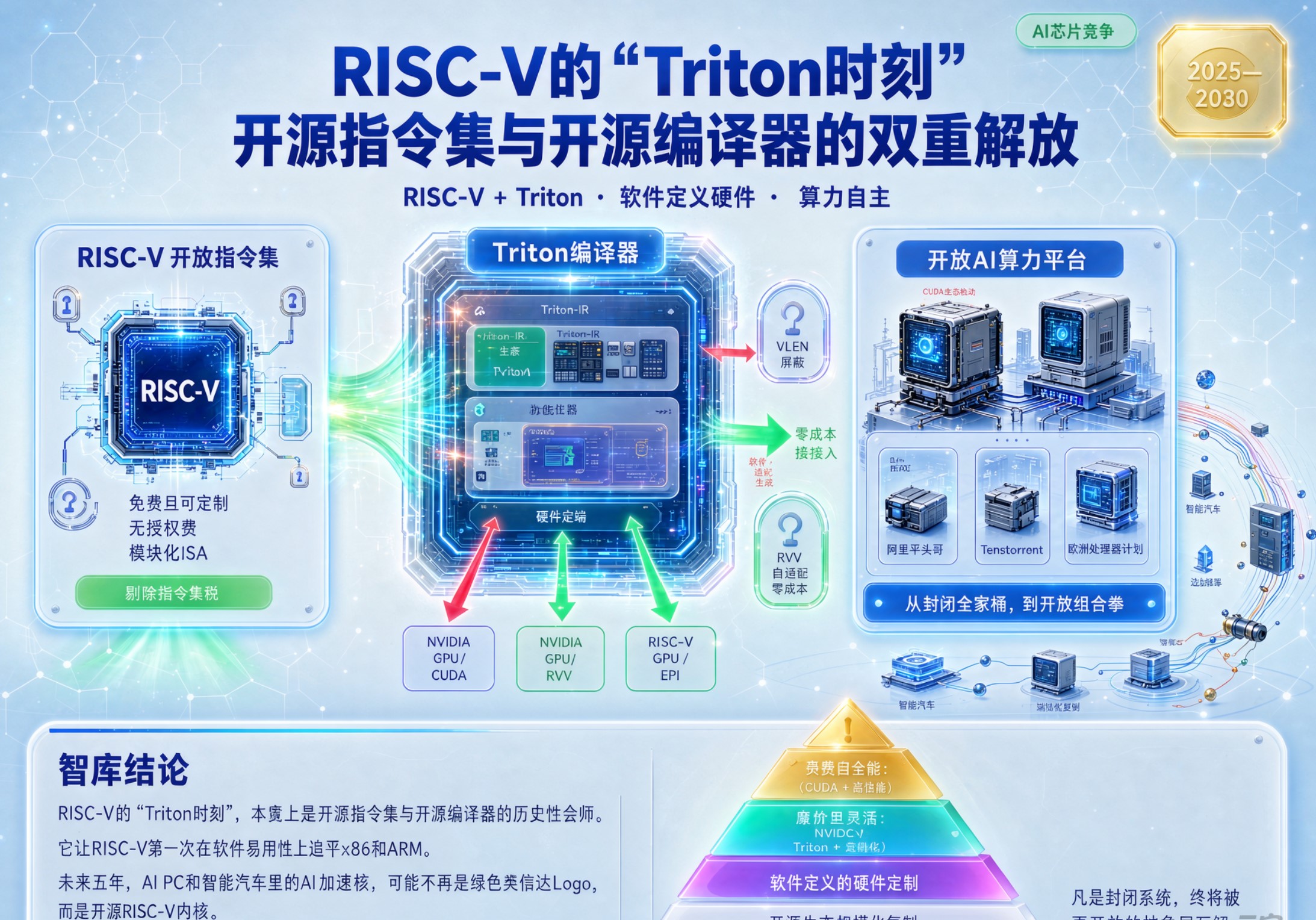
Triton不是终点,它只是开源编译器长河中的最新一朵浪花。下一个十年,当AI编译器进一步进化,或许我们会看到RISC-V架构的AI芯片,在Triton的加持下,以极低成本挑战现有霸主。历史的车轮滚滚向前,而编译器,永远是那个在车轮下铺路的碎石,也是最坚硬的基石。
Triton is not the end; it is merely the latest wave in the long river of open-source compilers. In the next decade, as AI compilers evolve further, we may witness RISC-V-based AI chips challenging current incumbents at drastically lower costs, empowered by Triton. The wheels of history roll forward, and the compiler remains forever the gravel paving the road beneath—yet also its hardest foundation.
词汇表 / Glossary
-
GCC (GNU Compiler Collection): GNU编译器套装,包含C、C++、Fortran等多种语言的编译器,是自由软件运动的基石。
-
LLVM (Low Level Virtual Machine): 一个模块化和可重用的编译器和工具链技术的集合,现已成为macOS、iOS、Linux等众多系统的默认编译基础设施。
-
Clang: LLVM项目的C/C++/Objective-C编译器前端,以编译速度快和诊断信息清晰著称。
-
Reference Implementation (参考实现): 在标准中定义的一个实现,用于验证其他实现是否符合规范。在编译器语境下,指硬件厂商提供的最优代码生成路径。
-
UXL Foundation: 一个致力于定义异构编程开放标准的行业组织,旨在提供CUDA的替代方案,核心项目是Intel的oneAPI。
此文由 怡心湖 编辑,若您觉得有益,欢迎分享转发!:首页 > 常识论 » 开源编译器正在吃掉硬件厂商的午餐:从GCC/LLVM到Triton的历史轮回