算力自主与地缘博弈:RISC-V如何成为各国“算力备胎”的首选
Computing Sovereignty and Geopolitical Games: How RISC-V Became the World’s Preferred "Compute Backup"
编者按 / Editor’s Note
在AI与算力成为“新石油”的今天,芯片指令集架构(ISA)的归属权,已不再是单纯的技术路线选择,而是国家算力主权的核心议题。x86掌握在英特尔与AMD手中,Arm受软银控制且受美国出口管制长臂管辖,唯有开源的RISC-V,提供了“不受单一国家控制”的可能性。从美国的DARPA到欧盟的《芯片法案》,从印度的国家半导体使命到中国的“香山”处理器,RISC-V正在被全球主要经济体不约而同地列为“算力备胎”的首选。本文将拆解这场围绕开源指令集的地缘暗战,揭示为何RISC-V是各国摆脱“算力卡脖子”的唯一结构性解。
In an era where AI and computing power are the "new oil," ownership of the Instruction Set Architecture (ISA) is no longer a mere technical choice but a core issue of national computing sovereignty. x86 is controlled by Intel and AMD, while Arm is under SoftBank’s control and subject to US export administration regulations. Only the open-source RISC-V offers a viable path to being "free from unilateral national control." From DARPA in the US to the EU Chips Act, from India’s Semicon India Mission to China’s "XiangShan" processor, major global economies are converging on RISC-V as the preferred "compute backup." This article dissects the geopolitical shadow war surrounding open-source ISAs and reveals why RISC-V is the only structural solution for nations seeking to escape "compute strangleholds."
一、 算力主权:为何指令集比光刻机更致命?
I. Computing Sovereignty: Why the ISA Is More Critical Than the Lithography Machine?
大众往往关注光刻机的卡脖子问题,但忽视了更底层的危机:如果指令集架构被断供,光刻机造出的芯片将无法运行任何软件。
The public often focuses on lithography machines as the primary chokepoint, overlooking a more fundamental crisis: If the ISA is cut off, chips produced by lithography machines will be unable to run any software.
1. Arm的“长臂管辖”之痛
Arm虽然是英国公司,但其IP授权受美国出口管制条例(EAR)约束。2020年,Arm曾被要求停止与部分中国客户合作,尽管法律诉讼仍在继续,但这给全球敲响了警钟:依赖闭源ISA,就等于将国家算力安全的钥匙交给了他国司法体系。
1. The Sting of Arm's "Long-Arm Jurisdiction"
Although Arm is a UK-based company, its IP licensing falls under US Export Administration Regulations (EAR). In 2020, Arm was reportedly required to cease cooperation with certain Chinese clients. While legal proceedings continue, this incident served as a global alarm: Relying on a proprietary ISA equates to handing over the keys to national computing security to a foreign judicial system.
2. x86的“生态围墙”
x86架构不仅封闭,且授权极其苛刻。除了AMD和英特尔,几乎没有其他国家能获得x86的完整授权。即便通过VIA(威盛)等渠道获得部分授权,也无法跟进最新的指令集扩展(如AVX-512、AMX)。这意味着,闭源ISA不仅带来政治风险,还带来技术代差的必然性。
2. The "Ecological Walled Garden" of x86
The x86 architecture is not only closed but also subject to extremely restrictive licensing. Beyond AMD and Intel, few nations can obtain full x86 licenses. Even through channels like VIA (Centaur), obtaining partial licenses does not grant access to the latest extensions (e.g., AVX-512, AMX). This implies that proprietary ISAs entail not only political risks but also inevitable technological obsolescence.
3. RISC-V的“免疫基因”
RISC-V国际基金会(RISC-V International)注册在瑞士,遵循瑞士的中立法律。更重要的是,RISC-V的ISA规范是完全开源的,采用宽松的BSD许可证。这意味着:
-
无人能断供: 指令集规范写在纸上,开源在社区,谁也无法收回。
-
无限可定制: 国家可以在基础指令集之上,添加自定义的加密、AI加速或安全指令,构建“主权指令集”。
-
永久使用权: 一旦获得RISC-V规范,永久拥有使用权,不受基金会成员变更影响。
3. RISC-V's "Immunity Gene"
RISC-V International is incorporated in Switzerland, governed by Swiss neutrality laws. Crucially, the RISC-V ISA specification is entirely open-source under permissive BSD licenses. This implies:
-
Immune to Cut-offs: The ISA spec is documented and open-sourced; no single entity can revoke it.
-
Infinitely Customizable: Nations can extend the base ISA with custom cryptographic, AI acceleration, or security instructions to build a "Sovereign ISA."
-
Perpetual Usage Rights: Once adopted, usage rights are permanent and unaffected by changes in foundation membership.
二、 全球博弈:四大经济体的RISC-V战略
II. Global Gambit: RISC-V Strategies of the Four Major Economies
RISC-V不再是一家公司的技术路线,而是各国国家战略的组成部分。
RISC-V is no longer merely a corporate technology roadmap but a component of national strategies worldwide.
1. 美国:DARPA的“开源国防”逻辑
美国看似支持Arm,但在国防与国家安全领域,美国国防部高级研究计划局(DARPA)早在2017年就开始资助RISC-V。
-
动机: 确保美军芯片供应链不受单一商业公司(如Arm)牵制。军用芯片强调可靠性和长期支持,闭源ISA随时可能因商业并购或出口管制而断供。
-
动作: DARPA资助了RISC-V的向量扩展(RVV)和安全扩展,确保其在高性能计算和加密领域的领先地位。
-
悖论: 美国在民用市场打压RISC-V的竞争对手(如华为),却在国防领域拥抱RISC-V。这恰恰证明了RISC-V在“算力自主”上的不可替代性。
1. The United States: DARPA's "Open-Source Defense" Logic
While appearing to support Arm commercially, the US Department of Defense's DARPA began funding RISC-V as early as 2017.
-
Motivation: To ensure the US military's chip supply chain is not held hostage by a single commercial entity (like Arm). Military chips prioritize reliability and long-term support; proprietary ISAs risk disruption due to mergers or export controls.
-
Actions: DARPA funded RISC-V's Vector (RVV) and Security extensions, ensuring its leadership in HPC and cryptography.
-
Paradox: The US restricts RISC-V's competitors (like Huawei) in civilian markets while embracing it for defense. This underscores RISC-V's irreplaceable role in "computing sovereignty."
2. 欧盟:数字主权与《芯片法案》
欧盟将RISC-V视为摆脱对美亚依赖、实现“数字主权”的核心。
-
欧洲处理器计划(EPI): 斥资1.2亿欧元,联合博世、西门子、意法半导体等,开发基于RISC-V的欧洲自主高性能芯片。
-
目标: 减少对x86(Intel/AMD)和Arm的依赖,确保从云计算到汽车电子的供应链安全。
-
立场: 欧盟明确表示,RISC-V是“地缘政治中立”的最佳选择,符合欧洲追求技术自主的战略利益。
2. The European Union: Digital Sovereignty and the Chips Act
The EU views RISC-V as central to escaping dependency on the US and Asia and achieving "digital sovereignty."
-
European Processor Initiative (EPI): Invested €120 million, collaborating with Bosch, Siemens, STMicroelectronics, etc., to develop European autonomous HPC chips based on RISC-V.
-
Goal: Reduce reliance on x86 (Intel/AMD) and Arm, securing supply chains from cloud computing to automotive electronics.
-
Stance: The EU explicitly identifies RISC-V as the optimal choice for "geopolitical neutrality," aligning with its strategic interest in technological autonomy.
3. 印度:国家半导体使命的“豪赌”
印度是全球首个将RISC-V定为国家指令集的国家。
-
战略: 印度政府启动“数字印度RISC-V”(DIR-V)计划,投入巨资,目标是在2023年底实现流片,2030年实现年出货量10亿颗。
-
野心: 印度希望跳过Arm架构的高额授权费,直接利用RISC-V构建从手机到服务器的完整IT生态,成为全球半导体设计中心。
-
进展: 印度理工学院(IIT)主导开发了Shakti系列处理器,并已成功流片,应用于国防、核能等关键领域。
3. India: The "Gamble" of the National Semiconductor Mission
India is the first nation to adopt RISC-V as its national ISA.
-
Strategy: The Indian government launched the "Digital India RISC-V" (DIR-V) initiative, investing heavily with targets for tape-outs by late 2023 and 1 billion annual shipments by 2030.
-
Ambition: India aims to bypass Arm's hefty licensing fees, leveraging RISC-V to build a complete IT ecosystem from mobile phones to servers, positioning itself as a global semiconductor design hub.
-
Progress: IITs led the development of the Shakti processor family, successfully taped out for critical sectors like defense and nuclear energy.
4. 中国:从“香山”到“算力网”
中国可能是RISC-V最大的推动者与受益者。
-
中科院“香山”架构: 中科院计算所发布的“香山”高性能RISC-V处理器,已成为开源社区的标杆。第二版“南湖”架构性能已对标Arm Cortex-A76。
-
平头哥的生态建设: 阿里平头哥发布了玄铁系列RISC-V处理器,并完成了从端到云的软件栈适配,成功运行了Llama 2等大模型。
-
战略意义: 在美国收紧对华半导体出口的背景下,RISC-V是中国实现算力自主、构建“全国一体化算力网”的唯一可行路径。中国工程院院士倪光南直言:“RISC-V是中国芯片产业摆脱垄断的最佳机遇。”
4. China: From "XiangShan" to the "Compute Grid"
China is arguably RISC-V's largest proponent and beneficiary.
-
CAS "XiangShan" Architecture: The "XiangShan" high-performance RISC-V processor from the CAS Institute of Computing Technology has become a benchmark in the open-source community. Its second-gen "Nanhu" core rivals the Arm Cortex-A76.
-
T-Head's Ecosystem: Alibaba's T-Head division released the Xuantie RISC-V series and completed end-to-end software stack adaptations, successfully running LLMs like Llama 2.
-
Strategic Value: Amid tightening US semiconductor export controls, RISC-V is China's only viable path to computing autonomy and building a "National Integrated Computing Grid." As CAS Academician Ni Guangnan stated, "RISC-V is China's best opportunity to break monopolies."
三、 “算力备胎”的成熟度:从“可用”到“好用”
III. The Maturity of the "Compute Backup": From "Usable" to "Reliable"
各国押注RISC-V,不仅是因为政治正确,更是因为技术成熟度的快速提升。
Nations are betting on RISC-V not just for political correctness, but because of rapid maturation in technical readiness.
1. 性能鸿沟的弥合
早期RISC-V被认为性能低下,仅适用于MCU。但近年来,随着乱序执行(Out-of-Order)、超标量(Superscalar)和多核技术的引入,RISC-V的性能已逼近主流水平。
-
SiFive P870: 性能已接近Arm Cortex-A78,足以支撑高端智能手机和笔记本电脑。
-
Ventana Veyron: 基于RISC-V的服务器CPU,单核性能达到AMD EPYC的90%以上。
-
玄铁C920: 在SPECint2017测试中达到9.8分,足以运行复杂的操作系统和AI模型。
1. Closing the Performance Gap
Early RISC-V implementations were dismissed as low-performance, fit only for MCUs. However, recent advancements in out-of-order execution, superscalar pipelines, and multicore technologies have brought RISC-V performance close to mainstream levels.
-
SiFive P870: Performance approaches Arm Cortex-A78, sufficient for high-end smartphones and laptops.
-
Ventana Veyron: Server-class CPUs based on RISC-V achieve over 90% of the single-core performance of AMD EPYC.
-
Xuantie C920: Scores 9.8 on SPECint2017, capable of running complex OSes and AI models.
2. 软件生态的“Triton时刻”
如前文所述,Triton编译器的成熟,解决了RISC-V最大的软肋——软件适配。
-
操作系统: Linux、Android、Windows(通过模拟层)均已支持RISC-V。
-
AI框架: PyTorch/TensorFlow通过Triton实现RISC-V后端支持,使得AI模型迁移成本降至最低。
-
工具链: GCC/LLVM均已主线支持RISC-V,开发环境与x86/Arm无异。
2. The "Triton Moment" in Software Ecosystem
As previously discussed, the maturation of the Triton compiler addresses RISC-V's greatest weakness: software adaptation.
-
Operating Systems: Linux, Android, and Windows (via emulation) all support RISC-V.
-
AI Frameworks: PyTorch/TensorFlow support RISC-V backends via Triton, minimizing AI model porting costs.
-
Toolchains: GCC and LLVM offer mainline RISC-V support, making the development environment indistinguishable from x86/Arm.
3. 供应链的“去美化”
RISC-V不仅开源,其EDA工具链也在快速开源化。
-
Chisel语言: 伯克利开发的硬件构造语言,使得RISC-V芯片设计效率提升数倍。
-
Yosys+NextPNR: 开源EDA工具链,已能支持中小规模RISC-V芯片的设计与流片。
-
工艺节点: 虽然先进工艺仍受限于光刻机,但在28nm及以上成熟工艺节点,RISC-V已完全实现供应链自主。
3. "De-Americanizing" the Supply Chain
RISC-V is not only open-source but also driving the open-sourcing of EDA toolchains.
-
Chisel: A hardware construction language from Berkeley that boosts RISC-V chip design productivity significantly.
-
Yosys+NextPNR: Open-source EDA toolchains capable of designing and taping out small-to-medium scale RISC-V chips.
-
Process Nodes: While cutting-edge nodes remain constrained by lithography, RISC-V achieves full supply chain autonomy at mature nodes (28nm and above).
四、 挑战与暗礁:RISC-V并非万能药
IV. Challenges and Hidden Reefs: RISC-V Is Not a Panacea
尽管前景广阔,但RISC-V成为“算力备胎”之路仍布满荆棘。
Despite its promise, the path to RISC-V as a "compute backup" is fraught with challenges.
1. 碎片化风险
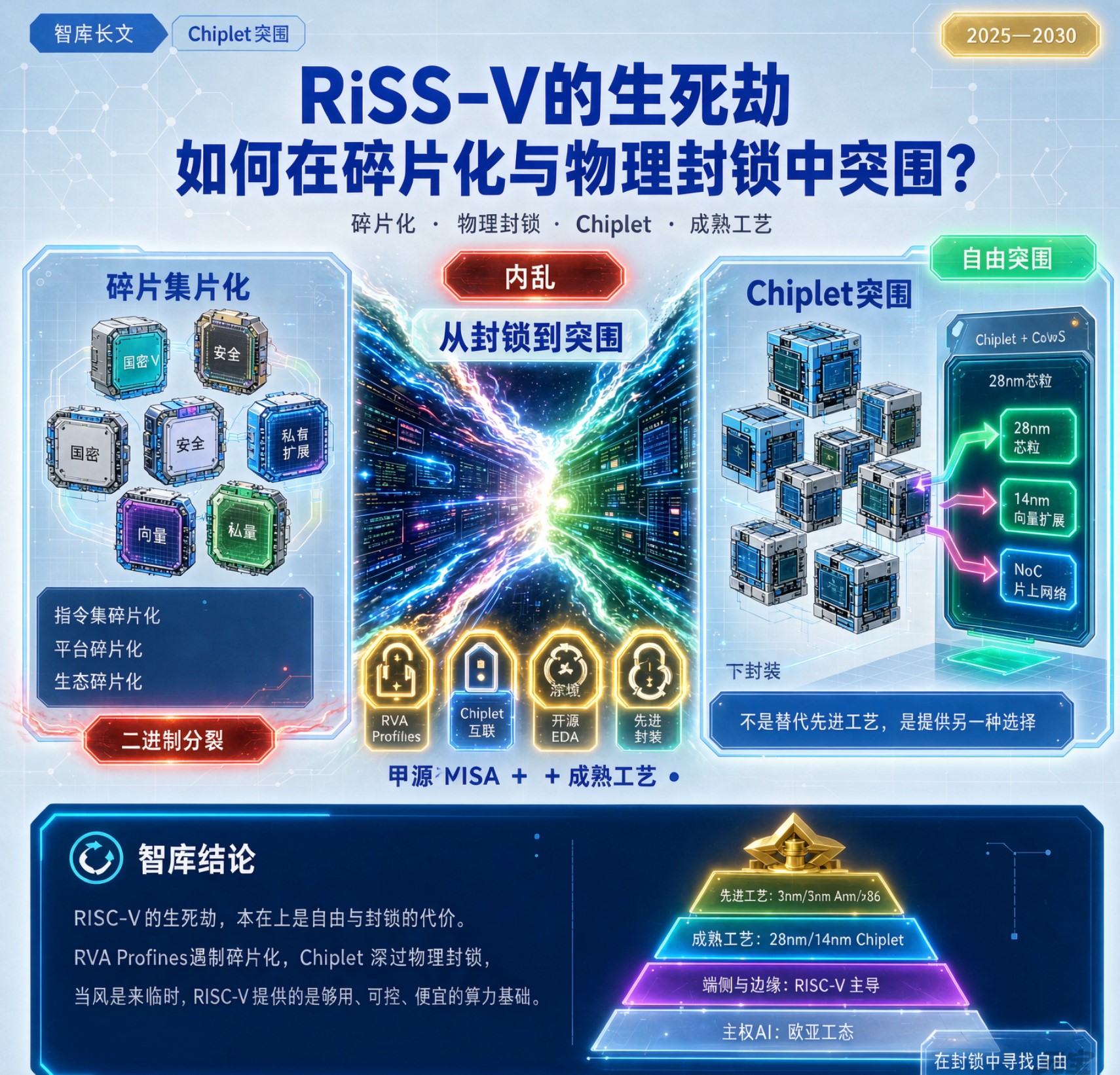
RISC-V的开放性是一把双刃剑。各国为了构建“主权指令集”,纷纷添加自定义扩展。如果缺乏协调,可能导致生态碎片化,重蹈Unix战争覆辙。RISC-V国际基金会正在努力通过“配置文件”(Profiles)机制,强制统一基础环境。
1. Fragmentation Risk
RISC-V's openness is a double-edged sword. Nations adding custom extensions to build "Sovereign ISAs" risk ecosystem fragmentation, repeating the Unix wars. RISC-V International is mitigating this via "Profiles" mechanisms to enforce baseline uniformity.
2. 先进工艺的“物理封锁”
RISC-V解决的是“逻辑封锁”,但无法解决“物理封锁”。如果EUV光刻机被断供,即便拥有RISC-V架构,也无法制造出7nm及以下的高端芯片。这需要半导体设备和材料的整体突破。
2. "Physical Blockade" of Advanced Nodes
RISC-V addresses "logical lockout" but not "physical lockout." Without access to EUV lithography, possessing the RISC-V architecture does not enable manufacturing sub-7nm high-end chips. This requires holistic breakthroughs in semiconductor equipment and materials.
3. 商业生态的滞后
虽然技术可行,但商业软件(如Windows原生支持、Adobe套件、工业软件)对RISC-V的支持仍滞后。这需要市场占有率的提升来倒逼软件厂商适配,形成一个漫长的正反馈循环。
3. Lagging Commercial Ecosystem
While technically feasible, commercial software support (native Windows, Adobe suite, industrial CAD) lags. This requires market share growth to incentivize vendors, creating a slow positive feedback loop.

五、 结语:算力自主的“诺亚方舟”
V. Conclusion: The "Noah's Ark" of Computing Sovereignty
RISC-V正在成为一场全球性的“算力备胎”运动。它不仅仅是一项技术,更是一种地缘政治对冲工具。
RISC-V is catalyzing a global movement for "compute backups." It is not merely a technology but a geopolitical hedging tool.
对于美国,它是国防供应链的安全阀;对于欧盟,它是数字主权的基石;对于印度,它是跨越式发展的跳板;对于中国,它是突破封锁的生命线。
For the US, it is a safety valve for the defense supply chain; for the EU, the cornerstone of digital sovereignty; for India, a springboard for leapfrog development; for China, a lifeline to break blockades.
未来的算力世界,可能不会是RISC-V取代x86或Arm,而是形成“三足鼎立”的格局:
-
x86: 坚守高性能服务器与桌面,但份额缓慢下滑。
-
Arm: 统治移动端与嵌入式,但在地缘政治中摇摆。
-
RISC-V: 在端侧、边缘侧、AI加速及特定主权领域快速扩张。
The future computing landscape may not see RISC-V replace x86 or Arm, but rather a triad:
-
x86: Holds high-performance servers and desktops, albeit with slowly declining share.
-
Arm: Dominates mobile and embedded, but remains geopolitically vulnerable.
-
RISC-V: Expands rapidly in endpoints, edge computing, AI acceleration, and sovereign domains.
在这场关乎国运的地缘博弈中,RISC-V就是那艘正在建造中的“诺亚方舟”。它未必是最快的船,但它是唯一一艘不受单一船坞控制的船。当风暴来临,谁能登上这艘船,谁就保住了未来的算力火种。
In this geopolitical game concerning national destiny, RISC-V is the "Noah's Ark" under construction. It may not be the fastest vessel, but it is the only one not controlled by a single shipyard. When the storm hits, those who board this ark will preserve the spark of future computing.
词汇表 / Glossary
-
ISA (Instruction Set Architecture): 指令集架构,定义了CPU所能识别和执行的所有指令的集合,是软硬件之间的契约。
-
EAR (Export Administration Regulations): 美国出口管理条例,是美国实施长臂管辖的主要法律依据。
-
Shakti: 印度自主研发的RISC-V处理器系列,由印度理工学院主导。
-
香山 (XiangShan): 中国科学院计算技术研究所主导开发的高性能开源RISC-V处理器核。
-
Profiles: RISC-V基金会推出的标准化机制,定义了特定应用场景下必须支持的指令集和功能集合,以防止碎片化。
此文由 怡心湖 编辑,若您觉得有益,欢迎分享转发!:首页 > 观·世界 » 算力自主与地缘博弈:RISC-V如何成为各国“算力备胎”的首选
 开源编译器正在吃掉硬件厂商的午餐
 PyTorch是如何变成“AI界的POSIX”
 CUDA的护城河与AI生态的开放之战 C
 后GPU时代的基础设施之争:英特尔AI
 隐形霸权与产业断层:日本科技的“咽
 算力迁徙:AI时代下PC与移动互联网的
 Brute Force vs Efficiency: Cloud
 硅、栈与主权:AI 时代中国 GPU 国产