情報司令塔か、それとも「新・特高」か——日本「国家情報局」設立をめぐる軍政観察
The "Intelligence Command Tower" or a Reborn Tokkō? — A Tri-Language Military-Political Observation on Japan's National Intelligence Agency
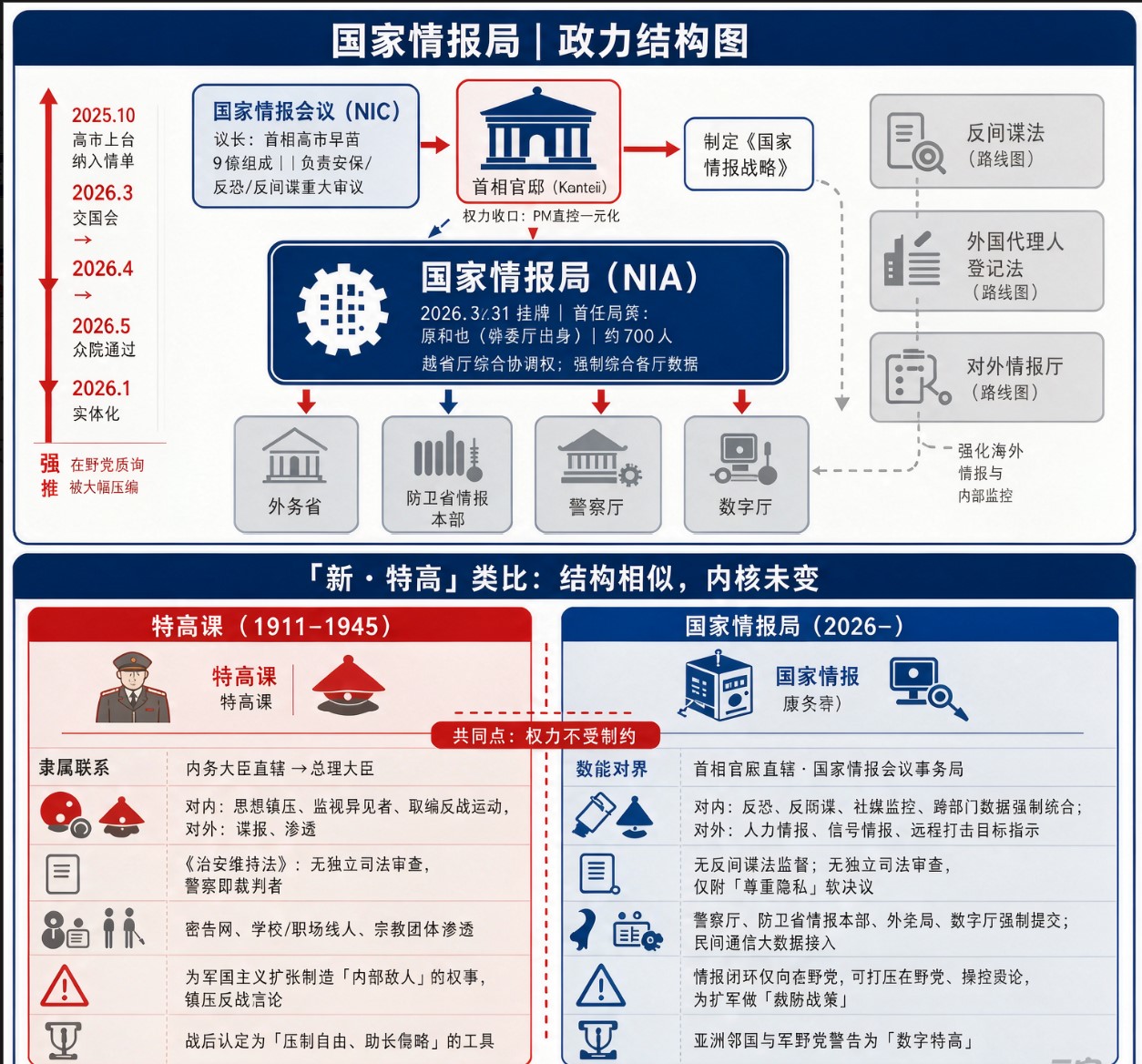
2026年7月24日、高市早苗内閣は閣議で「国家情報局(こっかじょうほうきょく)」の7月31日発足を決定した。初代局長は警察庁警備局出身の原和也・元内閣情報官。同機関は従来の「内閣情報調査室(ないかくじょうほうちょうさしつ)」を昇格・改組し、「国家情報会議(こっかじょうほうかいぎ)」(議長=首相)の事務局として、外務省・防衛省・警察庁・デジタル庁のデータを強制的に統合する「越省庁(えっしょうちょう)コーディネート権」を握る。
On 24 July 2026, the Takaichi Cabinet resolved to launch the National Intelligence Agency (国家情報局 / Kokka Jōhōkyoku) on 31 July. Its first director, Kazuya Hara, is a former Police Agency Security Bureau chief. Born from the upgraded Cabinet Intelligence and Research Office, it serves the National Intelligence Council (国家情報会議) chaired by the PM, and is granted cross-ministerial compulsory coordination power over MOFA, MOD, NPA and the Digital Agency.
これは戦後81年で初の「首相直轄・中央集権型」インテリジェンス体制である。日本側は「米英型NSC/CIAの近代化」と自称するが、権力収口(しゅうこう)の仕方は戦前の特高課(とっこうか/特別高等警察)を連想させる。
This is the first PM-direct centralized intelligence architecture in 81 postwar years. Tokyo sells it as a "modern Anglo-American NSC/CIA model," yet the way power is locked into the Kantei mirrors the prewar Tokkō (Special Higher Police).
一、権力構造:分権から官邸一元へ/From Fragmentation to Kantei Monopoly
戦後日本の情報は「省庁縦割り」だった。外務省国際情報統括官、防衛省情報本部、警察庁国際犯罪調査局、内閣情報調査室——各々がサイロ(silo)化し、首相への報告は遅く薄かった。
Postwar Japanese intelligence was a maze of silos: MOFA's Intelligence and Analysis Service, MOD's Intelligence Headquarters, NPA's International Crime Investigation, and CIRO. Reporting to the PM was slow and thin.
新体制では:
-
国家情報会議:首相議長、官房長官・外相・防相・法相・国家公安委員長ら9閣僚。初の《国家情報戦略》を策定。
-
国家情報局:約700人体制、各省庁へ情報提出を「求める」法定権限(事実上の強制徴集)。原和也局長という警察・警備系エリートの配置は、「対外スパイ」以上に「対内監視」を本丸にするシグナルだ。
The new stack:
-
NIC: chaired by PM, 9 ministers, drafts the first National Intelligence Strategy.
-
NIA: ~700 staff, legally empowered to "request" (read: compel) data from all ministries. Appointing a Police Security Bureau career man as director signals that domestic surveillance is as core as foreign espionage.
日本語で言えば「戦後憲法の『軍事・警察分権』デザインを、官邸が静かに解体した」。
In Chinese: 战后宪法刻意设计的"军警情报分权制衡",被官邸悄悄拆掉了。
In English: The postwar constitutional firewall between police, military and cabinet intelligence just got dissolved into one Kantei black box.
二、なぜ「強推」か——監督ゼロ、付帯決議だけ/Why "Forced": No Oversight, Only Soft Resolutions
立憲民主党は「プライバシー制限」「第三者監査」「国会報告」を盛り込んだ修正を出したが否決。最終テキストには独立監視機関も、収集対象の明示も、政治利用禁止条項もない。市民団体は「空白授権(くうはくじゅんいん)」と呼ぶ。
The CDP submitted amendments demanding privacy limits, an independent review body, and annual Diet reports—all voted down. The enacted text has no independent watchdog, no defined collection scope, no anti-politicization clause. Civic lawyers call it "blank-check authorization."
高市は「慎重に検討」と繰り返すが、並行して《反スパイ法》・《外国代理人登録法》・「対外情報庁」新設をロードマップに載せた。2013年《特定秘密保護法》→2017年《共謀罪》→2026年この統合→続く反スパイ法。一つ一つは「治安理由」だが、繋げば「秘密定義→漏洩罰則→統合徴集→社会監視」の完全チェーンになる。
Takaichi says she will "deliberate carefully" on a future Anti-Espionage Act, Foreign Agents Registration, and an overseas spy agency (対外情報庁). String 2013's Secrets Law, 2017's Conspiracy Crime, 2026's NIA together and you get a closed loop: define secrets → criminalize leaks → centralize collection → monitor society.
東京・国会前では「反対国家情報局」「監視国家ストップ」の集会が複数回起き、弁護士福山和人は「戦前教訓を何も汲まぬ悪法」と断じた。

三、「新・特高」類比はオーバーか/Is "Neo-Tokkō" Hyperbole?
構造比較で見ると、似る所は多い:
|
次元 |
特高課(1911–1945) |
国家情報局(2026–) |
|---|---|---|
|
所属 |
内務大臣直轄 |
首相・官房直轄 |
|
機能 |
対内思想鎮圧+対外諜報 |
対内治安・反スパイ+対外情報統合 |
|
監督 |
司法・議会ほぼ無効 |
独立監査なし、付帯決議のみ |
|
政治利用 |
治安維持法で異論者検挙 |
反スパイ名目で反戦・左派に「寒蝉効果」 |
学者・張勇(社科院)や項昊宇は「権力集中・内外兼備・監督不在」の三点で本質的類似と指摘。《東京新聞》《琉球新報》も「デジタル特高」の表現を使う。
Scholars Zhang Yong and Xiang Haoyu note the triple overlap—centralized command, dual domestic/foreign reach, zero external check—makes the Tokkō analogy structurally fair, not rhetorical. Tokyo Shimbun and Ryukyu Shimpo literally call it a "digital Tokkō."
但し違う所もある:2026年の日本は米軍枠組みの中にあり、憲法9条は形として残る。だから正確には「特高の幽霊を借りた、米同盟型インテリジェンス=軍事転用装置」である。
But it is not 1930s Japan: it sits inside the US alliance and Article 9 still exists on paper. The precise label is: a US-aligned intelligence-military converter wearing the ghost of Tokkō.
四、軍政(ぐんせい)チェーンの最後の歯車/The Last Gear in the Remilitarization Chain
国家情報局は単体では動かない。周辺で同時に回っている歯車:
-
防衛予算増・「対敵基地攻撃能力」保有
-
自衛隊「情報作戦群(せんたい)」新編(海自3200人規模)
-
殺傷兵器輸出禁止の事実上解除
-
《安保3文書》改定・憲法解釈のさらに右へ
NIA does not stand alone. It feeds: rising defense budget + enemy-base strike capability; new SDF "Information Operations Group" (3,200 personnel); de facto lift on lethal weapon exports; revised National Security Strategy.
つまりインテリジェンスは「耳」であり「目」であり、次は「拳」になる。呂耀東(社科院)の言を借りれば、「専守防衛の殻を破り、再軍事化(さいぐんじか)へ全チェーンを繋ぐ仕掛け」である。
Intelligence is the eyes and ears; next comes the fist. As Lü Yaodong puts it, this is the gear that connects "breaking passive defense" to "full remilitarization."
アジア隣国が警戒するのは「日本版CIA」ではなく、「首相一人で戦争可否を判断できる情報独占」が出来上がる点だ。沖縄・台湾海峡・朝鮮半島のすべてのシグナルが、7月31日以降は原局長の画面に、官邸の判断材料として秒単位で集まる。
What alarms Asia is not a "Japanese CIA" but information monopoly enabling one PM to decide war. From 31 July, every signal on Okinawa, the Taiwan Strait and the Korean Peninsula flows in real time to the Kantei's sole decision screen.
結語/Coda
日本語:「平和憲法の重しを外し、特高の影を通し、官邸が耳をそろえる——それが2026年夏の東京の正体。」
中文:卸下和平宪法的压舱石,借特高的影子,让官邸把耳朵凑到一起——这就是2026年夏东京的真身。
English: Remove the pacifist ballast, channel the Tokkō shadow, let the Kantei grow one pair of ears—that is Tokyo's true face in summer 2026.
国家情報局は「効率」の名で生まれ、「監視」の実態を抱え、「戦争準備」の歯車となる。これを行政改革と呼ぶなら、戦前の日本も皆そう呼んでいた。
Born in the name of efficiency, pregnant with surveillance, geared toward war preparation—if this is "administrative reform," prewar Japan called its Tokkō the same way.
注:本稿は中日英三語混記の軍政観察。固有名詞は初出に原語併記。取材根拠は2026年7月現在の閣議決定・国会通過テキスト・主要メディア報道に依拠()。
此文由 怡心湖 编辑,若您觉得有益,欢迎分享转发!:首页 > 观·世界 » 情報司令塔か、それとも「新・特高」か——日本「国家情報局」設立をめぐる軍政観察
 银鞍照白马的现代回响:中国军力在东
 东亚安全十字路口:中日战争概率评