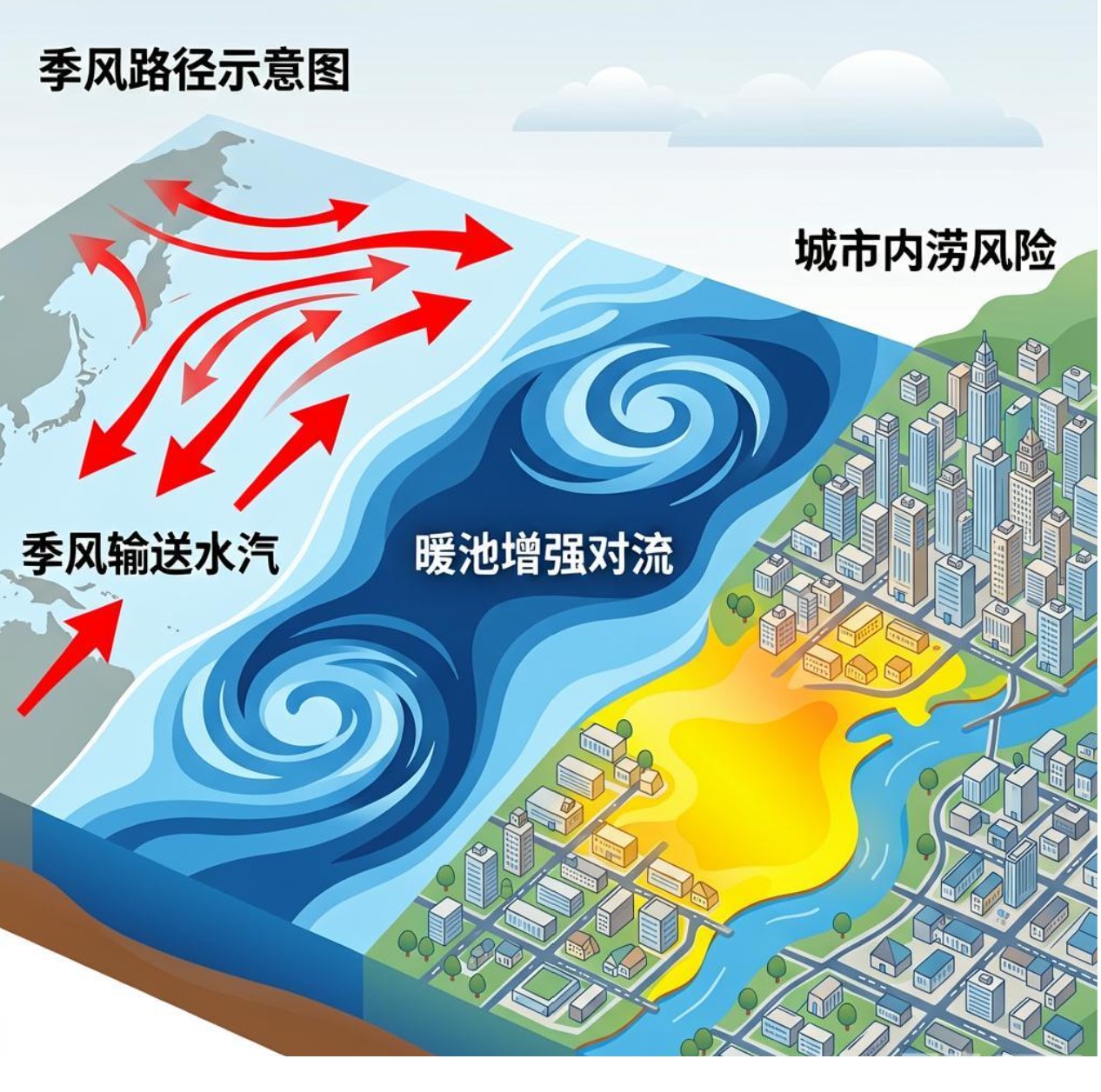
季风、暖池与城市:解码中国夏季洪涝的复合驱动机制
Monsoon, Warm Pool, and Cities: Decoding the Compound Drivers of Summer Flooding in China
引言:周期性的“气候大考”
Introduction: The Recurring "Climate Stress Test"
每年六月到九月,中国便进入一年一度的“防汛时间”。从珠江流域的前汛期,到长江流域的梅雨,再到华北东北的“七下八上”,洪涝灾害似乎成了夏季的“标配”。这并非单纯的巧合,而是大气环流、海洋热力状态与下垫面变化三者耦合的复杂结果。本文旨在通过气象学与气候学的视角,拆解这场年度“气候大考”背后的深层逻辑。
From June to September, China enters its annual "flood season." From the pre-flood season in the Pearl River Basin to the Meiyu in the Yangtze River Basin, and the critical flood period ("July-end and August-start") in North and Northeast China, flooding seems to be a standard feature of summer. This is no mere coincidence but a complex result of the coupling among atmospheric circulation, oceanic thermal states, and underlying surface changes. This article aims to deconstruct the deep logic behind this annual "climate stress test" from meteorological and climatological perspectives.
一、大气环流的“指挥棒”:季风与副高的博弈
I. The Baton of Atmospheric Circulation: The Game between Monsoon and Subtropical High
夏季洪涝的根本驱动力在于东亚夏季风(East Asian Summer Monsoon, EASM)的爆发与推进。
夏季风的本质是从海洋吹向陆地的暖湿气流。每年5月,随着太阳直射点北移,太平洋副热带高压(Western Pacific Subtropical High, WPSH,简称“副高”)开始增强并向北挺进。它的西北边缘,正是输送水汽的“高速公路”。
The root driver of summer floods lies in the onset and progression of the East Asian Summer Monsoon (EASM).
The essence of the summer monsoon is warm, moist airflow blowing from the ocean to the land. Every May, as the solar declination moves northward, the Western Pacific Subtropical High (WPSH) intensifies and advances northward. Its northwestern periphery serves as a "highway" for moisture transport.
-
雨带的季节性位移(Seasonal March of Rain Belts):
气象学上常用500 hPa位势高度场来追踪副高脊线。当脊线稳定在北纬20°附近时,华南前汛期开始;推进至25°N时,江淮梅雨登场;抵达30°N左右时,华北和东北迎来最强降水。这种“走走停停”的节奏,决定了洪涝发生的时空分布。
-
“列车效应”(Training Echo Effect):
当天气系统移动缓慢,或者对流单体在同一地区反复经过时,就像一列列火车相继驶过同一轨道,导致极端降水累积。这在夏季的华北平原尤为常见,往往造成“城市看海”的景象。
二、海洋的“遥控器”:ENSO与印度洋偶极子
II. The Remote Controller of the Ocean: ENSO and IOD
如果说大气环流是“指挥棒”,那么热带海洋就是“遥控器”。厄尔尼诺-南方涛动(ENSO)和印度洋偶极子(IOD)是影响我国夏季降水的两大关键海温模态。
If atmospheric circulation is the "baton," then the tropical oceans act as the "remote controller." El Niño-Southern Oscillation (ENSO) and the Indian Ocean Dipole (IOD) are two key sea surface temperature (SST) modes influencing summer precipitation in China.
-
ENSO的滞后效应(Lagged Effects of ENSO):
统计表明,厄尔尼诺事件次年夏季,西太平洋副高往往偏强、偏南、偏西。这会导致雨带长期滞留在江南、华南地区,使得这些区域降水偏多,而华北地区易发生干旱(尽管近年来气候态有所改变,但统计规律依然显著)。
-
暖池异常(Warm Pool Anomalies):
西北太平洋暖池(Warm Pool)的海温异常直接影响大气对流活动。暖池增温加剧了海气相互作用,为台风的生成提供了充足的能量。夏季频繁的台风活动,往往是洪涝灾害的直接触发因子。

三、变暖的“放大器”:热力学机制的升级
III. The Amplifier of Warming: Upgrading Thermodynamic Mechanisms
在全球变暖的背景下,克劳修斯-克拉珀龙方程(Clausius-Clapeyron Relation)解释了为何现在的雨比过去更猛。该方程指出,气温每升高1°C,大气的持水能力增加约7%。
Against the backdrop of global warming, the Clausius-Clapeyron relation explains why rainfall today is more intense than in the past. This equation states that for every 1°C increase in temperature, the atmosphere's water-holding capacity increases by approximately 7%.
-
极端降水阈值降低(Lower Threshold for Extreme Precipitation):
变暖使得大气处于一种“更湿”的状态。这意味着在同样的天气系统下,现在能够产生的降水量远高于几十年前。所谓的“百年一遇”暴雨,正在变得不再罕见。
-
复合型灾害(Compound Extremes):
高温与暴雨的“组合拳”日益频繁。例如,前期极端高温导致土壤干裂、硬化,降低了下渗率;随后的短时强降水无法被土壤吸收,迅速转化为地表径流,加剧了山洪和城市内涝的风险。
四、城市的“承压阀”:下垫面改变与脆弱性
IV. The Pressure Valve of Cities: Underlying Surface Changes and Vulnerability
除了自然因素,人类活动改变了地球的“皮肤”(下垫面),显著影响了洪涝的形成机制。
Beyond natural factors, human activities have altered the Earth's "skin" (the underlying surface), significantly affecting flood genesis mechanisms.
-
不透水面(Impervious Surfaces):
城市化进程中,混凝土和沥青取代了植被与土壤。这导致径流系数(Runoff Coefficient)急剧增大。自然状态下,50%的雨水会下渗;而在城市中,这一比例可能降至15%以下,85%以上的降水瞬间变为地表径流,给排水管网带来巨大压力。
-
热岛与雨岛效应(Urban Heat Island & Rain Island Effects):
城市排放的热量改变了局地大气边界层结构,增强了上升运动,使得城市及其下风向地区的降水量显著高于周边郊区。这是一种典型的“人为制造”的气候异常。
五、案例复盘:2023年华北极端降水的气象诊断
V. Case Review: Meteorological Diagnosis of the 2023 Extreme Precipitation in North China
以2023年7月底京津冀地区的特大暴雨为例,我们可以清晰地看到上述机制的叠加:
Taking the extreme torrential rain in the Beijing-Tianjin-Hebei region at the end of July 2023 as an example, we can clearly observe the superposition of the aforementioned mechanisms:
-
环流配置: 副高异常强盛并北抬,台风“杜苏芮”残余环流与西风带槽脊系统长时间对峙,形成了稳定的经向环流。
-
地形动力: 太行山、燕山的迎风坡强迫抬升作用,极大地增强了降水效率(地形增幅效应)。
-
水汽条件: 来自南海、东海及西太平洋的三支水汽通道同时向中国北方输送,水汽通量达到历史极值。
六、对策建议:从工程防御到气候韧性
VI. Policy Recommendations: From Engineering Defense to Climate Resilience
面对日益复杂的夏季水患,传统的单一工程防御已显不足,亟需构建更具韧性的防灾减灾体系。
In the face of increasingly complex summer flooding, traditional single-structure engineering defenses are proving insufficient. There is an urgent need to build a more resilient disaster prevention and mitigation system.
-
精准预报预警(Precision Forecasting & Early Warning):
利用AI和高分辨率数值模式(如CMA-MESO),提高对短时强降水(Short-duration Heavy Rainfall)和中小尺度系统的捕捉能力,延长预警提前量。
-
海绵城市建设(Sponge City Construction):
恢复城市水文循环,增加绿地、透水铺装和生物滞留设施,从源头削减地表径流。
-
流域统筹管理(Integrated River Basin Management):
打破行政区划限制,实施全流域水库群联合调度,平衡防洪、供水与生态需求。
夏季水灾频发,是大自然对人类社会的警示。它既是季风节律的自然体现,也是全球变暖背景下极端天气常态化的缩影,更是快速城市化进程中暴露出的系统性脆弱。唯有深刻理解其背后的气象机理,尊重自然规律,才能在与水的博弈中赢得主动。
The frequent occurrence of summer floods serves as a warning from nature to human society. It represents both the natural manifestation of monsoon rhythms and a microcosm of the normalization of extreme weather under global warming, as well as systemic vulnerabilities exposed during rapid urbanization. Only by deeply understanding the underlying meteorological mechanisms and respecting the laws of nature can we take the initiative in our interactions with water.
此文由 怡心湖 编辑,若您觉得有益,欢迎分享转发!:首页 > 常识论 » 季风、暖池与城市:解码中国夏季洪涝的复合驱动机制
 灰色驻军与切香肠式挑衅:美军“绿色
 碧波深处有中华:中国在南海领土主权
 烽火欧陆,震荡东海:乌克兰战场升级对
 亚洲水塔的黄昏:冰川拐点、气候危机
 IMF逆势上调中国2026年GDP增速至4.
 中国大豆进口来源多元化进展(巴西/
 中国粮食进口依赖度高的问题何时能