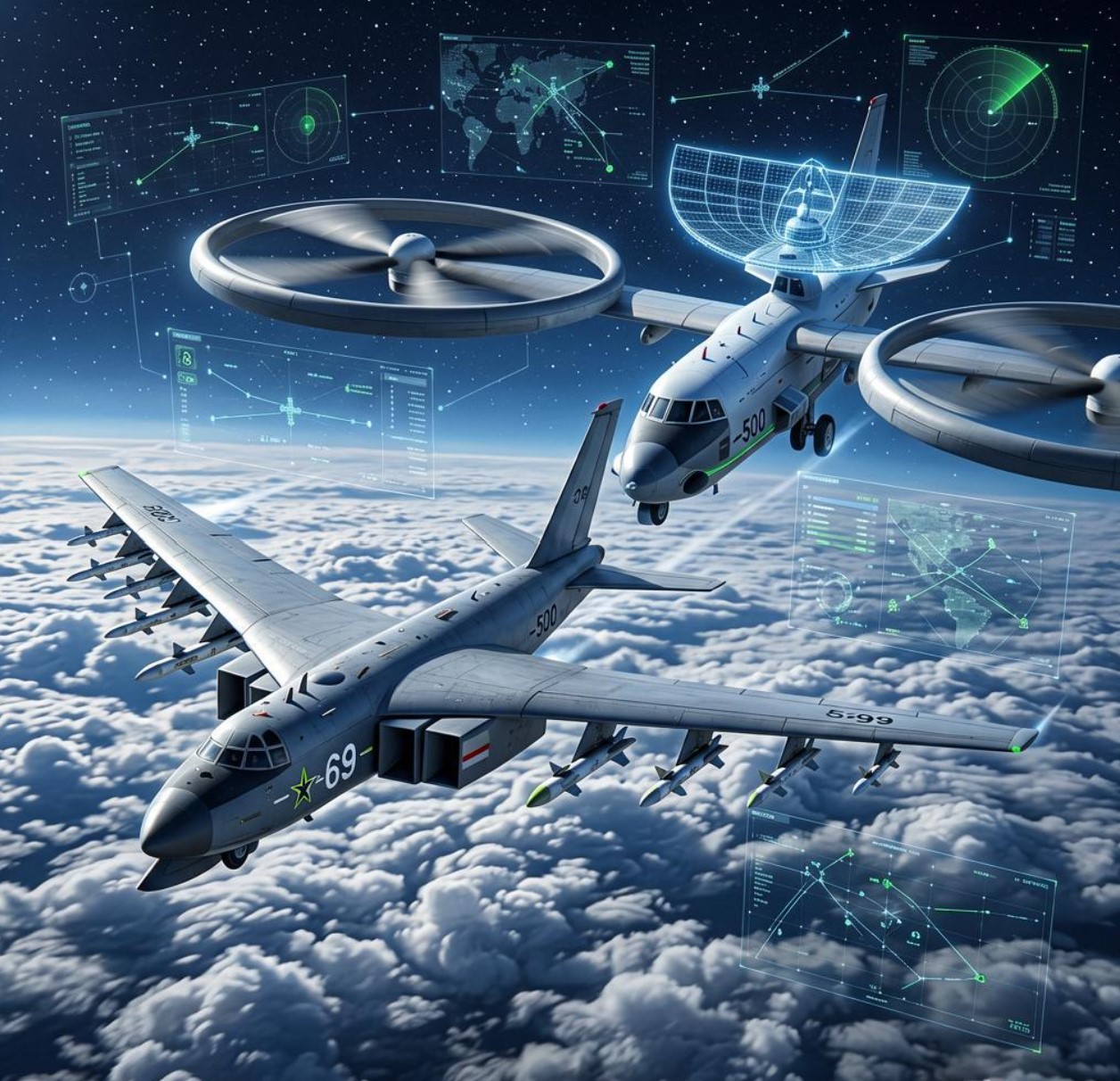
云端“铁拳”与“天眼”的耦合:轰-6K与空警-500体系作战的架构、机理与战略意涵
The Coupling of the “Iron Fist” and the “Sky Eye”: Architecture, Mechanisms, and Strategic Implications of H-6K and KJ-500 System-of-Systems Combat
【怡心湖智库综述 / Think Tank Overview】
在现代空战从“平台中心战”向“网络中心战”演进的背景下,单一武器的性能优势已不足以决定战局,体系化协同(System-of-Systems Synergy)才是衡量一支战略空军实战能力的核心标尺。中国空军轰-6K中远程轰炸机与空警-500预警指挥机的深度融合,构建了一套覆盖“探测—决策—打击—评估”全链路的空中作战闭环。本文从技术架构、协同机理、典型战术场景及战略威慑价值四个维度,剖析这一组合如何重塑西太平洋及南海方向的空中力量平衡。
In the context of modern air warfare evolving from “platform-centric warfare” to “network-centric warfare,” the performance advantage of a single weapon is no longer sufficient to determine the outcome of a battle; System-of-Systems Synergy has become the core metric for measuring the actual combat capability of a strategic air force. The deep integration of the PLAAF’s H-6K medium-long range bomber and the KJ-500 airborne early warning and control (AEW&C) aircraft has constructed an aerial combat closed-loop covering the entire chain of “detection—decision—strike—assessment.” This paper analyzes how this combination reshapes the balance of air power in the Western Pacific and the South China Sea from four dimensions: technical architecture, synergy mechanisms, typical tactical scenarios, and strategic deterrence value.
一、装备画像:火力投送端与态势感知端的职能界定
I. Equipment Profiles: Defining the Roles of Firepower Delivery and Situational Awareness
轰-6K:“远程铁拳”与防区外打击节点
H-6K: The “Long-Range Iron Fist” and Stand-off Strike Node
轰-6K作为“战神”家族的骨干型号,换装D-30KP-2涡扇发动机后,作战半径延伸至3500公里以上,最大航程超9000公里。其核心定位并非临空轰炸,而是重型导弹载机(Missile Truck)。它可挂载长剑-20(CJ-20)巡航导弹(对陆/对海,射程约1500km+)、鹰击-12(YJ-12)超音速反舰导弹及鹰击-21(YJ-21)空射高超音速导弹(射程约1500km,末速超5Ma),具备在第一、第二岛链关键节点防区外实施饱和攻击的能力。
The H-6K, as the backbone of the “Divine Warrior” family, extends its combat radius to over 3,500 km with a maximum range exceeding 9,000 km after re-engining with D-30KP-2 turbofans. Its core role is not dive bombing but serving as a heavy missile carrier (Missile Truck). It can carry CJ-20 land-attack cruise missiles (range >1,500 km), YJ-12 supersonic anti-ship missiles, and YJ-21 air-launched hypersonic missiles (range ~1,500 km, terminal speed >Mach 5), enabling saturated strikes beyond the defensive perimeters of key nodes within the First and Second Island Chains.
空警-500:“数字天眼”与空中指挥中枢
KJ-500: The “Digital Sky Eye” and Aerial Command Hub
空警-500搭载全球领先的数字阵列雷达(DAR),采用全固态有源相控阵技术,重量轻、探测距离远,具备对隐身目标、低空小型目标的较强探测能力。它不仅是传感器,更是空中作战管理中心(AOC),通过高速数据链(如Link-XX级别的综合战术互联网)实现多平台间火控级数据的实时分发与任务重组,是编队“OODA环”(观察—调整—决策—行动)的加速引擎。
The KJ-500 is equipped with the world-leading Digital Array Radar (DAR) using all-solid-state AESA technology, featuring light weight and long detection range, with strong capability against stealth targets and low-altitude small targets. It is not merely a sensor but an Airborne Operations Control (AOC) center, realizing real-time fire-control-grade data distribution and mission reorganization among multiple platforms via high-speed datalinks (such as integrated tactical internet at Link-XX level), acting as the acceleration engine for the formation’s “OODA Loop” (Observe—Orient—Decide—Act).
二、体系耦合机理:“A射B导”与超视距杀伤链构建
II. System Coupling Mechanism: “A-Shoot-B-Guide” and Beyond-Visual-Range Kill Chain Construction
轰-6K与空警-500的协同,本质是解决非隐身轰炸机在强对抗环境下的生存性与打击精度矛盾:
-
态势感知延伸(Extended Situational Awareness):轰-6K自身雷达孔径有限且开启火控雷达易暴露电磁特征。空警-500在后方安全空域利用其高空优势雷达,将目标诸元(坐标、航向、速度)通过数据链隐秘下发至轰-6K座舱,实现“静默探测”。
H-6K’s own radar aperture is limited and activating fire-control radar exposes electromagnetic signatures. KJ-500, operating from a safe rear area leveraging its altitude and radar advantage, covertly downlinks target parameters (coordinates, heading, speed) to H-6K cockpits via datalink, achieving “silent detection.”
-
A射B导与第三方制导(Third-Party Targeting):在发射长剑-20或鹰击-21后,导弹中段惯导+卫星/空警-500中继修正。空警-500可持续跟踪移动目标(如航母编队),实时修正弹道,弥补轰-6K脱离后视距丢失问题,实现“发射后不管”的体系化版本。
After launching CJ-20 or YJ-21, the missile relies on mid-course INS + satellite/KJ-500 relay correction. KJ-500 can continuously track moving targets (e.g., carrier battlegroups) and provide real-time trajectory updates, compensating for H-6K’s line-of-sight loss after egress, realizing a system-level version of “fire-and-forget.”
-
电磁频谱管理(EMS Management):空警-500统筹编队电磁环境,引导伴随的歼-16D或大型电子战飞机对敌防空雷达实施压制(SEAD),为空警-500与轰-6K的通信链路清扫干扰,确保指挥控制(C2)不被切断。
KJ-500 manages the formation’s electromagnetic spectrum, directing accompanying J-16D or large electronic warfare aircraft to suppress enemy air defenses (SEAD), clearing interference for KJ-500 and H-6K communication links to ensure Command and Control (C2) remains intact.
三、典型作战编成与战术流程推演
III. Typical Operational Formation and Tactical Process Walkthrough
以远海反舰/对陆纵深打击任务为例,该体系通常嵌套于更大的联合网络(含无侦-7/8、运油-20、水面舰艇):
-
前沿侦察与信息融合:无侦-7/8前出至西太平洋,回传高价值目标坐标至空警-500;空警-500融合卫星、地基雷达数据,构建全维战场图。
High-altitude UAVs (WZ-7/8) penetrate forward into the Western Pacific, relaying high-value target coordinates to KJ-500; KJ-500 fuses satellite and ground-based radar data to construct a full-dimensional battlespace picture.
-
编队集结与空中加油:轰-6K打击编队在运油-20支援下跨越第一岛链;歼-16/歼-20负责制空护航;空警-500A在侧翼或后方建立空中指挥所,保持对敌预警机、舰载机的距离优势。
H-6K strike packages cross the First Island Chain supported by Y-20U; J-16/J-20 provide air dominance cover; KJ-500A establishes an aerial command post on the flank or rear, maintaining stand-off advantage against enemy AEW&C and carrier-borne aircraft.
-
任务分配与防区外齐射:空警-500识别高威胁目标优先级,分配打击任务。轰-6K在1000—1500公里外齐射高超音速/巡航导弹,形成多轴向饱和攻击。
KJ-500 identifies target priority and assigns strike tasks. H-6Ks launch salvos of hypersonic/cruise missiles from 1,000–1,500 km stand-off range, generating multi-axis saturated attacks.
-
毁伤评估与二次打击:空警-500及无人机群评估毁伤,若未达阈值,引导后续批次轰-6K或转交舰艇/火箭军补打。
KJ-500 and UAV swarms assess damage; if thresholds are unmet, they guide subsequent H-6K waves or hand off to naval/rocket force units for supplementary strikes.
在中俄联合空中战略巡航(如第十一次巡航)中,该组合已实现6小时以上的跨海区协同,空警-500A甚至承担了对俄方编队的态势共享,验证了跨国体系互操作性雏形。
四、战略意涵:A2/AD体系的核心支柱与威慑重构
IV. Strategic Implications: Core Pillar of A2/AD Architecture and Deterrence Restructuring
-
反介入/区域拒止(A2/AD)的空基锚点:轰-6K+空警-500的组合,使中国空军的威慑圈从近海推至第二岛链(关岛方向)。鹰击-21的射程覆盖结合空警-500的引导,使敌方航母战斗群在距离中国海岸1500公里外即面临极高生存风险。
This combination extends PLAAF deterrence from offshore waters to the Second Island Chain (Guam direction). The range of YJ-21 coupled with KJ-500 guidance exposes enemy carrier strike groups to high survivability risks beyond 1,500 km from China’s coast.
-
南海“堡垒海域”的空中支点:依托永兴岛等南沙/西沙机场,轰-6K与空警-500的前置部署,可在南海构建全天候监控与打击圈,实现“发现即打击”,巩固南海立体防御体系。
Forward-deployed at Yongxing Island and other Spratly/Paracel airstrips, H-6K and KJ-500 can establish all-weather surveillance and strike rings in the South China Sea, achieving “detect-to-engage” and consolidating the multi-domain defense system.
-
消解隐身与数量劣势:通过体系赋能,非隐身的轰-6K在空警-500的“单向透明”保护下,避免了与隐身战机正面格斗的短板;而空警-500的数字阵列雷达本身具备反隐身潜力,形成对高端对手的非对称制衡。
Through system empowerment, non-stealthy H-6K avoids the短板 of frontal engagement with stealth fighters under KJ-500’s “one-way transparency” protection; meanwhile, KJ-500’s DAR possesses inherent anti-stealth potential, creating asymmetric checks on high-end adversaries.
五、结论:从“单打独斗”到“云端一体”的质变
V. Conclusion: Qualitative Leap from “Solo Platforms” to “Integrated Cloud-Edge Systems”
轰-6K与空警-500的体系作战,标志着中国空军已突破传统“轰炸机突击”的线性思维,进化为网络化、节点化、智能化的体系对抗形态。在这一架构中,轰-6K是伸出的“铁拳”,空警-500是运转的“大脑”,而连接二者的数据链则是“神经”。未来的西太平洋空战,将不再是单一战机的性能比拼,而是预警指挥效率、杀伤链闭合速度、多域融合深度的体系之争。中国这一组合的成熟,正在实质性地压缩潜在对手在远海的行动自由度与战略喘息空间。
The system-of-systems combat of H-6K and KJ-500 signifies that the PLAAF has transcended the linear thinking of traditional “bomber penetration” and evolved into a networked, nodal, and intelligent system-of-systems confrontation paradigm. In this architecture, H-6K is the extended “iron fist,” KJ-500 is the functioning “brain,” and the datalink connecting them is the “nerve.” Future air warfare in the Western Pacific will no longer be a contest of single-aircraft performance, but a system competition of AEW&C efficiency, kill-chain closure speed, and multi-domain fusion depth. The maturation of this Chinese combination is substantively compressing the operational freedom and strategic breathing space of potential adversaries in distant seas.
此文由 怡心湖 编辑,若您觉得有益,欢迎分享转发!:首页 > 观·世界 » 云端“铁拳”与“天眼”的耦合:轰-6K与空警-500体系作战的架构、机理与战略意涵
 台海/南海 A2/AD 信息优势博弈推演
 A2/AD与网络战:网电融合时代的反介
 反介入与区域拒止(A2/AD):现代大国海
 海上无人系统的发展:从单平台试验走