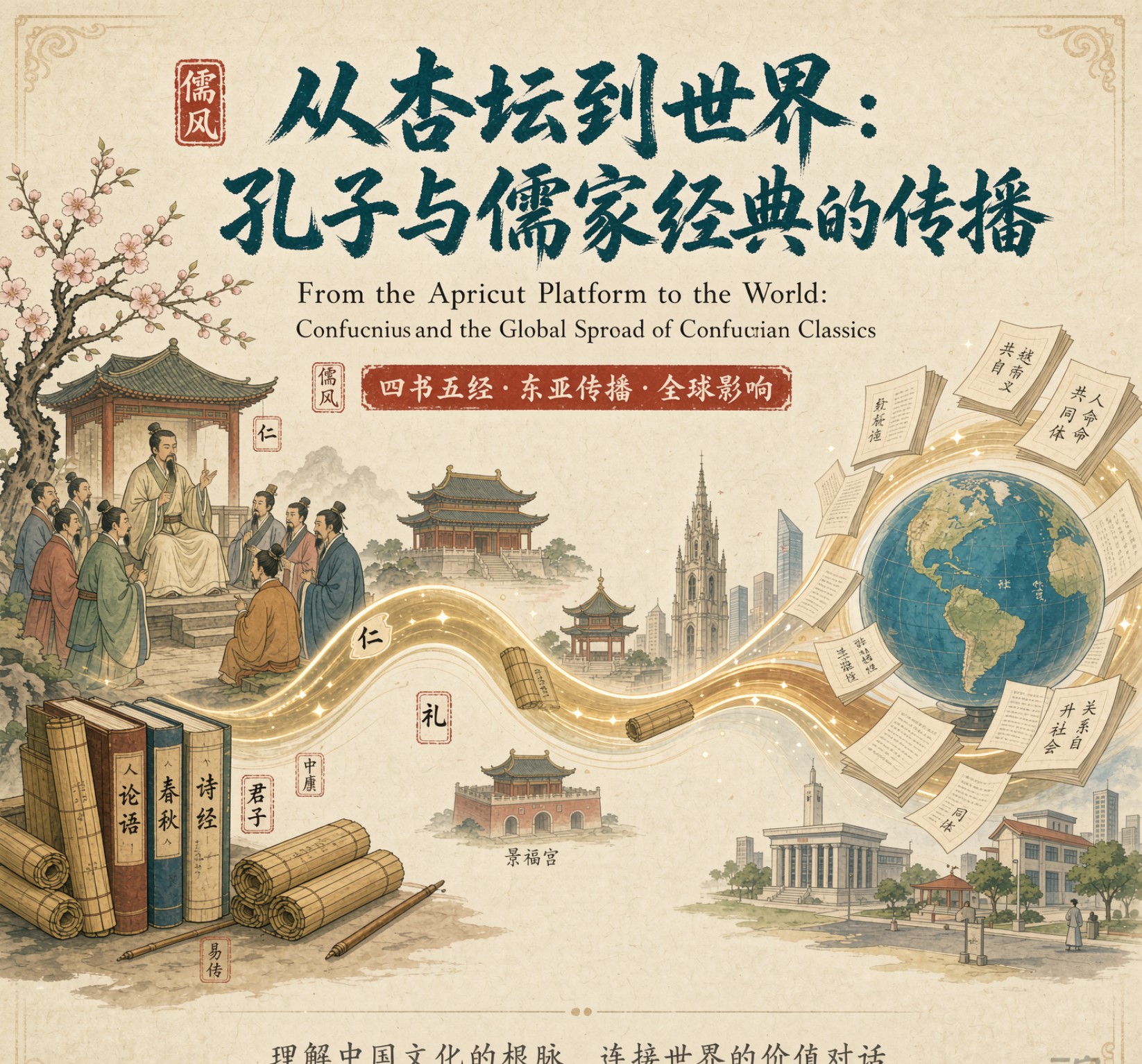

从杏坛到世界:孔子与儒家经典的传播
From the Apricot Platform to the World: Confucius and the Global Spread of Confucian Classics
公元前5世纪,一位名叫孔丘的哲人在鲁国设坛讲学。他的声音起初只回荡在“杏坛”之间,却最终穿越两千多年的时光,成为东亚文明的底色,并持续影响着今日世界的价值讨论。
In the 5th century BCE, a philosopher named Kong Qiu began teaching at a private academy in the State of Lu. His voice first echoed only around the “Apricot Platform,” yet it has traversed more than two millennia to become the bedrock of East Asian civilization—and continues to shape global conversations on ethics and governance today.
一、经典之源:孔子与“四书五经”
The Source: Confucius and the “Four Books and Five Classics”
孔子被尊为“至圣先师”,并非因为他自创了一套封闭的理论,而是因为他系统地整理、阐释了上古以来的文化成果,并通过弟子口耳相传,形成了儒家的核心经典体系。
Confucius is revered as the “Great Sage and First Teacher.” This is not because he invented a closed theoretical system, but because he systematically compiled and interpreted the cultural heritage of ancient China. Through his disciples, these teachings were passed down and crystallized into the core canon of Confucianism.
1. 最直接的记录:《论语》
1. The Most Direct Record: The Analects
如果说儒家思想有一部“圣经”,那便是《论语》。这部语录体著作记录了孔子与其弟子冉有、子路、颜回等人的对话。
If Confucianism has a “Bible,” it is The Analects. This collection of sayings records the conversations between Confucius and his disciples—such as Ran You, Zilu, and Yan Hui.
-
仁 (Ren):** 孔子思想的核心,意为“爱人”,强调同理心与道德自觉。
-
礼 (Li):** 社会秩序与行为规范,不仅是仪式,更是和谐人际关系的基础。
-
君子 (Junzi):** 儒家理想人格,指“有德行的领导者”,而非单纯的贵族身份。
-
Ren (Benevolence): The core of Confucius’ thought, meaning “loving others,” emphasizing empathy and moral self-awareness.
-
Li (Ritual/Propriety): Social order and normative behavior; not mere ceremony, but the foundation of harmonious human relations.
-
Junzi (Exemplary Person): The Confucian ideal personality—an “ethical leader,” not merely a person of noble birth.
2. 孔子的“述而不作”与“五经”
2. Confucius’ “Transmitting Rather Than Creating” and the “Five Classics”
孔子自称“述而不作”(shu er bu zuo),即整理旧文而非凭空创作。他晚年修订的“五经”,奠定了中华文化的基石:
Confucius claimed to “transmit rather than create” (shu er bu zuo). In his later years, he edited the Five Classics, which became the cornerstone of Chinese culture:
-
《诗经》 (The Book of Songs):** 中国最早的诗歌总集,孔子以诗教人,认为“不学诗,无以言”。
-
《尚书》 (The Book of Documents):** 上古政治文献,体现了“民为邦本”的治国理念。
-
《礼》 (The Book of Rites):** 规范社会行为的准则,后发展为《周礼》《仪礼》《礼记》。
-
《易经》 (The Book of Changes):** 一部哲学占卜书,孔子作《十翼》阐释其中的天道与人事变化。
-
《春秋》 (The Spring and Autumn Annals):** 孔子亲修的鲁国编年史,以一字寓褒贬,开创“微言大义”的史家传统。
-
The Book of Songs: The earliest anthology of Chinese poetry. Confucius used poetry as moral education, stating, “Without studying the Odes, one cannot speak.”
-
The Book of Documents: Ancient political documents reflecting the principle that “the people are the foundation of the state.”
-
The Book of Rites: Standards for social conduct, later expanded into the Rites of Zhou, Etiquette and Ritual, and The Book of Rites.
-
The Book of Changes: A philosophical divination text. Confucius wrote the Ten Wings to explain the dynamics between heaven’s patterns and human affairs.
-
The Spring and Autumn Annals: A chronicle of the State of Lu edited by Confucius himself. With subtle phrasing, he embedded praise and blame, establishing the historian’s tradition of “profound meaning in concise language.”
3. 思想的延续:四书
3. The Continuation: The “Four Books”
到了宋代,朱熹将《礼记》中的《大学》《中庸》抽出,与《论语》《孟子》合为“四书”,成为后世科举与教育的核心。
By the Song Dynasty, Zhu Xi extracted The Great Learning and The Doctrine of the Mean from The Book of Rites and compiled them with The Analects and Mencius into the Four Books, which became the core curriculum for civil service examinations and education for centuries.
二、传播的轨迹:从东亚到世界
The Trajectory: From East Asia to the World
儒家思想并未止步于中国。随着汉字文化圈的形成,儒家经典成为了东亚共同的文明基因。
Confucianism did not remain confined to China. With the formation of the Sinosphere, Confucian classics became a shared civilizational DNA across East Asia.
1. 汉字文化圈(Sinosphere)的共振
1. Resonance in the Sinosphere
-
朝鲜半岛 (Korea): 儒学在李氏朝鲜时期成为国教,朱子学深刻影响了韩国的伦理观与社会结构。
-
日本 (Japan): 江户时代,儒学(尤其是阳明学与朱子学)成为幕府的官方意识形态,塑造了武士道精神中的“忠”与“义”。
-
越南 (Vietnam): 科举制度与儒家经典教育延续近千年,深深嵌入越南的文化肌理。
-
Korea: During the Joseon Dynasty, Neo-Confucianism became the state ideology, profoundly shaping Korean ethics and social structure.
-
Japan: In the Edo period, Confucianism (particularly Wang Yangming’s School and Zhu Xi’s School) became the shogunate’s official ideology, influencing the “loyalty” and “righteousness” in Bushido.
-
Vietnam: The civil service examination system and Confucian education lasted for nearly a millennium, deeply embedding themselves in Vietnam’s cultural fabric.
2. 西学东渐与东学西传
2. The Exchange Between East and West
16世纪末,利玛窦(Matteo Ricci)等耶稣会士来华,将《论语》《大学》译为拉丁文,儒家思想首次系统性地进入欧洲视野。启蒙运动时期,伏尔泰(Voltaire)等思想家将孔子视为理性的化身,用儒家“德治”思想批判欧洲的封建神权。
In the late 16th century, Jesuit missionaries like Matteo Ricci arrived in China and translated The Analects and The Great Learning into Latin, introducing Confucianism systematically to Europe for the first time. During the Enlightenment, thinkers like Voltaire regarded Confucius as the embodiment of reason, using Confucian “rule by virtue” to critique feudal theocracy in Europe.
三、现代回响:儒家思想的当代价值
Modern Resonance: The Contemporary Value of Confucianism
今天,当我们谈论“人类命运共同体”或“和谐社会”时,依然能听到孔子思想的回响。
Today, when we discuss the “Community with a Shared Future for Mankind” or a “Harmonious Society,” we still hear the echoes of Confucius.
-
修身 (Self-Cultivation): 《大学》中“修身齐家治国平天下”的逻辑,依然是许多东亚人理解个人与社会关系的框架。
-
仁爱 (Benevolence): 在全球化的冲突中,“己所不欲,勿施于人”的金科玉律,被视为全球伦理的基石。
-
中庸 (The Golden Mean): 不走极端,追求平衡,为解决现代社会的焦虑与对立提供了智慧。
-
Self-Cultivation: The logic of “cultivating the self, regulating the family, governing the state, and bringing peace to the world” from The Great Learning remains a framework for understanding the relationship between the individual and society in East Asia.
-
Benevolence: Amid global conflicts, the golden rule—“Do not impose on others what you yourself do not desire”—is regarded as a cornerstone of global ethics.
-
The Golden Mean: Avoiding extremes and pursuing balance offers wisdom for addressing anxiety and polarization in modern society.

Conclusion
从《论语》的只言片语,到《春秋》的微言大义,孔子的智慧通过经典代代相传。儒家思想之所以能跨越时空,在于它始终关注“人”本身——如何成为一个更好的人,如何建立一个更善的社会。这不仅是中国的遗产,更是世界的财富。
From the fragmented sayings in The Analects to the profound implications in The Spring and Autumn Annals, Confucius’ wisdom has been passed down through the classics. The reason Confucianism transcends time and space lies in its enduring focus on “human beings” themselves—how to become a better person, and how to build a better society. This is not merely China’s heritage, but a treasure for the world.
Key Terms 关键词:
-
仁 (Ren / Benevolence)
-
礼 (Li / Ritual Propriety)
-
君子 (Junzi / Exemplary Person)
-
四书五经 (The Four Books and Five Classics)
-
杏坛 (Apricot Platform / The birthplace of private education in China)
此文由 怡心湖 编辑,若您觉得有益,欢迎分享转发!:首页 > 赞·中华 > 儒释道 » 从杏坛到世界:孔子与儒家经典的传播 Confucius and the Global Spread of Confucian Classics
 食色性也,礼以行之:儒家“饮食男女”
 以财发身:儒家财富观的现代启示 Usi