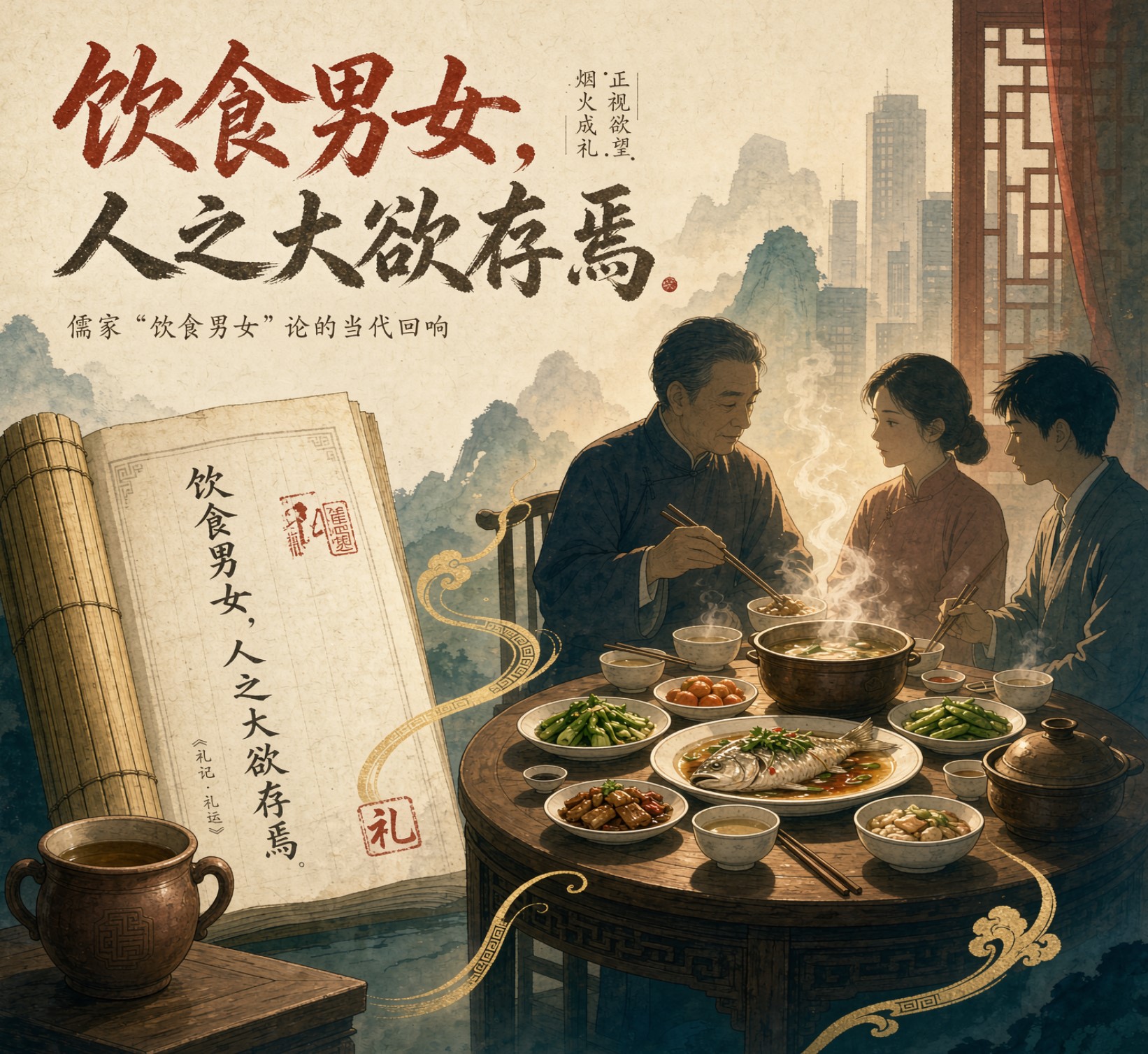
食色性也,礼以行之:儒家“饮食男女”论的当代回响
On Food, Sex, and the Rites: The Contemporary Resonance of Confucian Wisdom on Human Desires
“饮食男女,人之大欲存焉。”
“Food and sex are where the great desires of humankind reside.”
——《礼记·礼运》 The Book of Rites: Conveyance of Rites
一、正视欲望:从“存天理,灭人欲”的误解说起
I. Acknowledging Desires: Dispelling the Myth of "Eliminating Human Desires"
长久以来,儒家常被误读为“存天理,灭人欲”的严苛教条。然而,翻开《礼记》,孔子早已直言:“饮食男女,人之大欲存焉。”在儒家看来,食欲与爱欲并非罪恶的深渊,而是人性的起点。告子所谓“食色,性也”,正是对这一点的精准注脚。
For a long time, Confucianism has been misconstrued as a harsh dogma demanding the "elimination of human desires to preserve heavenly principles." Yet, in The Book of Rites, Confucius candidly states: "Food and sex are where the great desires of humankind reside." From the Confucian perspective, appetite and the desire for love are not abysses of sin but the very starting points of human nature. Gaozi’s famous dictum, "Food and sex are part of our nature," serves as a precise annotation of this truth.
古为今用之处在于:当代社会常陷入两个极端——要么是消费主义对欲望的无度煽动(暴饮暴食、容貌焦虑、流量至上),要么是禁欲式的自我压抑(身材羞耻、情感隔离)。儒家提醒我们:欲望是中性的,是“天之理”。 真正的智慧,不在于否定它,而在于承认它。只有承认“我饿了”、“我爱他/她”,我们才具备了做人的诚实。
The contemporary relevance lies here: Modern society often swings between two extremes—either the unrestrained incitement of desires by consumerism (overeating, appearance anxiety, obsession with virality) or an ascetic repression of the self (body shaming, emotional detachment). Confucianism reminds us: Desires are neutral; they are "the principles of heaven." True wisdom does not lie in negating them, but in acknowledging them. Only by admitting "I am hungry" or "I love him/her" do we embrace the honesty fundamental to being human.
二、礼以节欲:在放纵与压抑之间寻找“中道”
II. Regulating Desires with Rites: Finding the "Middle Way" Between Indulgence and Repression
孔子紧接着说:“欲恶者,心之大端也……舍礼何以哉?”意思是,人有大欲,也有大恶(死亡贫苦),人心复杂难测,若没有“礼”来规范,社会将陷入丛林法则。
Confucius immediately follows: "Desires and aversions are the great pivots of the human heart... Without the Rites (Li), how can we govern them?" This means that humans possess great desires and great aversions (like death and poverty). The human heart is complex and unpredictable; without the Rites to regulate behavior, society would descend into a state of nature governed by brute force.
这里的“礼”,并非僵化的封建礼节,而是社会规范、道德底线与审美情趣的总和。
Here, Li (the Rites) does not refer to rigid feudal etiquette, but rather the sum total of social norms, moral bottom lines, and aesthetic sensibilities.
饮食之礼(The Rites of Food):
古人讲究“毋抟饭”(不要抢饭团)、“毋放饭”(不要把刚入口的饭放回碗里)。今日,这种“礼”演化为餐桌礼仪与可持续饮食。它反对的是暴饮暴食的浪费,提倡的是“一粥一饭,当思来处不易”的敬畏。在米其林餐厅的精致摆盘与家常便饭的烟火气中,我们实践着对食物的尊重,这便是现代的“礼”。
In ancient times, people observed rules like "do not grab rice balls" or "do not put food back into the common bowl after touching it with your mouth." Today, this Li has evolved into table manners and sustainable eating. It opposes the wastefulness of gluttony and advocates for the reverence captured in the saying, "When eating porridge or rice, think of the toil behind its origin." Whether in the exquisite plating of a Michelin-starred restaurant or the homely aroma of a family meal, practicing respect for food is the modern manifestation of Li.
男女之礼(The Rites of Sex and Marriage):
古人讲“男女有别”、“发乎情,止乎礼”。今日,这并非指压抑天性,而是指确立亲密关系的边界与尊重。在现代约会文化、婚姻制度乃至职场交往中,“礼”体现为 consent(同意)、忠诚、责任以及对人格的平等尊重。没有礼的“男女”,只是荷尔蒙的宣泄;有了礼的“男女”,才升华为爱情与家庭。
In ancient times, there were norms like "distinction between men and women" and "letting emotions begin, but stopping them at the boundaries of rites." Today, this does not mean repressing one's nature, but rather establishing boundaries and mutual respect in intimate relationships. In modern dating culture, marriage, and even workplace interactions, Li manifests as consent, loyalty, responsibility, and the equal respect for one another's personhood. Without Li, "men and women" are merely a discharge of hormones; with Li, "men and women" elevate into love and family.
三、李安的启示:烟火气中的儒家伦理
III. Ang Lee’s Insight: Confucian Ethics in the Aroma of Daily Life
李安的电影《饮食男女》是对这一命题最生动的影像诠释。老朱作为名厨,每周日精心烹制大餐,这是“饮食”;三个女儿各自面临情感与婚姻的抉择,这是“男女”。
Ang Lee’s film Eat Drink Man Woman is the most vivid cinematic interpretation of this thesis. Master Chef Zhu, the patriarch, meticulously prepares a Sunday feast each week—this is "food." His three daughters each face choices regarding love and marriage—this is "sex" (in the broad sense of relationships).
电影的高明之处在于,它没有说教,而是展示了“礼”的崩塌与重建。
老朱味觉丧失,象征着传统父权与旧礼的失效;女儿们看似离经叛道,却在新的家庭组合中找到了各自的秩序。李安告诉我们:儒家伦理不是一成不变的教条,而是像那桌热腾腾的饭菜一样,需要不断更新食材,调整火候。只要一家人围坐在一起,那份维系情感的“礼”就在,“大欲”便有了安顿之处。
The brilliance of the film lies in its lack of didacticism; instead, it shows the collapse and reconstruction of Li. Zhu’s loss of taste symbolizes the failure of traditional patriarchy and old rites. The daughters, seemingly rebellious, find their own order in new family configurations. Ang Lee tells us: Confucian ethics are not immutable dogmas but are like that steaming hot table of food—they require constant updates in ingredients and adjustments in cooking. As long as the family sits together, the Li that sustains emotional bonds persists, and the "great desires" find their proper place.

四、做一个有尊严的“饮食男女”
IV. Conclusion: Being a Dignified "Man/Woman of Food and Sex"
在算法推荐不断投喂我们、感官刺激无处不在的今天,重读“饮食男女,人之大欲存焉”,具有极强的现实意义。
In an era where algorithms constantly feed us content and sensory stimulation is omnipresent, revisiting "Food and sex are where the great desires of humankind reside" holds profound practical significance.
-
面对饮食(面对物质): 我们要从“吃饱”走向“吃好”,从满足口腹之欲走向对健康的关注、对环境的责任。这叫“克己复礼”——克制贪欲,恢复对自然的敬畏之礼。
Regarding Food (Materialism): We must move from "eating to fullness" to "eating well," from satisfying mere appetite to focusing on health and environmental responsibility. This is "restraining the self to restore the rites"—curbing greed to restore the reverence for nature.
-
面对男女(面对情感): 我们要从“搭子文化”的浅层社交走向深度的情感连接,从单纯的生理吸引走向对灵魂的尊重。这叫“文质彬彬”——既有自然情感(质),又有文明修养(文)。
Regarding Sex/Relationships (Emotions): We must move from the superficial "accountability partner (dazi)" culture to deep emotional connections, from mere physical attraction to respect for the soul. This is being "refined both in substance and in manner"—possessing natural emotions (zhi) coupled with cultural cultivation (wen).
“人之大欲”不可怕,可怕的是只有欲望,没有灵魂。
The "great desires" of humankind are not terrifying; what is terrifying is having only desires but no soul.
愿我们在美食中品味人生,在爱欲中看见神圣。这,便是儒家古老智慧在21世纪的回响。
May we savor life through fine food and see the sacred within love and desire. This is the resonance of ancient Confucian wisdom in the 21st century.
词汇表 (Glossary for Language Learners):
-
饮食男女 (Yǐnshí Nánnǚ): Food and sex / Men and women (referring to basic human desires).
-
礼 (Lǐ): Rites, rituals, propriety, the underlying ethical code.
-
性 (Xìng): Nature, innate quality.
-
节 (Jié): To regulate, to restrain, to moderate.
-
发乎情,止乎礼 (Fā hū qíng, zhǐ hū lǐ): Emotions begin, but are restrained by propriety.
-
文质彬彬 (Wén zhì bīn bīn): Refined; combining substance (nature) and manner (culture) harmoniously.
此文由 怡心湖 编辑,若您觉得有益,欢迎分享转发!:首页 > 赞·中华 > 儒释道 » 食色性也,礼以行之:儒家“饮食男女”论的当代回响 On Food, Sex, and the Rites: The Contemporary Resonance of Confucian Wisdom
 秦始皇‘焚书’令对后世中国文化和
 复调的文明:超越儒法二元叙事,重审中
 法天则地,兼采百家:《吕氏春秋》中的