When a Slender Giant Stumbles: Long March 7A, the 85-Second Anomaly, and the Physics of Failure
当修长巨人踉跄:长征七改、85 秒异常与失败的物理法则
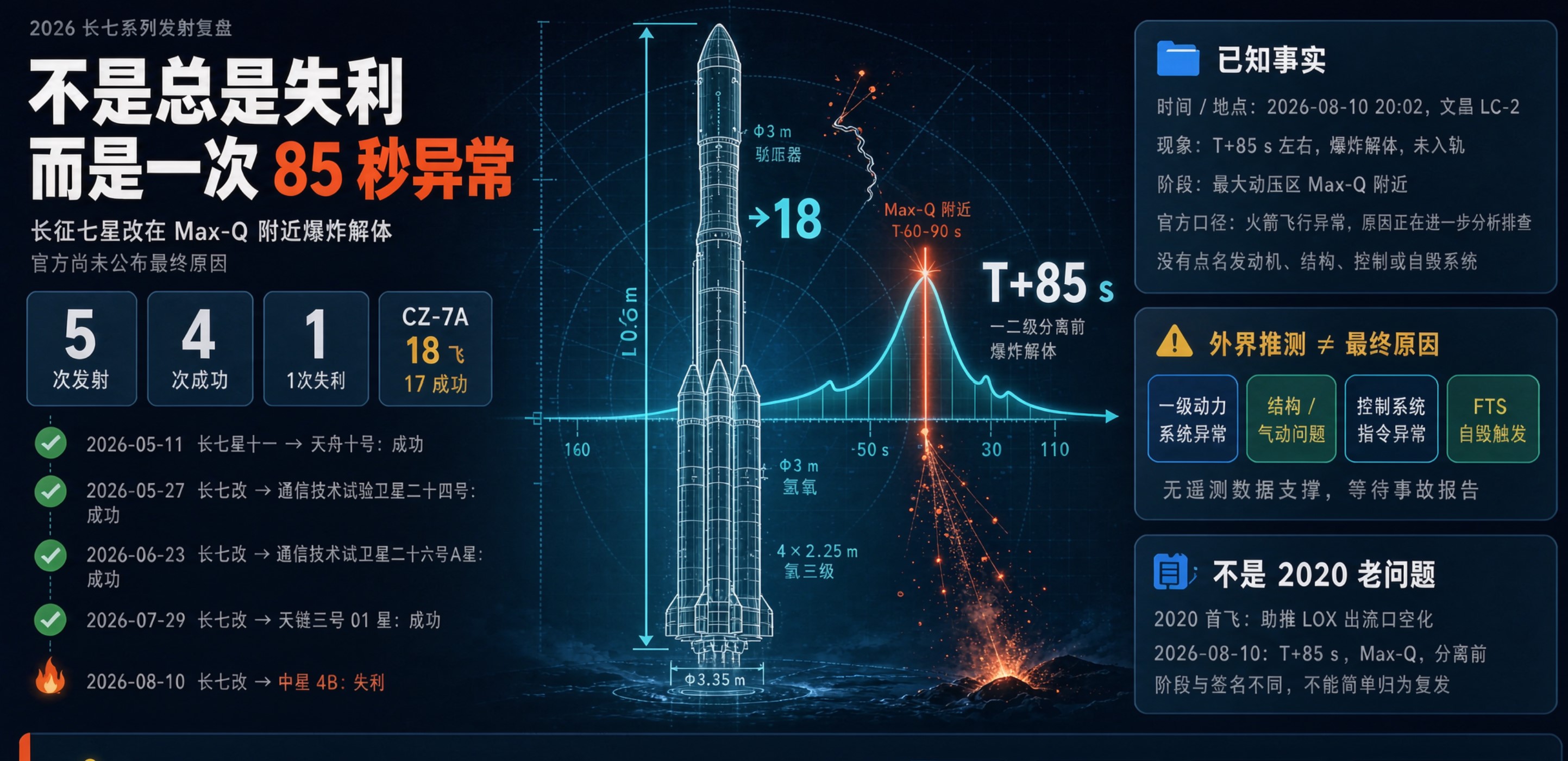
2026-08-10, 20:02 CST, Wenchang LC-2. A Long March 7A (CZ-7A / 长七改) carrying the ChinaSat-4B communications satellite lifted off cleanly, rode through the first minute of flight on a nominal thrust curve—and then, at T+85 seconds, in the first-stage burn just before booster/core jettison, it came apart in a fireball over the South China Sea. Xinhua’s dispatch was three lines long: rocket flight abnormal, mission failed, cause under investigation.
2026 年 8 月 10 日 20:02(北京时),文昌二号工位。长征七号改(CZ-7A)托举中星 4B 通信卫星起飞,前 80 秒推力曲线正常;随后在 T+85 秒、一级飞行段、助推器/芯一级集束分离前突然解体,火球坠入南海。新华社通稿只有三行:“火箭飞行异常,发射任务失利,具体原因正在进一步分析排查。”
It was not a “year of failures” for the Long March 7 family. It was one failure inside a string of successes: CZ-7 (baseline) flew Tianzhou-10 in May; CZ-7A flew three clean GTO missions in May, June, and July. The August 10 event was the 2nd failure in 18 flights of the CZ-7A variant, and the first since its maiden flight blew up in March 2020.
这不是“长七今年总是失利”。而是成功序列里的一次断裂:基线型长七 5 月打天舟十号成功;长七改 5、6、7 月连续三次高轨任务成功。8·10 是长七改 18 飞中的第 2 次失败,也是 2020 年 3 月首飞失利后第一次再摔。
1. Two rockets behind one name | 一字之差,两型火箭
The “Long March 7” label hides two different vehicles.
“长征七号”这一个名字底下,其实是两型火箭。
|
CZ-7 (baseline / 长七) |
CZ-7A (改 / 长七改) |
|
|---|---|---|
|
Configuration |
2.5-stage (CZ-724) |
3.5-stage (CZ-734) |
|
Length |
53.1 m |
60.1 m |
|
Core / Booster |
Φ3.35 m core, 4×Φ2.25 m boosters |
same, + Φ3 m hydrogen upper stage |
|
Payload |
~17 t LEO, Tianzhou logistics |
>7 t GTO, comsat / TDRS class |
|
Booster sep |
Boosters drop early (~2 min) |
Boosters + core-1 bundle separation at T+173 s |
|
L/D ratio |
moderate |
>18, highest in China |
CZ-7 is the ISS-cargo truck. CZ-7A is the high-orbit specialist: it bolts a Long March 3A-series hydrogen third stage onto the CZ-7 lower stack, trades LEO muscle for GTO reach, and pays for its elegance with a slender, flexible airframe that behaves less like a rigid spear and more like a tuned beam under load.
长七是空间站“货运专列”(LEO 200×400 km)。长七改是把长三甲系列氢氧三子级嫁到长七下半身上,换 LEO 力气换 GTO 运力(>7 t),代价是长细比 >18、国内第一修长——飞行中不像刚性长矛,更像一根受载的梁。
That slenderness is not cosmetic. At Max-Q (roughly T+60–90 s, dynamic pressure peak), the rocket is simultaneously fighting aerodynamic bending, engine gimbaling authority, and a control system trying to keep a 60-meter whip straight in high-altitude wind shear. The 85-second breakup sits exactly on that cliff edge.
修长不是好看,是物理。到了 最大动压点 Max-Q(约 T+60–90 s),箭体同时扛气动弯矩、发动机摆动纠偏、高空风切变——控制系统要把 60 米长鞭捋直。85 秒解体,正好踩在这道悬崖边上。
2. What we know about the 85-second event | 85 秒那一下,已知什么
From open sources, not speculation:
公开信源(非臆测)能确认这几条:
-
Timeline — Nominal lift-off 20:02:xx; anomaly at T+85 s; first-stage burn, pre-booster-jettison; no orbit.
-
Debris — Low-altitude disintegration, fragments into sea; Jonathan McDowell’s read of public video agrees it never reached staging velocity.
-
Official line — “Flight abnormal, cause under investigation.” No engine named, no structure named, no FTS (flight termination system) confirmed.
-
Pre-text context — CZ-7A had 16 consecutive successes since the 2021 return-to-flight; the baseline CZ-7 has never failed in 2026.
时间线:20:02 起飞,T+85 秒一级段、集束分离前异常,未入轨。残骸低空解体落海。官方只说“异常”,没点发动机、没点结构、没确认是否触发自毁(FTS)。背景是长七改自 2021 复飞后 16 连胜,基线长七 2026 零失败。
Everything beyond that—pump cavitation, structural buckling, control divergence, FTS trigger—is a hypothesis bracketed by the video and the flight phase. The CZ-7A telemetry bandwidth (6 Mbit/s Ka-band via TDRS) means the data to close the case already exists on the ground; we just don’t have it.
再往外走——泵空化、结构屈曲、控制发散、自毁触发——都只是按视频和飞行阶段反推的假设。长七改有 6 Mbit/s Ka 天基遥测,判案数据其实已经在地面,只是没公开。
3. Ghost of 2020: cavitation, not recurrence | 2020 的幽灵:空化,但不是复发
The last CZ-7A failure (2020-03-16, maiden flight) was not a Max-Q breakup. Telemetry showed a clean curve to T+162 s, then collapse. Root cause, closed in ~20 days by CALT’s fluid-simulation team: cavitation at the booster LOX tank outlet, which depressed pump inlet pressure below the YF-100 engine’s floor and starved combustion.
上一次长七改失败(2020-03-16 首飞)不是 Max-Q 解体。遥测飞到 T+162 秒曲线都漂亮,然后塌了。一院用 20 天闭环定位:助推器液氧箱出流口空化,泵入口压力掉到 YF-100 工作下限以下,烧不起来。
That fix—reshaped outlet, cavitation-suppressed feedline—flew successfully on every CZ-7A mission from 2021 to 2026-07-29. So the 2026 event is unlikely to be the 2020 bug reborn; the phase (T+85 s, Max-Q, pre-separation) doesn’t match the 2020 signature (T+162 s, upper-first-stage transition). Treating them as “the same failure” is the lazy reading.
那个改法(重设计出流口、抑空化输送路)从 2021 用到 2026-07-29 全部成功。所以 2026 这次不太可能是 2020 老毛病复活——阶段不对(T+85 秒 Max-Q 分离前 vs T+162 秒一级末),硬说“又栽在同一条沟里”是偷懒。
The honest shortlist for 2026-08-10:
2026-08-10 的诚实清单:
-
First-stage propulsion anomaly — YF-100 family (booster or core) turbine/pump/plumbing failure causing over-pressure or uncommanded shutdown. Plausible, but the video shows upper-stack rupture before a pure engine fireball, which doesn’t fit cleanly.
-
Structural / aeroelastic failure — L/D>18 beam under Max-Q bending + wind shear; interstage, booster-core bundle joint, or forward fuselage buckling. The “whip” problem CALT designers explicitly called out in 2021.
-
Guidance / control divergence — Gimbal rate saturation, IMU fault, or software edge-case in the high-L/D attitude law, letting aerodynamic load tear the stack.
-
FTS activation — Range safety sending the destruct command because the vehicle was already outside corridor; explosion is then consequence, not cause.
-
一级动力异常(YF-100 系涡轮/泵/管路超压或熄火)——但视频是先上部断裂再爆,不像纯发动机火球。
-
结构/气动弹性失效——L/D>18 梁在 Max-Q 弯矩+风切变下,级间段、助推-芯级集束接头或前体屈曲。这正是 2021 一院设计师点名的“长鞭”难题。
-
制导控制发散——摆动饱和、IMU 故障、高长细比姿态律软件边界,气动载荷把箭撕了。
-
FTS 自毁——安控判定出走廊主动引爆,爆炸是结果不是原因。
Until the accident board speaks, all four sit at equal weight.
在调查组开口前,四条权重相等。
4. Why “always failing” is the wrong frame | 为什么“总是失利”是错帧
Launch cadence in 2026 (CZ-7 family):
2026 长七系列发射节奏:
-
May 11 — CZ-7 Y11 → Tianzhou-10 ✅
-
May 27 — CZ-7A → Comsat Tech Test 24 ✅
-
Jun 23 — CZ-7A → Comsat Tech Test 26A ✅
-
Jul 29 — CZ-7A → Tianlian-3 01 ✅
-
Aug 10 — CZ-7A → ChinaSat-4B ❌ (T+85 s)
Five attempts, four successes, one failure. The failure is visually spectacular (night fireball, 85 seconds, GTO payload), so it crowds out the four greens in public memory. But cadence-wise, CZ-7A’s 17/18 lifetime success rate is still healthy for a high-L/D cryogenic variant in its sixth operational year.
五发四成。失败之所以像“总是败”,是因为夜空火球、85 秒、高轨通信星,视觉权重碾压那四次绿勾。但按频次算,长七改 lifetime 17/18 在修长低温改型、服役第六年这个语境里,依然健康。
The real story is not “Chinese rocket keeps failing.” It is: a high-energy-density, maximum-slenderness liquid stack flying in a dense 2026 cadence hit a Max-Q anomaly the telemetry will explain in weeks. That is how rocket science actually iterates—not by myth, by regression.
真正的新闻不是“中国火箭又炸了”,而是:高密度发射下的高长细比低温捆绑箭,在 Max-Q 撞上一次异常,几周后遥测会给出回归结论。火箭科学就是这样迭代的——不靠神话,靠归零。
5. The closure loop: Chinese-style “归零” | 收口方式:归零
One thing the 2020 case taught and 2026 will repeat: the CALT closure path is back-to-back simulation + scaled rig test + full telemetry reconstruction, on a timeline of weeks to a few months. The 2020 cavitation fix took 361 days to return to flight; the report itself landed in ~20 days. Expect the same shape now: silent investigation, then a narrow technical bulletin, not a press spectacle.
2020 给 2026 的模板是:一院闭环 = 背靠背仿真 + 缩比试验 + 全遥测重构,周期几周到几个月。2020 年空化定位 20 天出、361 天复飞。这次形状一样:先沉默调查,再出一份窄技术通报,不是发布会秀。
If the root cause is structural/aeroelastic, the fix will be local—stiffener, interstage joint, gust-response gain, maybe a small GNC gain schedule change for Max-Q. If it is propulsion, a feedline or turbopump batch issue gets isolated. Either way, CZ-7A doesn’t disappear; it absorbs the 85-second anomaly into its next 60.1-meter flight.
若根因是结构/气动弹性,改法是局部的——加筋、级间接头、阵风响应增益、Max-Q 段 GNC 增益表微调。若是动力,就隔离某批输送路或涡轮泵。无论哪种,长七改不会退场,它会把 85 秒异常吸收进下一发 60.1 米的飞行里。
Bottom line | 一句话
The Long March 7 family is not stumbling through 2026—it stumbled once, at T+85 seconds, in the most physically hostile second of a slender rocket’s life. The 2020 ghost was cavitation and is closed; the 2026 ghost is unnamed and sitting in the telemetry. Wait for the regression. Don’t narrate the fireball as the whole story.
长七系列不是 2026 年一路摔——它只在 T+85 秒、在修长火箭一生中最敌意的哪一秒摔了一次。2020 的幽灵叫空化、已闭环;2026 的幽灵没名字、躺在遥测里。等归零报告,别把火球当成全部剧情。
— Written from open-source telemetry, Xinhua dispatch 2026-08-10, CALT post-2020 review, and Max-Q physics. No classified input.
此文由 怡心湖 编辑,若您觉得有益,欢迎分享转发!:首页 > 赞·中华 > 经验谈 » 当修长巨人踉跄:长征七改、85 秒异常与失败的物理法则
 光纤之盾:中国弹载FOG‑INS的体系化
 拒止天空下的"盲飞者":光纤惯性导航
 分层拒止与梯次火力:PHL-191远程火
 Project Canard:基于PLA 3D打印件的