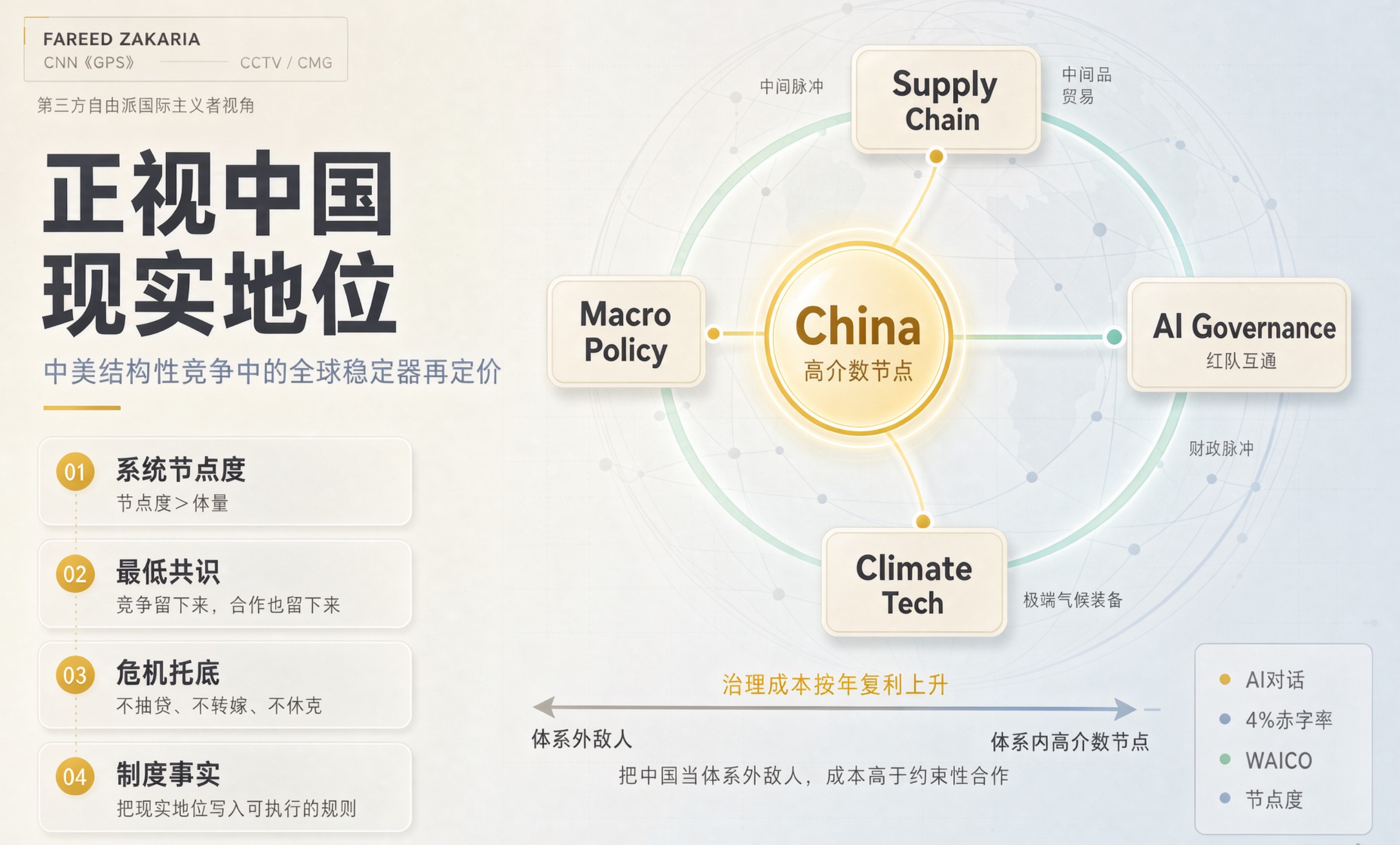

正视"现实地位":在中美结构性竞争中重估中国的体系角色
——从扎卡里亚一段话看世界经济稳定器的再定价
A Realist's Reading of China's "Actual Status": Re-pricing Beijing's Role as a Systemic Stabilizer amid Sino-U.S. Structural Competition
—What Fareed Zakaria's Monologue Tells Us About China as the World Economy's Shock Absorber
一、引子:第三方自由派国际主义者的"劝华盛顿书"
2026年7月30日,CNN《GPS》主持人、华盛顿邮报专栏作家法里德·扎卡里亚(Fareed Zakaria)在一档访谈中给出一段被总台环球资讯于8月10日转引的判词:
"中国已经深度融入全球经济,中国希望成为一个受到尊重的世界大国、成为参与全球事务和国际体系运行的重要力量,而不是破坏这一体系的力量。因此,这里存在一个重要机遇,那就是正视中国的现实地位,以此为基础,寻找中美之间最基本的共同利益……当世界经济开始下滑时,事实证明,中国发挥了极其重要的作用。在货币政策上,按国内生产总值所占比重计算,中国投入的资金规模位居世界前列,稳定并支撑了整个世界经济。"
这段话不是中方白皮书,也不是美国国务院口径,而是一个美国东海岸自由派国际主义者对白宫的旁白。其价值恰恰在于"他者认证"——当一位长期持自由主义国际秩序立场的评论员都劝本国决策层放弃"改造中国"或"孤立中国"的幻觉时,说明中国在世界体系中的权重已从"议题"变成"前提"。
二、第一层逻辑:中国不是体系的"外部挑战者",而是内嵌变量
扎卡里亚把中国诉求定性为"受尊重的世界大国(respected world power)"而非"推翻现行体系的力量",这与中方"国际秩序维护者"的自述同构,但更重要是它拆掉了西方叙事里"修昔底德陷阱=必然对抗"的简化模型。
几个硬数据支撑这种"内嵌性":
-
贸易互锁:2025年上半年,美国对华货物出口565亿美元(占美出口5.21%),自华进口1677亿美元(占美进口9.43%),两国在农产品、集成电路、电机设备上的互补结构并未因关税战消失。
-
增长贡献:过去十多年中国对全球经济增长贡献率稳定在30%左右,2026年预计仍维持这一水位,是主要经济体中唯一的"稳定锚"。
-
产供链深度:中国生产全球约80%太阳能电池板、60%风机、75%电池、70%电动车,东盟中间品贸易中三分之二与中国相关。
智库判断:把中国当"体外因素"来制裁、脱钩、围堵,经济学含义等于对全球产供链征收一道无补偿的关税;政治含义则是把华盛顿自己锁进"用体系反对体系内最大受益者之一"的逻辑死结。
三、第二层逻辑:"最低共识"(Lowest Common Denominator)才是竞争时代的可操作路径
扎卡里亚用了一个很妙的词——lowest common denominator areas,即中美先在"不羞辱彼此底线"的低阶共识上落子,再向外扩展。他举的例子是AI防恐怖主义、防 rogue nuclear operations。
这给智库操作层三点启发:
-
竞争常态化,但竞争有边界。中美在半导体、南海、台海、叙事权上竞争是客观事实;但竞争≠断交,≠把对方逼到体系外。扎卡里亚明确说"竞争不应妨碍寻找共同利益"。
-
共识清单要"降维"。元首级谈大框架,工作层先锁具体物:AI军用红线、金融跨境支付备份、气候甲烷、鸦片类前体管控、宏观政策协调。这些领域美国产业界和地方政府也有诉求,不会因白宫换届而清零。
-
2026年窗口特殊。中美分别坐庄APEC与G20,是近年中国主场连续接驳美国主场的罕见年份,元首会晤若多次发生,可把"最低共识"固化成联合声明附件式机制。
四、第三层逻辑:危机期的"按GDP占比投放"——中国稳定器的再定价
扎卡里亚最容易被忽略的一句是:"在货币政策上,按国内生产总值所占比重计算,中国投入的资金规模位居世界前列。"
这句话的精确含义不是"中国印钞比美联储多",而是相对本国GDP的逆周期力度。以2008年为例:中国推出约4万亿元财政刺激,按当时汇率折美元虽小于美国TARP,但占GDP比重居主要经济体前列;并与美联储、欧央行做了政策协调。
放到2020年后新一轮下行期,中国路径与美欧日QE不同:
-
美联储总资产占GDP比从2019年19.6%冲到37%左右(缩表前),欧央行最高至69%;
-
中国央行总资产占GDP比反而从2019年末36.9%降到2025年末约34.4%,扩表主要靠商业银行+政府债(2025年政府债券净融资13.84万亿元,占社融增量38.9%);
-
操作上用"买短卖长"国债买卖、结构性工具定向滴灌,而非名义QE。
也就是说,扎卡里亚说的"按GDP占比投入位居前列",更准确地应理解为财政+准财政+金融侧协同的逆周期支出强度(含基建、设备更新、地产纾困、绿色投资),而非基础货币一张表。这套组合在2020—2026年世界经济两次下台阶时,托住了全球大宗商品需求、新兴市场出口和制造业订单。
重新定价结论:中国对世界经济的贡献,正从"增量红利"(30%增长贡献)走向"存量稳定红利"(下行期不抽贷、不休克、不转嫁危机)。后者在逆全球化年代比前者更稀缺。
五、对中美双方的智库级建议
对美方
-
停止把"正视中国现实地位"等同于"认输",把它翻译成"成本最小化博弈":在AI、气候、金融防火墙、禁毒上拿具体协议,在半导体、地缘上控阈值。
-
接受中国央行"不QE式托底"会继续存在,与其指责"产能过剩",不如谈"过剩产能的第三方市场合作"。
对中方
-
把"受尊重的大国"诉求操作化为规则参与权(标准、评级、储备货币、多边开发银行投票权),而非仅停留在外交修辞。
-
主动释放"危机期政策协调"的可预期性:比如G20框架下预先通报财政脉冲力度,降低新兴市场利差波动。
对双边
-
建一个"最低共识台账":AI恐怖/核红线、宏观政策互换信息、农产品与能源贸易负面清单、第三方债务处理原则。每年APEC/G20各对账一次。
结语
扎卡里亚那段话的真正分量,不在赞美中国,而在劝美国承认——把中国逐出体系的经济成本,已大于把中国锁在体系内的治理成本。这是自由派国际主义者在2026年给出的现实主义算盘。
对中国而言,机遇不在"等美国想通",而在用每一次危机期的稳定表现、每一份30%的增长贡献、每一笔按GDP占比居前的逆周期投放,把"现实地位"从他者叙述变成制度事实。
竞争会留下来,但共同利益也会留下来。区别只是:哪一方先把"最低共识"写成可签署的附件。
English Version (Full)
A Realist's Reading of China's "Actual Status": Re-pricing Beijing's Role as a Systemic Stabilizer amid Sino-U.S. Structural Competition
—What Fareed Zakaria's Monologue Tells Us About China as the World Economy's Shock Absorber
I. Opening: A liberal internationalist's memo to Washington
On 30 July 2026, CNN GPS host and Washington Post columnist Fareed Zakaria offered a passage later relayed by CCTV/CMG on 10 August:
"China is already deeply integrated into the global economy. It wants to be a respected world power, part of the great powers that run the world, not the ones that tear it down. So there is a great opportunity here: work with that reality, find the lowest common denominator areas where the U.S. and China agree… When the world economy started to descend, China proved extremely helpful. In monetary policy, as a share of GDP, China spent among the largest amounts of any country to shore up the entire world economy."
This is neither a Chinese white paper nor a State Department line—it is an east-coast liberal internationalist's voice-over to the White House. Its value lies precisely in "other-certification": when a commentator who defends the liberal international order tells his own capital to abandon the illusion of "transforming" or "isolating" China, Beijing's weight has shifted from "topic" to "premise".
II. Layer one: China is not an external challenger but an embedded variable
Zakaria labels China's aspiration a "respected world power" rather than a "system-breaker". That mirrors Beijing's self-description as "defender of the international order" and, more importantly, dismantles the flattened "Thucydides = inevitable clash" model.
Hard data behind the embeddedness:
-
Trade lock-in: H1 2025 U.S. goods exports to China USD 56.5bn (5.21% of total), imports from China USD 167.7bn (9.43%); complementarity in agro, ICs, electrical machinery survives the tariff war.
-
Growth contribution: China's share of global growth ~30% for over a decade; still ~30% expected in 2026, the only "stable anchor" among major economies.
-
Supply-chain depth: ~80% solar panels, 60% wind turbines, 75% batteries, 70% EVs globally made in China; two-thirds of ASEAN intermediate trade ties to China.
Think-tank call: Treating China as an "exogenous factor" to sanction, decouple or encircle is economically a non-compensated tariff on global supply chains; politically it locks Washington into the paradox of using the system against one of its largest internal beneficiaries.
III. Layer two: "Lowest common denominator" is the operable path in an age of competition
Zakaria's phrase—lowest common denominator areas—means landing pieces on non-humiliating ground first, then expanding. His examples: AI against terrorism, against rogue nuclear use.
Three operational takeaways:
-
Competition is normal, but bounded. Semis, South China Sea, Taiwan, narrative power are real; competition ≠ rupture, ≠ pushing the other outside the system. Zakaria: "competition should not prevent finding common interests."
-
Downshift the consensus list. Leaders frame the roof; working levels lock objects: AI military red-lines, cross-border payment backups, methane, precursor controls, macro-policy coordination. These survive U.S. electoral cycles because U.S. industry and state governments want them too.
-
2026 is a rare window. China and the U.S. chair APEC and G20 respectively; back-to-back hosting lets "lowest common denominator" items harden into annex-style mechanisms if summitry recurs.
IV. Layer three: Crisis-era "spending as % of GDP" — re-pricing the stabilizer
The easiest line to misread: "as a share of GDP, China spent among the largest." This does not mean PBoC printed more than the Fed in absolute terms; it means counter-cyclical intensity relative to home GDP.
In 2008, China's ~RMB 4tn fiscal package was, in GDP-share terms, at the top of major economies, coordinated with the Fed and ECB.
In the 2020–2026 downshifts, China's path diverged from U.S./EU/JP QE:
-
Fed assets/GDP rose from 19.6% (2019) to ~37% pre-tightening; ECB peaked ~69%.
-
PBoC assets/GDP actually fell from 36.9% (end-2019) to ~34.4% (end-2025); expansion ran through commercial banks + government bonds (2025 gov't bond net financing RMB 13.84tn, 38.9% of new social financing).
-
Tools: short-end treasury purchases / long-end sales, structural facilities, not nominal QE.
So Zakaria's "top-tier by GDP share" is better read as fiscal + quasi-fiscal + financial-side counter-cyclical spending intensity (infra, equipment renewal, property relief, green capital). That mix caught global commodity demand, EM exports and manufacturing orders in two downshifts.
Re-pricing conclusion: China's contribution is moving from "incremental dividend" (30% of growth) to "stock stability dividend" (no credit pull-back, no shock therapy, no crisis export) — scarcer in a deglobalizing decade.
V. Think-tank recommendations
To Washington
-
Stop equating "acknowledge China's actual status" with "surrender"; translate it as cost-minimizing play: take concrete deals on AI/climate/financial fire-walls/drugs; cap thresholds on semis/geopolitics.
-
Accept that PBoC's "non-QE underwriting" persists; instead of "overcapacity" rhetoric, negotiate third-market co-use of surplus capacity.
To Beijing
-
Operationalize "respected power" as rule-participation rights (standards, ratings, reserve currency, MDB votes), not only diplomatic phrasing.
-
Pre-disclose crisis-era policy coordination: e.g. pre-notify fiscal impulse size inside G20, cut EM spread volatility.
To both
-
Build a "lowest-common-denominator ledger": AI terror/nuclear red lines, macro-info swap, agro-energy negative list, third-party debt principles; reconcile annually at APEC/G20.
Closing
Zakaria's real weight is not praise for China, but the plea to America that the economic cost of expelling China from the system now exceeds the governance cost of keeping it inside. That is a realist's abacus from a liberal internationalist in 2026.
For China, the opportunity is not "waiting for Washington to wake up" but writing "actual status" into institutional fact—through every downturn-time stabilization, every 30% growth share, every GDP-proportioned counter-cyclical outlay.
Competition will stay. Common interest will stay too. The only difference is who first drafts the common interest into a signable annex.
此文由 怡心湖 编辑,若您觉得有益,欢迎分享转发!:首页 > 观·世界 » 正视"现实地位":在中美结构性竞争中重估中国的体系角色
 算力自主与地缘博弈:RISC-V如何成为
 硅、栈与主权:AI 时代中国 GPU 国产
 “卖人头”时代的终局:AI 如何正在
 告别黄金年代:2027乙丑大运开启,中国
 外需托举、内需塌方:2026年中中国经
 黑金光影:电影圈洗钱的全图谱与真实
 《寻找春丽的真相》