外需托举、内需塌方:2026年中中国经济观察
Exports Hold the Line, Domestic Demand Sags: A Mid-2026 China Economic Observation
一、上半年的“温差”:船外风满,舱内水冷
I. The “Temperature Gap” of H1: Full Sail Outside, Cold Cabin Within
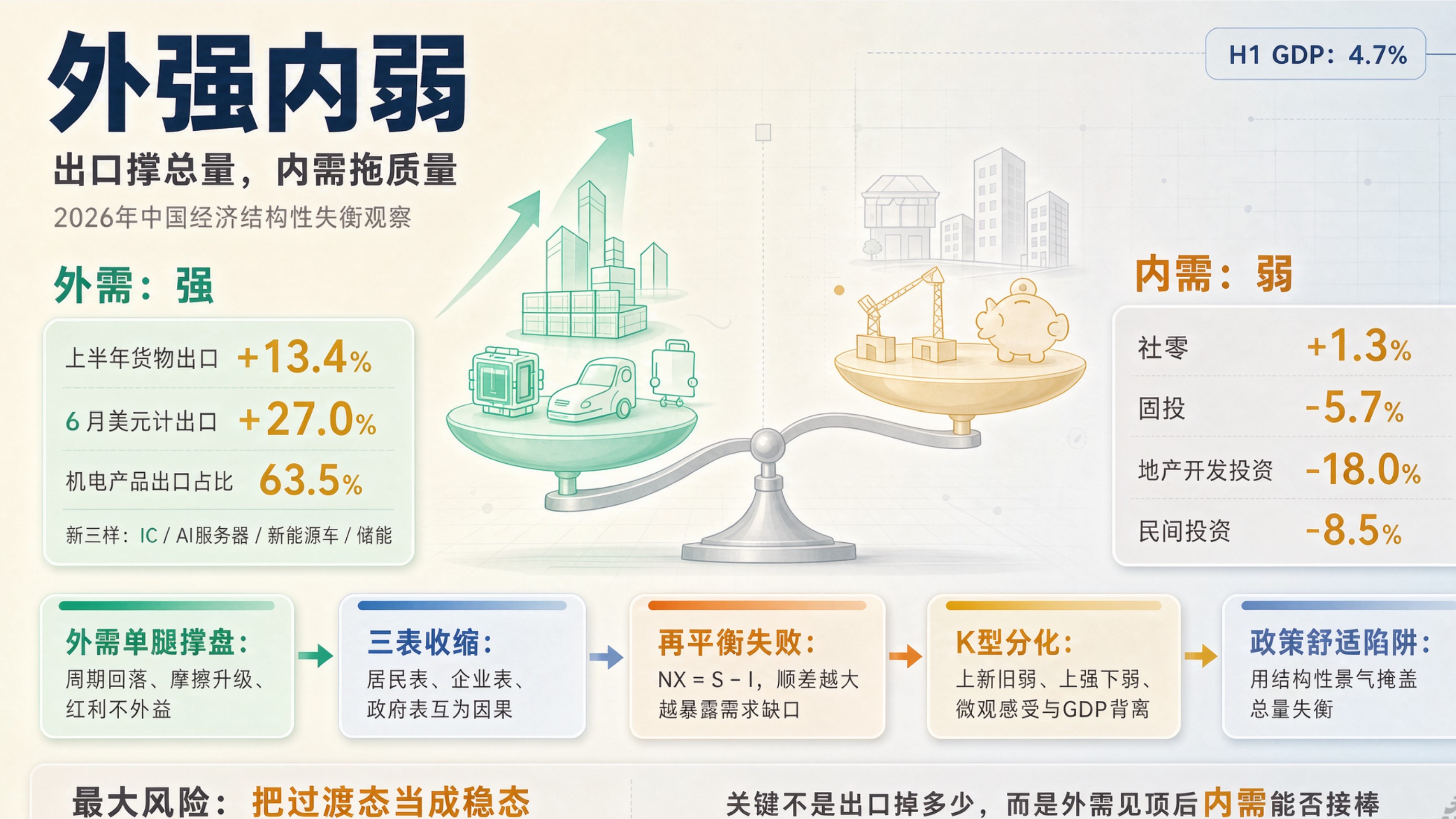
2026年上半年,中国GDP同比增长4.7%,一季度5.0%、二季度滑至4.3%,仍落在全年4.4%—4.8%目标区间内。 但数字平稳的表层之下,是一组尖锐的反差:外需如火,内需如冰。
In the first half of 2026, China’s GDP grew 4.7% YoY—5.0% in Q1, slowing to 4.3% in Q2—still inside the full-year target band of 4.4%–4.8%. Beneath the placid headline, however, lies a sharp contrast: external demand is on fire, domestic demand is frozen.
-
出口:上半年货物出口同比+13.4%(人民币计),6月单月出口2.82万亿元,同比+20.7%,美元计同比+27.0%;机电产品出口占63.5%,集成电路、AI服务器、新能源车、储能“新三样”领跑。
-
消费:上半年社零同比仅+1.3%,6月小幅回正至+1.0%(5月为-0.6%);服务零售+5.3%尚可,商品零售仅+1.1%,居民人均消费支出实际增速(约2.7%)明显低于收入实际增速(4.2%)。
-
投资:上半年固定资产投资同比-5.7%,地产开发投资-18.0%,民间投资-8.5%,基建(不含电力)-2.4%;仅信息传输、高技术服务等局部两位数正增长。
Exports: H1 goods exports +13.4% YoY (RMB); June exports RMB 2.82 tn, +20.7% YoY (RMB) / +27.0% YoY (USD). Electromechanical goods = 63.5% of total; ICs, AI servers, EVs and storage lead.
Consumption: H1 retail sales +1.3% YoY; June +1.0% (vs -0.6% in May). Service retail +5.3%, goods retail +1.1%. Real per-capita consumption growth (~2.7%) trails real income growth (4.2%).
Investment: H1 fixed-asset investment -5.7% YoY; property development -18.0%; private investment -8.5%; infrastructure (ex-power) -2.4%. Only pockets like IT and high-tech services grow double digits.
上财宏观论坛将之概括为:“生产稳、出口强、消费弱、投资慢。” 央行二季度例会亦首提“结构性背离”挑战。
The SUFE macro report sums it up: “Production stable, exports strong, consumption weak, investment slow.” The PBoC’s Q2 monetary committee explicitly flagged “structural divergence” as a challenge.

二、出口为什么强:不是订单回流,是产业链重估
II. Why Exports Are Strong: Not Order Spillover, but Supply-Chain Re-rating
这一轮出口强,并非简单“抢订单”或低基数修复,而是三层力量叠加:
This export strength is not a simple “order grab” or low-base rebound. Three forces stack:
-
全球AI+能源资本开支周期:数据中心、算力硬件、储能、光伏、电动车正处超级周期。前5个月高新技术机电出口7.58万亿元(+18.4%),IC出口上半年同比约+99%,自动数据处理设备+41.3%。
-
市场多元化对冲单边摩擦:对“一带一路”进出口+14.8%,民营主体进出口+17.0%、占比57.0%,单一对美依赖显著下降。
-
产能+供应链韧性变现:中东扰动下海外客户提前锁货,中国工厂交付稳定性变成溢价。摩根士丹利称当前是中国“AI与能源周期驱动的双速格局”。
-
Global AI + energy capex super-cycle: data centers, compute hardware, storage, PV, EVs. First 5 months high-tech electromechanical exports RMB 7.58 tn (+18.4%); IC exports ~+99% H1, data-processing equipment +41.3%.
-
Market diversification: BRI trade +14.8%; private-sector imports/exports +17.0%, 57.0% of total. Single-market dependence on the US is down.
-
Capacity + supply-chain resilience monetized: Middle-East disruptions pushed overseas buyers to lock inventory early; Chinese factories’ delivery stability became a premium. Morgan Stanley calls it a “two-speed economy driven by AI and energy cycles.”
但出口越强,越暴露一个被忽视的恒等式:净出口=储蓄-投资。刘世锦指出,2025年中国货物贸易顺差近1.2万亿美元,相当于把一块庞大国民储蓄配置到了国外;顺差越高,往往对应国内消费越弱。
But the stronger exports are, the more they expose an overlooked identity: net exports = savings − investment. Liu Shijin notes China’s 2025 goods trade surplus hit ~$1.2 tn—a massive chunk of national savings allocated abroad. The larger the surplus, the weaker domestic consumption tends to be.
三、内需为什么软:不是没钱,是不敢花、没处投
III. Why Domestic Demand Is Soft: Not No Money, but No Will to Spend, No Place to Invest
内需疲弱的根本,不在短期收入断流,而在三个中长期裂缝:
The root of weak domestic demand is not a short-term income stoppage, but three structural cracks:
-
房地产去泡沫的财富效应反转:地产投资-18%、房价自2021年峰值回撤15%—20%,居民资产负债表收缩,边际消费倾向走低。过去被地产+基建掩盖的“低消费率”短板(中国消费率约54%,低于全球均值约20个百分点)水落石出。
-
地方财政化债挤占有效投资:基建转负、民间投资连续负增,传统“铁公基”托底逻辑失效,新质生产力投资体量尚不足以补位。
-
高储蓄+低保障的预期锁死:社保覆盖深度、育儿教育成本、青年就业压力(制造业/非制造业PMI就业分项低于荣枯线)共同推高预防性储蓄。2026上半年居民可支配收入实增4.2%,但消费实增约2.7%。
-
Wealth-effect reversal from property de-leveraging: property investment -18%, home prices 15–20% off 2021 peak, household balance sheets shrink, marginal propensity to consume falls. The long-masked “low consumption rate” (China ~54% vs world avg ~74%) is now exposed.
-
Local fiscal deleveraging crowds out effective investment: infrastructure negative, private investment persistently negative; old “iron-road-base” cushion fails, while new-quality-capital spending is not yet large enough to fill the gap.
-
High savings + low safety net locks expectations: social-security depth, child-raising costs, youth employment stress (PMI employment sub-indices below 50) all lift precautionary savings. H1 real income +4.2%, real consumption only ~2.7%.
于是出现奇特组合:工业产能利用率二季度降至73.0%,生产还在扩,但产成品堆在厂里、房子卖不动、商场人流淡。 出口把GDP托在4.7%,却托不起物价——上半年CPI+1.0%、核心CPI+1.2%,PPI仅+1.5%,终端需求修复极不均匀。
Hence the odd combo: Q2 capacity utilization fell to 73.0%—production still expands, but finished goods pile up, homes don’t sell, malls stay thin. Exports hold GDP at 4.7%, but not prices—H1 CPI +1.0%, core CPI +1.2%, PPI just +1.5%; terminal demand recovery is highly uneven.
四、这种“外强内弱”能持续多久?
IV. How Long Can “Strong Outside, Weak Inside” Last?
短期看,出口韧性至少延续到2026下半年:全球AI硬件周期未止、车企出海份额仍在升、人民币汇率阶段性温和利好外贸。 IMF将2026年中国增速预估上调至4.6%,底气正在出口与高技术制造。
In the near term, export resilience likely runs through H2 2026: the global AI-hardware cycle is unfinished, EV export share is still rising, and RMB’s phased mild strength helps trade. The IMF lifted its 2026 China forecast to 4.6%, anchored precisely on exports and high-tech manufacturing.
但三件事会逐步反噬:
Yet three things will bite back:
-
外需的阶段性和政治化:欧美关税、CBAM碳边税、AI芯片管制都在抬级;出口份额每升一寸,摩擦成本升一尺。
-
产能利用率下行→制造业投资内卷:若内需不接棒,出口订单波动将直接转化为停工和价格战,PPI通缩回潮。
-
顺差越大、再平衡越难:刘世锦强调,若不把国民收入使用结构从“高储蓄-低消费”扳过来,顺差越大说明国内终端需求缺口越大,长期增长越依赖别人买单。
-
External demand is cyclical and politicized: EU/US tariffs, CBAM, AI-chip controls all escalate. Every inch of export-share gain raises friction cost a foot.
-
Falling utilization → manufacturing involution: if domestic demand doesn’t take the baton, export-order swings turn directly into shutdowns and price wars, with PPI deflation returning.
-
The bigger the surplus, the harder rebalancing gets: Liu Shijin stresses that unless the income-use structure shifts from “high savings–low consumption,” a larger surplus only proves a larger domestic terminal-demand gap—long-run growth leans on others paying the bill.
五、政策含义:别再用外需证明自己,要用内需解放自己
V. Policy Implication: Stop Proving Yourself by Exports, Free Yourself via Domestic Demand
上半年政策对“外强内弱”的反应偏稳:货币端适度宽松、财政端未搞海量刺激,某种程度上是出口强降低了反周期宽松的紧迫性。 但这恰是陷阱——用结构性景气掩盖总量失衡。
H1 policy response to “strong out / weak in” was restrained: moderately loose money, no massive fiscal blast. In a sense, strong exports reduced the urgency for counter-cyclical easing. That is the trap—using a structural bright spot to mask a aggregate imbalance.
真正要做的不是再压产能出海,而是三件事:
What’s actually needed is not more capacity pushed abroad, but three moves:
-
把消费从“补贴刺激”升格为“收入分配改革”:提高居民部门在GDP初次分配占比,扩社保、降自付、稳房价预期,才动得了42%高储蓄率的根。
-
投资从“项目堆砌”转向“人本资本”:育儿、养老、医疗、职业教育、城市更新,比再修一条高速更补短。
-
接受增速下台阶,换结构上台阶:4.5%—5%区间不可丢,但若靠外需守4.7%、内需继续塌,不如主动用改革换3—5年后消费率回到65%的底层逻辑。
-
Upgrade consumption policy from “subsidy stimulus” to “income distribution reform”: raise households’ primary-distribution share, broaden social security, cut out-of-pocket ratios, stabilize housing expectations—only then touches the root of the 42% savings rate.
-
Shift investment from “project piling” to “human capital”: childcare, elderly care, health, vocational education, urban renewal beat building another expressway for shortening gaps.
-
Accept a lower growth step for a higher structural step: the 4.5–5% band must hold, but guarding 4.7% on exports while domestic demand caves is worse than using reform to rebuild the bottom line—lifting the consumption rate toward 65% in 3–5 years.
船行半程,风在船外,火在船上。2026年的中国经济不是没有动力,而是动力偏在一侧——出口撑着总量,内需拽着质量。哪天“内”和“外”同频了,4.7%才不是被顺风推出来的数,而是自己长出来的速。
Halfway through the voyage, the wind is outside the hull, the fire is on the deck. China’s 2026 economy is not short of engines—it is short of balance. Exports hold the volume, domestic demand pulls the quality. Only when “inside” and “outside” sync will 4.7% stop being a number pushed by tailwind and become a speed grown from within.
此文由 怡心湖 编辑,若您觉得有益,欢迎分享转发!:首页 > 马·春风 » 外需托举、内需塌方:2026年中中国经济观察
 《寻找春丽的真相》