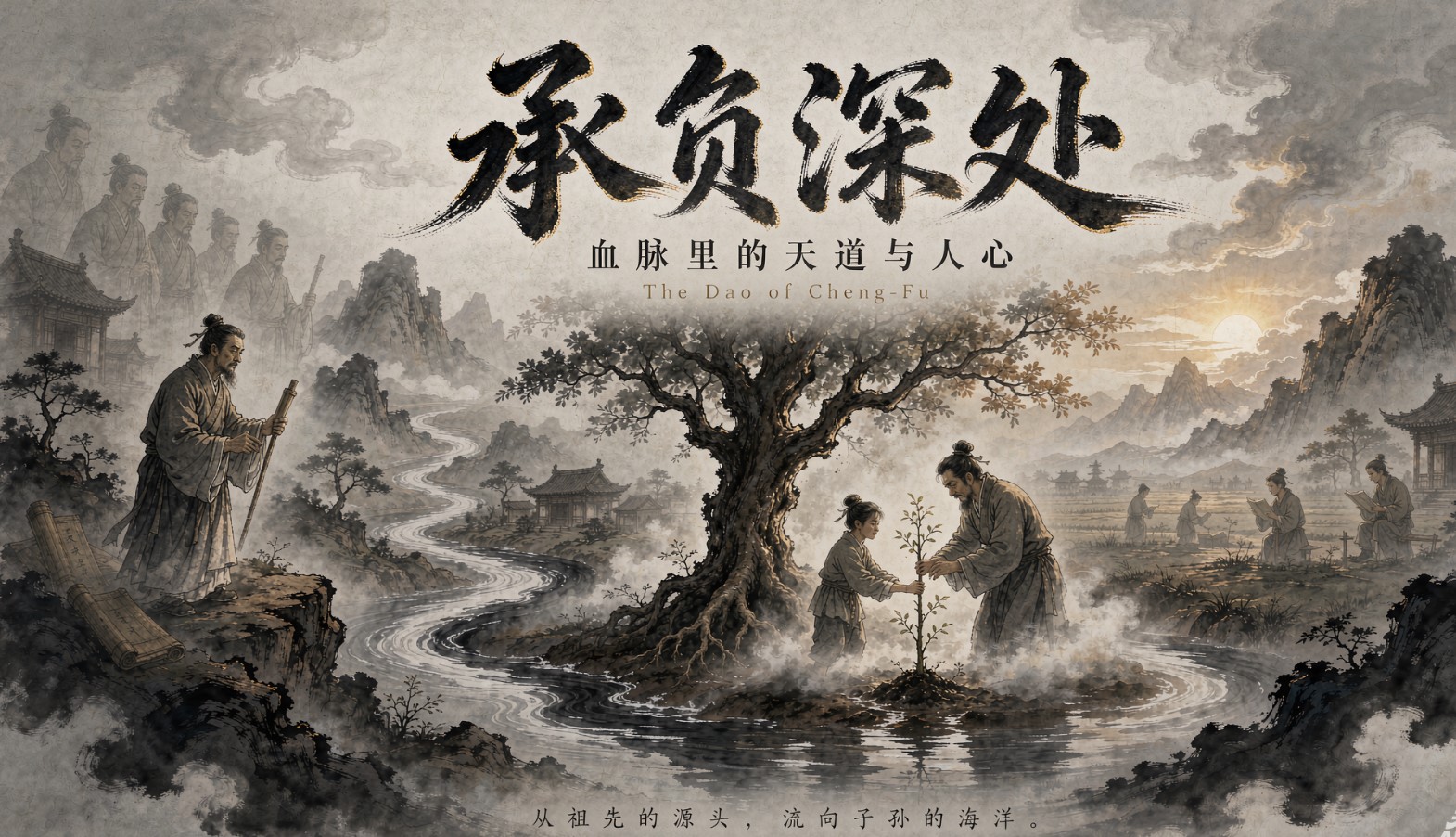
承负之道:中华文明的因果长河
The Dao of Cheng-Fu: The River of Cause and Effect in Chinese Civilization
序章 · Prologue
"道生一,一生二,二生三,三三生万物。"
"The Dao gives birth to the One; the One to the Two; the Two to the Three; the Three to all things."
—《道德经》· Dao De Jing
在中华文明的浩瀚星空中,有一种思想如暗河般流淌了两千余年,它不似儒家"仁义礼智信"那般高悬庙堂,也不似佛家"因果轮回"那般远渡重洋而来。它是本土的、深沉的、几乎刻在中国人骨血里的宇宙观——承负论。
In the vast constellation of Chinese civilization, there flows a current of thought like an underground river, running for over two thousand years. It does not hang high in the halls of power like Confucianism's Ren-Yi-Li-Zhi-Xin (Benevolence, Righteousness, Ritual, Wisdom, Integrity), nor did it cross oceans like Buddhism's Karma and Samsara. It is indigenous, profound, and almost inscribed into the very bone and blood of the Chinese people — the cosmological view of Cheng-Fu (承负).
一、何为承负 · What Is Cheng-Fu?
1.1 词源与定义 | Etymology and Definition
"承"者,受也——承受、继承、接续;"负"者,荷也——背负、负载、承担。
Cheng (承) means to receive — to inherit, to carry forward.
Fu (负) means to bear — to carry on one's back, to shoulder, to be accountable for.
承负二字合在一起,构成了一个极具张力的动态系统:前人种因,后人得果;前人造孽,后人遭殃。反之亦然——今人之行,或福或祸,未必尽显于当下,而可能流布于子孙后世。
Together, Cheng-Fu forms a dynamic system of tremendous tension: The ancestors sow causes, and descendants reap effects. The ancestors commit transgressions, and descendants suffer calamities. Conversely — the deeds of the present generation, for better or worse, may not fully manifest in the here and now, but may ripple forth into the lives of children and grandchildren yet unborn.
1.2 经典出处 | Scriptural Origins
承负论最早系统见于道教经典 《太平经》(成书于东汉,约公元2世纪):
The theory of Cheng-Fu is first systematically articulated in the Daoist scripture "Taiping Jing" (Scripture of Great Peace), compiled during the Eastern Han Dynasty (c. 2nd century CE):
"承者为前,负者为后。承者,乃谓先人本承天心而行,小小失之,不自知,用日积久,相聚为多,今后生人反无辜蒙其过谪,连传被其灾,故前为承,后为负也。"
"Cheng refers to what comes before; Fu refers to what comes after. Cheng means that the ancestors originally acted in accordance with the Heart of Heaven, but through small deviations — unknown to themselves — and accumulated over long periods of time, these gathered into great masses. Thus the later-born people innocently bear the blame and are afflicted by the disaster. Therefore, what is before is Cheng, and what is after is Fu."
—《太平经·卷三十九》
这段话揭示了一个令人战栗的真相:善恶的账本不是以个体的一生为结算周期的,而是跨越代际的。
This passage reveals a chilling truth: The ledger of good and evil is not settled within the span of a single lifetime — it crosses generations.
二、承负与因果:同与不同 · Cheng-Fu and Karma: Similarities and Distinctions
|
维度 Dimension |
佛家因果 Buddhist Karma |
道家承负 Daoist Cheng-Fu |
|---|---|---|
|
主体 Subject |
个体轮回 Individual reincarnation |
家族/集体代际 Family/collective across generations |
|
时间跨度 Time Span |
多生多世 Multiple lives |
三代至五代 Three to five generations |
|
核心逻辑 Core Logic |
自作自受 One reaps what one sows (self) |
祖作孙受 / 孙作祖荫 Ancestors act, descendants receive |
|
解脱路径 Liberation |
断轮回、证涅槃 End samsara, attain Nirvana |
行善消灾、改过迁善 Practice virtue, rectify errors, transform fortune |
|
宇宙观 Cosmology |
业力不虚 Karmic force is inexorable |
天道承负,赏善罚恶 Heaven's Dao bears and transmits, rewarding good and punishing evil |
关键区别:佛家因果是"纵向的"——贯穿一个人的多世轮回;承负是"横向的"——在家族与社群的代际之间传递。
The key distinction: Buddhist karma is vertical — threading through one person's multiple rebirths. Cheng-Fu is horizontal — transmitted across generations within a family and community.
这并非说中国人不懂个人因果。恰恰相反,承负论是对因果的扩容与深化——它将道德责任的半径从"我这一世"扩展到了"我这一脉"。
This is not to say the Chinese people do not understand individual karma. On the contrary, Cheng-Fu is an expansion and deepening of causality — it extends the radius of moral responsibility from "this one life of mine" to "this entire lineage of mine."
三、承负的运作机制 · How Cheng-Fu Operates
3.1 累积效应:小善小恶的复利 | The Compound Effect of Small Deeds
《太平经》中有一个极为精妙的比喻:
The Taiping Jing contains an exquisitely subtle metaphor:
"比若若天地生凡物,悉自有本根,得之者生,失之者死。凡事不得其本,悉废而消亡。"
"It is like Heaven and Earth giving birth to all things — each has its own root. Those who obtain it live; those who lose it die. If any matter loses its root, it is abandoned and perishes."
承负的运作不是"一因一果"的简单线性对应,而是复利式的累积。祖先的一念之善,如种下一粒种子,经过三代人的滋养,可能长成庇荫百代的参天大树;祖先的一念之贪,如埋下一颗毒种,经过几代人的浇灌,可能酿成家族衰败的苦果。
Cheng-Fu does not operate as a simple linear "one cause, one effect" correspondence. Rather, it works through compound accumulation. A single thought of goodness from an ancestor is like planting a seed — nurtured across three generations, it may grow into a towering tree that shelters hundreds of descendants. A single thought of greed is like burying a toxic seed — watered across generations, it may ripen into the bitter fruit of a family's decline.
这便是为什么中国人常说:
This is why the Chinese often say:
"积善之家,必有余庆;积不善之家,必有余殃。"
"A family that accumulates good deeds will certainly have overflowing blessings; a family that accumulates bad deeds will certainly have lingering calamities."
—《周易·坤卦》· Book of Changes, Kun Hexagram
3.2 代际传递的三重通道 | Three Channels of Intergenerational Transmission
承负并非玄学迷信,若以现代视角审视,它至少通过三重通道在现实中运作:
Cheng-Fu is not mere mystical superstition. Viewed through a modern lens, it operates in reality through at least three channels:
① 基因与生物遗传 | Genetic and Biological Inheritance
现代表观遗传学(Epigenetics)发现:祖辈经历的环境压力、创伤、营养状态,会通过DNA甲基化等机制影响后代的基因表达。祖辈的"因",确实在后代身上留下了"果"。
Modern epigenetics has discovered that environmental stress, trauma, and nutritional states experienced by ancestors can affect the gene expression of descendants through mechanisms like DNA methylation. The "causes" of ancestors do, in fact, leave "effects" on descendants.
② 文化与行为模式 | Cultural and Behavioral Patterns
家风、家训、教养方式——这些是比基因更强大的传承力量。"忠厚传家久,诗书继世长",一个家族的思维模式、价值取向、行为习惯,像隐形的程序一样在代际间复制。
Family traditions,家训 (family precepts), and parenting styles — these are forces of transmission even more powerful than genes. "Loyalty and sincerity pass down through generations; poetry and books continue the family line." A family's patterns of thought, values, and behavioral habits replicate across generations like invisible programs.
③ 社会网络与资源积累 | Social Networks and Resource Accumulation
祖辈积累的社会资本、财富、声誉(或债务、仇怨、污名),直接构成子孙的起点。这就是最"唯物"的承负——你出生在哪张网络上,决定了你人生的初始条件。
The social capital, wealth, and reputation (or debts, enmities, and stigmas) accumulated by ancestors directly constitute the starting point of descendants. This is the most "materialist" dimension of Cheng-Fu — the network into which you are born determines the initial conditions of your life.

四、承负智慧在中华文化中的体现 · Manifestations of Cheng-Fu Wisdom in Chinese Culture
4.1 家训文化 | The Culture of Family Precepts
从 《颜氏家训》 到 《朱子家训》,从 《曾国藩家书》 到 《钱氏家训》,中华家训的核心逻辑只有一个:为子孙计深远。
From the "Yan Family Instructions" to the "Zhu Zi Family Maxims", from "Zeng Guofan's Family Letters" to the "Qian Family Precepts" — the core logic of Chinese family instructions is singular: Plan far ahead for one's descendants.
"子孙虽愚,经书不可不读。"
"Though one's descendants may be dull, the classics must not go unread."
—《朱子家训》· Zhu Zi Family Maxims
这不是功利的"望子成龙",而是一种承负意识:我今日种下读书的种子,未必我这一代能收获功名,但我的子孙将在文化的滋养中受益无穷。
This is not the utilitarian "hoping one's child becomes a dragon." It is a consciousness of Cheng-Fu: The seed of learning I plant today may not yield scholarly honors in my own lifetime, but my descendants will benefit immeasurably from the nourishment of culture.
4.2 风水与生态智慧 | Feng Shui and Ecological Wisdom
风水常被误解为迷信,但从承负论角度看,它是一套代际环境伦理:
Feng Shui is often misunderstood as superstition, but from the perspective of Cheng-Fu, it is a system of intergenerational environmental ethics:
"觅龙、察砂、观水、点穴" — 选择一处藏风聚气之地安葬先人、营建宅第,本质上是为后代选择一个可持续的生存微环境。
"Seeking the dragon, examining the sand, observing the water, locating the acupoint" — choosing a site where wind is stored and energy gathered for ancestral burial and dwelling construction is, at its essence, selecting a sustainable micro-environment for future generations.
这与现代可持续发展理念惊人地一致:我们不是从祖先那里继承了地球,而是从子孙那里借来了它。
This aligns astonishingly well with modern sustainability: We have not inherited the Earth from our ancestors; we have borrowed it from our children.
4.3 历史书写与集体记忆 | Historical Writing and Collective Memory
中国是世界上唯一一个拥有连续三千年官方史书的文明。为什么?
China is the only civilization in the world with three thousand years of continuous official historical records. Why?
因为史书本身就是一种承负装置——"孔子作春秋而乱臣贼子惧"。历史书写让个体的行为不再随肉身消亡而湮灭,而是被置于"青史"的天平上,接受千秋万代的评判。这就是承负的文化超我:你做的每一件事,都可能被你的子孙、你的后人、甚至千年之后的陌生人知晓和审判。
Because historical writing itself is a Cheng-Fu apparatus — "Confucius composed the Spring and Autumn Annals, and rebellious ministers and traitorous sons were struck with fear." Historical writing ensures that individual actions do not perish with the body, but are placed on the scales of "history," subject to the judgment of countless future generations. This is the cultural superego of Cheng-Fu: everything you do may be known and judged by your descendants, your posterity, even strangers a thousand years hence.
五、承负的现代启示 · Modern Revelations of Cheng-Fu
5.1 对"短视主义"的当头棒喝 | A Wake-Up Call to Short-Termism
现代社会的最大病症之一,是时间视野的极度收缩。资本主义的逻辑是"季度财报",政治的逻辑是"下一个选举周期",个人的逻辑是"及时行乐"。
One of the greatest maladies of modern society is the radical contraction of temporal horizon. The logic of capitalism is the "quarterly report"; the logic of politics is the "next election cycle"; the logic of the individual is "seize the pleasure of the moment."
承负论提供了一种截然不同的时间尺度:三代人。
Cheng-Fu offers a radically different time scale: three generations.
你今天砍伐的森林,你的孙子将呼吸不到清新的空气。
你今天排放的碳,你的曾孙将生活在更炎热的地球上。
你今天对教育的投资,你的玄孙将站在更高的起点上。
你今天种下的仇恨,你的后代将在冲突中流血。
The forest you cut down today — your grandson will breathe air that is no longer fresh.
The carbon you emit today — your great-grandson will live on a hotter Earth.
The investment you make in education today — your great-great-grandson will stand on a higher starting point.
The hatred you plant today — your descendants will bleed in conflicts yet to come.
5.2 个人责任与集体命运的和解 | Reconciling Individual Responsibility with Collective Destiny
承负论最深刻的地方在于:它既承认结构性命运(你无法选择出生在什么样的家庭),又强调能动性(你可以通过自己的善行改变家族的轨迹)。
The most profound aspect of Cheng-Fu is this: it acknowledges structural destiny (you cannot choose the family into which you are born), while simultaneously emphasizing agency (you can alter the trajectory of your family through your own virtuous deeds).
"前人有余殃,后人能消之;前人有余庆,后人能续之。"
"If ancestors left lingering calamities, descendants can dissolve them; if ancestors left overflowing blessings, descendants can continue them."
这是一种不怨天、不尤人的积极生命态度。你不必为祖先的过错感到绝望,因为你有能力通过自己的善行"截断众流",为后代开创一条新路。
This is a positive life attitude of blaming neither Heaven nor others. You need not despair over the faults of your ancestors, because you have the power to "cut through the flowing currents" through your own good deeds, forging a new path for future generations.
5.3 生态承负:地球是我们共同的祖先 | Ecological Cheng-Fu: Earth as Our Common Ancestor
如果将承负的主体从"家族"扩展到"人类物种",我们便得到了一种深刻的生态承负观:
If we expand the subject of Cheng-Fu from "family" to "human species," we arrive at a profound ecological Cheng-Fu perspective:
地球不是我们从父母那里继承来的遗产,而是我们向子孙借来的债务。
我们每一代人都是"承"前人恩惠的"负"债者,也是"负"后人未来的"承"诺者。
The Earth is not an inheritance from our parents, but a debt we owe to our children.
Each generation is both the beneficiary (Cheng) of前人's gifts and the debtor (Fu) to the future — and simultaneously the promise-keeper (Cheng) who bears (Fu) the responsibility for what comes next.
六、承负的修行:如何在当下活出承负智慧 · Practicing Cheng-Fu: Living This Wisdom in the Present
6.1 每日三问 | Three Questions for Daily Reflection
受曾子"吾日三省吾身"启发,以承负视角可立三问:
Inspired by Zengzi's "I daily examine myself in three ways," we can establish three Cheng-Fu questions:
- 我今日之行,将给三年后的我带来什么?
What will today's actions bring to me three years from now? - 我今日之教,将给子孙三代带来什么?
What will today's teachings bring to three generations of descendants? - 我今日之择,将给这片土地百年后留下什么?
What will today's choices leave for this land a hundred years hence?
6.2 五种承负修行 | Five Cheng-Fu Practices
|
# |
修行 Practice |
说明 Explanation |
|---|---|---|
|
1 |
种因不急于求果 Plant causes without rushing for fruits |
做正确的事,不为即时回报所困。Do the right thing without being trapped by the need for immediate回报. |
|
2 |
忏悔先祖之过 Repent for ancestors' faults |
承认家族阴影,以自身善行化解。Acknowledge family shadows; dissolve them through personal virtue. |
|
3 |
广积阴德 Accumulate hidden virtue |
不为人知的善行,力量最深远。Good deeds unknown to others carry the deepest power. |
|
4 |
教育胜于遗产 Education over inheritance |
留财给子孙,不如留德与智慧。Leaving wealth to descendants pales before leaving virtue and wisdom. |
|
5 |
敬天惜物 Revere Heaven, cherish all things |
对自然万物怀承负之心,节制消费。Hold Cheng-Fu consciousness toward all things; practice restraint. |
七、结语:承负——中国人的"深时"智慧 · Conclusion: Cheng-Fu — The Chinese "Deep Time" Wisdom
"善不积,不足以成名;恶不积,不足以灭身。"
"Good is not accumulated enough to make a name; evil is not accumulated enough to destroy a body."
—《周易·系辞下》· Book of Changes, Xi Ci
承负论最终指向的,是一种"深时"(Deep Time)的生存智慧。它告诉我们:
Cheng-Fu ultimately points to a survival wisdom of "Deep Time." It tells us:
- 你不是一座孤岛,你是一条河——连接着过去与未来。
- 你的每一个选择,都在雕刻你尚未谋面的后代的命运。
- 你无法选择河流的源头,但你可以决定河流的流向。
- You are not an island; you are a river — connecting past and future.
- Every choice you make is sculpting the destiny of descendants you will never meet.
- You cannot choose the river's source, but you can determine its course.
在这个加速的时代,承负论是一副减速镜——它让我们慢下来,把目光从"下一秒的快感"移向"三代人的命运",从"我"移向"我们",从"今天"移向"千年"。
In this age of acceleration, Cheng-Fu is a lens of deceleration — it slows us down, shifting our gaze from "the pleasure of the next second" to "the destiny of three generations," from "I" to "We," from "today" to "a thousand years."
承先祖之德,负后世之重。
Receive the virtue of ancestors; bear the weight of generations to come.
这,就是中华文明最深邃的智慧之一。
This, is one of the most profound wisdoms of Chinese civilization.
此文由 怡心湖 编辑,若您觉得有益,欢迎分享转发!:首页 > 赞·中华 > 儒释道 » 承负之道:中华文明的因果长河 The Dao of Cheng-Fu: The River of Cause and Effect in Chinese Civilization
 天地不仁,以万物为刍狗;圣人不仁,以百
 君子若冰释于水:道家“和光同尘”的
 见路不走:在因果的荒原上,做自己的摆