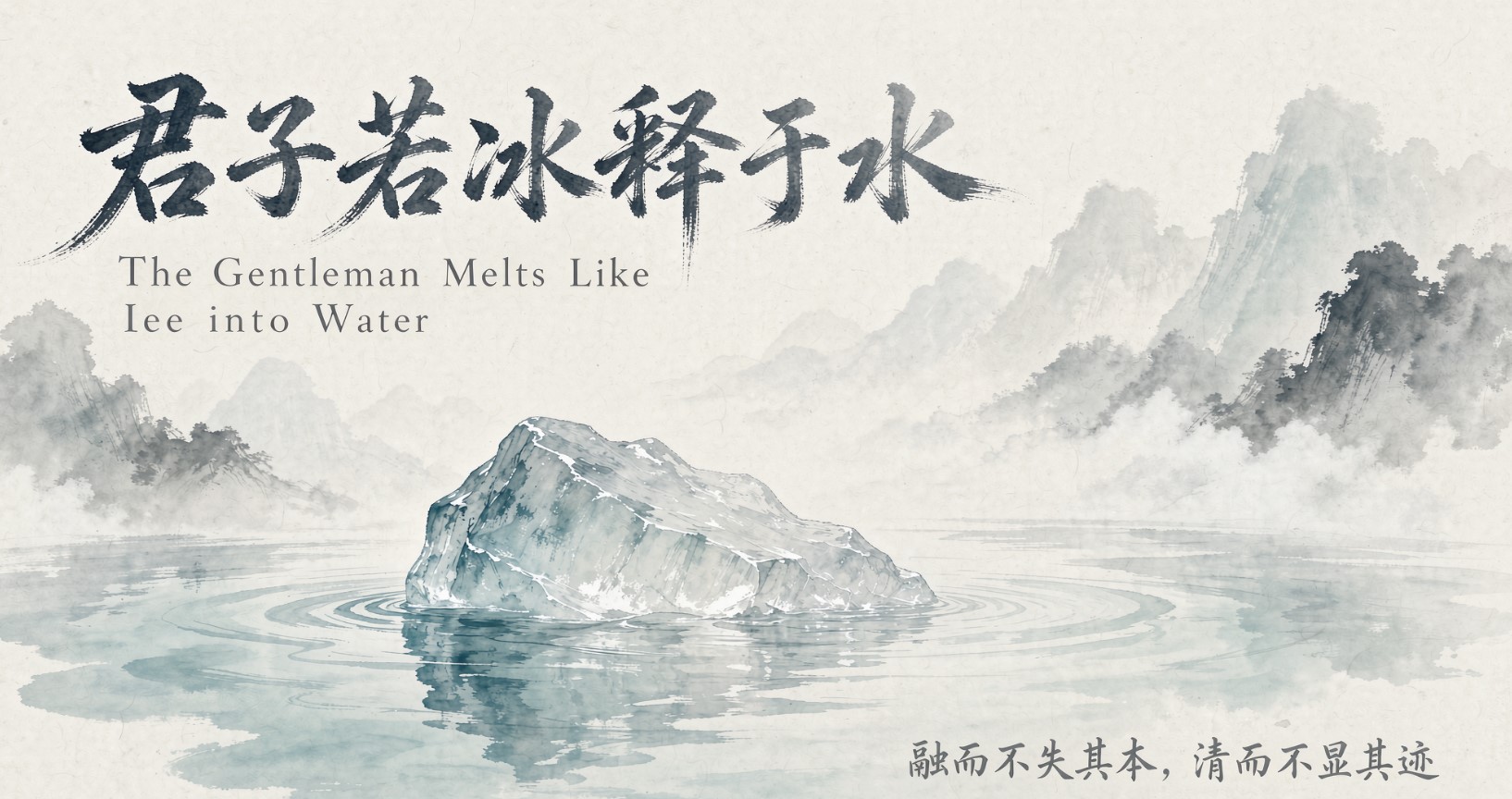

君子若冰释于水:道家“和光同尘”的处世智慧
The Gentleman Melts Like Ice into Water: The Taoist Wisdom of “Blending Light with Dust”
一、冰之将释:一个被误读的意象
I. Ice on the Verge of Melting: A Misunderstood Image
《道德经》第十五章有言:“涣兮若冰之将释。”
这一句原本是老子描述得道之人的神态:疏朗通达,毫无滞碍,像春天的冰,将化未化,既不坚硬,也不散乱。
后世却由此生发出另一句广为流传的话:“君子与人处,若冰释于水。”
这并非《道德经》原文,而是后人根据老子点化阳子居的典故提炼而成,却意外地精准捕捉了道家处世哲学的精髓。
Chapter 15 of the Tao Te Ching states: “Loose and flowing, like ice on the verge of melting.”
This line originally described the bearing of one who embodies the Tao—unobstructed and lucid, like ice in spring, on the verge of melting: neither rigid nor scattered.
Later generations derived from this another widely circulated phrase: “When a gentleman interacts with others, he is like ice melting into water.”
Though not a direct quote from the Tao Te Ching, this line—inspired by the anecdote of Lao Tzu instructing Yang Ziju—captures with striking precision the essence of Taoist social philosophy.
冰是冷的、硬的、有形的;水是柔的、流的、无形的。
冰入水,不是被水同化而失去自我,而是消融了棱角,却保留了本质。
君子之于人群,亦当如是。
Ice is cold, hard, and formed; water is soft, flowing, and formless.
When ice melts into water, it is not assimilated and stripped of its identity; rather, it dissolves its sharp edges while retaining its essence.
So too should the gentleman be among the crowd.
二、阳子居之傲:君子为何要“释”
II. The Arrogance of Yang Ziju: Why Must the Gentleman “Melt”?
《庄子·寓言》中记载了这样一幕:
阳子居拜见老子,昂首挺胸,神色傲然。老子见状,叹道:“你这般昂头露齿、唯己独尊,谁愿与你共处?”
随后便留下了那句著名的教诫:
君子与人处,若冰释于水;与人共事,如童仆谦下。
洁白无瑕,而似含垢藏污;德性丰厚,而似鄙俗平常。
The Zhuangzi recounts the following episode:
Yang Ziju went to visit Lao Tzu, chin held high, expression proud. Seeing this, Lao Tzu sighed: “With your head raised and teeth bared, so self-important—who would wish to dwell with you?”
He then offered this famous admonition:
“When a gentleman interacts with others, he is like ice melting into water; when working with others, he is like a humble servant.
Pure and unblemished, yet appearing as if containing filth; rich in virtue, yet seeming vulgar and plain.”
老子并非要阳子居放弃操守,而是点破了一个更深的悖论:
真正的君子,恰恰因为内心足够洁净,才不需要通过外在的“清高”来证明自己。
若像一块孤零零的坚冰,虽洁却寒,虽清却远,众人避之不及,德性再高,亦难行于世。
Lao Tzu did not ask Yang Ziju to abandon his integrity. Instead, he exposed a deeper paradox:
Precisely because the true gentleman’s heart is pure enough, he need not prove himself through outward “loftiness.”
To be like a solitary block of ice—pure yet frigid, clear yet distant—only drives people away. No matter how lofty one’s virtue, it cannot function in the world if no one draws near.

三、和光同尘:冰化水后的境界
III. Blending Light with Dust: The State After Ice Melts into Water
“冰释于水”在道家体系中,对应的正是《道德经》第五十六章的核心思想:
挫其锐,解其纷,和其光,同其尘。
“Melting like ice into water” corresponds precisely to the core teaching of Chapter 56 of the Tao Te Ching:
“Blunt the sharpness, untangle the knots, soften the glare, and blend with the dust.”
这并非圆滑世故,而是一种极高的精神修养:
-
挫其锐:不露锋芒,不争高下。冰化水后,不再有刺人的棱角。
-
和其光:不炫己明,不显己智。如光入光,不夺人眼目。
-
同其尘:不避污浊,不拒凡俗。如水入尘,不嫌地卑。
This is not worldly cunning; it is a profound spiritual cultivation:
-
Blunt the sharpness: Do not flaunt one’s edge or compete for superiority. Once ice melts into water, it no longer has piercing angles.
-
Soften the glare: Do not dazzle with one’s own brightness or flaunt one’s wisdom. Like light merging into light, it does not seize the eye.
-
Blend with the dust: Do not shy away from impurity or reject the mundane. Like water mingling with dust, it does not disdain lowliness.
老子在第四十一章中早已埋下伏笔:
大白若辱,盛德若不足。
最洁白的东西,看起来反而像有污垢;最有德行的人,看起来反而像有所不足。
君子若冰释于水,正是这种“藏洁于浊”的大智慧。
Lao Tzu had already laid the groundwork in Chapter 41:
“The purest white seems sullied; the fullest virtue seems lacking.”
What is whitest appears stained; the most virtuous appears deficient.
For the gentleman to melt like ice into water is precisely this great wisdom of concealing purity within the turbid.
四、童仆之谦:冰化水后的姿态
IV. The Humility of a Servant: The Posture After Ice Melts into Water
“若冰释于水”之后,老子紧接着说:“与人共事,如童仆谦下。”
这不是自我贬低,而是去除了“我慢”后的自然状态。
Following “melting like ice into water,” Lao Tzu continues: “When working with others, be like a humble servant.”
This is not self-degradation, but the natural state after the dissolution of ego and arrogance.
冰是“我”,水是“众”。
当冰不再坚持自己是冰,便能与水同流;当君子不再执着于“我”的清高,便能真正与人共事。
童仆之谦,在于无争、无拒、无分别心:
-
不挑工作,不嫌人微,不矜己能。
-
如水流低处,自然成渊;如冰化无形,自然入群。
Ice is the “self”; water is the “multitude.”
When ice ceases to insist on being ice, it can flow with the water. When the gentleman no longer clings to the loftiness of the “self,” he can truly work with others.
The humility of a servant lies in non-contention, non-rejection, and non-discrimination:
-
Not picking tasks, not disdaining the lowly, not boasting of one’s own ability.
-
Like water flowing to the lowest place, naturally forming a deep pool; like ice melting into formlessness, naturally merging into the crowd.
五、现代回响:在坚硬世界里做一片“融冰”
V. Modern Resonance: Being a “Melting Ice” in a Hard World
今日的世界,人人皆是一块急于证明自己的“冰”:
-
社交媒体上,我们展示棱角,唯恐不够独特;
-
职场竞争中,我们显露锋芒,唯恐被人忽视;
-
人际交往中,我们竖起边界,唯恐被同化、被消耗。
In today’s world, everyone is a piece of “ice” eager to prove itself:
-
On social media, we display our edges, fearing we are not unique enough;
-
In professional competition, we bare our sharpness, fearing being overlooked;
-
In human interactions, we erect boundaries, fearing assimilation and depletion.
然而,道家智慧提醒我们:
真正的力量,往往不是坚硬,而是柔化。
真正的君子,不是那块最坚硬、最耀眼的冰,而是那片融化自己、滋养众水的冰。
-
在团队中,他不抢镜,却能让整体更和谐;
-
在冲突中,他不争胜,却能化解对立;
-
在世俗中,他不避污,却能保持内心的清澈。
Yet Taoist wisdom reminds us:
True strength often lies not in hardness, but in softening.
The true gentleman is not the hardest, most dazzling piece of ice, but the ice that melts itself to nourish the waters.
-
In a team, he does not steal the spotlight, yet makes the whole more harmonious;
-
In conflict, he does not strive for victory, yet dissolves opposition;
-
In the mundane world, he does not shy from the impure, yet maintains inner clarity.
冰去水存,道隐无名
When Ice Vanishes, Water Remains; The Tao Hides in the Nameless
君子若冰释于水,最终达到的是一种“无迹”的境界。
冰化了,你看不到冰,只看到水。
君子融了,你看不到“君子”的标签,只看到一个温润、谦和、却不可夺其志的人。
When the gentleman melts like ice into water, he ultimately reaches a state of “tracelessness.”
When the ice melts, you no longer see the ice—only the water.
When the gentleman blends in, you no longer see the label “gentleman”—only a person who is gentle, humble, yet whose will cannot be taken.
这便是道家的最高理想:
太上,下知有之。
最好的统治者,百姓只知道他存在,却感觉不到他的压迫。
最好的君子,众人只知道他在身边,却感觉不到他的“特别”。
This is the supreme ideal of Taoism:
“The highest good: the people only know that one exists.”
The best ruler—the people only know he exists, yet feel no oppression.
The best gentleman—those around him only know he is near, yet feel no “specialness.”
愿你我皆能修得此心:
守身如冰之洁,处众如冰入水。
清而不显,融而不失。
如此,方是真正的“君子若冰释于水”。
May you and I cultivate such a heart:
Guard the self with the purity of ice; dwell among others like ice melting into water.
Clear yet unobtrusive; blended yet not lost.
Only thus is the true meaning of “the gentleman melts like ice into water.”
此文由 怡心湖 编辑,若您觉得有益,欢迎分享转发!:首页 > 常识论 » 君子若冰释于水:道家“和光同尘”的处世智慧 The Gentleman Melts Like Ice into Water
 以财发身:儒家财富观的现代启示 Usi
 佛口蛇心:五阴会局与"金为忌"的心性