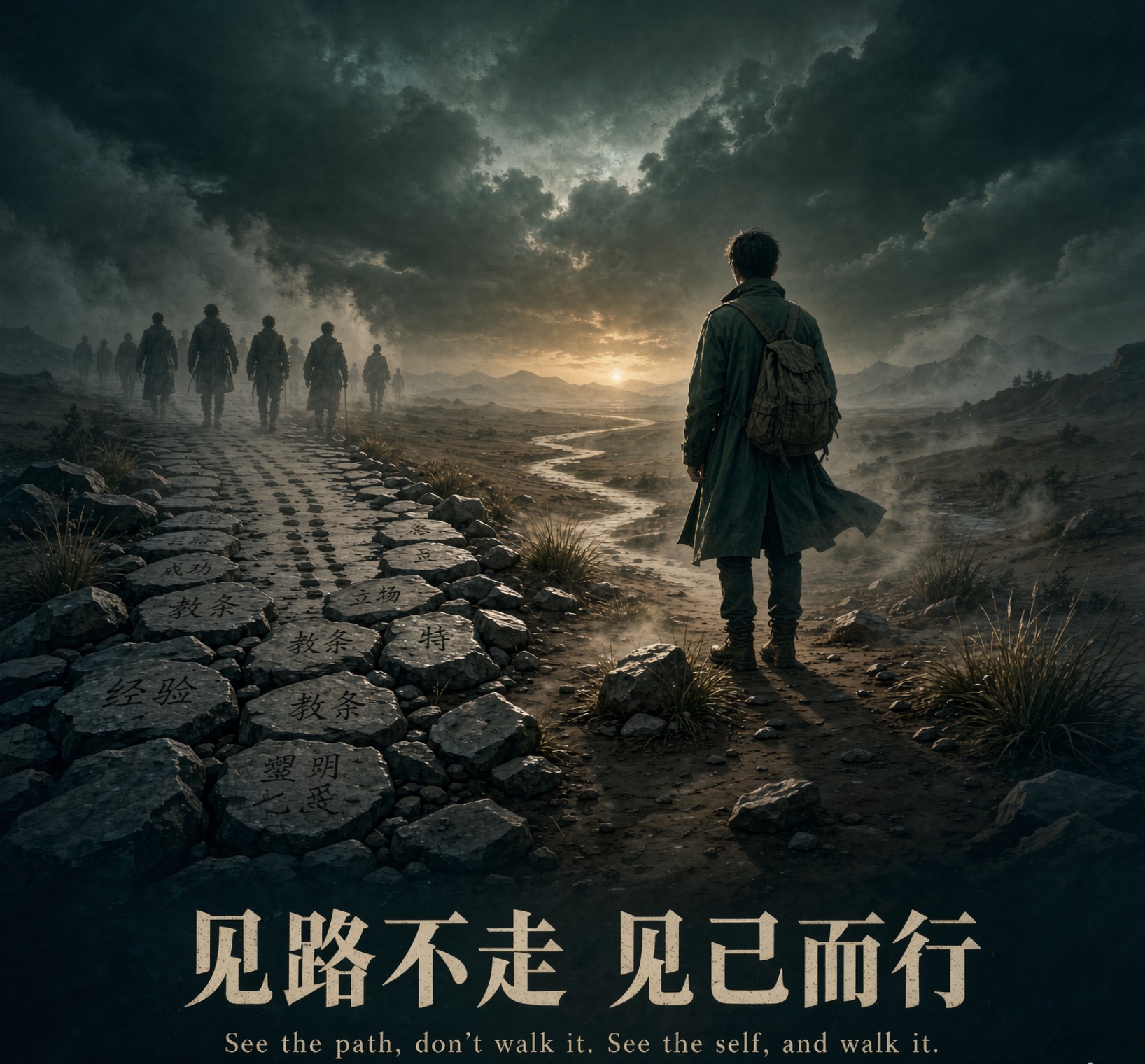
见路不走:在因果的荒原上,做自己的摆渡人
See the Path and Don’t Walk It: Be Your Own Ferryman on the Wasteland of Causality
“见路不走。”
“See the Path and Don’t Walk It.”
这四个字,是叶子农留给这个世界最锋利的手术刀。它出自豆豆的《天幕红尘》,却像一把钥匙,试图打开困住无数人的认知牢笼。
These four words are the sharpest scalpel Rye Diannong left to this world. They come from Heaven’s Curtain, Earth’s Dust by Dou Dou, yet they act like a key, attempting to unlock the cognitive cages that trap countless souls.
大多数人初读《天幕红尘》,都会卡在“见路不走”这四个字上。乍一听,像是愤世嫉俗的叛逆,又像是故弄玄虚的玄学。直到叶子农对老九说出那段关于“因果”的注解,才如醍醐灌顶:
Most readers stumble over these four words when they first encounter Heaven’s Curtain, Earth’s Dust. At first glance, they sound like cynical rebellion or esoteric mysticism. It is not until Rye Diannong explains “causality” to Lao Jiu that the realization strikes like a blow to the crown:
“啥叫路呢?成功者的经验、方法叫路。路管不管用?管用,不管用早没人走了。但是它只对一种人管用,就是符合这种条件的人。如果不符合条件,路就是一句谎言。”
“What is a ‘path’? The experiences and methods of the successful—that is the path. Does the path work? Yes. If it didn’t, no one would walk it long ago. But it only works for one kind of person: the one whose conditions match it. If your conditions don’t match, the path is a lie.”
这便是“见路不走”的第一层开悟:拒绝经验主义。
This is the first layer of enlightenment in “See the Path and Don’t Walk It”: Reject Empiricism.
我们生活在一个被“路”拥堵的时代。书店里摆满了《XX成功学》、《XX七天速成》,互联网上充斥着“底层逻辑”、“顶层认知”。人们像寻找藏宝图一样,疯狂地搜集别人的“路”。然而,叶子农冷冷地指出:“成功者的经验是他那个条件的可能,你不可能完全复制他的条件。”
We live in an era congested by “paths.” Bookstores are stacked with Success in XX and Master XX in Seven Days. The internet overflows with “underlying logic” and “top-tier cognition.” People hunt for others’ “paths” as if searching for buried treasure maps. Yet Rye Diannong states coldly: “The experience of the successful is the possibility under their specific conditions. You cannot replicate their conditions entirely.”
你看到的是马云在湖畔花园的豪情,却没看到那个时代的风口与特定的政策红利;你看到的是巴菲特的价值投资,却没看到他背后的保险浮存金与美股长达百年的国运。
What you see is Jack Ma’s boldness in Lakeside Garden, but you miss the tailwinds of that era and the specific policy dividends. What you see is Warren Buffett’s value investing, but you miss the insurance float behind him and the century-long national fortune of the U.S. stock market.
“见路不走”不是让你闭眼瞎走,而是让你睁眼看因果。
“See the Path and Don’t Walk It” does not mean walking blindly; it means opening your eyes to causality.

立场的迷雾:众生只信愿意信的
The Fog of Standpoints: Sentient Beings Believe Only What They Wish to Believe
叶子农还有一句极为扎心的话,道破了红尘的本质:
Rye Diannong utters another piercing truth that lays bare the nature of the “red dust” (the mundane world):
“这是一个‘场’的世界,有多少立场就有多少观点、多少真理。众生是立场的、利益的、好恶的,众生只相信自己愿意相信的东西。”
“This is a world of ‘fields.’ As many standpoints as there are, so many views and truths. Sentient beings are defined by their standpoints, interests, and preferences. They believe only what they are willing to believe.”
我们常常以为自己在追求真理,其实只是在捍卫自己的立场。
We often think we are pursuing truth, when in fact we are merely defending our own standpoint.
你是员工,你相信“万恶的资本家”;你是老板,你相信“懒惰的员工”。你相信的,往往不是客观事实,而是对你有利的事实。在这个“场”里,没有绝对的真理,只有相对的立场。
If you are an employee, you believe in “the wicked capitalist.” If you are a boss, you believe in “the lazy employee.” What you believe is often not objective fact, but the fact that benefits you. In this “field,” there is no absolute truth, only relative standpoints.
真正的开悟,是意识到自己正戴着有色眼镜。
True enlightenment lies in realizing that you are wearing tinted glasses.
当你不再执着于证明自己是对的,而是开始探究“为什么我会这么想”,你就跳出了“众生”的迷雾。你开始剥离立场的偏见,去触摸那坚硬的、冰冷的、却无比真实的——因果。
When you stop clinging to proving yourself right and start asking, “Why do I think this way?” you step out of the fog of “sentient beings.” You begin to strip away the biases of standpoint to touch what is hard, cold, yet utterly real—causality.
实事求是:最朴素的神性
Seek Truth from Facts: The Simplest Divinity
叶子农说:“实事求是是个很大的概念……好多人在说实事求是的时候,其实实事求是根本不关他的事。”
Rye Diannong says: “Seeking truth from facts is a vast concept… Many people talk about it, yet it has nothing to do with their actual practice.”
在中文语境里,“实事求是”常常被挂在墙上,变成一句口号。但在叶子农的哲学里,它是见路不走的具体操作手册。
In the Chinese context, “seeking truth from facts” is often hung on walls as a slogan. But in Rye Diannong’s philosophy, it is the operational manual for ‘Seeing the Path and Not Walking It.’
什么叫实事求是?就是不唯上,不唯书,只唯实。
What is seeking truth from facts? It is not deferring to authority, not deferring to scriptures, but deferring only to reality.
这很难。因为人的本能是懒惰的。照搬别人的路(教条主义)或者固守自己的旧路(经验主义),都比“具体问题具体分析”要省脑子。
This is difficult. It is human instinct to be lazy. Copying others’ paths (dogmatism) or clinging to one’s old paths (empiricism) is far less taxing than “analyzing specific problems specifically.”
叶子农用做面举例:如果你照搬别人的面馆模式,那是“见路走”;如果你根据自己当下的面粉质量、水质、火候、客群口味来调整配方,哪怕最后做出来的面很难看,但只要是符合当下因果的最优解,那就是“见路不走”。
Rye Diannong uses noodle-making as an example: If you copy someone else’s noodle shop model, that is “seeing the path and walking it.” If you adjust the recipe based on your current flour quality, water, heat, and customer preferences—even if the resulting noodles look unappealing—as long as it is the optimal solution given the current causality, that is “seeing the path and not walking it.”
“见路不走,就是实事求是。不唯经验,不唯教条,只唯条件。”
“Seeing the Path and Not Walking It is seeking truth from facts. Neither dogma nor empiricism, but only conditions.”
优越感的幻象与穷酸的真相
The Illusion of Superiority and the Truth of Poverty
书中有一段精彩的对话。当红明星戴梦岩嫌弃叶子农寒酸时,叶子农淡淡地回了一句:
There is a brilliant dialogue in the book. When the famous star Dai Mengyan scorns Rye Diannong for his shabbiness, he replies softly:
“谢谢,能让您获得优越感,这让我觉得我的穷酸也有了价值。”
“Thank you. Knowing that my shabbiness can give you a sense of superiority makes me feel that my poverty has found its value.”
这句话,是叶子农对世俗价值体系的彻底解构。
This statement is Rye Diannong’s complete deconstruction of the secular value system.
在这个物欲横流的世界,人们习惯用金钱、地位、名气来丈量一个人的价值。戴梦岩的“优越感”,建立在叶子农的“匮乏”之上。但叶子农看透了这种比较的虚妄。他不需要通过打败别人来证明自己,因为他早已在因果律中找到了安身立命之所。
In this materialistic world, people habitually measure a person’s worth by money, status, and fame. Dai Mengyan’s “sense of superiority” is built upon Rye Diannong’s “lack.” But Rye Diannong sees through the illusion of such comparisons. He does not need to prove himself by defeating others, for he has long found his footing within the law of causality.
真正的强大,是允许别人有优越感,是能够平静地接受自己的“不合时宜”。
True strength lies in allowing others to feel superior and in calmly accepting one’s own “anachronism.”
这让我想起另一句话:“宠辱不惊,看庭前花开花落;去留无意,望天上云卷云舒。” 叶子农的穷酸,不是窘迫,而是一种主动的选择,一种剥离了社会评价后的精神自由。
This reminds me of another saying: “Unmoved by favor or disgrace, watch the flowers bloom and fall before the courtyard; unconcerned with staying or leaving, gaze at the clouds roll and unroll in the sky.” Rye Diannong’s shabbiness is not embarrassment; it is an active choice, a spiritual freedom stripped of social evaluation.
结语:在荒原上种出自己的花
Epilogue: Growing Your Own Flowers on the Wasteland
叶子农最后死于非命,但他留下的思想却震耳欲聋。
Rye Diannong met an untimely end, yet the thoughts he left behind are deafening.
“见路不走”不是一条通往世俗成功的捷径,它是一条通往清醒的窄路。
“Seeing the Path and Not Walking It” is not a shortcut to worldly success; it is a narrow path leading to sobriety.
它告诉我们:
It tells us:
不要羡慕别人的路,因为那是别人的因果。
Do not envy others’ paths, for those are their causalities.
不要恐惧脚下的荒原,因为那是你的道场。
Do not fear the wasteland beneath your feet, for that is your dojo.
不要寻找救世主,因为能救你的,只有对客观规律的尊重。
Do not look for a savior, for only respect for objective laws can save you.
“神即道,道法自然,如来。”
“God is Tao; Tao follows nature; Thus Comes the One.”
当我们在人生的十字路口迷茫时,不妨问问自己:
When we stand bewildered at the crossroads of life, we might ask ourselves:
“此刻,我的条件是什么?我面临的因果是什么?我是否因为看见了别人的‘路’,而遮蔽了自己的‘眼’?”
“What are my conditions at this moment? What causality am I facing? Have I blinded my own ‘eyes’ simply because I saw someone else’s ‘path’?”
见路不走,不是不走,而是走自己的路。
Seeing the Path and Not Walking It does not mean not walking at all, but walking your own path.
愿你我都能在因果的荒原上,不慌不忙,种出只属于自己的那朵花。
May you and I, unhurried on the wasteland of causality, grow the flower that belongs to no one else but us.
Inspired by Rye Diannong (叶子农) from 《天幕红尘》 (Heaven’s Curtain, Earth’s Dust).
此文由 怡心湖 编辑,若您觉得有益,欢迎分享转发!:首页 > 赞·中华 > 经验谈 » 见路不走:在因果的荒原上,做自己的摆渡人 See the Path and Don’t Walk It
 菩萨畏因,凡夫畏果 Bodhisattvas Fe
 身宫:红尘炼心的肉身道场——职业、