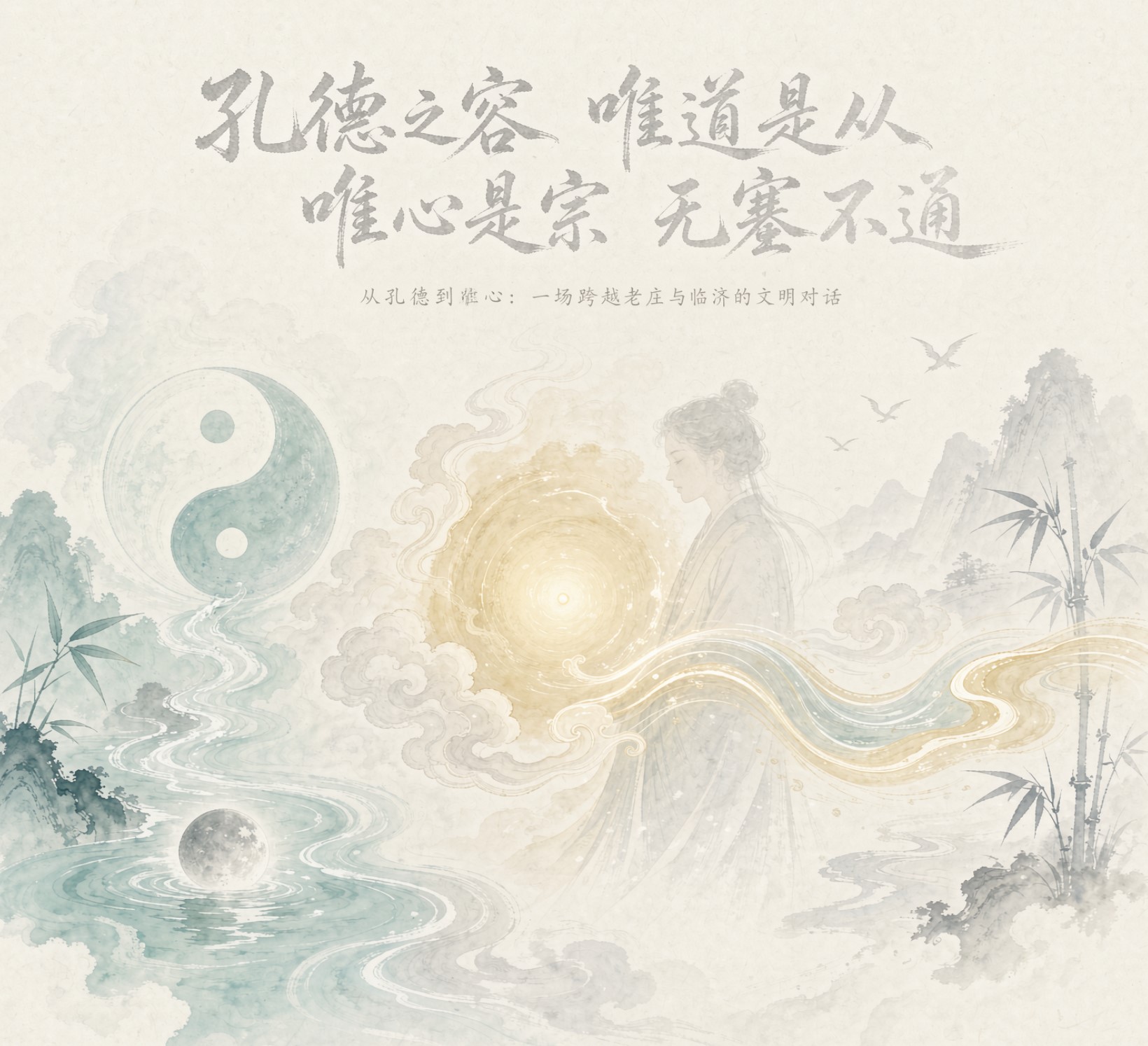
从“孔德”到“唯心”:一场横跨老庄与临济的文明对话
From "Great Virtue" to "Mind-Only": A Civilizational Dialogue Across Laozhuang and Linji
题记: 在中华文化的长河中,道家如静水深流,佛家似皓月当空。宋僧释祖钦以一句“惟道是从,惟心是宗”,将《道德经》的玄牝之门与禅宗的明心见性熔于一炉。这不仅是文本的互文,更是文明智慧的升华。
Epigraph: In the long river of Chinese culture, Daoism flows like a silent, deep current, while Buddhism shines like the bright moon in the night sky. The Song Dynasty Chan Master Shi Zuqin, with the line "Following the Dao, taking Mind as the Source," fused the mystical gateway of the Dao De Jing with the Chan insight of "seeing one's nature." This is not merely textual intertextuality, but a sublimation of civilizational wisdom.
一、 孔德之容:大道的显化
I. The Appearance of Great Virtue: The Manifestation of the Dao
《道德经》第二十一章开宗明义:“孔德之容,惟道是从。”
"The appearance of great virtue is solely in accordance with the Dao." (Dao De Jing, Ch. 21)
老子告诉我们,世间最伟大的德性,并非某种僵化的教条,而是“道”在现象界的投射。道是无形的,它“惟恍惟惚”,但在恍惚之中,却蕴含着“象”、“物”、“精”与“信”。这种“有”生于“无”的辩证,构成了中国哲学的底色。
Laozi teaches us that the greatest virtue is not a rigid dogma, but the projection of the Dao into the phenomenal world. The Dao is formless—"elusive and indistinct"—yet within this elusiveness lies "image," "substance," "essence," and "integrity." This dialectic of "Being" arising from "Non-being" forms the very foundation of Chinese philosophy.
然而,道体虽大,若无依归,则难以捉摸。这便引出了释祖钦的偈语:“惟道是从,惟心是宗。”
However, although the Dao is vast, without an anchor, it remains elusive. This leads us to Master Zuqin’s verse: "Following the Dao, taking Mind as the Source."
二、 唯心是宗:从外在遵循到内在觉醒
II. Mind as the Source: From External Compliance to Internal Awakening
释祖钦在《道从上人》中,巧妙地将老子的“从道”转向了禅宗的“宗心”。
In his poem "To Dao-cong Shangren," Zuqin ingeniously shifts Laozi's concept of "following the Dao" towards the Chan focus on "Mind as the Source."
如果说“孔德之容”是向外观察宇宙的浩瀚,那么“唯心是宗”便是向内审视心源的澄明。禅宗认为,道不在远方,就在当下一念。心若清净,道自现前。这一转化,是中华文化对形而上学的重大贡献——它不再满足于仅仅描述“道”的客观存在,而是强调修行者主观心性的决定性作用。
If "the appearance of great virtue" is an outward observation of the universe's vastness, then "taking Mind as the Source" is an inward contemplation of the mind's clarity. Chan Buddhism posits that the Dao is not distant; it resides in the present thought. When the mind is pure, the Dao manifests. This transformation is a monumental contribution of Chinese culture to metaphysics—it moves beyond merely describing the objective existence of the Dao to emphasizing the decisive role of the practitioner's subjective mind.
“空即是色,色即是空。”
"Form is emptiness, emptiness is form."
偈中的这句般若心经语,看似与老子无关,实则是对“惟恍惟惚”的极致诠释。老子说其中有物,佛家说色即是空。两者皆破除了对“实有”的执着。老子破“顽空”,佛家破“执有”,一阴一阳,一立一破,共同构建了中华智慧中“不落两边”的中道思想。
This line from the Heart Sutra, seemingly unrelated to Laozi, is actually the ultimate interpretation of "elusive and indistinct." Laozi says there is substance within; Buddhism says form is emptiness. Both dismantle the attachment to "substantial existence." Laozi refutes "stubborn nihilism," while Buddhism refutes "attachment to existence." Like Yin and Yang, one establishes and the other deconstructs, together they build the "Middle Way" of Chinese wisdom—avoiding the extremes of eternalism and nihilism.

三、 无塞不通:生命境界的圆融
III. Unobstructed Passage: The Perfect Interpenetration of Life
老子言“孔德”,意在通达;祖钦言“无塞不通”,意在圆融。
Laozi speaks of "Great Virtue" to signify unobstructed flow; Zuqin speaks of "unobstructed passage" to signify perfect interpenetration.
偈云:“梦幻了了,来去匆匆。水中之月,树上之风。”
The verse continues: "Dreams and illusions, clearly perceived; coming and going, in a hurry. The moon in the water, the wind in the trees."
这是典型的禅家气象。水月风影,看似有,实非实。老子说“窈兮冥兮,其中有精”,是要在深幽中见真精;禅师说“水月镜花”,是要在幻象中见空性。前者重“有”之真,后者重“有”之幻。
This is quintessential Chan atmosphere. The moon in the water and the wind in the trees appear real but lack substantiality. Laozi says, "Obscure and dark, yet within it is the essence," seeking the true essence within the obscure. The Chan master speaks of "flowers in the mirror and the moon in the water," seeing the emptiness within illusions. The former emphasizes the truth of "Being," while the latter emphasizes the illusory nature of "Being."
然而,当我们将两者结合,便得大自在。
However, when we synthesize the two, we attain great freedom.
真正的智慧,是既知道德之“真”(老子),又见万象之“幻”(佛家)。不执着于幻象,故能“无塞”;不否定道体之真,故能“不通”而“通”。
True wisdom lies in recognizing both the "truth" of the Dao (Laozi) and the "illusory" nature of phenomena (Buddhism). By not clinging to illusions, one achieves "no obstruction"; by not negating the truth of the Dao, one achieves passage through the seemingly impassable.
“作如是观,无塞不通。”
"Contemplate in this way, and nothing obstructs, all flows through."
这十六字偈的结尾,正是对《道德经》“孔德之容”的最好注脚。大德之所以能包容万物,正是因为它像水一样,不执着于任何形状(唯心之空),却又能随顺一切地形(从道之真)。
The conclusion of this sixteen-character verse serves as the perfect footnote to Laozi's "appearance of great virtue." The reason Great Virtue can contain all things is precisely because it is like water: it does not cling to any fixed shape (the emptiness of Mind) yet follows all terrains (the truth of following the Dao).
四、文明的互鉴与新生
IV. Conclusion: Mutual Learning and Renewal of Civilizations
“孔德之容,唯道是从,唯心是宗,无塞不通。”
"Great Virtue's appearance, follows only the Dao; Mind as the Source, nothing obstructs the flow."
这并非某一部典籍的原文,而是中华文脉在千年流淌中自然形成的智慧结晶。它告诉我们:
This is not a direct quote from a single classic, but a crystallization of wisdom naturally formed over millennia of Chinese cultural evolution. It tells us:
-
根植于道(Rooted in the Dao): 无论心灵如何觉醒,都不能脱离对宇宙本源规律的敬畏与遵循。
Rooted in the Dao: No matter how awakened the mind is, it must never depart from reverence for and compliance with the fundamental laws of the universe.
-
觉悟于心(Awakened in the Mind): 无论大道如何玄妙,终究要在当下一念的清净心中得以体证。
Awakened in the Mind: No matter how profound the Dao is, it must ultimately be realized within the clarity of the present thought.
-
圆融于行(Integrated in Action): 以出世之心(空),做入世之事(有),在纷繁复杂的现代社会中,保持内心的宁静与外在的通达。
Integrated in Action: With a mind of renunciation (emptiness), engage in worldly affairs (existence). Amidst the complexities of modern society, maintain inner tranquility and outer efficacy.
这便是中华文化的魅力:它不拘泥于门户之见,而是在“惟道是从”的宏大视野下,以“唯心是宗”的敏锐,最终抵达“无塞不通”的生命化境。
This is the charm of Chinese culture: it transcends sectarian boundaries. Under the grand vision of "following only the Dao," with the acuity of "taking Mind as the Source," it ultimately reaches the state of "unobstructed passage"—a life of perfect integration.
词汇注释 (Glossary):
-
孔德 (Great Virtue): 孔,大也。指最高境界的德性。
-
惟道是从 (Following only the Dao): 完全依从于道。
-
唯心是宗 (Mind as the Source): 以心为根本宗旨。
-
无塞不通 (Unobstructed): 没有滞碍,处处通达。
-
恍惚 (Elusive/Indistinct): 道家形容道体若有若无、不可名状的状态。
此文由 怡心湖 编辑,若您觉得有益,欢迎分享转发!:首页 > 赞·中华 > 儒释道 » 从“孔德”到“唯心”:一场横跨老庄与临济的文明对话
 不争之道:为何不与天下争者,天下莫能
 大道无形,随势流转