From "Catch-Up" to "Rule-Maker": China's Auto Superpower Path and Its Second-Order Spillovers
从"追赶者"到"规则制定者":中国成为全球汽车超级大国的路径与二阶溢出
International Economic Policy Institute · Industrial Geo-Economics Watch
怡心湖智库 · 产业地缘经济观察
Ⅰ. The American Mirror: What Automotive Week Saw in August 2026
一、美国镜面:2026年8月《汽车周刊》看到了什么
The U.S. trade press has stopped asking "can Chinese cars be good?" and moved to "what does it mean that they already are?" The Aug 3, 2026 cover piece of Automotive Week — "How China Became a Global Auto Superpower" — is less a discovery than a confession: Detroit's own consultants (e.g. Tu Le of China Automotive Insights, Troy MI) now brief Ford line workers that Chinese vehicles will land on U.S. soil within 5–10 years, while executive chairman Bill Ford admits "we cannot keep Chinese cars out forever."
美国行业媒体已不再问"中国车能好么",而改问"它们已经好成这样意味着什么"。2026年8月3日《美国汽车周刊》封面文《中国如何成为全球汽车超级大国》更像一份认账书:底特律自己的咨询顾问(密歇根Troy的China Automotive Insights创始人涂乐)如今在福特内部会上告诉产线工人,中国车将在5–10年内登上美国本土,执行董事长比尔·福特亦承认"不可能永远把中国车挡在门外"。
The hard numbers the article had to absorb:
-
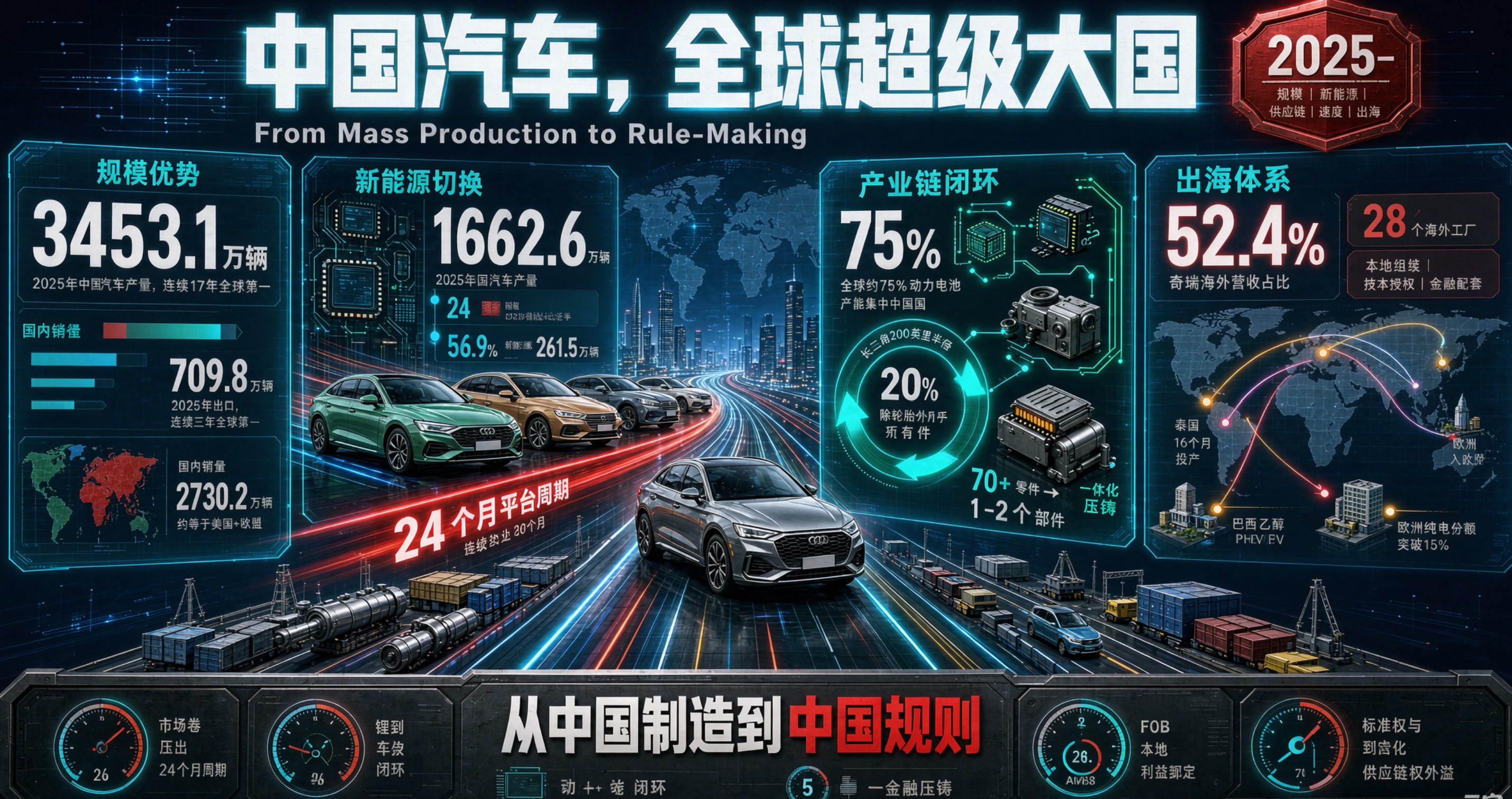
34.531m units produced in 2025 (10.4% YoY), 34.40m sold — 17th straight year No.1, >2× U.S. output.
-
7.098m vehicles exported (+21.1% YoY), 3rd consecutive year world No.1; NEV exports 2.615m (doubled).
-
16.626m NEVs produced / 16.49m sold in 2025, 47.9% domestic penetration; May 2026 hit 56.9%.
-
H1 2026 export 5.096m (+65.3%), NEV export 2.355m (+120%); June & July each >1m/month — the 10m-export annual run-rate is now plausible (AlixPartners: ~10m for 2026).
-
Chinese-brands' home share 71.8% in H1 2026 vs 28.2% foreign/JV — a 60/40 split five years ago is now inverted.
文章必须咽下的硬数据:2025年产3453.1万(同比+10.4%)、销3440万,连续17年第一,超美国两倍;出口709.8万(+21.1%),连续三年全球第一,其中新能源出口261.5万(翻倍);新能源产销1662.6万/1649万,国内渗透率47.9%,2026年5月达56.9%;2026上半年出口509.6万(+65.3%),新能源出口235.5万(+120%),6、7月单月均破百万,全年千万级出口已成可能(艾睿铂估2026约1000万);2026上半年自主品牌国内份额71.8%,五年前中外六四开现已倒置。
Institute note: The American anxiety is not "they sell cheap cars." It is that China converted a scale advantage into a systems advantage — and systems advantages do not reverse with a tariff schedule.
本所札记: 美国的焦虑不在"他们卖便宜车",而在"中国把规模优势转成了系统优势"——系统优势不会随一张关税表反转。
Ⅱ. The Four-Layer Stack: Why the Lead Is Structural, Not Cyclical
二、四层堆叠:为何领先是结构性的而非周期性的
Layer 1 — Market mass as a R&D subsidy(市场体量即研发补贴)
A 27.3m domestic market (2025) ≈ EU + U.S. combined. Hyper-competition (100+ brands, ~700 NEV nameplates on sale) forces 24-month full-platform cycles vs 60-month legacy cadence. Every sale funds data: China NEV fleets now feed ADAS/NOA loops at a scale Western OEMs cannot replicate without buying access.
2025国内销量2730万≈欧盟+美国之和。百个品牌、约700款在售新能源车型的内卷,把全新平台周期压到24个月(传统60个月)。每卖一辆都在喂数据:中国NEV车队以西方OEM不买权限就复刻不了的规模反哺ADAS/NOA闭环。
Layer 2 — Battery-to-body closed loop(锂矿到车身闭环)
~75% global battery cells, >80% cell output, pack cost 30% below North America / 35% below Europe. Integrated die-casting cuts lower-body parts from 70+ to 1–2. Within a 200-mile radius around Yangtze Delta you source everything except tires.
全球约75%电芯、80%+电池产量在中国,包成本比北美低30%、比欧洲低35%。一体化压铸把下车体零件从70+降到1–2个。长三角200英里半径配齐除轮胎外所有件。
Layer 3 — Software-defined vehicle (SDV) as default architecture(软件定义车成默认架构)
Bill Russo (Automobility): China skipped "EV popularization" and entered "EV 2.0" — central computing, OTA monthly, cabin-as-smartphone. U.S. 25–35kICE/CUVsegmentishollowing;Chinasells20–30k NEVs with air suspension, NOA, 4K cockpit. The comparison is not spec-for-spec, it is category-for-category.
Automobility比尔·鲁索言:中国跳过"电动普及"直接进入"电动2.0"——中央计算、月更OTA、座舱即手机。美国2.5–3.5万美元燃油/CUV段正在空心化,中国2–3万美元NEV给空悬、NOA、4K座舱。比的已不是参数,是品类。
Layer 4 — Export upgraded from "units" to "system" (localized footprint)(出海从卖车升到扎根)
H1 2026: Brazil = No.1 passenger destination, Russia No.2, Europe (BEV share >15% in April 2026), SE Asia +130% YoY, Middle East +60%, LatAm +55%. BYD/Geely/Chery building in Thailand, Hungary, Spain; R&D in Munich. Tariff walls in EU/Brazil/Turkey push the model from ship-and-sell to build-and-comply.
2026上半年:巴西乘用车第一目的国、俄罗斯第二、欧洲(2026年4月纯电份额>15%)、东南亚+130%、中东+60%、拉美+55%。比亚迪/吉利/奇瑞在泰、匈、西建厂,慕尼黑设研发。欧巴土关税墙把模式从"运过去卖"逼成"建过去合规"。

Ⅲ. The Second-Order Spillovers (Beyond Autos)
三、二阶溢出:超出汽车本身
|
Domain 域 |
Mechanism 机制 |
Early signal 早期信号 |
|---|---|---|
|
Industrial standards 标准权力 |
133 NEV national standards (19 new in 2025, incl. world-first energy-consumption limit); ISO working groups chaired by Chinese experts in Geneva |
"20th C = U.S. safety / EU emission / Japan quality; 21st C adds China SDV+charge+swap" |
|
Commodity geopolitics 商品地缘 |
Lithium processing, nickel sulfate, LFP cathode capacity concentrated in CN → pricing power shifts from London/Chicago to Ningde/Shanghai |
LFP becomes global default LFP, not "Chinese chemistry" |
|
Labor arbitrage reversal 劳动套利逆转 |
Mexican/EE car hubs now import Chinese drivetrains to stay price-competitive |
"Near-shoring to Mexico" partially becomes "China-in-Mexico" |
|
Capital markets 资本市场 |
CATL + BYD + Li Auto + Xiaomi-auto cluster reweights EM equity benchmarks; global auto indices de-weight Detroit/Wolfsburg |
MSCI EM auto weight crosses 5% for first time |
标准权力:133项NEV国标(2025年新增19项含全球首发电耗限值),ISO工作组由中国专家任召集人,"20世纪美定安全/欧定排放/日定质量,21世纪加中国SDV+充电+换电"。
商品地缘:锂加工/硫酸镍/LFP正极聚于中国,定价权从伦敦/芝加哥移师宁德/上海,LFP成全球默认而非"中国化学"。
劳动套利逆转:墨东汽车枢纽进口中国驱动系统保价,"近岸墨西哥"部分变"中国-in-墨西哥"。
资本市场:宁德+比亚迪+理想+小米汽车集群重写EM股权基准,全球汽车指数减配底特律/狼堡。
Ⅳ. The Cracks Americans Do Not See (But Beijing Watches)
四、美国人没看到、北京自己在盯的裂缝
The superpower label is real but not cost-free:
-
Margin compression: 2025 auto sector revenue +4% to ¥10.6tn, profit −8%, margin 4.3%; price war eats the very scale dividend.
-
Overcapacity vs. global pushback: 10m export run-rate meets EU anti-subsidy duties, Brazil/Turkey tariff hikes, U.S. Section 301+UFLPA screening — volume growth must convert to localization capex, not just FOB volume.
-
Tech frontier risk: solid-state, 800V silicon-carbide yield, L4 data-licensing — China leads on integration, not on every upstream physics breakthrough.
-
Domestic demand ceiling: H1 2026 domestic NEV penetration ~50%, incremental volume increasingly depends on replacement cycle + export, not first-time buy.
超级大国标签真实但不免费:2025行业营收+4%至10.6万亿、利润−8%、利润率4.3%,价格战吞噬规模红利; 千万出口遇欧盟反补贴、巴土关税、美301+UFLPA,增量须转本地化capex而非FOB量;固态/800V SiC良率/L4数据许可上中国强在集成不强在每寸物理突破;国内NEV渗透已~50%,增量越发靠置换+出口而非首购。
The CBO-style fiscal warning we wrote earlier applies here too: scale masks drift until the marginal unit stops paying for the fixed cost. China's auto lead is durable, but its profitability is not yet proven across a full cycle.
前文CBO式财政警告在此同样成立:规模会掩盖漂移,直到边际一辆车的收入付不起固定成本。中国汽车领先是耐久的,但跨周期盈利能力尚未证毕。
Ⅴ. 2030 Baseline and Three Scenarios
五、2030基线及三种情景
Base case (60%): CN produces ~38% of global light vehicles in 2030, NEV share domestic ~65%, exports 9–10m with >40% localized overseas assembly; BYD+Geely+Chery+Xiaomi in global top 10.
基线(60%):2030中国占全球轻型车~38%,国内NEV渗透~65%,出口900–1000万且海外本地化组装>40%,比亚迪+吉利+奇瑞+小米进全球前十。
Soft-landing reform (20%): Price war ends via CR to ~8 brands; margin recovers to 6–7%; EU accepts battery-plant investment in exchange for tariff relief.
软着陆(20%):价格战经洗牌剩~8牌,利润率回6–7%,欧盟以电池厂投资换关税减让。
Pushback fragmentation (20%): U.S. keeps 100% tariff + ban on connected-V data; EU duty 30%+; emerging markets impose local-content 40% — China still leads volume but ROIC on overseas capex falls below domestic.
反制碎片化(20%):美维持100%税+禁联网数据,欧盟30%+税,新兴市场本地含量40%——中国仍领量但海外capex的ROIC低于国内。
Ⅵ. Bottom Line
六、结语
Automotive Week's August cover is a symptom, not a cause. The cause is that China treated the auto industry not as a product but as a platform — lithium, silicon, software, and logistics bolted into one compounding stack. The West can still build fine cars; what it lost is the tempo and the stack. The next five years decide whether "auto superpower" means making the most vehicles or writing the rules the others must compile against.
《汽车周刊》8月封面是症状不是病因。病因是中国把汽车不当产品当平台——锂、硅、软件、物流铆成一个复利堆叠。西方仍造得好车,丢的是节奏与堆叠。未来五年决定"汽车超级大国"意指"造最多车"还是"写别人必须编译的规则"。
Data as of Aug 12, 2026: CAAM, IEA Global EV Outlook 2026, AlixPartners mid-year update, U.S. Treasury Aug-12 fiscal release (for cross-reading with our prior fiscal note).
数据截至2026年8月12日:中汽协、IEA《2026全球电动汽车展望》、AlixPartners年中更新、美国财政部8月12日财政发布(与本所前篇赤字文交叉参读)。
此文由 怡心湖 编辑,若您觉得有益,欢迎分享转发!:首页 > 观·世界 » 从"追赶者"到"规则制定者":中国成为全球汽车超级大国的路径与二阶溢出
 美国7月联邦赤字创五年多新高:周期
 8月21日:一道分水岭——《恢复贸易
 正视"现实地位":在中美结构性竞争中
 动荡时代的科技突围:以韧性创新重塑
 算力自主与地缘博弈:RISC-V如何成为
 硅、栈与主权:AI 时代中国 GPU 国产
 “卖人头”时代的终局:AI 如何正在
 告别黄金年代:2027乙丑大运开启,中国