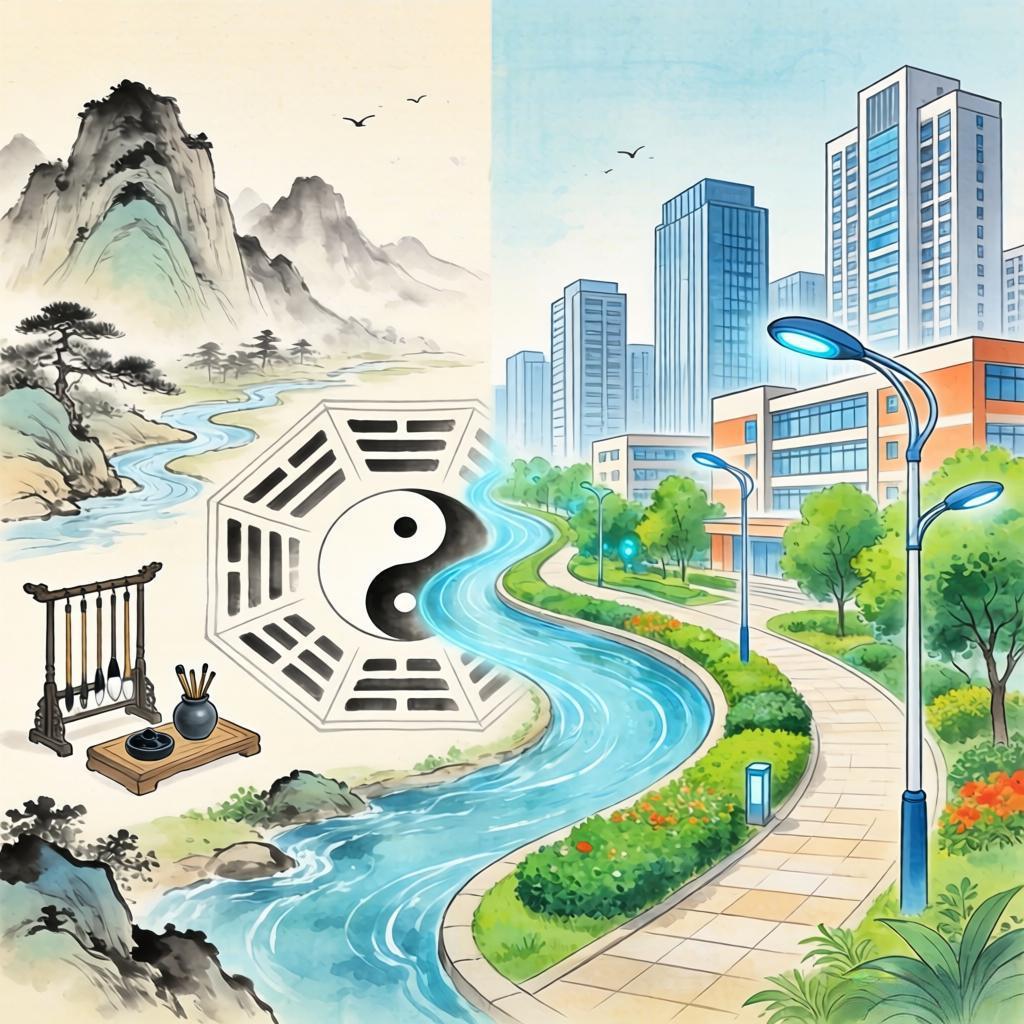

The Surrounding of Literary Pivots: On the Feng Shui Dialectics and Modern Transformation of School-District Communities
在中国传统风水理论中,聚居地的“气场”深受周边环境属性影响。学校,作为教书育人之所,在风水体系中归类为“文昌”之地,象征文化、智慧与蓬勃生气。若小区方圆三公里内汇聚八九所学校,则形成了罕见的“文枢环绕”之局。从形法派视角看,学校建筑多开阔明朗,操场如“明堂”可纳气,读书声属“阳动”可激发生机,整体上易形成清新向上、利于思维活跃的气场环境。然而,理气派更强调时空与方位的精密计算,如此密集的文教设施是否真正转化为吉气,需视其与小区具体的方位关系、元运流转及住宅本身的坐向而定,不可一概而论。
In traditional Chinese Feng Shui theory, the "energy field" of a residential area is deeply influenced by the attributes of its surrounding environment. Schools, as places of education, are categorized as "Wenchang" (Literary Star) sites in the Feng Shui system, symbolizing culture, wisdom, and vigorous vitality. If eight or nine schools gather within a three-kilometer radius of a residential area, it forms a rare configuration of "surrounding literary pivots." From the Form School perspective, school buildings are often open and bright, with playgrounds acting as "bright halls" to gather Qi, and the sound of reading, belonging to "active Yang," can stimulate vitality. Overall, this tends to create a fresh, uplifting environment conducive to active thinking. However, the Compass School emphasizes precise calculations of time, space, and orientation. Whether such dense educational facilities translate into auspicious Qi depends on their specific directional relationship to the community, the flow of current periods, and the sitting and facing directions of the dwellings themselves; it cannot be generalized.
此种格局的核心优势在于“文昌之气”的聚集与共振。风水经典《阳宅爱众》有云:“文昌位上有文峰,俊士英才出此中。”多所学校形成的气场联动,可类比为多重“文笔峰”或“砚台水”的叠加,理论上能显著强化区域的文运潜力,尤其利于家有学子的家庭,或在文化、教育、科研领域从业的居民。但这种“文气”是否能为特定住宅所用,还取决于个体住宅能否有效承接这股气息。若小区主要入口、住宅阳台或书房恰能收纳来自学校的旺气,则为吉应;反之,若气场被高楼阻挡或直冲为煞,则效益大减。
The core advantage of this configuration lies in the gathering and resonance of "Wenchang Qi." The Feng Shui classic Yang Zhai Ai Zhongstates: "When a literary peak sits in the Wenchang position, outstanding scholars and talents emerge from within." The interconnected energy field formed by multiple schools can be likened to the叠加 of multiple "literary brush peaks" or "inkstone water," theoretically significantly enhancing the area's potential for literary fortune. This is particularly beneficial for families with students or residents working in culture, education, or research. However, whether this "literary Qi" can be utilized by a specific dwelling depends on whether the individual home can effectively receive this energy. If the main entrance, balcony, or study of a dwelling can appropriately gather the vibrant Qi from the schools, it is auspicious; conversely, if the Qi is blocked by tall buildings or forms a direct rushing Sha (negative energy), the benefit is greatly reduced.
然而,物极必反是风水的核心辩证法则。过度的“文昌”聚集可能打破五行的平衡。学校在五行中属“木”(生长、发展)与“火”(文明、礼仪),过盛的木火之气可能导致区域内气场“阳亢”。具体表现为:居民易心浮气躁、睡眠不安,或竞争意识过强而失却中和。尤其对于命理忌火木的住户,或体质属阴虚阳亢者,长期居住可能加剧身心失衡。因此,理想格局需有“水”(如池塘、公园)或“土”(如平整广场、低矮山丘)的元素进行调和,以达到“木火通明,水土润泽”的共生状态。
However, the core dialectical principle of Feng Shui is that "extremes beget reversal." Excessive gathering of "Wenchang" energy can disrupt the balance of the Five Elements. Schools belong to the "Wood" (growth, development) and "Fire" (civilization, propriety) elements. Overly strong Wood and Fire Qi may lead to an "excessively Yang" energy field in the area. Specific manifestations include residents being prone to restlessness, sleep disturbances, or excessive competitive spirit at the expense of harmony. Especially for residents whose personal astrology clashes with Fire/Wood, or those with Yin-deficient and Yang-excessive constitutions, long-term residence might exacerbate physical and mental imbalance. Therefore, an ideal configuration requires elements of "Water" (e.g., ponds, parks) or "Earth" (e.g., flat plazas, low hills) for harmonization, achieving a symbiotic state of "Wood and Fire shining brightly, Water and Earth providing moisture."
从现代环境行为学审视,学校密集区的实质影响远超玄学范畴。积极方面,该区域通常拥有更完善的文化设施、更安全的邻里环境(上学放学时段警力与监控集中)以及更活跃的社区氛围。消极方面,上下学高峰的交通拥堵产生“声煞”与“滞气”,集体活动的喧嚣可能形成“动煞”,而假期时突如其来的空寂又可能造成气场“断流”。这些变化对寻求宁静的住户,尤其是老年人,可能构成持续的压力。因此,风水中的“煞”,往往对应着现代人可感知的环境压力源。
Examining from the perspective of modern environmental psychology, the substantial impact of school-intensive areas extends far beyond metaphysics. Positively, such areas typically boast better cultural facilities, safer neighborhood environments (with concentrated police presence and surveillance during school hours), and a more vibrant community atmosphere. Negatively, traffic congestion during peak school hours generates "sound Sha" and "stagnant Qi," the noise from collective activities may form "movement Sha," and the sudden quiet during holidays can create a "disruption in Qi flow." These fluctuations can pose ongoing stress for residents seeking tranquility, especially the elderly. Therefore, the "Sha" in Feng Shui often corresponds to perceptible environmental stressors for contemporary people.
个体的命理与住宅的格局,是评估风水吉凶的终极坐标系。即便身处同一“文枢环绕”之地,不同坐向的楼栋、不同楼层的单元、不同生辰的住家,其效应天差地别。例如,一户缺“文昌位”的住宅,得此外界吉气弥补,可能运势大涨;而另一户本身“文昌”过旺的住宅,再逢此局,反可能导致子女学习压力过大或思维偏执。这便是风水的个性化精髓:没有放之四海而皆准的吉凶,只有具体情境下的生克制化。
The individual's astrological chart and the dwelling's layout are the ultimate coordinate system for assessing Feng Shui auspiciousness or harmfulness. Even within the same "literary-pivot-surrounded" area, the effects can vastly differ for buildings with different orientations, units on different floors, and households with different birth dates. For instance, a household lacking the "Wenchang position" in its home might receive compensation from this external auspicious Qi, potentially boosting its fortune significantly; whereas another household with an inherently excessive "Wenchang" might, upon encountering this configuration,反而 cause excessive academic pressure on children or obsessive thinking. This is the essence of Feng Shui's personalization: there is no universal good or bad, only the interplay of generation, restriction, and transformation within specific contexts.
因此,面对学区密集的住宅,理性的态度是结合科学与玄学进行综合评估。科学层面,需测量噪音分贝、分析交通流量、评估日照与通风;风水层面,则应聘请明师,使用罗盘精确测定学校建筑与住宅的方位关系,结合流年飞星,判断其气场互动是“生助”还是“冲克”。例如,在当下下元九运(2024-2043年),九紫右弼火星主事,学校属火,若其位于住宅的南方(离宫,亦属火),则火气过炎,需以水景或属土的黄色系装饰进行化解。
Therefore, when considering residences in school-dense areas, a rational approach involves a comprehensive assessment combining science and metaphysics. On the scientific level, it is necessary to measure noise decibels, analyze traffic flow, and evaluate sunlight and ventilation. On the Feng Shui level, one should consult a knowledgeable master, use a Luopan compass to precisely determine the directional relationship between school buildings and the residence, and combine this with the annual Flying Stars to judge whether the Qi field interaction is "generating and assisting" or "clashing and opposing." For example, in the current Lower Yuan 9 Period (2024-2043), the Nine Purple Right Assistant Fire Star is dominant. Schools belong to Fire. If a school is located in the south (Li Palace, also belonging to Fire) of a residence, the Fire energy becomes excessively intense, requiring remedies such as water features or Earth-element yellow décor.
最理想的状态,是促成传统“文气”与现代“人文社区”理念的融合。通过景观设计,在小区与学校间建立缓冲动线(如绿化带),既转化可能的形煞,又提供休闲空间;在社区文化上,可组织家校共建活动,将学校的“活气”有序引入社区,如举办读书会、科普讲座,使“文昌”之气以和谐方式滋养全龄段居民。如此,风水从一种趋吉避凶的术数,升华为营造可持续人文生态的社区规划智慧。
The ideal state is to foster an integration of traditional "literary Qi" and the modern concept of a "humanistic community." Through landscape design, buffer zones (e.g., green belts) can be established between the community and schools, transforming potential Form Sha while providing recreational space. In terms of community culture, activities co-organized by schools and families can be arranged, introducing the school's "vital Qi" into the community in an orderly manner, such as holding book clubs or science lectures. This allows the "Wenchang Qi" to nourish residents of all ages harmoniously. In this way, Feng Shui transcends being merely an art for seeking good fortune and avoiding harm, evolving into the wisdom of community planning for building a sustainable humanistic ecology.
最终,“文枢环绕”之地的风水奥秘,不在于简单断言吉凶,而在于理解其气场的特殊性与复杂性。它犹如一把双刃剑:为契合者提供文化滋养与进阶契机,为不谐者带来纷扰与压力。居住于此,既是选择一种环境,也是选择一种生活方式与能量互动模式。深刻的居住智慧,在于洞察环境特质,进而通过内外调整,达到“人宅相扶,感通天地”的和谐之境。这或许才是风水学说穿越千年,至今仍能启迪现代人居的核心价值。
Ultimately, the Feng Shui奥秘 of a "literary-pivot-surrounded" area lies not in simply declaring it auspicious or inauspicious, but in understanding the uniqueness and complexity of its energy field. It is like a double-edged sword: providing cultural nourishment and opportunities for advancement to those who resonate with it, while bringing disturbance and pressure to those who are discordant. Residing in such a place is choosing not only an environment but also a lifestyle and a mode of energy interaction. Profound residential wisdom involves discerning the characteristics of the environment and then achieving harmony—a state where "the resident and the dwelling support each other, sensing and connecting with heaven and earth"—through internal and external adjustments. This, perhaps, is the core value of Feng Shui theory, which has traversed millennia and can still inspire modern living.
此文由 怡心湖 编辑,若您觉得有益,欢迎分享转发!:首页 > 马·春风 » 文枢环绕:论学区聚居区的风水辩证与现代性转化