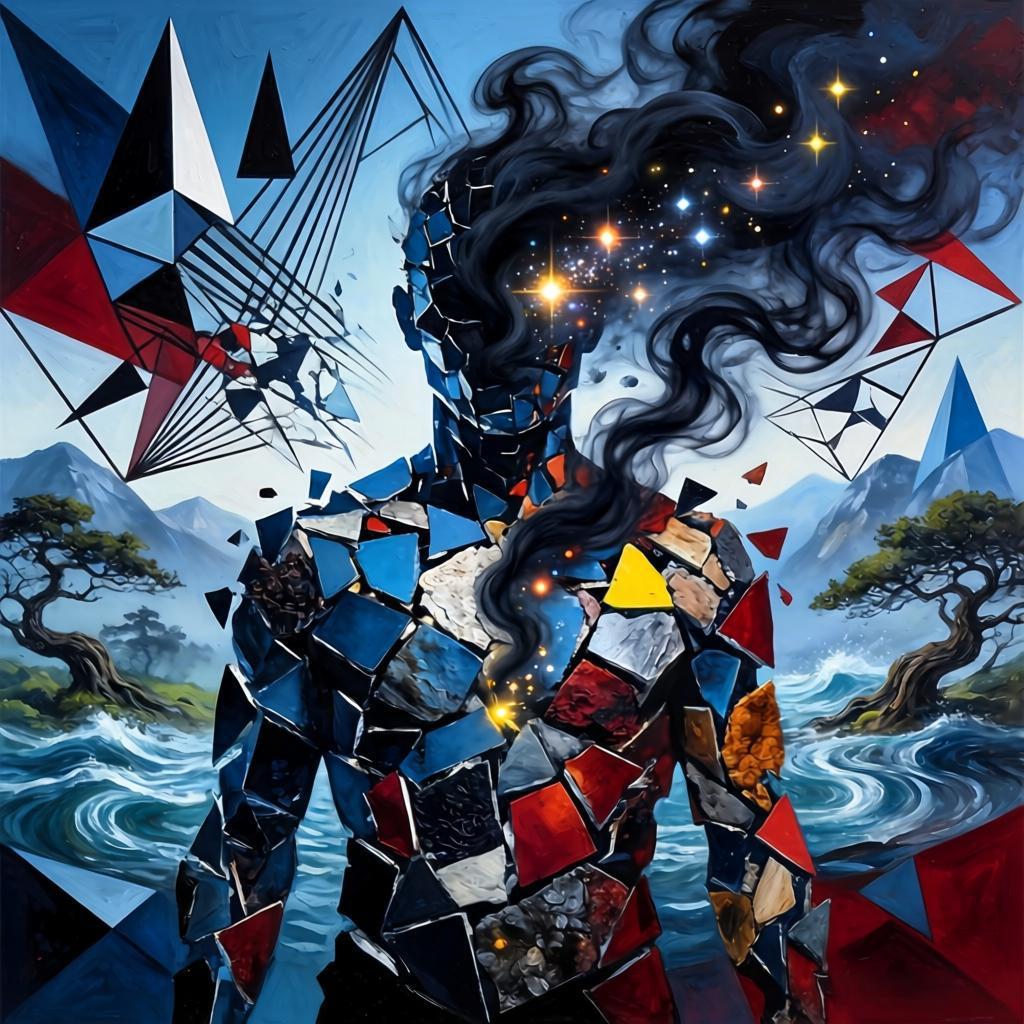

The Storm Within: On Inner Turmoil as the Core Dilemma of Human Existence
人类自古便致力于抵御外在的威胁——自然灾害、社会动荡、物质匮乏。然而,文明发展至今日,一个更为隐秘而普遍的困境日益凸显:外在环境纵然危机四伏,但其破坏力往往具有边界;真正令人深陷泥潭、耗尽心力的,却是那无形无相、却又无处不在的内在混乱。这是一种灵魂的失序状态,表现为贪欲的攫取、嗔恨的灼烧、愚痴的迷雾,以及无穷尽攀缘的杂念,它们共同构成了一个自我制造的精神牢笼。外在世界的喧嚣终会散去,而内心的纷争却能在寂静中自我增殖,成为痛苦最深厚的源泉。
Throughout history, humanity has striven to guard against external threats—natural disasters, social upheavals, material scarcity. However, as civilization has progressed to the present day, a more hidden and universal predicament has become increasingly prominent: even if the external environment is rife with perils, its destructive power often has boundaries; what truly entraps people in the mire and exhausts their vitality is the formless, yet omnipresent, inner turmoil. This is a state of disorder in the soul, manifested as the grasping of greed, the burning of hatred, the fog of ignorance, and the endless proliferation of clinging thoughts. Together, they form a self-constructed mental prison. The clamor of the external world eventually fades, yet the internal strife can proliferate within silence, becoming the deepest wellspring of suffering.
这种内在的混乱,其危险性首先源于它的“伪自然性”。我们容易将翻腾的思绪与躁动的情绪误认为“自我”的真实表达,从而对其毫无警惕,甚至全力认同。殊不知,这些念头与情绪大多是被外在符号、社会比较、未愈合的创伤所编程的“心理自动反应”。它们如同心灵的背景辐射,持续消耗着我们的注意力和精神能量,却很少导向有建设性的行动或真实的幸福。当一个人被内在的噪音完全占据,他便与当下的生命体验隔绝,活在对过去的懊悔或对未来的焦虑之中。
The danger of this inner turmoil stems first from its "pseudo-naturalness." We easily mistake churning thoughts and agitated emotions for the true expression of the "self," thus remaining unguarded against them, or even fully identifying with them. Unbeknownst to us, these thoughts and emotions are largely "psychological automatic reactions" programmed by external symbols, social comparisons, and unhealed traumas. They are like the background radiation of the mind, continuously consuming our attention and mental energy, yet seldom leading to constructive action or genuine happiness. When a person is completely occupied by internal noise, they become isolated from the experience of life in the present, living in regret of the past or anxiety about the future.
从认知层面看,内在混乱的本质是注意力的失能。健康的心智应如聚光灯,能有意识地将光亮投向所选目标;而混乱的心智则是弥散的、被动反应的光晕,被每一个掠过脑海的刺激所吸引、牵动。这种状态的持续,导致人丧失了对自身精神活动的主权,沦为思绪流中的浮木。更深刻的是,它模糊了“我”与“我的念头”之间的界限,使人误以为“我就是我的焦虑,我就是我的欲望”,从而加固了痛苦的实体感。
From a cognitive perspective, the essence of inner turmoil is the dysfunction of attention. A healthy mind should be like a spotlight, capable of consciously directing its beam toward chosen objects; whereas a chaotic mind is a diffuse, passively reactive glow, attracted and pulled by every stimulus that flashes through it. The persistence of this state leads to the loss of sovereignty over one's own mental activities, reducing a person to driftwood in the stream of thoughts. More profoundly, it blurs the boundary between "I" and "my thoughts," making one mistakenly believe that "I am my anxiety, I am my desire," thereby reinforcing the substantiality of suffering.
这种内在的失序,绝非单纯的个人心理问题,它有着深刻的社会与文化根源。现代性在带来空前自由与物质丰富的同时,也瓦解了传统的意义框架与共同体纽带。个体被抛入一个价值多元(乃至混乱)、选择过剩、竞争激烈的世界。外在的“成功”标准不断拔高,而内在的认同感却日益稀薄。这种张力催生了普遍的焦虑与自我怀疑——我们渴望成为“更好的自己”,却常陷入与他人无休止的比较(贪);我们面对挫折与不公,容易滋生愤怒与怨憎(嗔);我们在信息洪流中,迷失于表象,远离事物本质(痴)。社会如同一面扭曲的镜子,持续映照并放大了我们内心的混乱。
This internal disorder is by no means merely a personal psychological issue; it has profound social and cultural roots. While modernity has brought unprecedented freedom and material abundance, it has also dismantled traditional frameworks of meaning and communal bonds. The individual is thrown into a world of diverse (even chaotic) values, excessive choices, and fierce competition. External standards of "success" are constantly rising, while a sense of internal identity grows increasingly thin. This tension breeds widespread anxiety and self-doubt—we yearn to become a "better self," yet often fall into endless comparison with others (greed); we face setbacks and injustice, easily breeding anger and resentment (hatred); we lose ourselves in the flood of information, distracted by appearances and distant from the essence of things (ignorance). Society acts like a distorted mirror, continuously reflecting and amplifying our inner chaos.
那么,我们该如何面对这片内心的旷野风暴?首先需要的,或许不是激烈的对抗,而是培养一种“观察的距离”。正如你不会与天气认同,你可以学习不与你的念头和情绪完全认同。通过正念冥想、内省书写或深度的对话,我们练习将意识从思考的内容,转向思考的过程本身。这种“元认知”能力的觉醒,就像在汹涌的心海中发现一个稳固的观察点。从这里望去,那些曾经仿佛能吞噬一切的贪婪、恐惧、妄念,开始显露出其无常、依赖条件而生的本质——它们会升起,也会消散,但它们不是你存在的核心。
So, how should we face this storm within the wilderness of the mind? The first requirement, perhaps, is not fierce resistance, but cultivating a "distance of observation." Just as you do not identify with the weather, you can learn not to completely identify with your thoughts and emotions. Through mindfulness meditation, introspective writing, or deep dialogue, we practice shifting awareness from the contentof thinking to the processof thinking itself. The awakening of this "metacognitive" ability is like discovering a stable observation point in the turbulent sea of the mind. From here, those greeds, fears, and delusions that once seemed capable of devouring everything begin to reveal their impermanent, condition-dependent nature—they arise, and they will dissipate, but they are not the core of your existence.
在此基础上,重建内心的秩序需要智慧的引导。东方先哲将“戒、定、慧”作为根本路径。“戒”并非压抑,而是有意识地选择为生活建立简洁、清净的外缘,减少引发内心混乱的刺激。“定”是持续训练专注力,使心灵能够安住一处,如烛火不受风扰。“慧”则是穿透表象,洞见欲望的空洞、嗔怒的虚妄与自我概念的建构性。在西方哲学传统中,斯多葛学派强调区分“可控与不可控”,并将平静建立在专注于自身德行与当下职责之上,这与东方的智慧有着深刻的呼应。它们共同指向:平静不是没有波澜,而是在波澜中深知海洋的深邃与广阔。
On this basis, rebuilding internal order requires the guidance of wisdom. Eastern sages regard "precepts, meditation, and wisdom" as the fundamental path. "Precepts" are not suppression, but the conscious choice to establish simple, pure external conditions for life, reducing stimuli that trigger inner turmoil. "Meditation" is the continuous training of concentration, enabling the mind to abide peacefully in one place, like a candle flame undisturbed by wind. "Wisdom" is penetrating appearances, seeing the emptiness of desire, the fallacy of anger, and the constructed nature of the self-concept. In the Western philosophical tradition, Stoicism emphasizes distinguishing between "what is within our control and what is not," and bases tranquility on focusing on one's own virtue and present duties, which deeply resonates with Eastern wisdom. They both point to the same truth: tranquility is not the absence of waves, but knowing the depth and vastness of the ocean amidst the waves.
最终,处理内在混乱的旅程,也是一场深刻的自我认知与和解。它要求我们放下“必须达到某种完美平静状态”的执念,转而拥抱内心的完整——即接纳光明与阴影、有序与混乱共同构成了生命的真实纹理。真正的内在平和,并非消灭所有杂念,而是发展出一种宽广的容纳力,如同天空容纳云彩,但天空本身不被云彩沾染。当贪念起时,我们能看清其背后的匮乏感而不被其奴役;当怒火生时,我们能感受其能量而不被其控制;当困惑现时,我们能安住于未知而不急于抓住虚假的答案。
Ultimately, the journey of dealing with inner turmoil is also one of profound self-knowledge and reconciliation. It asks us to let go of the attachment to "having to achieve a certain state of perfect calm," and instead embrace the wholeness of the inner world—that is, accepting that light and shadow, order and chaos together constitute the true texture of life. Genuine inner peace is not about eliminating all distracting thoughts, but about developing a broad capacity for containment, like the sky holding clouds, yet the sky itself remains unstained by them. When greed arises, we can see the sense of lack behind it without being enslaved by it; when anger emerges, we can feel its energy without being controlled by it; when confusion appears, we can abide in the unknown without hastily grasping for false answers.
这并非一场轻易的胜利,而是一生的修行。其回报是无可估量的:当内心的风暴渐息,外在的世界并未改变,但我们与整个世界的关系改变了。我们不再是被动反应者,而是能够以更清晰、更慈悲、更有力量的意识去参与和回应。我们终于从自己制造的牢笼中走出,发现那一直存在的、不受扰动的内在空间——它才是自由与创造力的真正源头。那里,僻静与否已不再重要,因为心已成为自己的归处。
This is not an easy victory, but a lifelong practice. Its reward is immeasurable: when the storm within gradually subsides, the external world has not changed, but our relationship with the entire world is transformed. We are no longer passive reactors, but can engage and respond with clearer, more compassionate, and more powerful awareness. We finally step out of the prison we constructed ourselves and discover the ever-present, undisturbed inner space—it is the true source of freedom and creativity. There, whether one is in seclusion or not no longer matters, for the mind has become its own home.
此文由 怡心湖 编辑,若您觉得有益,欢迎分享转发!:首页 > 会·生活 » 内心的风暴:论内在混乱作为人类存在的核心困境