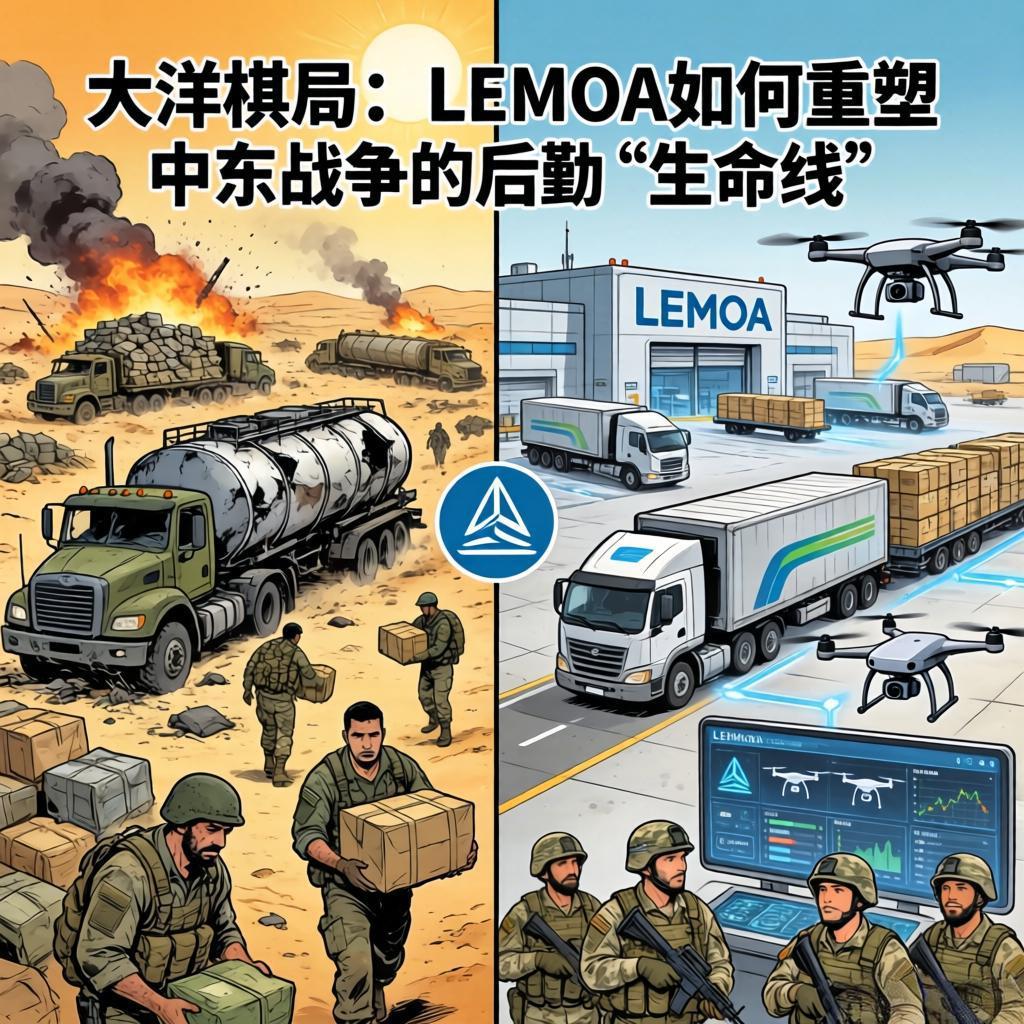

2016年,美国与印度签署的《后勤交换协定备忘录》(LEMOA)看似只是一份程序性文件,却悄然改写了印度洋地区的战略地形。它并未建立新军事基地,却通过“相互提供后勤支持”的条款,将印度西海岸的港口与机场,编织进了美军全球力量投送的网络之中。对远在千里之外的中东战场而言,这条悄然接通的“血管”,在战事最激烈的年代,成为了维系联军行动弹性与威慑可信度的关键后勤生命线。
The Oceanic Chessboard: How LEMOA Reshaped the Logistics "Lifeline" of the Middle East Conflict
The Logistics Exchange Memorandum of Agreement (LEMOA) signed between the United States and India in 2016 appeared to be a procedural document, yet it quietly redrew the strategic map of the Indian Ocean region. It did not establish new military bases, but through its clauses on "mutual provision of logistical support," it integrated the ports and airfields along India's western coast into the U.S. military's global power projection network. For the conflict zones in the Middle East thousands of kilometers away, this quietly activated "pipeline" became, during the most intense years of warfare, a critical logistical lifeline sustaining the operational flexibility and deterrent credibility of coalition forces.
它的直接影响最为直观:极大优化了美军跨越印度洋的机动与后勤效率。此前,美军舰机从太平洋调往波斯湾,或在中东与亚太之间轮转,严重依赖有限的中间站(如迪戈加西亚)。LEMOA生效后,印度港口如孟买、科钦成为了可靠的“中途加油站”和“维修站”。这意味着航母战斗群可以更佳状态进入战区,运输机部队的部署节奏得以加快,对突发危机的应急响应时间被实质缩短。这种“速度”与“可持续性”的提升,本身就是一种强大的战略威慑。
Its most direct impact was straightforward: a dramatic optimization of U.S. military mobility and logistical efficiency across the Indian Ocean. Previously, the transit of U.S. vessels and aircraft from the Pacific to the Persian Gulf, or their rotation between the Middle East and Asia-Pacific, heavily relied on limited waypoints like Diego Garcia. After LEMOA took effect, Indian ports such as Mumbai and Kochi became reliable "pit stops" and "service stations." This meant carrier strike groups could enter operational areas in better condition, the deployment tempo of airlift forces could be accelerated, and emergency response times to sudden crises were tangibly reduced. This enhancement of "speed" and "sustainability" was, in itself, a potent form of strategic deterrence.
在战术层面,这份协议直接支持了阿富汗战场。在2016-2021年间,当经巴基斯坦的北方陆地补给线因双边关系波动而充满不确定性时,LEMOA为一条关键的“南方空中与海上走廊”提供了法律框架。物资可经海路运抵印度西海岸,再通过协议安排的空中或陆路通道转运至阿富汗。这为驻阿联军提供了至关重要的后勤冗余,确保了军事行动不因单一补给线的中断而陷入瘫痪,堪称战时供应链的“保险策略”。
On a tactical level, the agreement directly supported the war effort in Afghanistan. Between 2016 and 2021, when the primary northern land supply route through Pakistan became unreliable due to bilateral tensions, LEMOA provided the legal framework for a crucial "southern air and sea corridor." Supplies could be shipped to India's western coast and then transferred to Afghanistan via pre-arranged air or land routes. This provided vital logistical redundancy for coalition forces in Afghanistan, ensuring military operations would not be paralyzed by the disruption of a single supply line—a veritable "insurance policy" for the wartime supply chain.
更重要的是,LEMOA巩固了美国对中东战场“海上大动脉”——阿拉伯海与北印度洋——的控制。中东的能源出口与军事物资流入,绝大部分依赖这片海域。美军通过更便捷地使用印度港口,实现了在该区域更持久、更高频的存在。这不仅增强了对海上通道(如霍尔木兹海峡)的监控,有效遏制了武器走私和海盗活动,也从侧翼对伊朗形成了持续的、静默的战略压力,塑造了更有利于联军的安全海上环境。
More importantly, LEMOA solidified U.S. control over the "maritime artery" of the Middle East conflict—the Arabian Sea and the northern Indian Ocean. The vast majority of the region's energy exports and military material inflows depend on these waters. By facilitating easier access to Indian ports, the U.S. military achieved a more persistent and frequent presence in the area. This not only enhanced monitoring of maritime chokepoints like the Strait of Hormuz, effectively curbing arms smuggling and piracy, but also exerted a continuous, quiet strategic pressure on Iran from its flank, shaping a more secure maritime environment favorable to coalition operations.
从宏观战略视角看,LEMOA的意义在于“连接”。它将美国的“印太战略”与其中东军事存在有机地衔接起来。印度不再是地缘版图上孤立的棋子,而成为了连接西太平洋基地群与波斯湾前线之间的关键战略枢纽。这使得美军能够以更低的成本和更高的效率,在“印太”与“中东”两大战略区之间调整和投送力量,实现了全球兵力部署的“一体化”和“网络化”,显著增强了应对两场潜在危机或进行长期消耗战的能力。
From a macro-strategic perspective, LEMOA's significance lies in "connection." It organically linked the U.S. "Indo-Pacific Strategy" with its military presence in the Middle East. India was no longer an isolated piece on the geopolitical chessboard but became a crucial strategic nexus connecting the Western Pacific base network with the frontline in the Persian Gulf. This allowed the U.S. military to adjust and project power between the two major strategic theaters of the "Indo-Pacific" and the "Middle East" with lower costs and higher efficiency, achieving an "integrated" and "networked" global force deployment, significantly enhancing its ability to handle two potential crises or engage in prolonged wars of attrition.
然而,这条生命线也并非没有脆弱性。其运作完全基于印度的政治同意,每一次使用均需新德里逐案批准。这确保了印度对国家主权的绝对掌控,但也意味着这条生命线的畅通与否,与瞬息万变的印美关系、印度国内政治以及其中东外交的微妙平衡深度绑定。它是一把双刃剑,既赋予了美军灵活性,也使其战略规划必须将印度的立场作为关键变量纳入其中。
However, this lifeline is not without its vulnerabilities. Its operation is entirely dependent on India's political consent, requiring New Delhi's case-by-case approval for each use. This ensures India's absolute control over its sovereignty but also means the lifeline's operability is deeply tied to the ever-changing dynamics of India-U.S. relations, India's domestic politics, and its delicate diplomatic balancing in the Middle East. It is a double-edged sword, granting the U.S. military flexibility while also forcing its strategic planning to incorporate India's stance as a critical variable.
历史地看,LEMOA代表了现代战争演化的一个缩影:胜负不仅取决于前线火力的交锋,更依赖于后方的、隐形的全球后勤网络的支持能力。一份远在南亚签署的后勤协议,通过对后勤效率、战略机动性和战区存在感的倍增效应,实质性地影响了中东战场的进程与态势。它证明了在全球化时代,战争的“后方”与“前方”的界限已然模糊,战略优势往往建立在由条约、港口和航线编织的、看不见的网络之上。
Historically, LEMOA represents a microcosm of the evolution of modern warfare: victory depends not only on frontline firepower but increasingly on the capacity of rear-area, invisible global logistical networks. A logistical agreement signed in distant South Asia tangibly influenced the course and posture of the Middle East conflict through its multiplicative effects on logistical efficiency, strategic mobility, and theater presence. It demonstrates that in the era of globalization, the boundary between the "rear" and the "front" in war has blurred, and strategic advantage is often built upon invisible networks woven from treaties, ports, and shipping lanes.
今天,随着美军从中东进行战略调整,LEMOA所支撑的这条“生命线”的重点,已更多转向支持“印太”地区的战略竞争。但其创立的原则与网络依然存在。它留下了一个持久的遗产:即在大国竞争时代,后勤协议的全球联动效应,能够以一种安静却深刻的方式,重新定义遥远战场的规则与平衡。大洋棋局上的一步闲棋,或许正是决胜千里之外的关键手。
Today, as the U.S. military recalibrates its focus from the Middle East, the emphasis of this LEMOA-supported "lifeline" has shifted more towards underwriting strategic competition in the "Indo-Pacific" region. Yet, the principles and networks it established endure. It leaves a lasting legacy: in an era of great power competition, the global linkage effects of logistical agreements can, in a quiet yet profound manner, redefine the rules and balance of distant battlefields. A seemingly minor move on the oceanic chessboard may indeed be the pivotal hand that decides the outcome a thousand miles away.
此文由 怡心湖 编辑,若您觉得有益,欢迎分享转发!:首页 > 观·世界 » 大洋棋局:LEMOA如何重塑中东战争的后勤“生命线”