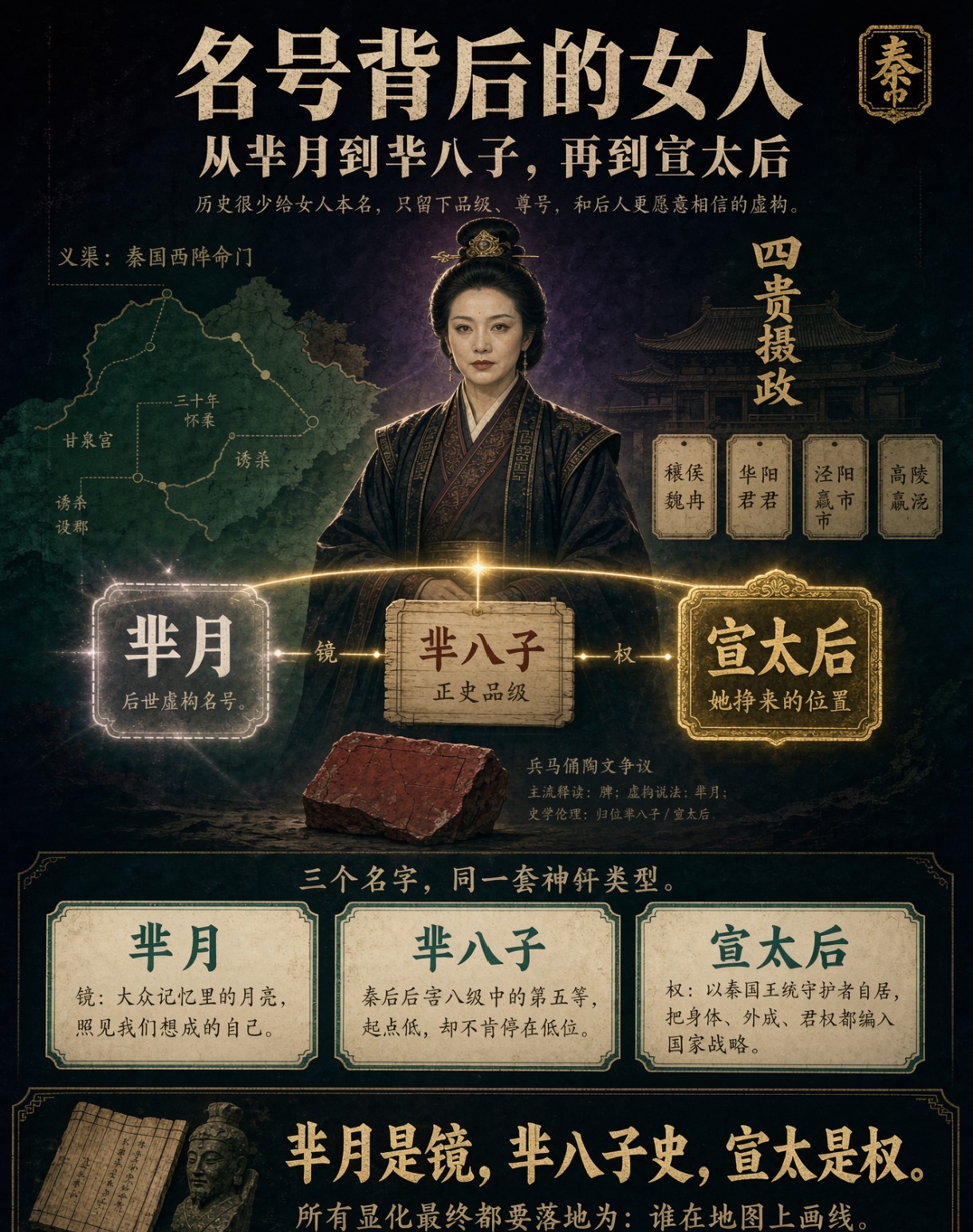
The Woman Behind the Name: From "Mi Yue" to Mi Bazi, the First Dowager of Qin
名号背后的女人:从"芈月"到芈八子,秦国的第一位太后
History rarely gives a woman her own name. Sometimes it gives her a title, sometimes a rank, and sometimes a fiction the later world prefers to the truth.
历史很少把一个女人的本名留给后人。有时给她一个尊号,有时给她一个品级,有时干脆留一段后人更愿意相信的虚构。
I. A Name That Never Existed in the Records
一、史册里不存在的那个名字
Scroll through Records of the Grand Historian (Shiji), and you will not find the two characters 芈月 (Mǐ Yuè). What you find is a rank and a title:
"The mother of King Zhaoxiang was formerly called Mi Bazi; when King Zhaoxiang ascended the throne, Mi Bazi was honored as Queen Dowager Xuan."
「昭王母故号为芈八子,及昭王即位,芈八子号为宣太后。」——《史记·穰侯列传》
Mi (芈) was the ancestral clan name of Chu. Bazi (八子) was not a pet name — it was the fifth rank in the Qin harem hierarchy: after Queen, Furen, Meiren, Liangren, came Bazi, then Qizi, Changshi, Shaoshi. She entered the court of King Huiwen of Qin as a concubine of middling status, bore him a daughter and three sons, and waited.
So who invented "Mi Yue"? The story starts in 1974, in Pit No. 1 of the Terracotta Army. On one warrior-figure, archaeologists found a carved mark. The lead excavator Yuan Zhongyi (袁仲一) read it as a single artisan's name — 脾 (pí), consistent with the Qin system of wu le gong ming (物勒工名, "every object bears its maker's name"). But scholar Chen Jingyuan (陈景元) argued the mark was a hewen (合文, ligature) of two characters: 芈月, and from that leap came the claim that the Terracotta Army was her burial pit, and that "Mi Yue" was her personal name.
Mainstream archaeology rejected both claims. The Qin script for "芈" has a grass-head radical nothing like the mark; the "太后" corpus of Sima Qian never uses the name; and the Qin of 265 BCE simply did not have the treasury to build Lintong's army — that belonged to the First Emperor fifty years later.
芈月 is a modern literary construct. 芈八子 is history. 宣太后 is the seat she earned.
芈月是今人的文学拼图,芈八子是史册的品级,宣太后是她自己挣来的位置。
II. From Chu Side-Line to Qin Power Center
二、从楚国的旁支宗女,到秦国的权力中枢
She was not the beloved little princess of King Wei of Chu the TV drama paints. She was a side-branch clanswoman of the Mi lineage — by the time she reached marriageable age, the family's luster had faded. She married into Qin as one of Huiwen's many concubines, produced Ying Ji (嬴稷) among other children, and lived under the shadow of the formal Queen (a Wei-clan daughter, not a Chu princess).
When Huiwen died, the throne passed to King Wu, a monarch "strong and fond of games" (武王有力好戏) who cracked his shin lifting a bronze ding and bled to death without an heir. In the scramble that followed, Mi Bazi's eldest son Ying Ji was a hostage in Yan. Her half-brother Wei Ran (魏冉), full brother Mi Rong (芈戎), and a handful of aligned ministers turned the crisis into a coup: they pulled Ying Ji back from Yan (with Zhao's King Wuling smoothing the road), crushed the rival line of Queen Huiwen's faction in what history calls the "Ji Jun zhi luan" (季君之乱), and seated the eighteen-year-old as King Zhaoxiang of Qin.
A mother with a minor concubine rank now stood above the court. The word "太后" (Queen Dowager / Empress Dowager) enters Chinese political usage here as a functioning office — Song scholar Chen Shidao later wrote: "母后临政,自秦宣太后始也。" ("A mother ruling from behind the curtain began with the Qin Queen Dowager Xuan.")
III. Forty Years of Qin in a Woman's Hand

三、四十年秦国,握在一个女人手里
From roughly 306 to 266 BCE, she governed. Around the young king she built a kinship bloc later called the Four Nobles (四贵):
-
Wei Ran (穰侯, her half-brother) — Prime Minister four times over
-
Mi Rong (华阳君, her full brother)
-
Ying Kui (高陵君) and Ying Shi (泾阳君) — her younger sons
Through them she promoted Bai Qi, won Yique, burned Yan and Ying into Chu's heartland, triumphed at Huayang. By the time the courtiers whispered "We hear of the Queen Dowager and the Four Nobles, not of the King of Qin," the phrase was no compliment but a structural fact.
Her most cold-blooded stroke was geographic. Northwest of Qin lay Yiqu (义渠), a nomadic confederation that had fought Qin for generations. Past kings met it with campaigns; she met it with her body. Shiji·Xiongnu Liezhuan records it without flinching:
"In the time of King Zhaoxiang, the Rong king of Yiqu committed adultery with Queen Dowager Xuan and had two sons. The Queen Dowager deceived him and killed the Yiqu king at Ganquan, then raised troops and smashed Yiqu."
「秦昭王时,义渠戎王与宣太后乱,有二子。宣太后诈而杀义渠戎王于甘泉,遂起兵伐残义渠。」
Hou Hanshu·Xiqiang Zhuan adds the date and the spoil: 272 BCE, Ganquan Palace, two sons borne, then the knife — and Qin annexed the land into Longxi, Beidi, and Shangjun, building the long wall against the Hu. Historian Ma Feibai judged her service no less than Zhang Yi's or Sima Cuo's taking of Ba-Shu.
This is the scene the novel and the screen retell as "勾引义渠王" — and yes, by the plain record, it was she, Queen Dowager Xuan, who drew the Yiqu king in, kept him for years, bore his children, and killed him when the map was ready. Not a lover's plot. A sovereign's trap.
IV. The Fall: When the King Remembered He Was King
四、退场:当秦王想起自己是王
Power borrowed from a son eventually comes due. Enter Fan Ju (范雎) from Wei, preaching yuan jiao jin gong (远交近攻, "befriend the far, strike the near") and a sharper warning:
"In Qi men speak of Lord Mengchang, not the King of Qi; in Qin they speak of the Queen Dowager, Ranghou, Huayang, Jingyang, Gaoling — not the King of Qin."
「闻秦但有太后、穰侯、华阳君、高陵君、泾阳君,不闻有秦王。」
King Zhaoxiang, now middle-aged, stripped Wei Ran of the seal, exiled the Four Nobles beyond the passes, confined his mother to the inner palace, and took the reins. Within a year, around October 265 BCE, the Queen Dowager Xuan died and was buried at Zhiyang, at the foot of Mount Li.
Even her last whim made the Zhanguo Ce: dying, she ordered her favorite Wei Choufu (魏丑夫) to follow her into the tomb. Wei panicked; his friend Yong Rui argued the dead feel nothing — she conceded the point and revoked the order. A woman who had used her body as statecraft ended by admitting, pragmatically, that there is no afterlife to perform for.
V. Why "Mi Yue" Wins and "Mi Bazi" Fades
五、为什么"芈月"赢了,"芈八子"退了
The paradox is clean. The archive gives us Mi Bazi / Queen Dowager Xuan — rank, office, deeds. The novel gives us Mi Yue — a girl's name, a moon (月) to hang a heroine on. Audiences remember the name because a name is portable; a rank is bureaucratic, a title is cold.
But the deeper truth sits between them. She did not need the name "Yue" to be real. She needed the rank to show how far she started, the title to show what she seized, and the deed at Ganquan to show what she was willing to pay. Strip the fiction, and the woman grows, not shrinks:
-
Not a Chu princess, but a side-branch clanswoman who out-rose the center.
-
Not a lover of Yiqu's king, but the hand that closed Qin's western door.
-
Not the first "太后" by dictionary origin (the term appears earlier in Zhanguo Ce for Wei's queen-mother), but the first to exercise the office as sovereignty.
-
Not a saint, not a monster — a Qin statesman in a woman's body, priced in two sons she did not spare.
The frequency she held was not gratitude or light; it was composure at the edge of blood. She did not manifest a softer reality. She manifested Qin.
她持有的频率不是感恩也不是光,而是血刃之前的镇定。她没有显化一个更温柔的现实,她显化了秦国。
Coda
If you meet her in a drama, she is Mi Yue, moon over Chu and Qin.
If you meet her in Sima Qian, she is Mi Bazi, the fifth-rank concubine who refused to stay ranked.
If you meet her in the ground of Zhiyang, she is Queen Dowager Xuan, who slept beside an enemy for a decade and woke with a kingdom.
Three names. One nervous system that never broke in front of the map.
Sources anchored to Shiji (穰侯列传 / 匈奴列传), Hou Hanshu (西羌传), Zhanguo Ce (秦策), and the Yuan Zhongyi–Chen Jingyuan exchange on the Pit No. 1 Terracotta mark.
此文由 怡心湖 编辑,若您觉得有益,欢迎分享转发!:首页 > 历史人文 » 名号背后的女人:从"芈月"到芈八子,秦国的第一位太后