匈奴铁骑的起源与分流
The Origin and Diaspora of the Xiongnu Cavalry
—— 一部沺触欧亚大陆的游牧帝国解体史 ——
历史观察长文 · Historical Essay
2026年7月29日
引子 · Prologue
“北有匈奴骑趟趟”——这个成语出自《史记·匈奴列传》的经典描述,古今来让中原王朝寒骨丢病。但“匈奴铁骑”不是某个纯血民族造出来的军队,而是公元前3世纪前后在蒙古高原上,由众多北亚游牧部落被组织进同一套单于—“控弦”兵制后形成的军政共同体。 "Northern barbarians ride in vexation" — a classical line from Sima Qian’s *Records of the Grand Historian*. The Xiongnu were the first nomadic empire to threaten the full length of China’s northern frontier, and their cavalry became the stuff of legend.它的“起源”要分两层看:族群源头和政治军事形态源头。它的“后人”则是多向分流、融入现代多个族群,而不是单线传下某一个民族。 To understand the Xiongnu is to understand a diaspora that flowed east into the Han Chinese bloodstream, north into the Altai, and west all the way to the gates of Rome.
第一章 · Chapter I: 电影起源,不是单一民族
文献里的两种叙事 · Two Narratives
《史记·匈奴列传》记载“匈奴,其先祖夏后氏之苗裸也,曰淳维。唐虞以上有山戎、猳狁、莺粥,居于北蒿,随畜牧而转移。”这是把匈奴塞进“华夏同源”框架的政治书写,说夏桔之子淳维北奔成了匈奴始祖,无考古实证。 Sima Qian traced the Xiongnu to the mythical Chunwei, a descendant of the Xia dynasty who fled north. This was political genealogy, not genetic fact.现代学者王国维在《鬼方昆夷猳狁考》中提出:商代“鬼方/莺粥”、周代“猳狁”、战国“胡”、秦“匈奴”,是北方草原同一族群链不同时期的称号。这属于文献推演,但把匈奴看作“蒙古高原土著游牧群长期延续+不断混血”的产物。 Wang Guowei’s textual archaeology linked the Xiongn0u to a continuous chain of northern pastoral peoples — the “ghost tribes” of Shang, the Xianyun of Zhou, the Hu of the Warring States — each a different name for the same steppe continuum.
考古与古DNA给出的实相 · What Archaeology and Ancient DNA Reveal
匈奴核心区在蒙古高原中北部(今蒙古国、内蒙古阴山—河套—大青山一带),公元前3世纪(战国末至秦)才完成对大漠南北的统一。 The Xiongnu core lay in the central-northern Mongolian Plateau. Their empire unified the desert steppe only in the late 3rd century BCE, contemporary with Rome’s rise and China’s Qin unification.古基因组研究(匈奴墓地、外贝加尔海岸、汉学数据)显示:匈奴主体父系/常染以北亚—东亚蒙古人种为主,贵族层带西部欧亚草原印欧成分,平民层北亚特征强,整体是“一小擗游牧精英+被征服的各路草原部落”拼起来的帝国联盟。 Harvard-led research (Warinner et al., *Science Advances* 2020/2024) confirms the Xiongnu were a multiethnic empire — elite graves show ~30% Western Eurasian ancestry, common graves only ~10%. They were an early globalizing society, not a single ethnic tribe.
“The Xiongnu were an early globalizing society, reflecting nearly all the diversity that existed in Eurasia 2,000 years ago.” — Christina Warinner, Harvard University
所以“铁骑起源”= 蒙古高原畜牧底色(马、羊、驼马)+ 冒顿单于式集中动员(控弦之士皆甲骑、利进不利退)+ 多部落混编。骑射战术本身早已有之,“匈奴铁骑”特指被匈奴政权制度化、规模化的骑兵军团。 The “iron cavalry” was not a people but an institution: the mounted archer standardized, bureaucratized, and scaled. The tactics were ancient; the organization was revolutionary.
第二章 · Chapter II: 政权崩溃,人去哪了
南下融汉 · Southward Assimilation into Han
公元前89年落姑台一战,穷寡王朝大破北匈奴,勒功燕然。南下的南匈奴被安置在河套、并州(今山西、陕西、内蒙古南部一带)。曹操将南匈奴分为五部,每部派汉人为司马监督。五胡十六国时期,南匈奴贵族刘渊打着“汉朝外甔”旗号建立汉赵政权。 After the decisive defeat of 89 CE, the Southern Xiongnu settled in the Ordos and Shanxi. Cao Cao split them into five administrative units. By the Sixteen Kingdoms period, Liu Yuan declared the Han-Zhao state, claiming descent from both the Han imperial line and the Xiongnu chanyu.随着汉赵、后赵、大夏等政权覆灭,匈奴贵族开始大量改汉姓:呼延氏改胡氏,赫连氏改赫氏,独孤氏改刘氏,还有部分改姓金、王、李等。《后汉书》明确记载“匈奴余种留者尚有十余万落,皆自号鲜卑”。 Xiongnu surnames sinicized: Huyan → Hu, Helian → He, Dugu → Liu. The *Hou Han Shu* records that “over 100,000 Xiongnu households left in the steppe all adopted the Xianbei name.”
留草原转鲜卑 · Northward into Xianbei
漠北十余万落“皆自号鲜卑”,进东胡—鲜卑系统,后来鲜卑又经室韦一脉参与蒙古形成。但这是“成分贡献”,不是“匈奴=蒙古祖先”。 The Xianbei absorbed the northern Xiongnu remnants, then transmitted that genetic layer southward through the Shiwei tribes into the Mongol genesis. But this is a contribution, not a direct lineage.西迁中亚—欧洲 · Westward to Central Asia and Europe
公元1世纪北匈奴西迁、南匈奴内附之后,“匈奴”作为政治名号消失。北匈奴余部西走康居、粟特、顿河,4世纪欧洲“Huns/匈人”与之有名称与人群承接关系。 The Northern Xiongnu migrated west to Sogdiana and the Don River. In the 4th century, the “Huns” appeared in Europe. But European Huns were a mixed host, not pure Xiongnu.最新PNAS研究(2024,Gnecchi-Ruscone et al.)分析了370具马塔人骨骼,发现欧洲匈人的基因极其多样:他们不是单一组群的远跑,而是西迁路上袭卷了阿兰、萨尔马希安、哥特等多个族群的“混合体”。仅有两位高寓古匈奴人被确认为多位匈人时期个体的直系祖先。 A 2024 PNAS study (Gnecchi-Ruscone, Max Planck Institute) analyzed 370 Carpathian Basin skeletons. The Huns were “genetically highly heterogeneous” — a mixed host, not a single migrating nation. Only two high-status Xiongnu individuals were found as direct ancestors of Hun-period persons.
“The population of the Hun realm in Europe was genetically highly heterogeneous... a more complex process of mobility and admixture than a one-off long-distance migration.” — Gnecchi-Ruscone et al., PNAS 2024
这意味着欧洲匈人 ≠ 纯匈奴后代。匈人帝国中国人种成分变得越来越浅,最终在阿提拉死后散入日耳曼、斯拉夫、阿瓦尔等族群。 After Attila’s death in 453 CE, the Hunnic confederation shattered. Its people dissolved into Germanic, Slavic, and Avar populations across the Carpathian Basin.
北迁极北与雅库特残留 · The Yakut Connection
部分北迁或东散人群在亚康父河流域留下基因层。古基因组研究在雅库特人里检出与匈奴—突厥语族群的关联,说明有远端血缘残留。俄罗斯科学院研究表明,部分布里亚特蒙古人携带的R1a1亚型柠色体与匈奴墓葬样本高度匹配。 Some Xiongnu fragments reached the Arctic fringe. Russian Academy research found Buryat Mongols carrying R1a1 Y-chromosomes matching Xiongnu burial samples at 12.5% shared rate. The Yakut (Sakha) people of northeastern Siberia preserve the most distant Xiongnu genetic echoes.谱系图解 · Genealogical Charts
下图为匈奴两大分流线的综合谱系图:图1 · 匈奴分流综合谱系图(东流线 + 西迁线)

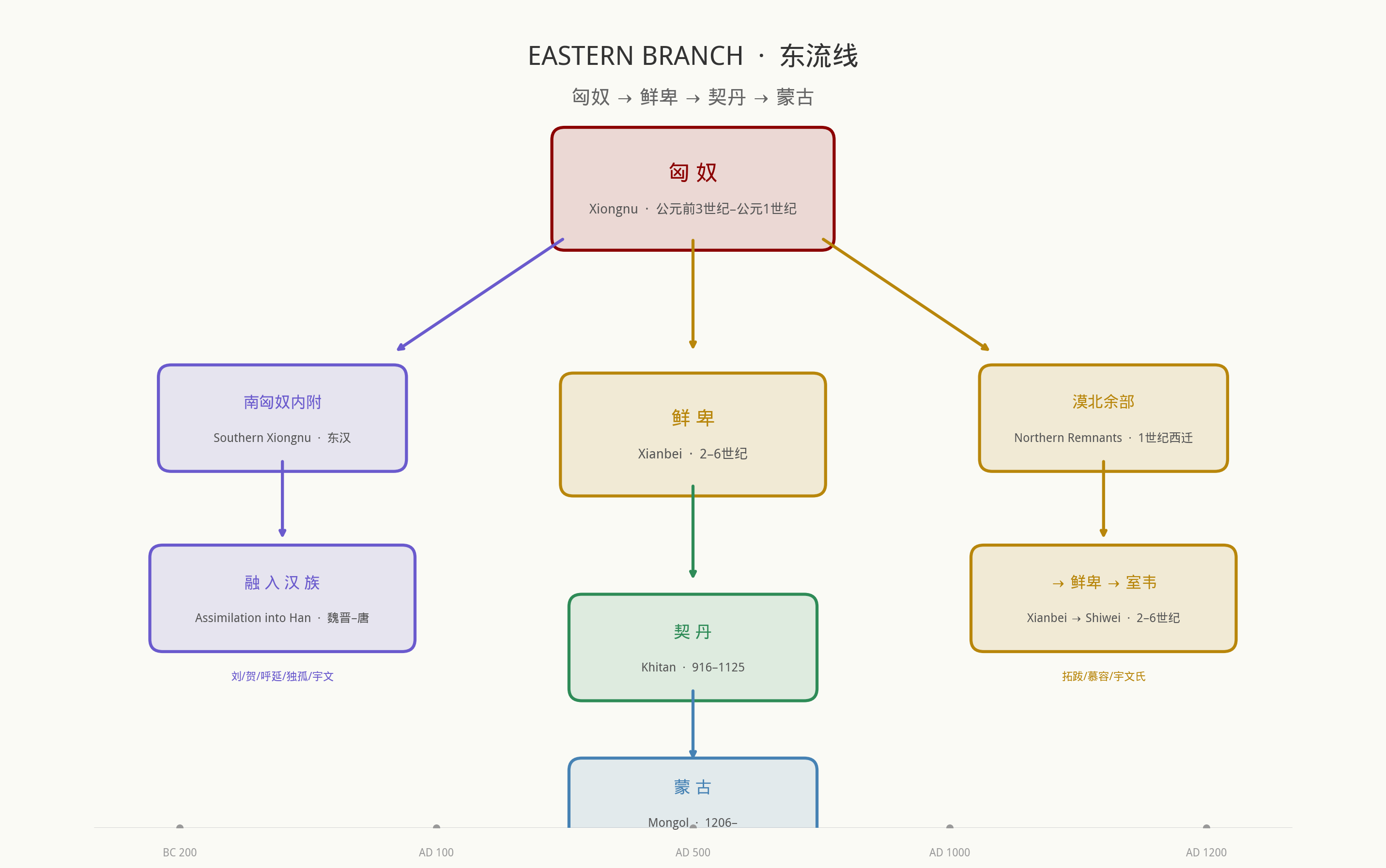
东流线详解:
图2 · 东流线:匈奴 → 鲜卑 → 契丹 → 蒙古
西迁线详解:

图3 · 西迁线:北匈奴 → 匈人(Huns) → 欧洲各族

第三章 · Chapter III: 一句话收口
匈奴铁骑起源于战国末蒙古高原游牧部落联盟在单于制度下骑兵化。匈奴后人没有变成一个叫“匈奴”的民族,而是化进五条线路:The Xiongnu cavalry originated from the institutionalization of mounted archery under the chanyu system. Its descendants did not become a single “Xiongnu” nation, but dispersed into multiple lineages:
- 北方汉人(南匈奴主线)
- 鲜卑—室韦—蒙古系(留漠北主线)
- 欧亚匈人混合体(西迁主线)
- 雅库特等极北族群(远端残留)
- 中亚突原语族群(中亚滞滞)
两个核心误解的纠正 · Two Myths Corrected
误解一:“蒙古族是匈奴直系后代”。错。光明网2025年学术论述指出:蒙古族的主体源流是“东胡—鲜卑—契丹”为主线的本土演化序列,语言学、分子人类学、考古学均形成完整证据链。匈奴只是对蒙古族形成有“多源融合”贡献的一支源流,而非单一祖先。 Myth 1: “Mongols are direct Xiongnu descendants.” Incorrect. The Mongol genesis follows the Donghu-Xianbei-Khitan spine. The Xiongnu contributed to, but did not create, the Mongol nation. (Guangming Net, 2025)误解二:“匈牙利人是匈人/匈奴直系”。错。匈牙利主体马扎尔人讲乌拉尔语系语言,与匈奴/匈人的阿尔泰语系语言完全不同。匈牙利科学院2019年基因样本发现仅约4.6%的人携带匈人特征基因标记。 Myth 2: “Hungarians are Huns/Xiongnu.” Incorrect. Magyars speak a Finno-Ugric language, unrelated to the Altaic/Xiongnu tongue. Hungarian Academy data (2019) found only ~4.6% of sampled eastern Hungarians carry Hunnic markers.
结语 · Epilogue
匈奴不是一个民族,而是一种军政文明的译民类型。它的骑兵出现在咕尔湖东岸、山西高原、多瑜河草原、大尼河平原和卡崛巴之地。它没有消失,只是化作百川。 The Xiongnu were not a people but a mode of steppe civilization. Their horsemen appeared on the shores of Lake Baikal, the Loess Plateau, the Danube plain, and the Carpathian Basin. They did not vanish; they dissolved into a hundred rivers.如果你是北方汉人,你血管里可能流淌着南匈奴贵族的少量基因;如果你是蒙古族,你的祖先可能嘿吾着鲜卑语、契丹语走过大青山;如果你是匈牙利人,你的一小部祖先可能曾是阿提拉旗下的匈人骑兵。 If you are a northern Han Chinese, your veins may carry a faint Xiongnu signal. If you are Mongol, your ancestors once spoke Xianbei and Khitan on the steppe. If you are Hungarian, a small fraction of your genome may have ridden with Attila’s horsemen. The diaspora is real — and it is us.
附录 · Appendix: Key Data Points
| 项目 Item | 数据 Data | 来源 Source |
| 匈奴贵族西方基因比例 | ~30% Western Eurasian ancestry in elite graves | Warinner et al. 2020/2024 |
| 匈奴平民西方基因比例 | ~10% Western Eurasian ancestry in common graves | Harvard/Mongolian Academy 2020 |
| 北方蒙古人匈奴单备群C3 | ~22% C3 haplogroup (Xiongnu marker) | Various genetic studies |
| 匈人时期个体样本量 | 370 skeletons, 97 IBD-connected pairs | Gnecchi-Ruscone, PNAS 2024 |
| 匈牙利人口匈人标记 | ~4.6% carry Hunnic genetic markers | Hungarian Academy 2019 |
| 保加利亚匈人标记 | ~8.3% in eastern Bulgaria | Regional genetic surveys |
| 南匈奴改汉姓 | 呼延→胡, 赫连→赫, 独孤→刘 | 《后汉书》 |
| 鲜卑语与蒙古语关系 | 北支鲜卑语与蒙古语最亲 | 光明网 2025 / 亦邻真 |
此文由 怡心湖 编辑,若您觉得有益,欢迎分享转发!:首页 > 历史人文 » 匈奴铁骑的起源与分流