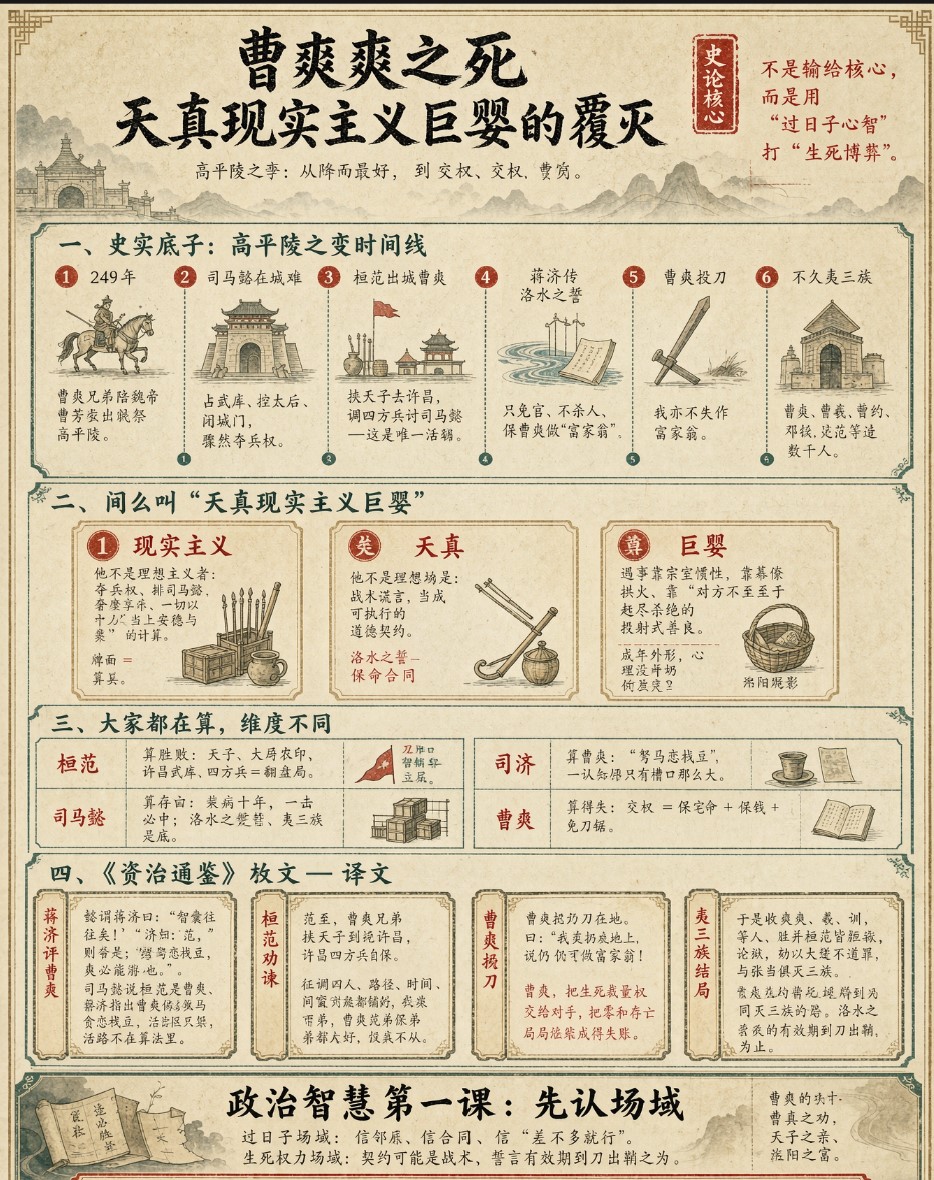
曹爽之死:一个“天真现实主义巨婴”的覆灭
The Death of Cao Shuang: The Fall of a "Naive Realist Man-Child"
公元249年,洛阳。高平陵的尘土尚未落定,曹爽掷刀于地,笑着说:“我亦不失作富家翁。”
In 249 AD, in Luoyang, the dust of Gaoping Mausoleum had not yet settled when Cao Shuang threw his sword to the ground and said with a smile, "I shall still live as a wealthy squire."
这一句,被司马光写进《资治通鉴》,被桓范骂作“豚犊”,被蒋济判为“驽马恋栈豆”,也被千年后的读史人提炼成一句冷峭的判词——天生现实主义的巨婴。
This single line was recorded by Sima Guang in Zizhi Tongjian, cursed by Huan Fan as "piglet calves," diagnosed by Jiang Ji as "a nag loath to leave its trough," and distilled by modern readers into a cold verdict—a born realist man-child.
一、他不是不懂现实,他是只懂“自己的现实”
I. He Did Not Misread Reality—He Only Read His Own
曹爽不是傻子。他夺过兵权,排过司马懿,把何晏、邓飏、丁谧塞进尚书台,让弟弟曹羲、曹训分掌中领军与武卫将军,饮食衣服拟于乘舆,尚方珍玩充牣其家。他太知道权力长什么样,也太知道怎么享用权力。
Cao Shuang was no fool. He seized military command, sidelined Sima Yi, packed the Secretariat with He Yan, Deng Yang, and Ding Mi, and gave his brothers Cao Xi and Cao Xun control of the palace guard. His food, clothes, and trinkets rivaled the emperor's. He knew exactly what power looked like—and how to enjoy it.
但他的“现实”有一条隐式前提:明天会和昨天一样,对手会和自己一样,契约会比刀锋更硬。
But his "realism" rested on a silent premise: tomorrow will resemble yesterday; rivals think like him; a sworn oath outlasts a sharpened blade.
司马懿称病数年,李胜探病时见其“衣落粥流”、声气才属,回去报称“尸居余气”。曹爽信了。不是信司马懿真病,是信一个七十老翁没必要再赌身家性命——用自己的人生算法去推别人的生死观。
When Sima Yi played dying—robe slipping, congee spilling down his chest, voice fading—before Li Sheng, Cao Shuang believed it. Not because he thought Sima Yi truly ill, but because a seventy-year-old had no reason to gamble his clan's life again. He ran another man's will-to-power through his own household arithmetic.
司马懿指洛水为誓:“唯免官而已。”蒋济以百口相保。曹爽算账:交权=保命+保宅+保钱+免刀锯。这笔账在太平年月是对的,在零和政变里是自杀。他把政治承诺当商业合同,把权臣誓言当乡绅口碑。
Sima Yi swore by the Luo River: "Only your office shall be stripped." Jiang Ji pledged his whole family. Cao Shuang tallied it up: surrender = life + manor + coin + no blade. The math held in peacetime; in a zero-sum coup it was suicide. He took a political pledge for a commercial contract, and a warlord's oath for a gentleman's word.
二、巨婴不在年龄,在认知没断奶
II. The Man-Child Is Not Young in Years, but Unweaned in Judgment
武志红谈“巨婴”:生理成年、心理婴儿,三件套是共生、全能自恋、偏执分裂。 曹爽全中,只是穿了朝服。
Wu Zhihong's "man-child" is biologically adult, psychologically infant: symbiosis, omnipotent narcissism, paranoid-splitting. Cao Shuang hit all three—in court robes.
-
共生:他与曹羲、曹训、曹彦兄弟并出祭陵,“总万机,典禁兵”却一同离城,桓范早劝“不宜并出”,他答“谁敢尔”。他把宗室身份、兄弟血缘、洛阳宅邸当成母体,离开这套共生壳就失重。巨婴不是一个人,是一团黏在舒适区里的共生物。
-
Symbiosis: He and his brothers—all holding core commands—left the city together for the rites. Huan Fan had warned "the helm and the guard should not both leave," and he answered "who dares?" He treated his clan name, his brothers' blood, and his Luoyang manor as a womb; outside that shell he had no gravity. The man-child is not one person, but a clump of symbiosis stuck to its comfort zone.
-
全能自恋:他以为“我是大将军曹真之子,天子同宗,司马懿再狠也不过夺权”。把自己位置的惯性当成了世界运行的法则——婴儿觉得一动念母亲就该来,他觉得一动念洛阳就该还是他的。
-
Omnipotent narcissism: He assumed, "I am son of Cao Zhen, kinsman to the throne; Sima Yi at worst wants my seat." He mistook the inertia of his office for the law of the world—as an infant expects the mother at every cry, he expected Luoyang to stay his.
-
偏执分裂:要么桓范说的“挟天子奔许昌,发四方兵”(全赢),要么司马懿说的“免官富家翁”(全保),中间没有第三态。他接不住“交权后可能被杀”的灰度,就像婴儿接不住“妈妈不在=世界灭亡”的焦虑,只能选那个听起来不疼的选项。
-
Paranoid-splitting: Either Huan Fan's "take the emperor to Xuchang, summon the provinces" (total win), or Sima Yi's "resign and keep your wealth" (total safe)—no third state. He could not hold the gray truth "surrender may still kill you," just as an infant cannot hold "mother absent = world ended," so he picked the option that sounded painless.
甲夜到五鼓,桓范把路一条条铺好:许昌别库、大司农印、典农治所、中领军别营,“不过中宿”可立旗。曹爽沉默一夜,末了投刀:“不失作富家翁。”桓范哭骂:“曹子丹佳人,生汝兄弟,豚犊耳!”
From dusk to the fifth watch, Huan Fan laid out every road: the armory at Xuchang, the Grand Farmer's seal, the camp outside the wall—"two nights' march and you stand a banner." Cao Shuang stayed silent the whole night, then dropped his blade: "I shall still be a wealthy squire." Huan Fan wept and cursed: "Cao Zidan was a fine man; he bred you brothers as piglets!"
巨婴的终极特征:遇事不决,回舒适区。洛阳的宅子、后园的弹弓、尚方的珍玩,就是曹爽的奶嘴。
The man-child's final tell: when trapped, crawl back to the crib. The Luoyang mansion, the slingshot in the back garden, the trinkets in the vault—these were Cao Shuang's pacifier.
三、政治智慧的第一课:分清“过日子”和“定生死”
III. The First Lesson of Statecraft: Tell "Living Well" from "Surviving the Kill"
高平陵之变里,所有人都在算,算的维度不同。
In the Gaoping coup, everyone calculated—but on different axes.
-
桓范算胜败:天子在手、大司农印在手、许昌在望,这是翻盘局。
-
Huan Fan calculated victory: the emperor in hand, the grain seal in hand, Xuchang in reach—a comeback board.
-
司马懿算存亡:装病十年,一击必中,洛水之誓是饵,夷三族才是底。
-
Sima Yi calculated existence: ten years playing dead, one strike must end it; the Luo oath was bait, the three-clan slaughter the floor.
-
蒋济算人情:他知道曹爽“驽马恋栈豆”,不是赞其聪明,是叹其认知半径只有槽口那么大。
-
Jiang Ji calculated temperament: he knew Cao Shuang was "a nag loath to leave its trough"—not praising wit, but sighing that his cognitive radius ended at the lip of the feed trough.
-
曹爽算得失:今天交权明天还有酒喝,比流血好。他把存亡局降维成得失题,把豺狼降维成乡老。
-
Cao Shuang calculated gain and loss: hand it over today, drink tomorrow; better than blood. He downshifted an existential game to a ledger problem, and demoted wolves to village elders.
政治智慧不是“比别人狡”,是先认场域:
Statecraft is not "be craftier than the next man"; it is first name the arena:
过日子场域里,天真现实主义无害——你信邻居、信合同、信“差不多就行”。
In the arena of daily living, naive realism harms nothing—you trust neighbors, contracts, "good enough."
生死权力场域里,天真现实主义是递刀。因为对手的“现实主义”不带天真,他的契约文本是临时战术,他的誓言有效期到刀出鞘为止。
In the arena of life-or-death power, naive realism hands over the knife. Because the rival's "realism" carries no naivety; his contract is a temporary tactic, his oath expires the moment the blade leaves its scabbard.

曹爽到死没明白一件事:当对方说“我只夺权不杀人”时,夺权与杀人是同一件事的两段式。权夺干净了,证人就不能留。洛水照过誓,也照过后来夷三族的血。
One thing Cao Shuang never grasped: when the rival says "I only take power, not life," taking power and taking life are two beats of one act. Once power is cleanly taken, the witness cannot remain. The Luo River mirrored the oath—and later mirrored the blood of three exterminated clans.
四、后人读曹爽,读的不是三国,是自己
IV. When Later Men Read Cao Shuang, They Read Not the Three Kingdoms but Themselves
我们笑曹爽,是因为我们身上都有一小块曹爽。
We laugh at Cao Shuang because a small piece of him lives in us.
-
谈薪资信老板“明年就涨”,是富家翁幻觉;
-
Trusting the boss's "next year for sure" on pay is the wealthy-squire illusion.
-
谈关系信“他不会真的走”,是驽马恋栈豆;
-
Trusting "he won't really leave" in love is the nag at its trough.
-
谈局势信“这么大体系不会出事”,是把宗室身份当免死金牌。
-
Trusting "a system this big can't collapse" is wearing a clan name as a pardon blade.
天真现实主义巨婴的生成公式很简单:
The formula for a naive-realist man-child is plain:
长期被缓冲带包裹 + 把缓冲带误认为世界常态 + 在零和时刻仍用非零和算法
Long cushioned by shock absorbers + mistaking the cushion for the world's default + running non-zero-sum math at a zero-sum hour
曹爽的缓冲带是曹真之功、天子之亲、洛阳之富;我们的缓冲带可能是平台、编制、房价红利、时代β。缓冲带撤掉那天,投刀说“不失富家翁”的人,未必不是镜中人。
Cao Shuang's cushions were Cao Zhen's merit, kinship to the throne, Luoyang's wealth. Ours may be the platform, the tenure, the housing dividend, the era's beta. On the day the cushion vanishes, the one who drops his blade and says "still a wealthy squire" may well be the man in the mirror.
尾声|洛水千年,誓不抵刀
Coda | A Thousand Years of Luo River, the Oath Outlasted by the Blade
嘉平元年正月,曹爽交印。
First month of Jiaping Year One: Cao Shuang surrendered the seals.
戊戌日,张当供“爽等谋逆”,夷三族,连桓范同戮,五千余口染血。
On the day Wu-Xu, Zhang Dang confessed "Shuang plots rebellion"; three clans were exterminated, Huan Fan among them; five thousand mouths bled.
蒋济惭恚,数月而卒,临死说“吾愧曹爽”。
Jiang Ji, ashamed, died within months, saying at the last: "I have wronged Cao Shuang."
司马懿赢了,曹魏输了,中原走向司马氏十七年后受禅的晋。
Sima Yi won; Cao Wei lost; the central plains drifted to the Jin, which received the abdication seventeen years later.
而那句“不失作富家翁”,从此成了中国政治语汇里的一枚暗钉——
And the phrase "still a wealthy squire" became since then a dark tack in China's political lexicon—
提醒一切掌权者:在存亡之局,拿“过日子心智”做决策的人,结局通常不是富家翁,而是族谱最后一页。
a warning to every wielder of power: in a game of survival, he who decides with the mind of a householder does not end as a wealthy squire, but as the last line of the clan register.
巨婴不是不会死,巨婴只是到刀落那一刻,还以为对方会守洛水之誓。
The man-child does not escape death; he only believes, until the blade falls, that the other side will keep its oath by the Luo River.
参考资料:司马光《资治通鉴·魏纪·高平陵之变》嘉平元年正月条;武志红《巨婴国》心理框架。
Sources: Sima Guang, Zizhi Tongjian, Wei Annals, Jiaping 1/1; Wu Zhihong, The Nation of Man-Children.
此文由 怡心湖 编辑,若您觉得有益,欢迎分享转发!:首页 > 历史人文 » 曹爽之死:一个“天真现实主义巨婴”的覆灭
 世界公民:后全球化时代的身份重构与