The Empire in a Porcelain Bowl: How Fire, Earth, and the Dao Shaped a Civilization
碗中有帝国:火、土与道如何塑造了一个文明
Prologue: The Weight of a Bowl
序章:一只碗的重量
Pick up a Song dynasty bowl. It weighs almost nothing. The walls are thin enough that light passes through the celadon glaze like morning mist through a jade forest. Tap it — it sings, a clear bell-tone that lingers and decays exactly the way a mountain stream does after the rain stops.
拿起一只宋代瓷碗。它几乎没什么重量。胎壁薄到光线能穿过青釉,像晨雾穿过玉色的森林。弹一下——它歌唱,一声清越的钟鸣,余音袅袅消散,恰如雨后山溪归于寂静的样子。
There is no signature. No royal seal screaming look at me. No gilded rim announcing its value. Just a color — a particular green-blue that the Chinese call ru-qing, the blue of rain clouds gathering over the Northern Song capital on the day the emperor stayed indoors and wrote poetry instead of commanding armies.
没有落款。没有皇家印章在喊"看着我"。没有金边宣告它的价值。只有一种颜色——中国人称之为"汝青",一种雨云在北宋都城上空聚集时的蓝绿色,那天皇帝留在宫中写诗,没有调兵遣将。
This bowl is eight hundred years old. It has survived dynasties, invasions, revolutions, earthquakes, and the careless hands of a dozen collectors. It will likely outlive you, me, and the building we're sitting in.
这只碗已有八百年历史。它熬过了王朝更迭、外族入侵、革命、地震,以及十几个收藏家漫不经心的手。它大概率会比你、我、我们所在的建筑都活得久。
And yet — it began as mud.
然而——它始于泥巴。
I. The Alchemy: Earth Remembers Fire
一、炼金术:土记住了火
Long before China was an empire, it was a geological accident waiting to be noticed. The Yangtze and Pearl River basins sat on some of the richest kaolin deposits on earth — a white, refractory clay that, when heated past 1,200°C, undergoes a transformation no other common material achieves: it vitrifies. It becomes a stone that was never a stone, a glass that was never molten sand, a substance that is at once bone-hard and translucent, resonant and inert.
早在"中国"成为一个帝国之前,它只是一个等待被发现的地质偶然。长江和珠江流域坐落在地球上最丰富的高岭土矿床上——一种白色的耐火黏土,加热超过1200°C时,会发生其他常见材料无法达到的转变:它玻化了。它变成了一种从未是石头的石头,一种从未是熔融沙子的玻璃,一种既坚硬如骨又半透明、既清越发声又化学惰性的物质。
No bronze smith ever achieved this. Bronze tarnishes, corrodes, eventually returns to the earth. No jade carver ever approached it — jade is eternal but passive; it waits in the mountain until someone digs it out. Porcelain actively transforms. It is earth that chose, under fire, to become something else entirely.
没有任何青铜匠能做到这一点。青铜会生锈、腐蚀,最终回归大地。没有任何琢玉人接近过它——玉是永恒的但被动的;它在山中等待,直到有人把它挖出来。瓷器主动转变。它是土在火的选择下,决定变成完全不同的东西。
The earliest Chinese potters — Liangzhu blackware, Longshan eggshell-thin cups — were already flirting with this threshold four thousand years before Christ. By the Eastern Han (25–220 CE), they crossed it. True celadon porcelain was born in the Yue kilns of Zhejiang. The West wouldn't see anything comparable for another fifteen hundred years.
中国最早的陶工——良渚黑陶、龙山蛋壳杯——早在公元前四千年就已经在试探这个门槛。到了东汉(公元25–220年),他们跨过去了。真正的青瓷在浙江越窑诞生。西方还要再过一千五百年才能看到可与之相比的东西。
But here's what makes this more than a materials story. The Chinese didn't just discover high-fire ceramics. They built an entire epistemology around it.
但这里有个关键:这让这个故事超越了材料学范畴。中国人不只是发现了高温陶瓷。他们围绕它建立了一整套认识论。
II. The Dao in the Kiln: Laozi's Favorite Object
二、窑中的道:老子最爱的物件
In Chapter 11 of the Daodejing, Laozi writes:
"三十辐共一毂,当其无,有车之用。埏埴以为器,当其无,有器之用。凿户牖以为室,当其无,有室之用。故有之以为利,无之以为用。"
"Thirty spokes converge on a single hub. It is the empty space at the center that makes the wheel useful. We shape clay into vessels. It is the emptiness inside that makes them useful. We cut doors and windows for a room. It is the empty space that makes the room useful. Therefore, what is there provides benefit; what is not there provides utility."
老子拿陶器举例,讲了一个颠覆性的道理:有用的是"空"。车轮转,靠的是辐条围出的那个空;房子住人,靠的是墙壁框出的那个空;碗盛饭,靠的是胎壁圈住的那个空。
No other major philosophical tradition made a pottery vessel its central metaphor for how reality works. Plato used the cave. Buddha used the lotus. Jesus used the mustard seed. Laozi used a bowl.
没有其他主要哲学传统把陶器当作解释现实如何运作的核心隐喻。柏拉图用了洞穴。佛陀用了莲花。耶稣用了芥菜种。老子用了一只碗。
This is not a casual choice. The bowl is the perfect embodiment of wu-sheng-you (无生有) — nothingness giving rise to somethingness. The clay is heavy, dark, earthly. The fire is violent, consuming, transformative. But what emerges is a vessel whose purpose is precisely to hold what isn't there yet: tomorrow's rice, next season's wine, a stranger's tea.
这不是随意的选择。碗是"无生有"的完美体现——空无生出实有。黏土沉重、黑暗、属土。火暴烈、吞噬、转化。但涌现出来的器物,其目的恰恰是容纳尚不存在之物:明天的米饭、下一季的酒、陌生人的茶。
In this sense, every piece of Chinese porcelain is a tiny sermon on the nature of reality. It says: the form is not the point. The space the form creates is the point.
从这个意义上说,每一件中国瓷器都是一篇关于现实本质的微型布道。它说:形不是重点。形所创造的空间才是重点。

III. The Aesthetics of Restraint: Why Song China Perfected the Single Color
三、克制的美学:宋为何把单色釉推向极致
If the Tang dynasty (618–907) was a fireworks display — polychrome, exuberant, slightly chaotic — the Song (960–1279) was the silence after the last spark faded. And in that silence, Chinese ceramic reached its absolute peak.
如果说唐代(618–907)是一场烟花秀——多彩、奔放、略带混乱——那么宋代(960–1279)就是最后一朵火花熄灭后的寂静。而在那片寂静中,中国陶瓷抵达了它的绝对巅峰。
The Song aesthetic can be summed up in one phrase: one color, total commitment.
宋代美学可以用一句话概括:一色,全力以赴。
-
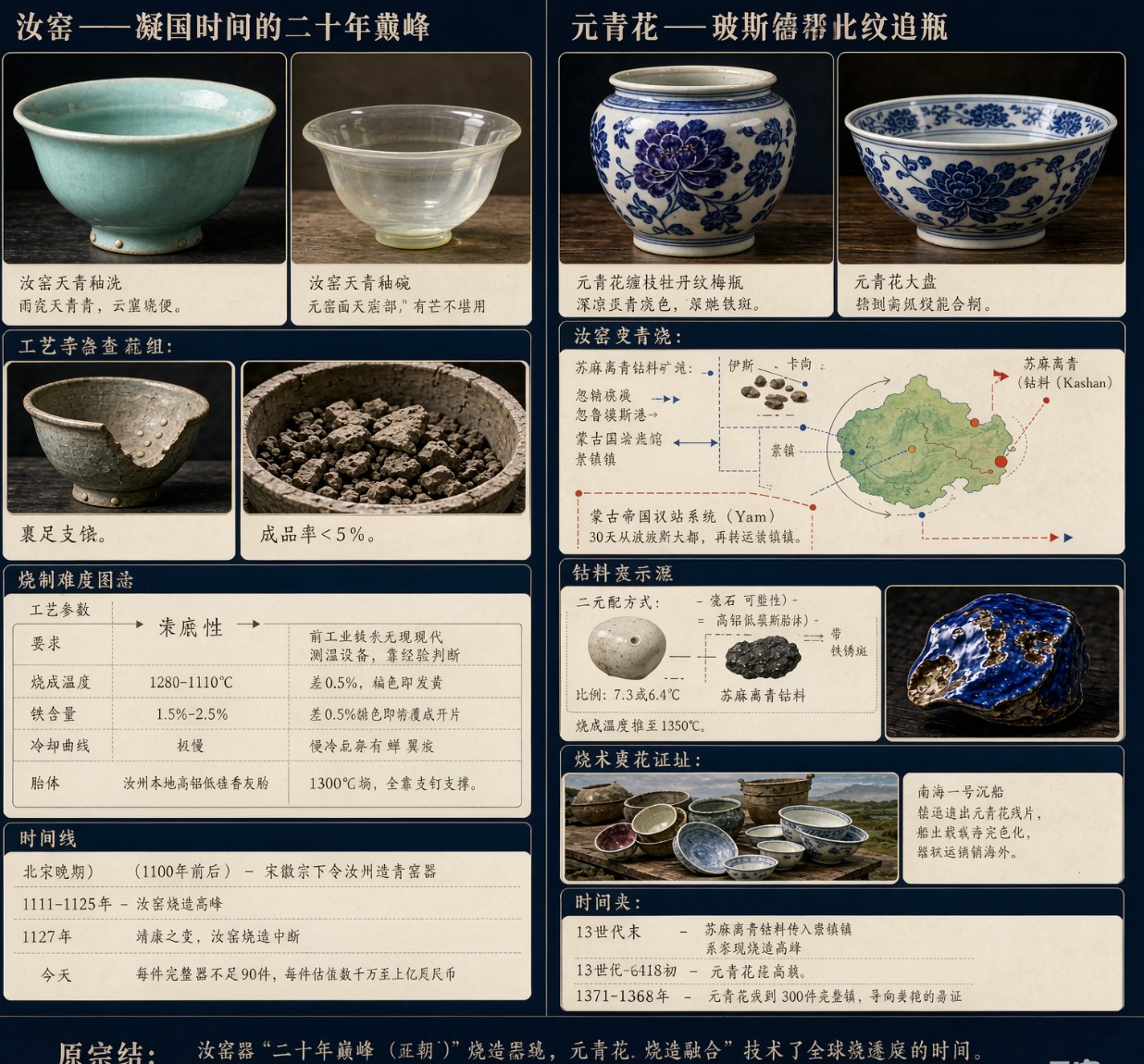
Ru ware (汝窑): A pale blue-green, like the sky after rain. Produced for only twenty years for Emperor Huizong. Fewer than 90 known pieces survive today. Each one looks like it's holding its breath.
-
Ding ware (定窑): Ivory-white with incised floral scrolls, thin as an eggshell, singing when struck.
-
Jun ware (钧窑): Copper-red splashed across a lavender-blue ground — the first controlled use of copper as a ceramic pigment in human history. The potter mixed the glaze, loaded the kiln, and then… walked away. The final pattern was the fire's decision, not his.
-
Jian hare's fur (建盏兔毫): Dark brown-black tea bowls with streaks of silver-gold, beloved by Chan (Zen) monks for their unpredictability. Every bowl is a unique record of a single night's flame.
-
汝窑:一种淡蓝绿色,像雨后天空。仅为徽宗烧造二十年。今天已知存世不足90件。每一件看起来都像在屏息。
-
定窑:象牙白,刻划花卉卷草,薄如蛋壳,叩之有声。
-
钧窑:紫蓝底色上泼洒铜红斑——人类历史上首次对铜作为陶瓷呈色剂的受控使用。陶工配好釉、装好窑,然后……走开。最终的图案是火的决定,不是他的。
-
建盏兔毫:黑褐茶碗,银金色条纹流淌,因其不可预测性被禅宗僧人珍爱。每只碗都是某一个夜晚火焰的独特记录。
This is wu-wei (无为) translated into glaze chemistry. The Song potter did not try to control everything. He prepared the conditions — clay body, glaze composition, stacking arrangement, reduction atmosphere — and then submitted to the kiln. The result was a collaboration between human intention and thermal chaos. Too much control, and the piece looked dead. Too little, and it was a failure. The sweet spot was a narrow band of elegant surrender.
这是"无为"翻译成釉料化学的结果。宋代陶工不试图控制一切。他准备好条件——胎体、釉方、装窑方式、还原气氛——然后向窑屈服。结果是人类意图与热混沌之间的合作。控制太多,作品显得死板。控制太少,就是废品。那个甜蜜点是优雅的臣服的一个窄带。
Compare this to European porcelain of the 18th century — Meissen, Sèvres — which is all about decoration piled upon decoration: gold leaf, painted scenes, gilded handles, cobalt blues with elaborate borders. Beautiful, yes. But it announces itself. It says look how expensive I am. Song porcelain says nothing. It simply is. And in saying nothing, it says everything.
将此与18世纪欧洲瓷器——梅森、塞弗尔——相比,后者全是装饰叠加装饰:金箔、彩绘场景、镀金把手、繁复边饰的钴蓝。美,是的。但它宣告自己。它说"看我多贵"。宋瓷什么都不说。它只是在。而在什么都不说中,它说了一切。
IV. Blue and White: When the World Came to Jingdezhen
四、青花:当世界来到景德镇
By the Yuan dynasty (1271–1368), something unprecedented happened. A Persian cobalt pigment called sumali qing (苏麻离青) arrived via the Silk Road. Chinese potters painted it onto white porcelain under a transparent glaze and fired it at 1,300°C.
到了元代(1271–1368),一件前所未有的事发生了。一种叫"苏麻离青"的波斯钴料沿着丝绸之路到来。中国陶工将它画在白瓷胎上,罩透明釉,1300°C烧成。
The result was blue-and-white — qinghua. And it changed the world.
结果就是青花。它改变了世界。
Blue-and-white was the first truly global consumer product. Before Coca-Cola, before the iPhone, before Swiss watches, there was Chinese blue-and-white. It traveled on every oceangoing route: to the Mamluk courts of Cairo, the samurai households of Japan, the spice ports of Malacca, the merchant warehouses of Amsterdam.
青花是第一个真正全球化的消费品。在可口可乐之前,在iPhone之前,在瑞士手表之前,有中国青花。它航行在每一条远洋航线上:到开罗的马穆鲁克宫廷、日本的武士宅邸、马六甲的香料港口、阿姆斯特丹的商人仓库。
The numbers are staggering. Between 1602 and 1682, the Dutch East India Company alone imported over 16 million pieces of Chinese porcelain into Europe. Not as curiosities — as everyday tableware for the emerging middle class. Entire European dining cultures reorganized themselves around the availability of Chinese porcelain. Before blue-and-white, Europeans ate off pewter and wood, which tasted metallic and harbored bacteria. Porcelain was clean, bright, and didn't taint the food. It was, quite literally, a public health upgrade wrapped in a trade good.
数字令人震惊。1602年至1682年间,仅荷兰东印度公司就向中国瓷器向欧洲进口了超过1600万件。不是作为奇珍——而是作为新兴中产阶级的日常餐具。整个欧洲的餐饮文化围绕着中国瓷器的可获得性进行了重组。在青花之前,欧洲人用锡镐和木头吃饭,有金属味且滋生细菌。瓷器干净、明亮,不影响食物味道。它简直就是包裹在贸易商品里的公共卫生升级。
And the cultural capital? Augustus the Strong, Elector of Saxony, traded 600 fully equipped cavalrymen — the famous Dragoon Regiment — to Frederick William I of Prussia for exactly 151 pieces of Kangxi blue-and-white. This episode entered history as the Porcelain War (Porzellankrieg). Six hundred soldiers for one hundred fifty-one bowls. That is not commerce. That is civilizational desire.
至于文化资本?萨克森选帝侯奥古斯都大帝用600名全副武装的龙骑兵——著名的"龙骑兵团"——向普鲁士腓特烈·威廉一世换了151件康熙青花。这一事件作为"瓷器战争"进入了历史。六百名士兵换一百五十一只碗。这不是商业。这是文明的渴望。
The word porcelain itself comes from the Italian porcellana ("little pig," referring to the cowrie shell, whose smooth surface resembled the glaze). But for centuries, Europeans simply called it china. The material and the nation became interchangeable.
porcelain这个词本身来自意大利语porcellana("小猪",指宝贝贝壳,其光滑表面类似釉面)。但几个世纪以来,欧洲人直接叫它china。材料和国家的名字变成了可互换的。
No other civilization's name became the generic term for its signature export. We don't call silk "Chinese-cloth." We don't call tea "Chinese-leaf." But we call porcelain China. The bowl named the country. Or perhaps the country named the bowl. Either way, the loop closed.
没有其他文明的名字变成其标志性出口商品的通用名称。我们不叫丝绸"中国布"。我们不叫茶"中国叶"。但我们叫瓷器China。碗命名了这个国家。或者说这个国家命名了碗。无论哪种方式,循环闭合了。
V. The Invisible Architecture: Ceramic as Social Operating System
五、隐形的架构:陶瓷作为社会操作系统
Beyond aesthetics and trade, Chinese ceramics functioned as something even deeper: the invisible infrastructure of daily life.
除了美学和贸易,中国陶瓷还发挥着更深层的功用:日常生活的隐形基础设施。
-
Ritual: From Neolithic li tripods to Ming imperial sacrificial vessels, ceramic was the medium through which the living spoke to ancestors and heaven. Bronze was too expensive, jade too rare. Ceramic was the democratic sacred — available to every household, yet capable of carrying the weight of cosmic ceremony.
-
Commerce: Before paper money, ceramic tokens and weights standardized trade. The uniformity of Song dynasty ciqian (ceramic coins) prefigured modern fiat currency systems.
-
Communication: Underglaze blue painting carried narratives, poems, and symbols across illiterate populations. A bowl with a carp leaping a gate told the story of social mobility to anyone who could see — the visual equivalent of a folk novel.
-
Burial: Mingqi (明器, tomb figurines) ensured the dead traveled with dignity. The famous Tang sancai horses and camels are not just art — they're afterlife logistics.
-
礼制:从新石器时代的鬲到明代御窑祭器,陶瓷是生者与祖先和天对话的媒介。青铜太贵,玉太稀。陶瓷是民主的神圣——每家每户都能用,却能承载宇宙仪式的重量。
-
商业:在纸币之前,陶瓷代币和砝码标准化了贸易。宋代"瓷钱"的统一性预示了现代法定货币体系。
-
传播:釉下青花绘画在文盲人群中传递叙事、诗歌和符号。一只画着鲤鱼跳龙门的碗向任何能看见的人讲述了阶层流动的故事——视觉版的民间小说。
-
丧葬:明器确保死者带着尊严上路。著名的唐三彩马和骆驼不仅是艺术——它们是来世的后勤保障。
In every one of these roles, ceramic operated exactly as Laozi prescribed in Chapter 17: 太上,不知有之. It was so deeply woven into the fabric of Chinese life that nobody thought about it. You ate from it, buried in it, traded with it, prayed over it — and never once considered that you were participating in a ten-thousand-year unbroken technological lineage.
在每一个角色中,陶瓷的运作方式都与老子第17章的描述完全一致:太上,不知有之。它被如此深入地编织进中国人的生活结构中,以至于没有人去思考它。你用它吃饭、用它陪葬、用它交易、在它面前祈祷——却从未意识到自己正参与着一个延续万年的未中断的技术谱系。
That is the mark of a true civilization-shaping technology: when it disappears into the background of ordinary life, and only foreigners, centuries later, realize what it was worth.
这是一个真正塑造文明的技术的标志:当它消失在普通人生活的背景中,只有几百年后的外国人,才意识到它曾经值多少。
VI. The Fragility That Outlasts Empires
六、比帝国更长久的脆弱
There is a final paradox worth sitting with. Ceramic is fragile. Drop a Song bowl on a stone floor and it shatters into a dozen pieces. Bronze dents. Wood splinters. Jade chips. But none of them shatter the way porcelain does — completely, instantly, irreversibly.
还有一个值得沉思的最终悖论。陶瓷是脆弱的。把一只宋碗摔在石板上,它会碎成十几片。青铜会凹。木会裂。玉会崩。但没有一种材料会像瓷器那样粉碎——彻底地、瞬间地、不可逆地。
And yet. A shattered bowl can be reassembled. A broken shard can be studied. A Song dynasty fragment excavated from a kiln site tells us the exact temperature, atmosphere, and clay composition of a firing from eight centuries ago. Ceramic is the only archaeological material that preserves its own manufacturing data.
然而。一只碎碗可以被重新拼合。一片碎瓷可以被研究。从窑址出土的一片宋代瓷片,能告诉我们八百年前那次烧成精确的温度、气氛和胎釉配方。陶瓷是唯一能保存自身制造数据的考古材料。
Bronze corrodes and loses its inscription. Paper rots. Silk disintegrates. Porcelain waits. In the dry loess of northern China, in the waterlogged shipwrecks of the South China Sea, in the permafrost of Siberian trade routes — ceramic endures. It is, in the deepest sense, the memory of the species.
青铜会锈蚀而丢失铭文。纸张腐烂。丝绸解体。瓷器等待。在中国北方的干燥黄土中,在南中国海的水下沉船中,在西伯利亚贸易路线的永久冻土中——陶瓷存续着。在最深的意义上,它是这个物种的记忆。
The Bronze Age ended. The Iron Age ended. The Information Age will end. But the Porcelain Age — ten thousand years and counting — has no end in sight. Because every time someone picks up a bowl to eat, the cycle renews itself. Clay. Wheel. Fire. Glaze. Use. Break. Bury. Excavate. Admire. Repeat.
青铜时代结束了。铁器时代结束了。信息时代会结束。但瓷器时代——一万年且仍在继续——看不到终点。因为每当有人拿起一只碗吃饭,这个循环就自我更新。黏土。轮盘。火。釉。使用。破碎。掩埋。发掘。赞叹。重复。
Epilogue: The Bowl That Holds Nothing
尾声:空无一物的碗
We began with a Song dynasty bowl. Let's return to it.
我们从一只宋代碗开始。让我们回到它。
It sits on a museum pedestal now, behind glass, climate-controlled, guarded. Thousands of people walk past it every week. Most glance and move on. A few stop. One or two linger. Maybe one person in ten thousand feels something shift in their chest — a recognition, faint but unmistakable, that this object connects them to something vast and old and patient.
它现在坐在博物馆的展台上,玻璃后面,恒温恒湿,有人看守。每周有数千人走过它。大多数人瞥一眼就走了。少数人停下来。有一两个人驻足。也许每万人中有一人感到胸腔里有什么东西动了——一种辨认,微弱但明确无误,这件物品将他们连接到某种广阔、古老而耐心的东西。
That feeling has a name. The Chinese call it yi-jing (意境) — the mood-scape beyond the object. Laozi would have called it Dao. The bowl doesn't contain the Dao, but it points to it, the way a finger points at the moon. The finger is not the moon. The bowl is not the Dao. But without the finger, you might never look up.
那种感觉有个名字。中国人叫它"意境"——物外的境。老子会叫它道。碗不包含道,但它指向道,就像手指指向月亮。手指不是月亮。碗不是道。但没有手指,你可能永远不会抬头。
The bowl holds nothing now. No rice, no tea, no wine. Its original purpose — to feed the body — is long obsolete. But it serves a higher purpose: to feed the recognition that we, too, are vessels. Shaped by forces we didn't choose, fired in circumstances we couldn't control, cracked in places we'd rather hide. And still — if the glaze is right, if the firing was true — we shine.
这只碗现在什么都没装。没有饭,没有茶,没有酒。它最初的目的——喂饱身体——早已过时。但它服务于一个更高的目的:喂养一种认知:我们也是器皿。被我们无法选择的力量塑形,在被我们无法控制的环境中烧造,在我们宁愿隐藏的地方开裂。然而——如果釉是对的,如果烧成是真实的——我们就会发光。
That is why ceramic is a Chinese treasure. Not because it is beautiful — though it is. Not because it is old — though it is. But because it is the physical proof that transformation is possible. Earth can become jade. Fire can become music. Mud can become memory. And an ordinary person, shaped by circumstance and fired by fate, can — if they learn the art of elegant surrender — become something that outlasts empires.
这就是为什么陶瓷是中华瑰宝。不是因为它美——虽然它确实美。不是因为它古老——虽然它确实古老。而是因为它是"转化是可能的"的物理证据。土可以变成玉。火可以变成音乐。泥可以变成记忆。而一个普通人,被境遇塑形、被命运烧造,如果他学会了优雅臣服的艺术——就能变成某种比帝国更长久的东西。
The bowl doesn't say this. It doesn't need to. It simply sits there, eight hundred years old, singing silently to anyone who knows how to listen.
碗不说这些。它不需要说。它只是坐在那里,八百岁了,向任何知道如何倾听的人无声地歌唱。
"大音希声,大象无形。"
"The greatest sound is barely audible. The greatest form has no shape."
Pick up the bowl. Listen.
拿起那只碗。倾听。
此文由 怡心湖 编辑,若您觉得有益,欢迎分享转发!:首页 > 花·烟火 » 碗中有帝国:火、土与道如何塑造了一个文明
 不朽的密码:解码中华文明“三不朽
 汉文语言与西方拉丁语系,谁更古老—
 《九紫离火运 · 平台与心智行持心
 离火铸器,智库生辉
 Green Rhetoric, Grey Barriers: F
 历次九紫离火运(九紫右弼星)时间表
 中国对菲日威慑手段矩阵表(China’s