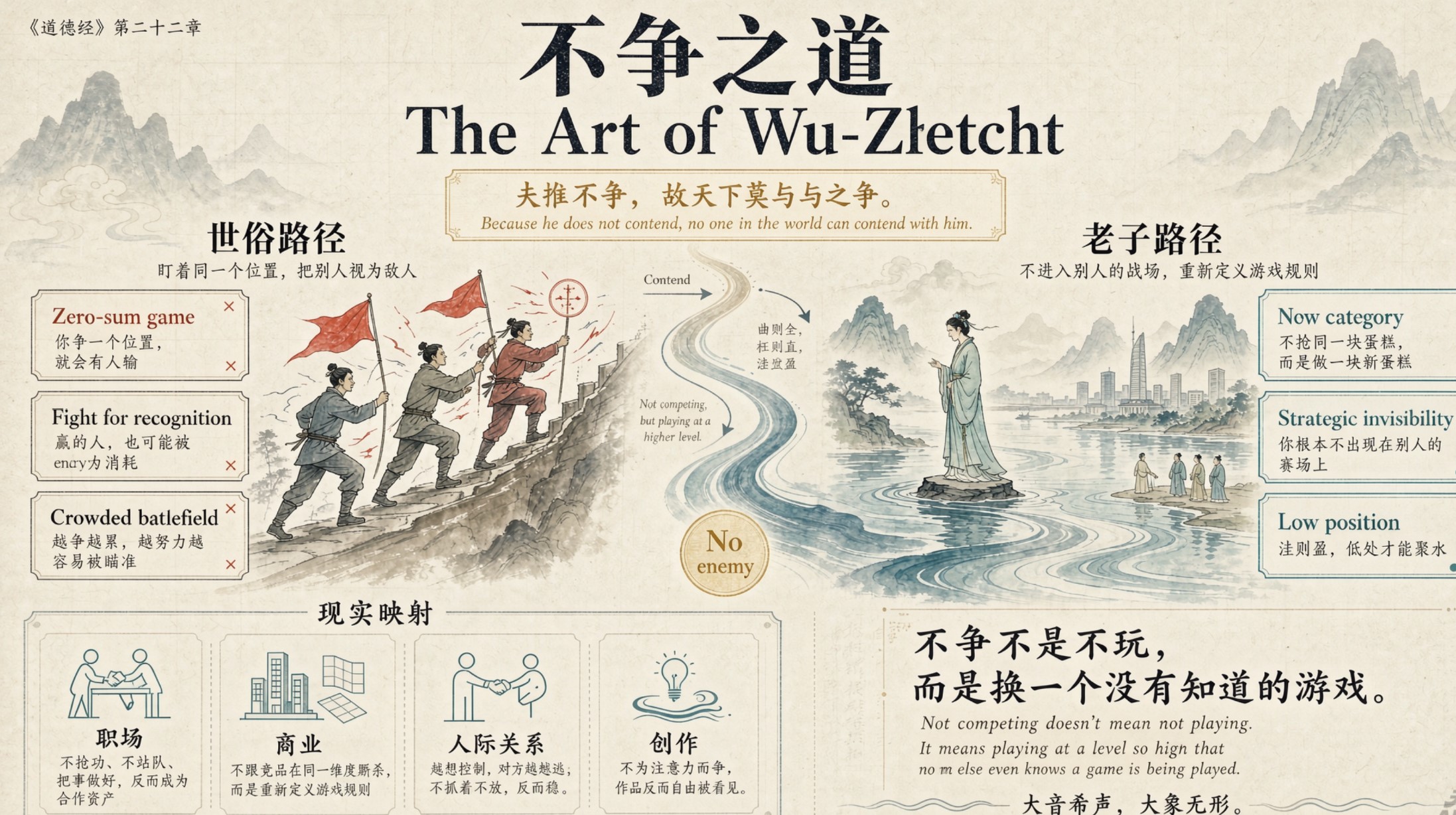
The Art of Wu-Zheng (Non-Contention): Why Those Who Don't Compete Win Everything
不争之道:为何不与天下争者,天下莫能与之争
Prologue: The Paradox That Breaks the Mind
序章:一个打破常识的悖论
"夫唯不争,故天下莫能与之争。"
"Because he does not contend, no one in the world can contend with him."
When Laozi wrote these words over two millennia ago, he wasn't offering a motivational slogan. He was describing a structural law of reality — as precise and impersonal as gravity.
两千多年前,老子写下这句话时,他并非在灌一碗鸡汤。他在描述一条现实的结构性法则——如同引力一般精确而不以人的意志为转移。
At first glance, it sounds like nonsense. In every arena we know — markets, politics, relationships, sports — competition is the engine. You fight, you win. You don't fight, you lose. End of story.
乍一听,这像是胡话。在我们所知的每一个竞技场——市场、政治、人际关系、体育——竞争都是引擎。你争,你赢。你不争,你输。故事结束。
But Laozi is playing a longer game. He's not talking about the next quarter's results. He's talking about the architecture of power itself.
但老子在下更大的一盘棋。他谈的不是下个季度的财报,而是力量本身的建筑结构。
I. The Geometry of Contention
一、争夺的几何学
Imagine two people pulling on opposite ends of a rope. Each exerts force. Each feels resistance equal to their own push. This is the geometry of contention: the harder you pull, the harder the world pulls back.
想象两个人各执一根绳子的两端对拉。每个人都用力。每个人都感受到与自己推力相等的反作用力。这就是争夺的几何学:你拉得越狠,世界反弹得越狠。
Newton would later formalize this as the Third Law. Laozi intuited it 2,500 years earlier and drew a different conclusion: step off the line of force entirely.
牛顿后来将其表述为第三定律。老子早2500年就直觉到了这一点,并得出了一个不同的结论:彻底退出这条力的轴线。
"上善若水。水善利万物而不争,处众人之所恶,故几于道。"
"The highest good is like water. Water benefits all things and does not compete. It dwells in places that all disdain. Therefore it is near to the Dao." — Chapter 8
Water doesn't try to be on top. It flows downward — into the low places, the cracks, the spaces everyone else avoids. And precisely because it occupies the lowest position, it eventually covers everything.
水不试图站在高处。它向下流——流向低处、裂缝、人人避之不及的空间。而恰恰因为它占据了最低的位置,它最终覆盖了万物。
This is not passivity. This is positional strategy.
这不是被动。这是位置战略。
The Three Moves of Wu-Zheng
不争的三步棋
|
Move 步法 |
Conventional Path 世俗路径 |
Daoist Path 道家路径 |
|---|---|---|
|
1. Choose the terrain 择地 |
Fight on the crowded battlefield 在拥挤的战场上厮杀 |
Step off the map entirely 彻底走出地图之外 |
|
2. Absorb, don't collide 化力 |
Meet force with force 以力敌力 |
Yield and redirect (like taiji) 柔化引导(如太极) |
|
3. Occupy the low 处下 |
Climb to the peak, make enemies 攀登高峰,树敌无数 |
Settle in the valley, let others flow to you 安居谷底,让别人流向你 |
The genius of non-contention is that it removes the premise of the game. If you're not trying to take my place, why would I see you as a threat? If I don't see you as a threat, I won't resist you. If I don't resist you, you face zero friction. Zero friction means momentum compounds without burnout.
不争的天才之处在于它取消了游戏的前提。如果你不想取代我的位置,我为什么把你当威胁?如果我不把你当威胁,我就不会抵抗你。如果我不抵抗你,你面对的阻力为零。零阻力意味着动量复利增长而不会燃尽。
II. The Invisible Winner
二、看不见的赢家
There's a peculiar phenomenon in nature and society alike: the less visible something is, the more powerful it becomes.
自然界和社会中有一个奇特的现象:某物越是不可见,就越是强大。
Wind has no shape, yet it moves oceans. Gravity has no mass, yet it holds galaxies. A great leader who doesn't need to remind you who's in charge — you follow them anyway, because resisting feels unnatural.
风无形,却能推动海洋。引力无质量,却能束缚星系。一位不需要提醒你谁说了算的伟大领袖——你还是会追随他,因为抵抗反而感觉不自然。
"太上,不知有之。"
"The best ruler: the people barely know he exists." — Chapter 17
This is the deepest form of power: power that doesn't announce itself. When your strength requires no declaration, it cannot be targeted. It cannot be attacked. It cannot be competed with — because there's nothing to grab onto.
这是力量最深的形式:不宣告自己的力量。当你的力量无需宣言,它就不可能被瞄准。不可能被攻击。不可能被与之竞争——因为没有什么可以被抓住。
In the modern world, this maps perfectly onto what we call "category creation."
在现代世界中,这完美对应了我们所谓的"品类创造"。
Most startups die because they enter an existing market and try to out-compete incumbents. They're pulling on the rope. The Daoist startup doesn't enter the market at all — it creates a new category where it is the only player. No competition. No contenders. No one to fight.
大多数初创公司死在它们进入现有市场并尝试超越在位者。它们在拉绳子。道家式的初创公司根本不进入市场——它创造一个新品类,在其中它是唯一的玩家。没有竞争。没有对手。无人可斗。
"企者不立,跨者不行。"
"He who stands on tiptoe cannot stand firm. He who strides cannot walk far." — Chapter 24
If you're reaching, straining, positioning yourself visibly above others — you're already unstable. The truly rooted don't reach. They sink.
如果你踮起脚尖站立,你站不稳。如果你大步跨越,你走不远。如果你在伸展、用力、把自己明显地置于他人之上——你已经不稳了。真正扎根的人不伸手。他们下沉。
III. The Strategy of Strategic Invisibility

三、战略性隐形的策略
Let's get practical. What does bu-zheng look like in real life?
让我们落到实处。"不争"在现实生活中长什么样?
In Career 在职场
The person who constantly promotes themselves, claims credit, and jockeys for position creates resistance in every direction. Every promotion threatens someone. Every self-promotion triggers envy. They're fighting a war on all fronts.
那个不断自我推销、抢功、钻营职位的人,在每个方向都制造了阻力。每次晋升都威胁到某人。每次自夸都触发嫉妒。他们在所有战线作战。
The Daoist professional does the work, shares the credit, asks for little, and delivers much. Colleagues stop seeing them as a rival and start seeing them as an asset. Managers stop fearing them as a threat and start depending on them as infrastructure. By the time they're indispensable, no one remembers that they "competed" for the role — because they never did.
道家式的职场人做事、分享功劳、索求甚少、交付甚多。同事不再视其为对手,而开始视其为资产。管理者不再害怕他们构成威胁,而开始依赖他们如同基础设施。等到他们变得不可或缺时,没人记得他们曾为这个角色"竞争"过——因为他们从未如此。
They won the game by never showing up to play.
他们赢得了游戏,因为从未出现在赛场上。
In Relationships 在关系中
The partner who tries hardest to control the relationship loses it. The parent who demands obedience gets rebellion. The friend who needs validation drives people away.
最努力控制关系的伴侣会失去关系。要求服从的父母得到叛逆。需要认可的朋友把人推开。
"天下之至柔,驰骋天下之至坚。"
"The softest thing in the world runs roughshod over the hardest." — Chapter 43
Non-contention in relationships isn't about being a doormat. It's about removing the friction of ego. When you don't need to be right, the other person doesn't need to be wrong. When neither needs to win, both can actually connect.
关系中的不争不是做受气包。它是关于消除自我的摩擦。当你不需要正确时,对方就不需要错误。当双方都不需要赢时,双方才能真正连接。
In Creativity 在创作中
Every artist who chases trends produces derivative work. The artist who follows their own curiosity, indifferent to the market, often creates the very thing the market didn't know it wanted.
每个追逐趋势的艺术家都产出衍生品。跟随自己好奇心、对市场漠不关心的艺术家,往往创造出市场不知道自己想要的东西。
This is bu-zheng at its purest: not competing for attention, therefore receiving it freely.
这是不争最纯粹的形式:不为注意力而争,因此自由地获得它。
IV. The Deeper Mechanics: Why It Works
四、深层机制:为何有效
To understand why non-contention is structurally superior, we need to look at three dynamics:
要理解为何不争在结构上更优,我们需要看三个动力学:
1. The Conservation of Energy 能量守恒
Contention is expensive. Every act of competition consumes cognitive bandwidth, emotional reserves, and social capital. Most "victories" in competitive environments are Pyrrhic — you won, but you're depleted.
争夺是昂贵的。每一次竞争行为消耗认知带宽、情感储备和社会资本。竞争环境中的大多数"胜利"都是惨胜——你赢了,但你耗尽了。
Non-contention redirects that entire budget toward building, not fighting. Over time, the compound advantage is devastating.
不争将整个预算重新导向建设,而非战斗。随着时间的推移,复利优势是毁灭性的。
2. The Trust Dividend 信任红利
People instinctively trust those who don't compete with them. A non-competitor is safe. A safe person receives confidences, opportunities, and alliances that competitors never see.
人们本能地信任那些不与自己竞争的人。非竞争者很安全。一个安全的人会收到竞争者永远看不到的信任、机会和联盟。
"信言不美,美言不信。"
"True words are not beautiful. Beautiful words are not true." — Chapter 81
The less you perform, the more authentic you appear. The less you contend, the more gravity you generate.
你表演得越少,就显得越真实。你争夺得越少,产生的引力就越大。
3. The Void Principle 虚空原理
"埏埴以为器,当其无,有器之用。"
"We shape clay into a vessel, and it is the emptiness inside that makes it useful." — Chapter 11
Non-contention creates space. Space is where things happen. The person who fills every moment with contention has no room left for serendipity, insight, or genuine connection. The person who practices wu-zheng leaves a void — and the Dao rushes in to fill it.
不争创造了空间。空间是事情发生的地方。每个时刻都塞满争夺的人,没有余地留给意外之喜、洞见或真正的连接。践行不争的人留下了一个虚空——而道涌入其中填满它。
V. The Misunderstandings
五、常见的误解
Before we close, we must clear three fatal misunderstandings:
在收尾之前,我们必须澄清三个致命的误解:
❌ Misunderstanding 1: Non-contention = Laziness
❌ 误解一:不争 = 懒惰
No. Bu-zheng requires immense discipline. It takes far more effort to not react when provoked, to not defend when criticized, to not climb when everyone else is scrambling upward. It is not the laziness of inertia. It is the discipline of a martial artist who chooses not to throw the first punch — and trains so hard that if forced to fight, they end it in one move.
不对。不争需要极大的自律。被激怒时不反应、被批评时不辩护、别人都在往上爬时不跟随——这需要多得多的努力。它不是惯性的懒惰。它是武术家的自律:选择不打第一拳——并且训练得如此刻苦,以至于一旦被迫出手,一招制敌。
❌ Misunderstanding 2: Non-contention = Having no standards
❌ 误解二:不争 = 没有标准
Wrong again. Water doesn't argue with rocks, but it carves canyons over millennia. Bu-zheng is not about accepting mediocrity. It's about refusing to measure yourself against anyone else's yardstick. Your standard is internal. Your scorecard is private. You compete only with who you were yesterday.
又错了。水不与岩石争论,但它用千年雕刻峡谷。不争不是接受平庸。它是关于拒绝用别人的尺子量自己。你的标准是内在的。你的记分牌是私人的。你只与昨天的自己竞争。
❌ Misunderstanding 3: Non-contention = Being a pushover
❌ 误解三:不争 = 任人摆布
Laozi himself answers this:
老子自己回答了这个问题:
"慈故能勇。"
"Because he is compassionate, he can be brave." — Chapter 67
The bamboo that bends in the storm survives it. The oak that resists snaps. But after the storm passes, the bamboo still stands — and now the oak is gone. Who is the pushover?
风暴中弯曲的竹子活了下来。抵抗的橡树折断了。但风暴过后,竹子依然挺立——而橡树已经不在。谁是软弱者?
Epilogue: The Final Move
尾声:最后一步
There is a famous story about the Chinese strategist Jiang Tai Gong (姜太公). He fished not with a barbed hook, not with bait, and not even below the surface of the water — his hook hung above the water, in plain sight. People laughed at him. He replied: "I'm not fishing for fish. I'm fishing for a king."
有一个著名的故事,关于中国谋略家姜太公。他钓鱼不用倒钩,不用鱼饵,甚至不在水面之下——他的钩子悬在水面之上,一目了然。人们嘲笑他。他回答:"我不是在钓鱼。我是在钓王。"
He wasn't competing with other fishermen. He had stepped off the riverbank entirely and was playing a different game. Eventually, King Wen came, recognized the signal, and made him prime minister. The rest is history.
他没有与其他渔夫竞争。他彻底走下了河岸,玩着另一个游戏。最终,文王来了,识别出了信号,任命他为丞相。其余的就是历史。
That is the art of wu-zheng.
那是不争的艺术。
Not competing doesn't mean not playing. It means playing at a level so high that no one else even knows a game is being played.
不竞争不意味着不参与。它意味着在一个如此高的层次上行动,以至于其他人甚至不知道有一场游戏正在进行。
"大音希声,大象无形。"
"The greatest sound is barely audible. The greatest form has no shape." — Chapter 41
The most powerful move in any contest is the one that cannot be seen coming — because it comes from a direction the contest never imagined.
任何竞赛中最强大的动作是无法被看见的——因为它来自竞赛从未设想过的方向。
And that direction is: nowhere.
而那个方向是:无处。
此文由 怡心湖 编辑,若您觉得有益,欢迎分享转发!:首页 > 赞·中华 > 儒释道 » 不争之道:为何不与天下争者,天下莫能与之争
 稳才是赢,熬才是本事