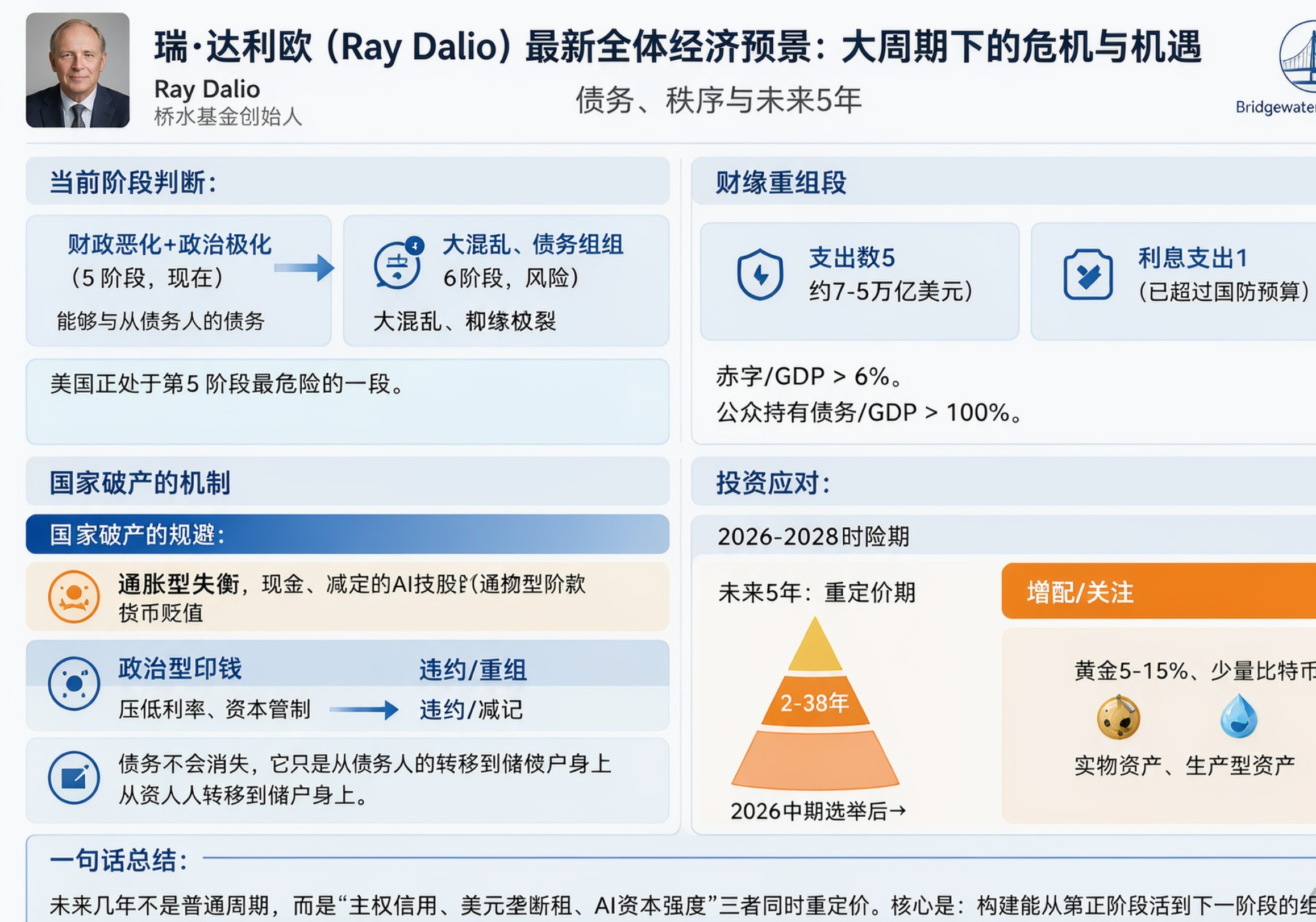
The Big Cycle Is Pricing In: 达利欧视角下的全球经济前瞻
Debt, Disorder, and the Next Five Years
“Countries don’t go bankrupt like companies. They inflate, they dilute, they redistribute — and savers pay the bill.”
“国家不会像公司那样破产。它们印钞、稀释、再分配——最后由储户买单。”
一、Where We Are: Stage 5, Not Yet Stage 6
我们站在第五阶段,不是第六阶段
Ray Dalio’s framework has five forces and six stages.
达利欧的框架里,五大力量驱动历史:
- Debt / money / economics — 债务与货币
- Domestic politics — 国内政治与贫富撕裂
- Geopolitics — 大国地缘重组
- Nature — 气候、疫情、灾害
- Technology — AI 与生产力跃迁
And the internal national cycle now reads like this:
国家内部周期当前最接近:
- Stage 3–4: peace & leverage → 和平繁荣 + 杠杆堆积
- Stage 5 (now): fiscal deterioration + political polarization → 财政恶化 + 政治极化
- Stage 6 (risk): disorder, default/restructure, monetary devaluation, new order → 大混乱、重组、货币重定价
The US, in Dalio’s words, is “in the dangerous part of Stage 5, sliding toward Stage 6.”
达利欧的原话口径:美国正处在“第五阶段里最危险的那一段”。
二、The Fiscal Math Is the Real Macro
真正的宏观,不是 CPI,是财政算术
Dalio keeps repeating the same numbers because they are the plot:
- Revenue: ~$5.0–5.5 trillion
- Spending: ~$7.0–7.5 trillion
- Gap: ~$2 trillion → funded by new debt
- Interest expense: > $1 trillion, already crowding out other spending
- Public-held debt / GDP: > 100%
- Deficit / GDP: > 6%
- Roll-over need: trillions of maturing debt every year
“It’s not a recession risk first. It’s a debt-supply vs debt-demand risk.”
“第一步不是衰退风险,而是‘发债供给’对‘买方需求’的风险。”
This is why 10y UST near 5%+ and 30y near 6% is not just “rates repricing growth.”
It is the bond market asking: who will buy the next trillion?
所以 10 年美债逼近 5%、30 年逼近 6%,不是单纯在给增长重新定价,而是在问:下一万亿,谁来接?
三、The Buyer Base Is Changing
买方结构坏了,这才是大事
Old world:
- Japan and China accumulate USTs for reserve management and geopolitical alignment
- Tech giants fund AI from equity, not debt
- Fed can lean on the curve when needed
New world:
- China / Japan demand is no longer automatic — geopolitics + currency defense change incentives
- US Treasury issuance is structural, not cyclical
- Hyperscalers borrow for data centers — government and Big Tech compete for the same capital pool
- Result: more supply, weaker natural demand, higher term premium
Dalio calls it “atherosclerosis in the financial system” — plaque builds slowly, then the heart attack is sudden.
达利欧把它叫“金融系统的动脉粥样硬化”:斑块慢慢积,发作是瞬间的。

四、AI Is Real, the Financing May Be Fragile
AI 是真的,AI 的杠杆可能是脆的
Dalio is not anti-AI. He is anti-“any price, any yield, any leverage.”
His point:
- AI = real productivity revolution ✅
- AI capex = electrification + railroads + dot-com fiber ✅
- AI financing = equity → debt → vendor financing → reflexivity ❌
- If rates stay high, free cash flow doesn’t catch capex, and the discount rate rises → the bubble breaks from the debt side, not the technology side
“A technology can change the world and still ruin its early investors.”
“技术可以改变世界,也可以先埋了最早冲进去的投资者。”
That is why he prefers companies using AI to improve cash flow over companies selling the dream of AI infra.
五、How Countries Go Broke
国家是怎么“破产”的
A sovereign doesn’t file Chapter 11. It does three things:
- Default / restructure — stretch maturities, haircut creditors
- Monetize — central bank buys time, currency loses purchasing power
- Financial repression — caps on rates, capital controls, forced institutional ownership of government paper, wealth taxes
Dalio’s version:
The debt doesn’t disappear. It moves from the borrower to the saver.
债务不会消失,它只是从债务人身上,转移到储户身上。
So “US goes broke” does not mean USD = 0.
It means:
- real returns on cash & long bonds shrink
- fiscal dominance over monetary policy
- gold, hard assets, scarce productive assets outperform
- non-government money (gold, maybe BTC as optionality) gets re-rated
Hence his allocation view: 5–15% gold, small BTC, short bonds, diversify across politically stable jurisdictions.
六、The Window: 2026 → 2028
时间窗:不是明天,是选举周期里的危险区
Dalio’s latest phrasing:
- Aug 2026 article: “within 3 years, ±2”
- Oct 2026 Greenwich Economic Forum: “within 2 years”
- Politically: post-midterm → pre-2028 election is the friction zone
- Mechanically: refunding pressure + AI refinancing + foreign bid withdrawal
Translation:
Not a calendar forecast, but a regime-risk cone.
不是日历预测,而是一个“危机概率锥”。
The trigger may not be stocks. It may be:
- a weak 30y auction
- a Japanese/Yuan reserve shift
- a tech-bond downgrade
- a fiscal standoff that forces the Fed to choose between inflation and solvency
七、Investment Implications(Dalio-style, not doom-style)
投资含义:不是末日,是再平衡
|
Asset |
Dalio lens 2026–28 |
|---|---|
|
Cash |
losing real purchasing power |
|
Long UST |
supply/demand unfavorable, he is short bonds |
|
Mag-7 / AI hype |
real tech, fragile financing |
|
Gold |
portfolio insurance, 5–15% |
|
BTC |
option on non-sovereign money, small |
|
Hard assets / commodities |
inflation + scarcity premium |
|
Geopolitically neutral countries |
diversification away from US-China center |
|
Companies with FCF + AI adoption |
preferred to pure AI capex stories |
The mistake is binary thinking:
“America collapses” vs “stocks only go up.”
Dalio’s point is more uncomfortable: the system survives, but the denominator changes.
八、One-Line Forward View
一句话前瞻
2026–2030 is less about a normal business cycle and more about the repricing of sovereign credit, the dollar’s monopoly rent, and AI-capital intensity.
未来几年不是普通周期,而是“主权信用、美元垄断租、AI 资本强度”三者同时重定价。
Dalio’s warning is not “sell everything.”
It is:
Build a portfolio that survives the transition from Stage 5 to whatever comes after.
构建一个能从“第五阶段”活到“下一阶段”的组合。
Because in the big cycle, the question is never whether the debt is paid.
The question is: paid in what — and by whom.
此文由 怡心湖 编辑,若您觉得有益,欢迎分享转发!:首页 > 观·世界 » The Big Cycle Is Pricing In: 达利欧视角下的全球经济前瞻 Debt, Disorder, and the Next Five Years
 《穷通宝鉴》古案今读:把古人的命,讲
 旧封神榜封的是神,新封神榜封的是人
 NATO Article 5 Trigger List 北约
 数字泔水:信息时代的剩饭与解毒剂 D
 文化战 / 文化战线(Cultural Front)
 多极、多文明与智能时代:2026—2035
 The American Guillotine Line: Pr
 BRICS and the Grammar of the Glo