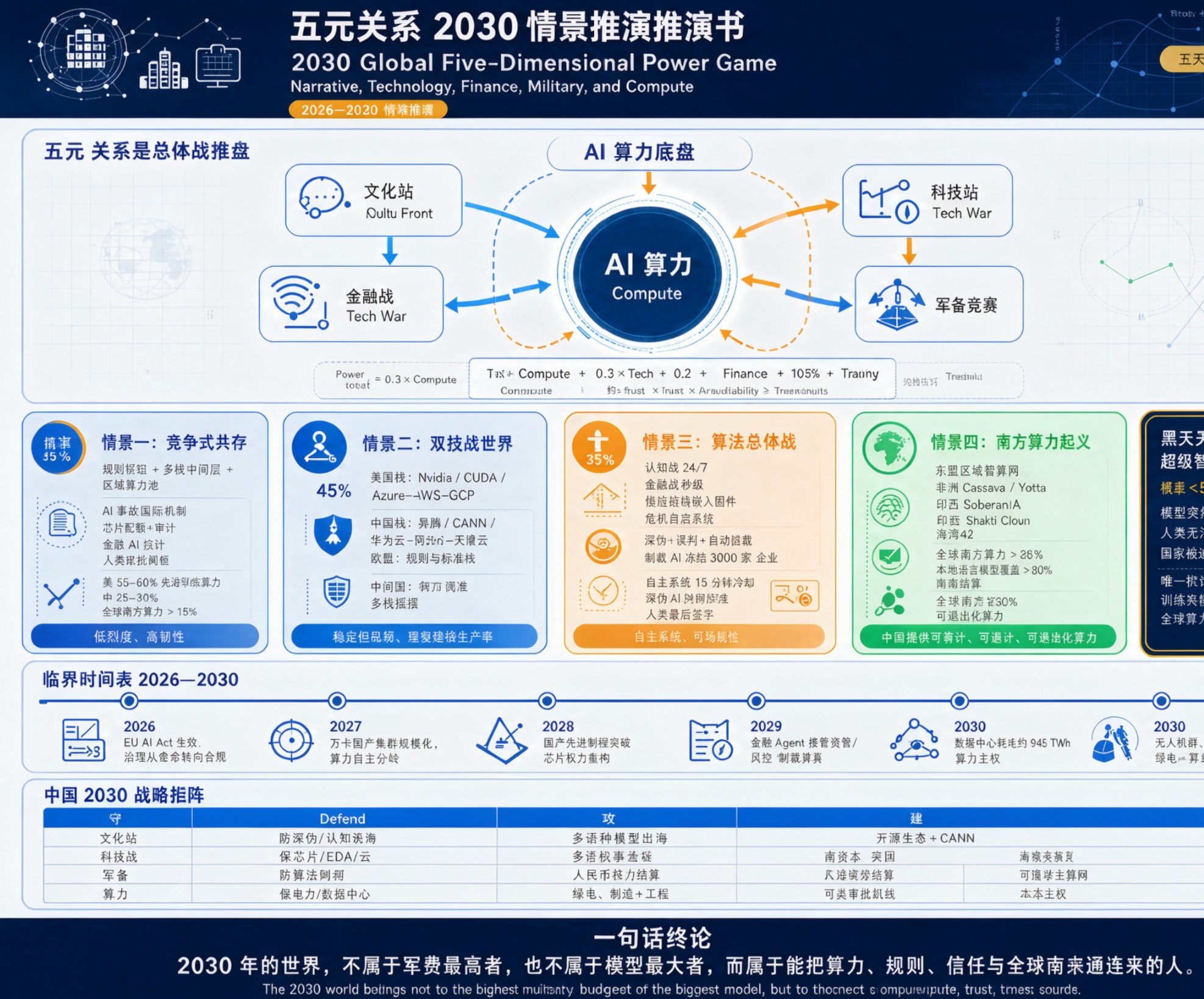
文化战 / 文化战线(Cultural Front)— 科技战(Tech War)— 金融战(Financial War)— 军备竞赛(Arms Race)— AI 算力(Compute)
总论:21 世纪的“总体战”不再是枪炮单独开火,而是算力在背后点火
The Total Contest of the 21st Century: Not Guns Alone, but Compute Pulling the Trigger
2026 年的大国竞争,已经不能再用“军事—经济—文化”三层老框架解释。
The great-power competition of 2026 can no longer be explained by the old trilogy of military, economic, and cultural power.
真正的新公式是:
The real formula is:
军备竞赛(Military) + 科技战(Tech) + 金融战(Finance) + 文化战(Narrative/Culture) = AI 算力驱动的总体制度竞争
Arms race + tech war + financial war + cultural front = compute-driven systemic competition
AI 算力不是其中一条战线,而是横切所有战线的底层能源:
AI compute is not one battlefield among others. It is the underlying energy cutting across all battlefields:
- 没有算力,导弹再多在认知战里也会“睁眼瞎”;
- 没有算力,高频交易、跨境资本监控、制裁规避、风险定价全都会退化;
- 没有算力,芯片、模型、卫星、密码、深伪、翻译、舆情推送都跑不起来;
- 没有算力,文化叙事只能靠人肉外交,做不到“每秒百万次心智接触”。
- Without compute, missiles fire blind in cognitive war.
- Without compute, HFT, cross-border capital monitoring, sanction evasion, and risk pricing degrade.
- Without compute, chips, models, satellites, cryptography, deepfakes, translation, and recommendation systems cannot run.
- Without compute, cultural narrative depends on human diplomacy alone—unable to achieve “a million mind-contacts per second.”
所以本文的中央命题:
So the central proposition of this paper:
AI 算力是新型国家权力中的“战略公分母”。文化战决定“为什么打”,科技战决定“用什么打”,金融战决定“能打多久”,军备竞赛决定“打了以后谁还站着”,而 AI 算力决定这四件事的响应速度、规模与精度。
AI compute is the strategic common denominator of new state power. The cultural front decides why to fight; the tech war decides what to fight with; the financial war decides how long one can fight; the arms race decides who remains standing; and AI compute decides the speed, scale, and precision of all four.
一、文化战:不是宣传战,而是“认知操作系统”之争
I. The Cultural Front: Not Propaganda, but a Fight Over the Cognitive Operating System
1. 文化战的传统含义
1. What “cultural front” used to mean
冷战时期,文化战 = 电台、电影、留学、出版社、展览、意识形态输出。
During the Cold War, the cultural front meant radio, film, study abroad, publishing, exhibitions, and ideological output.
西方有 Voice of America、British Council、好莱坞、MBA 教材;
The West had Voice of America, the British Council, Hollywood, and MBA textbooks.
东方有人民文学、反殖民叙事、不结盟运动、革命美学。
The East had people’s literature, anti-colonial narratives, the Non-Aligned Movement, and revolutionary aesthetics.
2. 2026 之后的文化战:算法分发 + 大模型生成 + 多语种心智基础设施
2. The cultural front after 2026: algorithmic distribution + LLM generation + multilingual mental infrastructure
今天的文化战不再是“我说你听”,而是:
Today’s cultural front is no longer “I speak, you listen.” It is:
- 谁的平台推荐谁的故事
whose platform recommends whose stories - 谁的模型翻译谁的价值观
whose model translates whose values - 谁的语言数据被训练、被加权、被设为默认
whose language data gets trained, weighted, and set as default - 谁的深伪检测标准被全球采用
whose deepfake-detection standard the world adopts - 谁把“现代化”“民主”“发展”“安全”重新定义
who redefines modernization, democracy, development, and security
生成式 AI 把文化生产从“精英作坊”变成“工业流水线”。
Generative AI turns cultural production from elite workshops into industrial pipelines.
一个国家拥有强算力,就能:
A state with massive compute can:
- 用多语种大模型做全天候公共外交;
run 24/7 public diplomacy with multilingual LLMs; - 用虚拟主播、本地语言短视频、宗教/法律/医疗问答渗透中小国信息空间;
penetrate smaller states’ information spaces with virtual anchors, local-language shorts, and religious/legal/medical QA; - 用推荐算法把对方社会撕裂议题放大;
use recommendation algorithms to amplify divisive issues in adversary societies; - 用生成内容填充新闻、教材、客服、政务热线,使“现实”被软性重写。
fill news, textbooks, customer service, and government hotlines with generated content, softly rewriting “reality.”
文化战的本质,从“讲故事”升级为“训练世界如何看见世界”。
The essence of the cultural front upgrades from telling stories to training the world how to see the world.
3. 算力是文化战的发动机
3. Compute is the engine of the cultural front
没有 GPU / TPU / NPU:
Without GPUs / TPUs / NPUs:
- 多语种模型跑不动
multilingual models cannot run - 实时翻译滞后
real-time translation lags - 深伪检测慢于深伪生产
deepfake detection lags behind deepfake production - 舆情推演只能靠分析师拍脑袋
sentiment war-gaming relies on analysts’ intuition - 小国媒体被两大生态吞掉
small-state media get swallowed by two ecosystems
因此:
Therefore:
文化主权 = 语言模型主权 + 推荐系统主权 + 数据语料主权 + 算力本地化
Cultural sovereignty = language-model sovereignty + recommendation-system sovereignty + corpus sovereignty + local compute
法国搞 Mistral,阿拉伯世界训伊斯兰金融与教法语言模型,印度做多语种模型,中国做中文/全球南方场景模型,都不是“技术爱好”,而是文化战补课。
France’s Mistral, Arab-world models for Islamic finance and jurisprudence, India’s multilingual models, and China’s Chinese / Global South models are not tech hobbies—they are cultural-front catch-up.
二、科技战:芯片、标准、开源与“可否认的能力封锁”
II. The Tech War: Chips, Standards, Open Source, and Deniable Capability Denial
1. 科技战已从“谁创新快”变成“谁能不让对方创新”
1. Tech war shifts from “who innovates faster” to “who can stop the other from innovating”
传统贸易战争关税;
Traditional trade wars fight over tariffs.
科技战争:
Tech wars fight over:
- EDA 软件
EDA software - 光刻机
lithography - HBM 高带宽内存
high-bandwidth memory - GPU / NPU
GPUs / NPUs - 云计算实例
cloud instances - 模型权重
model weights - 数据集授权
dataset licenses - 开源许可证政治
open-source license politics
美国对华先进芯片出口管制、对荷兰/日本设备链施压、把 CUDA 生态当战略资产,都是“算力封锁”。
US advanced-chip export controls on China, pressure on Dutch/Japanese equipment chains, and treating the CUDA ecosystem as a strategic asset are all forms of “compute denial.”
中国搞昇腾、鲲鹏、RISC-V、开源大模型、国产 EDA、稀土出口管理,是“算力突围”。
China’s Ascend, Kunpeng, RISC-V, open models, domestic EDA, and rare-earth leverage are “compute escape.”
2. AI 算力是科技战的中轴
2. AI compute is the axis of the tech war
科技战有三条链:
The tech war has three chains:
A. 硬件链:硅、光刻、封装、HBM、散热、电力
Hardware chain: silicon, lithography, packaging, HBM, cooling, power
B. 软件链:框架、编译器、算子库、模型架构、Agent 生态
Software chain: frameworks, compilers, operator libraries, model architectures, agent ecosystems
C. 规则链:安全评级、出口许可、数据跨境、红队标准、 watermark、模型卡
Rule chain: safety tiers, export licenses, cross-border data, red-teaming, watermarking, model cards
三者都绕回算力:
All three loop back to compute:
- 有芯片没电力 → 算力落不了地
chips without power = compute cannot land - 有模型没芯片 → 只能做论文
models without chips = only good for papers - 有云平台没主权 → 战时会被拔线
cloud without sovereignty = plug pulled in wartime - 有数据没算法 → 原料堆成山
data without algorithms = raw material piling up - 有算法没信任 → 别国不敢用
algorithms without trust = no one else dares use them
3. 开源模型:科技战里的“文化+技术”双武器
3. Open-weight models: a dual tech-cultural weapon
美国担心中国开源模型扩散;
The US worries about Chinese open-model proliferation.
中国担心美国闭源模型绑定全球开发者;
China worries about US closed models locking global developers.
所以模型权重本身成了地缘资产:
Thus model weights themselves become geopolitical assets:
开源不是“善良”,而是一种生态殖民/生态解放工具。
Open source is not “kindness”; it is a tool of ecological colonization or ecological liberation.
WAICO、OECD.AI、EU AI Office、中国人工智能治理原则、印度 AI 任务、非洲 AI 白皮书,都是在抢“模型世界观”的默认设置。
WAICO, OECD.AI, the EU AI Office, China’s AI governance principles, IndiaAI, and African AI white papers all compete for the default settings of the model’s worldview.
三、金融战:AI 把资本流动变成“算法战场”
III. The Financial War: AI Turns Capital Flows Into an Algorithmic Battlefield
1. 金融战过去靠利率、美元、SWIFT、评级、国债
1. Old financial war: rates, dollars, SWIFT, ratings, treasuries
20 世纪金融战工具:
20th-century financial weapons:
- 美元清算
dollar clearing - 美债收益率
Treasury yields - IMF 条件性
IMF conditionality - 评级下调
rating downgrades - 资本管制
capital controls - 汇率干预
FX intervention
2. 2026 金融战工具:AI 预期引擎
2. 2026 financial war: AI expectation engines
今天:
Today:
- 对冲基金用 LLM 读 10-K、央行动态、战争推文、卫星油轮图;
hedge funds use LLMs to read 10-Ks, central-bank signals, war tweets, and satellite tanker images; - 央行用 AI 做资本流动预警;
central banks use AI for capital-flow early warning; - 财政部用 AI 模拟制裁传导;
treasuries simulate sanction spillovers with AI; - 对手用生成式内容制造“假地缘事件”引发汇率跳变;
adversaries fabricate “geopolitical events” to trigger FX gaps; - 稳定币、代币化国债、链上清算把金融战从 T+2 缩到秒级。
stablecoins, tokenized Treasuries, and on-chain clearing compress financial war from T+2 to seconds.
金融战的本质,从“谁钱多”变成“谁先看懂钱要去哪”。
The essence of financial war shifts from “who has more money” to “who sees first where money will go.”
3. 算力—金融—军事的闭环
3. The compute–finance–military loop
一个典型链条:
A typical chain:
- 军用 AI 改变战争预期
military AI changes war expectations - 舆情模型放大避险情绪
sentiment models amplify risk-off mood - 高频模型抛售新兴市场资产
HFT models dump EM assets - 本币贬值 → 进口芯片变贵 → 军用供应链承压
currency depreciates → chips get expensive → military supply chain strains - 敌方用算力资本低价收购港口/电网/矿权
enemy compute-capital buys ports/grids/mining rights cheap - 下一轮军备竞赛融资能力被削弱
next-round arms-race financing weakens
所以:
So:
金融战不是军事战的影子,而是 AI 算力在和平时期执行的“前置战争”。
The financial war is not a shadow of the military war; it is the forward war executed by AI compute in peacetime.
中国把 AI 当“金融国防”,美国把模型能力当“资本定价权”,海湾把 AI 基建当“后石油主权”,逻辑一致。
China treats AI as financial defense; the US treats model power as capital-pricing power; the Gulf treats AI infrastructure as post-oil sovereignty. Same logic.
四、军备竞赛:从坦克集群到“模型—无人机—算力网格”
IV. The Arms Race: From Tank Masses to Model–Drone–Compute Grids
1. 传统军备竞赛:存量武器堆数量
1. Old arms race: stockpile weapons
坦克、航母、核弹、战机、导弹。
Tanks, carriers, nukes, jets, missiles.
特征是:
Features:
- 看得见
visible - 可核查
verifiable - 边际效用递减
diminishing marginal utility - 维护成本线性
linear maintenance cost
2. AI 军备竞赛:民用基建+军事迁移
2. AI arms race: civil infrastructure with military spillover
2026 的军备竞赛藏在:
The 2026 arms race hides in:
- 万卡集群
ten-thousand-GPU clusters - 云区域
cloud regions - 电力合同
power purchase agreements - 半导体产能
semiconductor capacity - 数据标注基地
data-labeling bases - 战场大模型
battlefield LLMs - 无人机群控制器
drone-swarm controllers - 自动目标识别
automatic target recognition - 兵棋推演 Agent
war-gaming agents
斯坦福 AI Index 已指出:中美顶级模型差距收窄到个位数百分点,而全球军费 2025 年升至 2.887 万亿美元。
The Stanford AI Index shows top US/China model gaps narrowing to single-digit percentages, while global military spending reached $2.887 trillion in 2025.
这不是巧合:
Not a coincidence:
民用算力投资越多,军事决策速度越快;模型推理越便宜,杀伤链越短。
More civil compute → faster military decisions. Cheaper model inference → shorter kill chain.
3. 新军备竞赛的恐怖之处:没有“开战时刻”
3. The scary part: no “moment of war”
核威慑有“按下按钮”。
Nuclear deterrence has “the button.”
AI 军备没有清晰开战线:
AI arms racing has no clear line:
- 认知战先打几个月
cognitive war runs for months - 金融定价先被扭曲
financial pricing distorts first - 供应链先被埋雷
supply chains get seeded with traps - 敌方电网调度模型先被投毒
enemy grid-scheduling models get poisoned first - 等导弹飞的时候,战争已经赢了一半
by the time missiles fly, half the war is already won
所以军备竞赛从“武器库存”转向“决策库存”:
Thus the arms race shifts from weapon stockpiles to decision stockpiles:
Military Power2026=Forces×Models×Compute×Data×Autonomy
五、AI 算力:把四条战线焊成一块钢板
V. AI Compute: Welding Four Fronts Into One Steel Plate
1. 算力不是技术资源,是“总体战底盘”
1. Compute is not a tech resource; it is the total-war floorboard
|
战线 Front |
没有算力 Without compute |
有算力 With compute |
|---|---|---|
|
文化战 Cultural |
人工发稿、慢、被算法淹没 |
多语种生成、实时认知战 |
|
科技战 Tech |
买别人芯片、跟跑、被锁死 |
自训模型、自定标准、生态输出 |
|
金融战 Finance |
被动接盘、晚 30 分钟 |
预期建模、秒级对冲、制裁仿真 |
|
军备 Military |
火力强但决策慢 |
感知—判断—打击闭环缩短到分钟级 |
|
Front |
Without compute |
With compute |
|
--- |
--- |
--- |
|
Cultural |
manual posts, slow, drowned by algorithms |
multilingual generation, real-time cognitive war |
|
Tech |
buy others’ chips, follow, get locked |
self-train models, set standards, export ecosystems |
|
Finance |
passive bag-holder, 30 minutes late |
expectation modeling, second-level hedging, sanction simulation |
|
Military |
strong firepower but slow decisions |
sense–decide–strike compressed to minutes |
2. 算力的五层堆栈
2. The five-layer compute stack
L1 能源:电网、核电、风光储、天然气调峰
L1 Energy: grid, nuclear, solar/wind/storage, gas peaking
L2 硬件:晶圆、HBM、GPU、NPU、光模块、液冷
L2 Hardware: wafers, HBM, GPUs, NPUs, optical modules, liquid cooling
L3 基础设施:数据中心、云、边缘节点、卫星链路
L3 Infrastructure: data centers, cloud, edge nodes, satellite links
L4 模型:基础模型、多模态、Agent、兵棋、风控、舆情
L4 Models: foundation models, multimodal, agents, war-gaming, risk, sentiment
L5 制度:出口管制、审计、红队、数据主权、互操作
L5 Institutions: export control, audit, red team, data sovereignty, interoperability
少一层,国家就变成“租户”。
Miss one layer, and the state becomes a tenant.
3. Compute-to-Power:新国力指标
3. Compute-to-Power: a new state-power metric
未来智库应跟踪:
Think tanks should track:
- Compute per capita
- Compute per GDP
- Compute per soldier
- Compute per diplomat
- Compute per billion dollars of exports
- Sovereign model share
- Local data-center energy self-sufficiency
- Share of global model downloads served by domestic ecosystems
不是“有没有 AI”,而是:
Not “do you have AI,” but:
你的 AI 在危机时会不会被别人关机? 算法生成内容会不会被别人审核? 军方推理会不会被别人限流?
Will your AI be shut down by others in a crisis? Will your generated content be moderated by others? Will your military inference be rate-limited by others?
六、全球南方:四战夹缝中的“算力租户”风险
VI. The Global South: The “Compute Tenant” Risk Between Four Wars
全球南方最危险状态不是穷,而是:
The Global South’s most dangerous state is not poverty, but:
- 数据在美方云
data on US cloud - 模型在中方 App
models inside Chinese apps - 支付在美元链
payments on dollar chains - 军队用西方 ERP + 中国无人机 + 印度 SaaS
military uses Western ERP + Chinese drones + Indian SaaS - 文化叙事由算法推荐决定
cultural narrative decided by recommendation algorithms - 算力完全租赁
compute fully rented
这叫:
This is:
政治独立 + 技术附庸 = 不完整主权
Political independence + technological vassalage = incomplete sovereignty
出路不是“每个国家训 GPT”,而是:
The way out is not “every country trains a GPT,” but:
- 区域算力池(东盟、非洲、拉共体)
regional compute pools - 本地数据确权
local data rights - 开源模型本地微调
fine-tune open models locally - 共同采购云与 GPU
collective GPU/cloud procurement - 南南 AI 互操作协议
South–South AI interoperability pacts - 把文化战写成“多语种公共品”而不是美式内容工厂
make the cultural front a multilingual public good, not a US content factory
七、美国、中国、欧盟、全球南方:四种算力—权力模型
VII. US, China, EU, Global South: Four Compute–Power Models
1. 美国:云+模型+资本+盟友链
1. US: cloud + models + capital + alliance chain
优势:前沿模型、风投、超大规模云、英语语料、盟友情报。
Strength: frontier models, VC, hyperscale cloud, English corpus, allied intelligence.
弱点:制造业外移、电力扩容慢、社会认知战反噬、云过于集中。
Weakness: offshored manufacturing, slow power scaling, domestic cognitive-war blowback, cloud concentration.
战略:compute denial + ecosystem lock-in。
Strategy: compute denial + ecosystem lock-in.
2. 中国:制造+能源+场景+开源模型+国家调度
2. China: manufacturing + energy + scenarios + open models + state coordination
优势:光伏、储能、电网、终端、工业互联网、应用迭代、数据规模。
Strength: solar, storage, grid, devices, industrial internet, application iteration, data scale.
弱点:前沿芯片、EDA、CUDA 替代、全球信任、模型出海合规。
Weakness: frontier chips, EDA, CUDA alternative, global trust, model-export compliance.
战略:compute autonomy + infrastructure export + Global South stack。
Strategy: compute autonomy + infrastructure export + Global South stack.
3. 欧盟:规则+数据保护+小模型+战略自主焦虑
3. EU: rules + data protection + small models + strategic-autonomy anxiety
优势:监管合法性、法治、工业标准、语言多样性。
Strength: regulatory legitimacy, rule of law, industrial standards, linguistic diversity.
弱点:云依赖美国、算力弱、资本不如中美、初创被收购。
Weakness: US cloud dependency, weak compute, less capital, startups acquired.
战略:AI Act + EuroHPC + GAIA-X + framework nations。
Strategy: AI Act + EuroHPC + GAIA-X + framework nations.
4. 全球南方:矿产+人口+数据+低算力
4. Global South: minerals + population + data + low compute
优势:锂、钴、铜、年轻人口、农业/气候场景。
Strength: lithium, cobalt, copper, young population, agriculture/climate scenarios.
弱点:数据中心少、电力贵、模型不在本地、叙事被推荐算法决定。
Weakness: few data centers, expensive power, models not local, narrative decided by recommender algorithms.
战略应是:compute cooperative,不是 lonely sovereignty。
Strategy should be: compute cooperative, not lonely sovereignty.
八、中国的战略含义:把“文化战”做成算力时代的国家操作系统
VIII. Strategic Implication for China: Make the Cultural Front a National OS for the Compute Age
中国常把文化战理解为“讲好中国故事”。
China often frames the cultural front as “tell China’s story well.”
但 2026 之后不够:
After 2026, that is not enough:
要做的不是讲故事,而是给世界一套“能跑中国模型、用中国云、读多语种、守本地数据、不被断服”的叙事—基础设施复合体。
The task is not storytelling, but offering the world a narrative–infrastructure complex that runs Chinese models, uses Chinese cloud, reads multilingual inputs, keeps local data, and will not be cut off.
具体五件事:
Five concrete moves:
- 文化战工程化:把多语种大模型、本地客服、政务问答、法律/农业/医疗模型打包出口。
Industrialize the cultural front: export multilingual LLMs + local CRM + gov-QA + legal/agri/medical models. - 科技战去单点:不只要“一颗芯片”,要 EDA+封装+HBM+电力+云+模型+标准全链。
De-single-point tech war: not one chip, but EDA + packaging + HBM + power + cloud + model + standard. - 金融战前置:用 AI 做本币清算、大宗定价、制裁仿真、资本异常流监测。
Front-load financial war: AI for local-currency clearing, commodity pricing, sanction simulation, abnormal capital-flow monitoring. - 军备竞赛民用化:军工 AI 与民用智算互为备份,和平期产生生产力,危机期转军事推演。
Civilianize the arms race: military AI and civil compute are mutual backups—productivity in peace, war-gaming in crisis. - 算力外交:帮东盟/非洲/拉美建“可审计、可退出、可本地化”的算力池。
Compute diplomacy: help ASEAN/Africa/LatAm build auditable, exitable, localizable compute pools.
九、风险:最危险的不是战争,而是“算法误判—自动升级”
IX. The Real Risk: Not War, but Algorithmic Misjudgment–Auto-Escalation
未来危机可能是:
A future crisis may look like:
- 某国舆情模型把正常军演判成“预热战”
a sentiment model reads a normal exercise as “pre-war” - 自动化防空 Agent 提高警戒
an air-defense agent raises alert - 对方雷达模型判定“将被打击”
the other side’s radar model infers “we will be hit” - 金融模型先抛资产
financial models sell first - 文化战模型生成“敌国先动手”多语种内容
cultural-front models generate “enemy struck first” in 40 languages - 人类指挥官在 90 秒内被迫反应
human commanders must react within 90 seconds - 军备系统自动开火
military systems fire automatically
这就是:
This is:
四战合一 + 人类决策被挤出回路 = 算法军备陷阱
Four wars fused + humans pushed out of the loop = algorithmic arms trap
所以未来军控对象不是“导弹数量”,而是:
Thus future arms control targets not “number of missiles,” but:
- 自主开火阈值
autonomous firing thresholds - 模型红队报告共享
shared model red-team reports - 深伪事件 15 分钟核查机制
15-minute verification for deepfake events - 金融 AI 熔断
financial-AI circuit breakers - 算力用途审计
compute-use audits - 文化战机器人账号披露
cultural-front bot-account disclosure
十、结论:谁掌握“可互操作的算力主权”,谁赢 2035
X. Conclusion: Whoever Holds Interoperable Compute Sovereignty Wins 2035
21 世纪大国竞争的最终公式:
The final formula of 21st-century great-power competition:
National Power=Compute0.3×Industry0.2×Finance0.2×Military0.15×Culture0.15
但乘号后面还有一项隐藏因子:
But there is a hidden factor behind the multiplication sign:
×Trust×Interoperability×Auditability
没有信任,算力越强越像堡垒;
Without trust, more compute looks like a fortress.
没有互操作,模型越多越像孤岛;
Without interoperability, more models look like islands.
没有审计,AI 越强越像黑箱炸弹。
Without auditability, stronger AI looks like a black-box bomb.
所以:
Therefore:
文化战决定“人信不信你”;
科技战决定“系统是不是你的”;
金融战决定“资源跟不跟你走”;
军备竞赛决定“开战后你活不活”;
AI 算力决定“前四件事发生得多快、多准、多便宜”。
The cultural front decides whether people trust you.
The tech war decides whether the system is yours.
The financial war decides whether resources follow you.
The arms race decides whether you survive after firing.
AI compute decides how fast, how precisely, how cheaply the first four happen.
2035 的世界,不属于最会打仗的国家,也不属于最会赚钱的国家,而属于:
The 2035 world will not belong to the best fighter or the best earner, but to:
能把算力、制度、文化吸引力与全球南方连接起来的“可审计主权者”。
the auditable sovereign that connects compute, institutions, cultural attraction, and the Global South.
附:政策要点 12 条(中英)
- 把 AI 算力列入国家安全资产,不等同于普通数字产业。
Treat AI compute as a national-security asset, not a normal digital industry. - 文化外交改为“模型+语料+平台”三位一体输出。
Make cultural diplomacy a trinity of model + corpus + platform. - 金融基础设施必须跑国产/可审计大模型,不能全委托境外云。
Financial infrastructure must run auditable domestic models, not fully foreign cloud. - 军工 AI 与民用智算互为灾备。
Military AI and civil compute should be mutual disaster recovery. - 建区域算力池,防止全球南方被云巨头收租。
Build regional compute pools to stop Global South rent-extraction by cloud giants. - 出口管制不仅限芯片,也要限“模型权重+云服务+人才捆绑”。
Export control must cover chips, model weights, cloud services, and talent捆绑. - 深伪/舆情/金融推演纳入同一国家风险台。
Deepfakes, sentiment war, and financial simulation belong on one national risk desk. - 中小国应有 AI 安全席位,否则规则天然不完整。
Small states need AI-safety seats, or rules are inherently incomplete. - 人民币国际化要与算力结算、模型许可、数据收益分享绑定。
RMB internationalization must bind with compute settlement, model licensing, and data-benefit sharing. - 欧盟式监管 + 中国式基建 + 美国式资本,可组合不可照搬。
EU-style regulation + Chinese infrastructure + US capital can be combined, not copied. - 军备控制从“核”扩到“自主杀伤链阈值”。
Arms control must expand from nuclear to autonomous kill-chain thresholds. - 智库要从写评论转向建“情景—算力—金融—认知”联合仿真。
Think tanks must move from commentary to joint scenario–compute–finance–cognition simulation.
下面把上一版再往下钻两层:从“关系描述”进入作战逻辑、制度接口、时间线与中国战略工具箱。这一版更接近战略情报备忘录(Strategic Intelligence Memo)的写法,中英文交织,可直接拆成内参或外文期刊长文。
深度推演:五元关系的作战逻辑与制度接口
Deep War-Game: The Operational Logic and Institutional Interfaces of the Five-Dimensional Nexus
一、从“总体战”到“算法总体战”:一个范式转换
I. From Total War to Algorithmic Total War: A Paradigm Shift
克劳塞维茨的“战争是政治的延续”,在 2026 年之后需要重写:
Clausewitz's dictum that "war is the continuation of politics by other means" needs rewriting after 2026:
战争是算法的延续,政治是算力的分配。
War is the continuation of algorithms; politics is the allocation of compute.
传统总体战的逻辑链:
The logical chain of traditional total war:
政治决策 → 动员社会 → 工业生产 → 前线交战 → 战后谈判
Political decision → social mobilization → industrial production → frontline combat → postwar negotiation
算法总体战的逻辑链:
The logical chain of algorithmic total war:
数据采集 → 模型训练 → 仿真推演 → 自动决策 → 跨域执行 → 实时反馈 → 模型再训练
Data collection → model training → simulation → automated decision → cross-domain execution → real-time feedback → model retraining
关键区别:
Key differences:
|
维度 |
传统总体战 |
算法总体战 |
|---|---|---|
|
决策主体 |
人类委员会 |
人类+Agent混合 |
|
时间尺度 |
月/周 |
秒/毫秒 |
|
战场边界 |
地理前线 |
认知+金融+供应链+物理 |
|
胜负判定 |
领土/投降 |
系统崩溃/意志瓦解 |
|
动员方式 |
征兵/宣传 |
API调用/模型微调 |
|
持续时间 |
有明确起止 |
无休止低烈度摩擦 |
|
Dimension |
Traditional Total War |
Algorithmic Total War |
|
--- |
--- |
--- |
|
Decision maker |
Human committees |
Human+Agent hybrid |
|
Time scale |
Months/weeks |
Seconds/milliseconds |
|
Battlefield boundary |
Geographic front |
Cognitive+financial+supply+physical |
|
Victory condition |
Territory/surrender |
System collapse/will dissolution |
|
Mobilization |
Conscription/propaganda |
API calls/model fine-tuning |
|
Duration |
Clear start/end |
Endless low-intensity friction |
二、五元关系的"因果引擎图"
II. The Causal Engine Map of the Five-Dimensional Nexus
下面这张图是全文的核心骨架,用文字描述:
The following is the core skeleton of this paper, described in text:
┌─────────────────────────────────────────────────────────────────────┐
│                         AI 算力(底座)                              │
│              Compute(Foundation)                                   │
│  ┌──────────┐  ┌──────────┐  ┌──────────┐  ┌──────────┐           │
│  │ 芯片制造  │  │ 数据中心  │  │ 模型训练  │  │ 电力网络  │           │
│  │ Fab      │  │ DC       │  │ Training │  │ Power    │           │
│  └────┬─────┘  └────┬─────┘  └────┬─────┘  └────┬─────┘           │
│       │              │              │              │                 │
│       ▼              ▼              ▼              ▼                 │
│  ┌─────────────────────────────────────────────────────────────┐     │
│  │              四层战场(输出)                                │     │
│  │         Four Battlefronts (Output)                          │     │
│  │                                                             │     │
│  │  ┌─────────┐  ┌─────────┐  ┌─────────┐  ┌─────────┐       │     │
│  │  │ 文化站   │  │ 科技战   │  │ 金融战   │  │ 军备竞赛 │       │     │
│  │  │ Culture │  │ Tech    │  │ Finance │  │ Military│       │     │
│  │  │ Front   │  │ War     │  │ War     │  │ Race    │       │     │
│  │  └────┬────┘  └────┬────┘  └────┬────┘  └────┬────┘       │     │
│  │       │              │              │              │         │     │
│  │       ▼              ▼              ▼              ▼         │     │
│  │  ┌─────────┐  ┌─────────┐  ┌─────────┐  ┌─────────┐       │     │
│  │  │ 叙事模型 │  │ 封锁/突围│  │ 预期引擎 │  │ 杀伤链   │       │     │
│  │  │ Narrative│  │ Denial/ │  │ Expect.  │  │ Kill    │       │     │
│  │  │ Models  │  │ Escape  │  │ Engine   │  │ Chain   │       │     │
│  │  └─────────┘  └─────────┘  └─────────┘  └─────────┘       │     │
│  └─────────────────────────────────────────────────────────────┘     │
│       │              │              │              │                 │
│       ▼              ▼              ▼              ▼                 │
│  ┌─────────────────────────────────────────────────────────────┐     │
│  │              反馈回路(闭环)                                │     │
│  │         Feedback Loops (Closed Loop)                        │     │
│  │                                                             │     │
│  │  ① 文化站效果 → 影响他国政策 → 改变制裁/联盟 → 影响算力获取  │     │
│  │  ② 科技战结果 → 决定芯片供给 → 决定模型能力 → 决定文化站火力  │     │
│  │  ③ 金融战结果 → 决定资本成本 → 决定数据中心投资 → 决定军备速度│     │
│  │  ④ 军备竞赛 → 消耗财政 → 挤压科技投资 → 倒逼金融战升级        │     │
│  │  ⑤ 算力本身 → 加速所有上述循环 → 形成正/负反馈雪崩           │     │
│  └─────────────────────────────────────────────────────────────┘     │
└─────────────────────────────────────────────────────────────────────┘
用公式表达五元之间的耦合关系:
Expressed as coupling equations:
dtd(Culture)=f1(Compute,Data,Narrative_Model)
dtd(Tech)=f2(Compute,Fab,Standard,Export_Control)
dtd(Finance)=f3(Compute,Expectation_Model,Capital_Flow)
dtd(Military)=f4(Compute,Sensor,Decision_Speed,Autonomy)
dtd(Compute)=g(Power,Fab,Finance,Talent,Culture)
这是一个五元耦合非线性动力系统,存在多个稳态和突变点。
This is a five-dimensional coupled nonlinear dynamical system with multiple steady states and tipping points.
三、文化站×AI算力:认知战的"工业升级"
III. Cultural Front × AI Compute: The Industrial Upgrade of Cognitive War
3.1 从"宣传"到"心智基础设施"
从"propaganda"到"mental infrastructure"
冷战时期,苏联需要建一座电台发射塔才能向欧洲广播。
During the Cold War, the Soviet Union needed a radio tower to broadcast to Europe.
2026 年,一个 700B 参数多语种模型 + 10 万张 GPU + 全球 CDN,可以同时用 50 种语言生成:
In 2026, a 700B multilingual model + 100K GPUs + global CDN can simultaneously generate in 50 languages:
- 新闻文章(每秒 10 万篇)
news articles (100K/sec) - 社交媒体帖子(每秒百万条)
social media posts (1M/sec) - 视频脚本+配音+虚拟人
video scripts + dubbing + virtual avatars - 法律/宗教/医疗问答(本地化信任背书)
legal/religious/medical QA (localized trust endorsement) - 翻译+润色+文化适配
translation + polishing + cultural adaptation
文化站的生产函数从"人力×创意"变成"算力×语料×模型"。
The production function of the cultural front shifts from "labor × creativity" to "compute × corpus × model."
3.2 认知战的"杀伤链"
The "kill chain" of cognitive war
军事杀伤链:发现→定位→跟踪→决策→打击→评估
Military kill chain: find → fix → track → decide → strike → assess
认知杀伤链:
Cognitive kill chain:
- 数据采集:爬取目标国社交媒体、新闻、论坛、搜索记录
Data collection: scrape target's social media, news, forums, search logs - 画像建模:用图神经网络构建个体/群体心理画像
Profiling: use GNNs to build individual/group psychological profiles - 叙事生成:用 LLM 生成定制化叙事,按人群细分 A/B 测试
Narrative generation: LLMs produce tailored narratives, A/B tested by demographic - 渠道分发:通过推荐算法、机器人网络、合作 KOL 精准投放
Distribution: recommendation algorithms, botnets, cooperating KOLs - 效果监测:实时情感分析、行为追踪、转化率计算
Effect monitoring: real-time sentiment analysis, behavior tracking, conversion metrics - 模型迭代:根据反馈自动调整叙事策略
Model iteration: auto-adjust narrative strategy based on feedback
整个链条可以在30 分钟内完成一次闭环,而人类外交官写一份政策备忘录需要两周。
The entire loop can close in 30 minutes, while a human diplomat needs two weeks for one policy memo.
3.3 算力差距 = 认知火力差距
Compute gap = cognitive firepower gap
|
国家/集团 |
可用训练算力 |
多语种模型数 |
日均生成内容量 |
认知火力评级 |
|---|---|---|---|---|
|
美国 |
~75% 全球先进算力 |
200+ |
~10 亿条 |
极强 |
|
中国 |
~20% 全球先进算力 |
100+ |
~5 亿条 |
强 |
|
欧盟 |
~3% 全球先进算力 |
30+ |
~5000 万条 |
中 |
|
全球南方 |
<2% 全球先进算力 |
<10 |
~500 万条 |
弱 |
|
Country/Bloc |
Available Training Compute |
Multilingual Models |
Daily Generated Content |
Cognitive Firepower |
|
--- |
--- |
--- |
--- |
--- |
|
US |
~75% global advanced |
200+ |
~1B pieces |
Extreme |
|
China |
~20% global advanced |
100+ |
~500M pieces |
Strong |
|
EU |
~3% global advanced |
30+ |
~50M pieces |
Medium |
|
Global South |
<2% global advanced |
<10 |
~5M pieces |
Weak |
全球南方在认知战中是"被讲述"的对象,不是"讲述者"。
The Global South is "spoken about," not "the speaker" in cognitive war.
四、科技战×AI算力:封锁与突围的博弈论
IV. Tech War × AI Compute: Game Theory of Denial and Escape
4.1 封锁的"三层漏斗"模型
The "three-layer funnel" model of denial
美国对华芯片出口管制实际上是一个三层漏斗:
US chip export controls to China are effectively a three-layer funnel:
Layer 1: 制造设备(光刻机、刻蚀机、薄膜)
Layer 1: Manufacturing equipment (lithography, etcher, deposition)
         ↓ 中国突破率 ~30%,时间滞后 3-5 年
         China breakthrough rate ~30%, 3-5 year lag

Layer 2: 先进芯片(GPU、HBM、NPU)
Layer 2: Advanced chips (GPUs, HBM, NPUs)
         ↓ 中国替代率 ~50%(华为昇腾等),性能差距 1-2 代
         China substitution rate ~50% (Huawei Ascend, etc.), 1-2 gen gap

Layer 3: 软件生态(CUDA、PyTorch、EDA)
Layer 3: Software ecosystem (CUDA, PyTorch, EDA)
         ↓ 中国自建生态(CANN、MindSpore、华大九天),兼容性差距 2-3 年
         China builds own (CANN, MindSpore, Empyrean), 2-3 yr compatibility gap
每一层都有"时间窗口":
Each layer has a "time window":
- 如果中国在 Layer 1 突破前被持续压制 → 算力增长停滞 → 模型能力停滞 → 文化站/金融战/军备全面落后
If China is suppressed before Layer 1 breakthrough → compute growth stalls → model capability stalls → all other fronts fall behind - 如果中国突破 Layer 1 → 算力自主 → 模型自主 → 四战线全面解锁
If China breaks through Layer 1 → compute autonomy → model autonomy → all four fronts unlocked
4.2 突围的"非对称路径"
Asymmetric escape paths
中国不需要在每一层都追上美国,而是:
China does not need to match the US in every layer. Instead:
- 用规模换性能:用更多低性能芯片做分布式训练,弥补单卡差距
Scale for performance: use more low-end chips for distributed training to compensate for per-chip gap - 用算法换算力:MoE 架构、模型压缩、知识蒸馏降低训练/推理需求
Algorithm for compute: MoE, compression, distillation reduce training/inference needs - 用场景换生态:在工业、政务、医疗等垂直场景先落地,倒逼工具链完善
Scenario for ecosystem: land in verticals like industry, gov, health to force toolchain maturity - 用开源换锁定:开源模型全球扩散,让"去 CUDA 化"成为国际共识
Open source for lock-in: global diffusion of open models makes "de-CUDA-ification" an international consensus - 用能源换算力:中国电力装机总量全球第一,绿电成本全球最低,这是美国短期无法封锁的优势
Energy for compute: China's total power capacity is world #1, green power cost is world lowest—an advantage the US cannot block short-term
4.3 科技战的"纳什均衡"推演
Nash equilibrium simulation of tech war
设美国收益矩阵:
US payoff matrix:
|
策略 |
中国妥协 |
中国突围 |
|---|---|---|
|
全面封锁 |
短期收益高,长期倒逼中国自主 |
短期收益中,长期中国完全自主 |
|
精准管控 |
短期收益低,长期维持依赖 |
短期收益中,长期部分自主 |
|
开放合作 |
短期收益高,长期失去垄断 |
短期收益高,长期共同繁荣 |
设中国收益矩阵:
China payoff matrix:
|
策略 |
美国封锁 |
美国合作 |
|---|---|---|
|
自主研发 |
短期痛苦,长期自主 |
短期舒适,长期依赖 |
|
谈判妥协 |
短期缓解,长期受制 |
短期舒适,长期依赖 |
|
南南合作 |
短期中等,长期去美元化 |
短期中等,长期多极化 |
当前均衡点:美国选"精准管控",中国选"自主研发+南南合作"。
Current equilibrium: US chooses "precision control," China chooses "independent R&D + South-South cooperation."
但这个均衡不稳定,因为:
But this equilibrium is unstable because:
- AI 技术迭代速度 > 政策调整速度
AI tech iteration speed > policy adjustment speed - 中国电力/制造优势在 2027-2030 窗口期可能形成不可逆的算力产能
China's power/manufacturing advantage may form irreversible compute capacity in the 2027-2030 window - 全球南方对低成本 AI 基础设施的需求 > 对"安全"的顾虑
Global South's demand for low-cost AI infrastructure > concern for "safety"
五、金融战×AI算力:算法定价权与制裁工程学
V. Finance War × AI Compute: Algorithmic Pricing Power and Sanction Engineering
5.1 金融战的"算法化"
The "algorithmification" of financial war
传统金融战:
Traditional financial war:
- 美联储加息 → 资本回流 → 新兴市场货币贬值 → 进口成本上升 → 经济衰退
Fed hikes → capital flows back → EM currency depreciates → import costs rise → recession
算法金融战:
Algorithmic financial war:
- LLM 实时解析全球新闻/政策/卫星图像 → 预测资本流向 → 自动调仓 → 放大波动
LLMs parse global news/policy/satellite in real-time → predict capital flow → auto-rebalance → amplify volatility - 生成式 AI 制造"假新闻" → 触发算法交易止损 → 市场闪崩 → 实体企业融资断裂
Generative AI creates fake news → triggers algo stop-loss → flash crash → real firm financing breaks - 制裁模拟器预测"哪家企业会在 90 天内因次级制裁破产" → 提前做空 → 加速死亡
Sanction simulator predicts which firm will go bankrupt in 90 days from secondary sanctions → short in advance → accelerate death
金融战从"用钱打钱"变成"用模型打钱"。
Financial war shifts from "using money to fight money" to "using models to fight money."
5.2 算力在金融战中的三个位置
Three positions of compute in financial war
位置一:定价引擎
Position 1: Pricing engine
全球 70%+ 的资产交易由算法执行。谁的模型更快、更准、更能处理非结构化数据,谁就拥有定价权。
70%+ of global asset trading is algorithmic. Whoever's model is faster, more accurate, and better at processing unstructured data holds pricing power.
位置二:制裁工程
Position 2: Sanction engineering
美国财政部 OFAC 已在用 AI 做制裁目标筛查。未来:
The US Treasury OFAC already uses AI for sanction target screening. In the future:
- 自动生成制裁清单(基于关系图谱推理)
auto-generate sanction lists (based on relation-graph reasoning) - 实时监测规避行为(链上分析+跨链追踪)
real-time evasion monitoring (on-chain analysis + cross-chain tracking) - 预测制裁效果(经济仿真+压力测试)
predict sanction effects (economic simulation + stress testing)
位置三:资本防御
Position 3: Capital defense
中国/全球南方需要的防御能力:
Defense capabilities China/Global South need:
- 跨境资本异常流动检测(用图神经网络发现隐蔽通道)
cross-border abnormal capital flow detection (GNN-based hidden channel discovery) - 本币结算网络智能路由(绕过 SWIFT 的 AI 优化路径)
local-currency settlement smart routing (AI-optimized paths bypassing SWIFT) - 大宗商品价格防御(用 AI 预测期货逼仓/操纵)
commodity price defense (AI-predicted cornering/manipulation) - 外汇储备智能配置(多目标优化:流动性+安全+收益)
FX reserve smart allocation (multi-objective optimization: liquidity + safety + yield)
5.3 人民币国际化的"算力路径"
The "compute path" of RMB internationalization
传统路径:贸易结算 → 投资货币 → 储备货币
Traditional path: trade settlement → investment currency → reserve currency
算力路径:
Compute path:
- 算力结算:用人民币购买中国 AI 云服务、模型 API、数据中心容量
Compute settlement: use RMB to buy Chinese AI cloud, model APIs, data center capacity - 数据收益分享:中国平台在海外产生数据收益,用人民币分润
Data benefit sharing: overseas data revenue from Chinese platforms distributed in RMB - 模型许可费:中国开源/闭源模型出海,许可费用人民币计价
Model licensing fees: Chinese model exports priced in RMB - 绿色算力债券:中国绿电+算力项目在海外发人民币债
Green compute bonds: overseas RMB bonds for Chinese green-power + compute projects - 南南算力互换:用中国算力设备换拉美锂、非洲矿、东盟封装
South-South compute swap: Chinese compute equipment for Latin American lithium, African minerals, ASEAN packaging
如果全球南方用人民币买算力、用人民币付模型费、用人民币结算数据收益,美元霸权就从底部被掏空。
If the Global South buys compute in RMB, pays model fees in RMB, and settles data benefits in RMB, the dollar's hegemony is hollowed from below.
六、军备竞赛×AI算力:从"火力密度"到"决策密度"
VI. Military Race × AI Compute: From Fire Density to Decision Density
6.1 新军事革命的核心指标
Core metric of the new military revolution
过去:火力密度 = 单位时间投射弹药量
Past: fire density = ordnance delivered per unit time
现在:决策密度 = 单位时间完成 OODA 循环次数
Now: decision density = OODA loops completed per unit time
Decision Density=LatencyCompute×Sensor×Bandwidth
OODA:Observe(观察)→ Orient(判断)→ Decide(决策)→ Act(行动)
6.2 中美军事 AI 差距的真实结构
Real structure of US-China military AI gap
|
维度 |
美国优势 |
中国优势 |
|---|---|---|
|
前沿模型 |
GPT-5 级、Gemini 级 |
追赶中,差距 < 1 年 |
|
军用数据 |
全球部署、实战经验 |
台海/南海仿真、工业数据 |
|
无人机群 |
领先,但成本高 |
规模化、低成本、蜂群 |
|
导弹制导 |
抗干扰强 |
反舰弹道导弹、高超音速 |
|
指挥系统 |
联合作战云 JADC2 |
军改后一体化指挥 |
|
工业产能 |
弱(去工业化) |
强(全门类比) |
|
电力保障 |
弱(电网老化) |
强(全球最大电网) |
|
卫星 |
数量多、全球覆盖 |
北斗、低轨补网 |
|
网络战 |
进攻强 |
防御强 |
|
认知战 |
全球叙事网络 |
国内管控+周边辐射 |
|
Dimension |
US Advantage |
China Advantage |
|
--- |
--- |
--- |
|
Frontier models |
GPT-5/Gemini class |
Catching up, <1yr gap |
|
Military data |
Global deployment, combat exp |
Taiwan/SCS simulation, industrial data |
|
Drone swarms |
Leading but expensive |
Scaled, low-cost, swarm tactics |
|
Missile guidance |
Strong jamming resistance |
ASBM, hypersonics |
|
C2 system |
JADC2 joint cloud |
Post-reform integrated C2 |
|
Industrial capacity |
Weak (deindustrialized) |
Strong (full spectrum) |
|
Power guarantee |
Weak (aging grid) |
Strong (world's largest grid) |
|
Satellites |
Many, global coverage |
Beidou, LEO fill-in |
|
Cyber |
Offensive strong |
Defensive strong |
|
Cognitive war |
Global narrative network |
Domestic control + regional reach |
美国赢在"模型+经验",中国赢在"产能+电力+系统"。
The US wins on "models + experience"; China wins on "capacity + power + system."
6.3 "算法军备陷阱"的三种触发场景
Three trigger scenarios for the "algorithmic arms trap"
场景 A:防空误判
Scenario A: Air defense misjudgment
- 中国无人机群靠近台湾海峡
Chinese drone swarm approaches Taiwan Strait - 美军爱国者系统 AI 判定"饱和攻击前奏"
US Patriot AI judges "prelude to saturation attack" - 自动发射拦截弹
Auto-launches interceptors - 中国系统判定"被攻击" → 反舰导弹锁定
Chinese system judges "under attack" → ASBM lock-on - 人类指挥官 60 秒内决策 → 来不及
Human commanders have 60 seconds → too late
场景 B:金融—军事联动
Scenario B: Finance-military linkage
- AI 交易模型检测到"异常资本外流+军工股异动"
AI trading model detects "abnormal capital outflow + defense stock anomaly" - 判定为"战前资本撤离"
Judges "pre-war capital flight" - 自动抛售对方资产 → 对方货币贬值 → 进口芯片能力下降 → 军事准备受阻
Auto-sells adversary assets → adversary currency depreciates → chip import capacity drops → military prep受阻 - 对方判定"经济战=前奏" → 军事升级
Adversary judges "economic war = prelude" → military escalation
场景 C:深伪触发
Scenario C: Deepfake trigger
- 生成式 AI 制作"某国领导人宣布开战"视频
Generative AI makes "leader declares war" video - 社交媒体算法放大 → 全球市场恐慌
Social media algorithms amplify → global panic - 对方军方 AI 情报系统抓取 → 判定"动员信号"
Adversary military AI intel system scrapes → judges "mobilization signal" - 自动提升警戒等级 → 连锁反应
Auto-raises alert level → chain reaction
七、制度接口:五元关系需要什么样的全球治理?
VII. Institutional Interfaces: What Global Governance Does the Five-Dimensional Nexus Need?
7.1 现有制度的"覆盖缺口"
Coverage gaps of existing institutions
|
战线 |
现有制度 |
缺口 |
|---|---|---|
|
文化站 |
UNESCO、WIPO |
无 AI 生成内容治理、无算法推荐监管 |
|
科技战 |
WTO、Wassenaar |
无 AI 模型出口管制、无算力贸易规则 |
|
金融战 |
IMF、FSB、BIS |
无算法交易熔断、无 AI 制裁标准 |
|
军备竞赛 |
UN Charter、CCW |
无自主武器阈值、无算法误判预防 |
|
AI 算力 |
无全球机构 |
无算力分配机制、无审计标准 |
|
Front |
Existing Institution |
Gap |
|
--- |
--- |
--- |
|
Cultural |
UNESCO, WIPO |
No AI-generated content governance, no algo recommendation regulation |
|
Tech War |
WTO, Wassenaar |
No AI model export control, no compute trade rules |
|
Finance War |
IMF, FSB, BIS |
No algo-trading circuit breakers, no AI sanction standards |
|
Arms Race |
UN Charter, CCW |
No autonomy threshold, no algorithmic misjudgment prevention |
|
AI Compute |
No global body |
No compute allocation mechanism, no audit standards |
7.2 需要的"五层制度栈"
The needed "five-layer institutional stack"
Layer 1:算力审计机制
Layer 1: Compute audit mechanism
- 全球数据中心登记(位置、规模、用途、能耗)
Global data center registry (location, scale, use, energy) - 大模型训练前申报(算力用量、数据来源、预期用途)
Pre-training declaration (compute used, data source, intended use) - 军民两用算力标识
Dual-use compute labeling
Layer 2:模型治理协议
Layer 2: Model governance protocol
- 红队报告国际共享(类似 CVE 漏洞库)
Shared red-team reports (like CVE database) - 深伪检测标准互认
Mutual recognition of deepfake detection standards - 模型权重出口许可
Model weight export licensing
Layer 3:金融 AI 护栏
Layer 3: Financial AI guardrails
- 算法交易熔断阈值(单模型日亏损上限)
Algo-trading circuit breaker (daily loss cap per model) - 制裁 AI 透明度要求(决策可解释)
Sanction AI transparency (decision explainability) - 稳定币/DeFi AI 风险监测
Stablecoin/DeFi AI risk monitoring
Layer 4:军事 AI 行为准则
Layer 4: Military AI code of conduct
- 自主杀伤链人类审批阈值
Human approval threshold for autonomous kill chains - 算法误判 15 分钟冷却期
15-minute cooling period for algorithmic misjudgment - 军事情报 AI 输出标注(区分机器生成与人类判断)
Military intel AI output labeling (machine vs. human)
Layer 5:文化站规则
Layer 5: Cultural front rules
- 政治机器人账号强制标注
Mandatory labeling of political bot accounts - 跨境生成内容来源声明
Cross-border generated content source declaration - 多语种模型文化偏见审计
Multilingual model cultural bias audit
八、中国战略工具箱:2026—2030 行动清单
VIII. China's Strategic Toolbox: Action List 2026–2030
8.1 算力主权"三步走"
Three steps to compute sovereignty
第一步(2026—2027):保底
Step 1 (2026–2027): Baseline
- 建成 10 个万卡以上国产集群(昇腾为主)
Build 10+ domestic 10K-GPU clusters (mainly Ascend) - 完成 CUDA→CANN 主流框架迁移工具
Complete CUDA→CANN migration tools for major frameworks - 电力保障:优先配给智算中心(绿电直供)
Power guarantee: priority green-power direct supply to compute centers
第二步(2028—2029):扩面
Step 2 (2028–2029): Scale
- 国产 7nm/5nm 量产(去 ASML 化)
Domestic 7nm/5nm mass production (de-ASML) - 区域算力池:东盟、中亚、中东、非洲各 1 个
Regional compute pools: one each in ASEAN, Central Asia, Middle East, Africa - 模型出口:100+ 发展中国家部署中文/多语种模型
Model export: deploy Chinese/multilingual models in 100+ developing countries
第三步(2030+):引领
Step 3 (2030+): Lead
- 全球算力治理规则参与制定
Participate in global compute governance rule-making - 人民币算力结算网络覆盖全球南方 50+ 国
RMB compute settlement network covers 50+ Global South countries - 中国标准成为 AI 基础设施默认选项之一
Chinese standards become default options for AI infrastructure
8.2 文化站"新基建"
Cultural front "new infrastructure"
- 建 10 个"多语种国家模型中心"(覆盖阿拉伯、非洲、拉美、东南亚、南亚、东欧、中亚、太平洋岛国、伊斯兰世界、非洲法语区)
Build 10 "multilingual national model centers" covering Arab, Africa, LatAm, SEA, South Asia, Eastern Europe, Central Asia, Pacific Islands, Islamic world, Francophone Africa - 每个中心配:本地语料库 + 微调模型 + 内容生成平台 + 人才培养计划
Each center equipped with: local corpus + fine-tuned model + content platform + talent program - 输出形式:不是"中国故事",而是"用本地语言讲本地问题+中国方案"
Output form: not "China stories" but "local problems + Chinese solutions in local languages"
8.3 金融战"防反一体"
Finance war "defense-counteroffense integration"
- 建"算法防御中心":实时监测跨境资本+大宗商品+汇率+舆情联动
Build "algorithmic defense center": real-time monitoring of cross-border capital + commodities + FX + sentiment - 推"人民币算力结算": 用人民币买中国云/模型/数据服务
Promote "RMB compute settlement": buy Chinese cloud/models/data services in RMB - 做"制裁仿真平台": 模拟 1000+ 种制裁情景,提前准备替代方案
Build "sanction simulation platform": simulate 1000+ sanction scenarios, prepare alternatives in advance
8.4 军备竞赛"民技军用"
Arms race "civil-military fusion"
- 民用智算中心按军用标准建灾备(电力+通信+物理防护)
Civil compute centers built to military disaster-recovery standards (power + comms + physical protection) - 军工 AI 用民用开源模型底座(降低研发成本、加速迭代)
Military AI uses civil open-model base (lower R&D cost, faster iteration) - 无人机/机器人/自动驾驶产业链直接服务国防
Drone/robot/autonomous driving supply chains directly serve defense
九、终论:算力即文明
IX. Final Argument: Compute Is Civilization
2026 年之前,文明由文字、法律、宗教、制度定义。
Before 2026, civilization was defined by writing, law, religion, and institutions.
2026 年之后,文明由谁的训练数据、谁的模型、谁的算力、谁的规则定义。
After 2026, civilization is defined by whose training data, whose models, whose compute, and whose rules.
一个不能训练自己模型的国家,其文明将被别人定义。
A nation that cannot train its own models will have its civilization defined by others.
一个不能保护算力的文明,其未来将被别人计算。
A civilization that cannot protect its compute will have its future computed by others.
一个不能输出算力的秩序,其叙事将被别人生成。
An order that cannot export compute will have its narrative generated by others.
这不是科幻。这是 2026 年 9 月 17 日的现实。
This is not science fiction. This is the reality of September 17, 2026.
附:核心公式汇总
Appendix: Core Formula Summary
Powertotal=α⋅Compute0.3+β⋅Culture0.15+γ⋅Tech0.2+δ⋅Finance0.2+ϵ⋅Military0.15
约束条件:
Constraints:
Compute≥Computemin(self_defense)
Trust×Interoperability×Auditability≥Threshold
dtd(Compute)>dtd(Denial)
此文由 怡心湖 编辑,若您觉得有益,欢迎分享转发!:首页 > 观·世界 » 文化战 / 文化战线(Cultural Front)— 科技战(Tech War)— 金融战(Financial War)— 军备竞赛(Arms Race)— AI 算力(Compute) 总论:2
 多极、多文明与智能时代:2026—2035
 Basic Research as the Root of Se
 The American Guillotine Line: Pr
 BRICS and the Grammar of the Glo
 纵横捭阖守中道:离火运中年人的生存
 Distillation Is the New Pretrain
 东亚美国部署的陆基反舰导弹有哪些
 当“堤丰”开上鹿屋基地:中国反制日