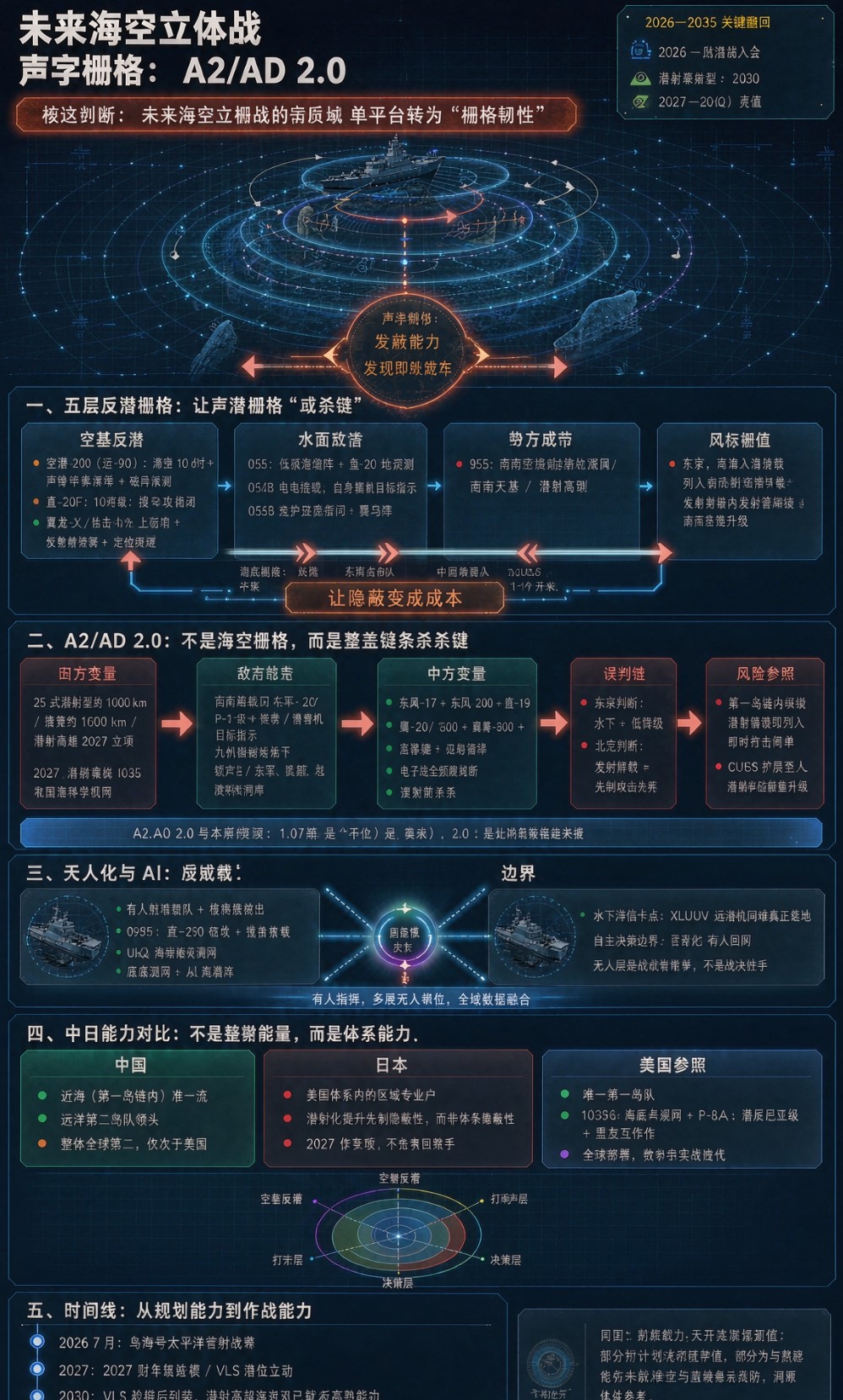
Future Sea-Air Joint Operations: The Underwater Acoustic Grid, A2/AD 2.0 and the Unmanned Layer
未来海空立体战:声学栅格、A2/AD 2.0 与无人层
引言:战争形态从"平台中心"走向"系统之系统"
Introduction: From platform-centric to "system of systems"
2026 年的西太水下,已经不再是"一艘驱逐舰找一艘潜艇"的旧剧本。中国军网在南海跨昼夜对抗训练中披露的细节很说明问题:运-9 反潜巡逻机(空潜-200)铺远距搜索,直-20F 从 055 双机库起飞补近距定位,055/052D 拖曳线列阵收被动声纹,海底观测网光纤水听器做固定哨,HSU 系列 UUV 做机动补盲——飞机、水面舰、直升机、水下平台一起找,发现之后还能继续跟住。
美国海军情报办公室 2026 年 3 月书面证词直接用了一个词:中国正在把空中、水面、海底、水下传感器连成多域反潜的 "system of systems"(系统之系统),并把海底声呐阵列、卫星连接浮标、UUV 列为关键能力。 这就是未来海空立体战的底座:探测即火力,火力即决策,决策即网络。
The Western Pacific subsurface in 2026 is no longer the old script of "one destroyer hunting one submarine." The PLA Navy's South China Sea cross-day-night exercise (China Military Online, July 2026) shows the new picture: a KQ-200 (Y-9 antisubmarine) lays out wide-area search, a Z-20F lifts off a Type 055 twin hangar to close in, Type 055/052D towed arrays pick up passive signatures, the seabed observatory's fiber-optic hydrophones hold fixed watch, and HSU-series UUVs fill the gaps—aircraft, surface ships, helicopters and underwater platforms hunt together and keep tracking after detection. The U.S. ONI's March 2026 testimony uses the phrase directly: China is linking air, surface, seabed and underwater sensors into a multi-domain antisubmarine "system of systems," with seabed arrays, satellite-linked sonobuoys and UUVs as key nodes. That is the floor of future sea-air joint warfare: detection is firepower, firepower is decision, decision is network.
一、空海潜一体反潜网:把"隐蔽"做成成本
I. The air-sea-sub ASW grid: making stealth itself expensive
1.1 空基层(Air layer)
- 空潜-200(运-9Q):滞空 10 小时+,声呐浮标+磁异探测,单次覆盖面积为舰载机数十倍,前推至第一岛链外为航母编队开道。
- 直-20F:10 吨级,对标 MH-60R;作战半径 200 km、滞空 5 小时,单机带吊放声呐+声呐浮标+2 枚鱼-11,搜-定-攻闭环;055 双机库可载 2 架。
- 翼龙-X / 攻击-11 上舰方向:长航时补盲+隐身穿透,配合歼-20/歼-35 前出琉球以东压制 P-1/SH-60K 中继。
1.2 水面/水下层(Surface & subsurface layer)
- 055 第二批:SJG-311 主被动复合拖曳阵(200 m 级)、可变深声呐穿温跃层、鱼-8 火箭助飞鱼雷+324 mm 轻雷,最远被动探测约 150 km。
- 054B 全电推进:自身辐射噪声大幅下降,变深声呐+拖曳阵精度跳档。
- 056A 轻护近海专司:40+ 艘带拖曳阵,锁宫古、巴士、台海北侧水道口。
- 海底科学观测网:东海、南海双系统,光电复合缆+光纤水听器,定位精度十米级;2024 年 10 月东海海底观测子网缆系主干开工,2026 年投用。
1.3 无人层(Unmanned layer)
- HSU-001 / 海翼滑翔机 / 潜龙:超大型 UUV 做前沿声学哨兵,仿 OZZ-5 思路但放大吨位。
- 中国海防水声载荷、中科海讯信号处理:构成"UUV 身体+七一五所声音+民企大脑"的分工。
- 2026 年初美海军已把"海鹰"无人艇编入航母打击群做前沿反潜;英、法、德走混合舰队路线;乌、伊走蜂群不对称路线——全球共识是无人层不是替代有人层,而是把有人高价值平台推到二线。
反潜网的真正产品不是"声呐",是时间:让大鲸级锂电艇"16 天不浮出"的隐蔽性,在跨昼夜交叉定位下变成"动一次暴露一次"的高昂成本。
The real product of an ASW grid is not "sonar" but time: the Taigei-class Li-ion boat's "16 days submerged" stealth becomes, under cross-day-night multi-node fixing, a costly bet that every move risks exposure.

二、A2/AD 2.0:覆盖整条杀伤链,不只覆盖潜艇
II. A2/AD 2.0: holding the whole kill chain, not just the boat
日本潜射导弹(25 式潜射型 1000 km / 战斧 1600 km / 2027 立项的潜射高超)的威胁不在弹头,在节点暴露:
- 宙斯盾载舰(鸟海号 2026-07 太平洋首射战斧)
- 九州 25 式阵地、西南诸岛 HVGP 阵地(2028 前 130 座弹药库)
- 吴、横须贺、舞鹤潜艇洞库
- P-1 反潜机中继、美军天基/预警机目标指示("美军侦察—日方打击")
中方 A2/AD 2.0 的对位打法:
- 东风-17(乘波体、末段 10 马赫)+ 东风-26D + 鹰击-19(潜射高超 6–8 马赫) 覆盖西南诸岛、冲绳、佐世保、横须贺;
- 歼-20/歼-35 + 空警-500 + 低轨星座 掐 P-1/SH-60K 中继链路;
- 电子战全频段扰断 25 式亚音速弹(0.8–0.9 马赫)的 GPS/地形匹配/末端雷达;
- 发射前击杀:潜射导弹未出水,发射平台已列入打击清单,生存概率算账 <30%。
A2/AD 2.0 与 1.0 的本质区别:1.0 是"不让你进"(拒止海域),2.0 是"让你整条链路失效"(拒止杀伤链)——固定声呐阵锁水道、UUV 锁机动、东风锁阵地、歼-20 锁中继、电子战锁制导,五把锁同时落。
The leap from A2/AD 1.0 to 2.0 is this: 1.0 denied sea room; 2.0 denies the kill chain. Fixed arrays lock the straits, UUVs lock mobility, DF missiles lock the launch bases, J-20s lock the relays, EW locks the guidance—five locks drop at once.
三、无人化与 AI:战力倍增器,但不颠覆底层逻辑
III. Unmanned + AI: force multiplier, not bottom-line disruptor
2026 年九三阅兵后,中国无人作战从"拥有"进到"体系化运用":攻击-11 与歼-20/歼-16 混编、舰载无人直升机、察打一体无人机、无人僚机同台。 但两个硬约束必须写进判断:
- 水下通信卡点:XLUUV 远程协同目前难真正落地,UUV 长时间脱离光纤/水声调制解调就变"盲潜"。美"虎鲸"、澳"幽灵鲨"、俄"波塞冬"都在踩同一个坑。
- 自主决策边界:基于深度强化学习的路径规划在动态环境可用,但"是否开火"仍有人回路(human-in-the-loop);无人层是战术倍增器,不是战略决胜手。
所以未来海空立体战的正确句式是:
有人航母编队 + 核潜艇前出 + 空潜-200/直-20F 航空反潜 + UUV 声学哨兵 + 海底观测网 + 低轨卫星 + AI 声纹库 = 一层有人指挥、多层无人执行、全域数据融合的"声学穹顶"。
无人平台在这里的角色是把有人高价值平台的暴露面往后撤——055 不必贴上去找潜艇,直-20F 不必孤机深入,UUV 先去触雷触声纹,有人层在 200 km 外做决策。
The correct sentence for future sea-air joint warfare is: carrier group + attack-nuke forward + KQ-200/Z-20F air ASW + UUV acoustic sentries + seabed observatory + LEO sats + AI hydro-acoustic library = a manned-command, unmanned-execute, all-domain-fused "acoustic dome." Unmanned platforms exist to pull the exposure surface of manned high-value platforms backward—the Type 055 need not close in, the Z-20F need not go alone, the UUV touches the acoustic contact first, and the manned layer decides 200 km away.
四、把日本潜射变量塞进立体战模型
IV. Plugging Japan's sub-launch variable into the joint-warfare model
日本 2027 财年预算 8.9 万亿日元(或破 10 万亿),含:
- 3 艘宙斯盾追加战斧(11 亿日元)
- 大鲸级潜射巡航弹采购(163 亿日元,三菱重工,鱼雷管发射)
- 潜艇 VLS 研发 2026–2029(39 亿日元,外置模块 14–24 单元)
- 水中发射型高超音速导弹立项(25HGP 衍生,仅"事项要求"未单独立项拨款)
在立体战模型里,这只改变发射端的隐蔽系数,不改变体系被压制的结构:
- 2030 年前日本潜射主要靠 533 mm 鱼雷管,25 式亚音速、载弹量受限 → 中国反潜网"发现即跟监"窗口足够;
- 2030 后若 VLS 模块上艇(大鲸级 5 艘+苍龙级),生存性提升但仍挂美军 C4ISR 目标链 → 中方优先打链路上游(天基/预警机/P-1),不是逐艇抓;
- 潜射高超即使 2027 立项、2030 后成型,面对的是已就位的鹰击-19 潜射高超 + 反高超滑翔段拦截(日本自己也在研发滑翔段拦截弹应对中俄)——代差对冲已提前布好。
最危险不是日本潜艇开火,是误判链:东京以为水下=低升级,北京把发射管解锁视为核常模糊下先制先兆。因此立体战模型里必须内嵌危机阈值——第一岛链内发射管解锁即列入即时打击清单,CUES 扩展至无人潜航器防碰撞升级。
Tokyo's sub-launch only changes the concealment coefficient of the launcher, not the structure of suppression. Pre-2030, tube-launched Type-25 subsonic with limited load gives the Chinese ASW grid enough track time; post-2030 VLS on Taigei raises survivor odds but still rides the U.S. C4ISR chain—so PLA hits the upstream chain (space/AEW/P-1), not boat-by-boat. Even a post-2030 sub-launched hypersonic meets a deployed YJ-19 + glide-phase interceptor (Tokyo itself is building glide-phase interceptors against China/Russia)—the generation gap is pre-priced. The real danger is the misjudgment chain, so the joint-warfare model must embed crisis thresholds: tube unlock inside the first island chain = instant target list; CUES extended to UUVs to stop collision escalation.
五、结论:立体战的赢家不靠单件武器,靠"栅格韧性"
V. Conclusion: the winner of joint warfare is not a single weapon, but "grid resilience"
把前面四层叠起来看:
|
层 |
中国已成型 |
日本缺口 |
美国参照 |
|---|---|---|---|
|
空基反潜 |
空潜-200+直-20F 批量 |
无舰载固定翼、P-1 非隐身 |
P-8A 喷气、留空优 |
|
水面声呐 |
055/054B 拖曳阵+海底网 |
大鲸级无 VLS(2029 前) |
弗吉尼亚级+IUSS |
|
无人层 |
HSU/海翼/天海 AUV |
迅鲸级 UUV 早期 |
海鹰/虎鲸 XLUUV |
|
打击层 |
东风-17/26D+鹰击-19+巨浪-3 |
25 式亚音速+战斧未上艇 |
战斧+LRASM+三叉戟 |
|
决策层 |
空警-500+低轨+AI 声纹 |
依赖美军数据链 |
全球 C4ISR |
中国排位:近海(第一岛链内)准一流,远洋第二梯队领头,整体全球第二仅次于美;日本是美国体系内的区域专业户,潜射化提升的是"先制隐蔽性"而非"体系生存性"。
Future sea-air joint warfare will not be won by the longest missile. It will be won by grid resilience—who can keep detecting after the first node dies, who can fuse a fiber-optic hydrophone ping with a KQ-200 sonobuoy drop and a Z-20F Doppler fix inside 90 seconds, who can make a submarine's stealth cost more than its strike is worth. China's bet is exactly that: an acoustic dome stitched from seabed to LEO, manned where it counts, unmanned where it burns. Japan's bet—sub-launched standoff fires under U.S. targeting—buys concealment, not immunity. The 2026 balance sheet already says so: every tube unlocked inside the first island chain triggers a disproportionate reply priced in before the missile leaves the water.
此文由 怡心湖 编辑,若您觉得有益,欢迎分享转发!:首页 > 观·世界 » 未来海空立体战:声学栅格、A2/AD 2.0 与无人层The Underwater Acoustic Grid, A2/AD 2.0 and the Unmanned Layer
 阿利·伯克级续造至2040与DDG(X)
 日本发展潜射导弹:中国如何应对 Jap
 鳩山由紀夫——日本政界の「異端」
 东亚军事动向观察:日本防卫省拟大规
 神社的香火与未散的阴魂:靖国问题的
 瓦森纳的红线与东京的密钥:日本五轴
 从"工业母机"到"技术主权":日本五轴
 隐形霸权与产业断层:日本科技的“咽