Trade as the Quiet Geopolitics: Reading the East Asian–Pacific Order Through Six Bilateral Numbers
贸易即静默的地缘政治——以六组双边贸易额重读东亚—太平洋秩序
In 2025, as Washington's tariff architecture kept shifting and "friend-shoring" became a keyword in every policy memo, the raw customs figures of Northeast Asia told a story more honest than any white paper. Money still flows where factories, chips and consumers actually are. Below, six bilateral trade volumes — China–US, Japan–US, Korea–US, Taiwan–US, China–Japan, China–Korea, and mainland–Taiwan — are laid side by side, not as dry statistics but as fault lines of the contemporary balance of power.
2025年,当华盛顿的关税架构持续摆动、"友岸外包"成为每份政策备忘录的关键词时,东北亚的原始海关数据讲了一个比任何白皮书都诚实的故事:钱仍流向工厂、芯片和消费者真正所在的地方。下面把六组双边贸易额——中美、日美、韩美、台美、中日、中韩、以及大陆—台湾——并排摆开,不当干瘪统计,而当作当代力量平衡的断层线来读。
1. China–US: the heavyweight that shrank but refused to fall
中美:缩水却不肯倒下的重量级配对
According to China's General Administration of Customs, China–US goods trade in 2025 reached RMB 4.01 trillion (≈ US575bn)∗∗,down18.2373.6 bn for Jan–Oct 2025, or 7.8% of America's global total. China remains the US's third-largest export market and third-largest source of imports; the US is still China's largest single export destination.
中国海关总署口径下,2025年中美货物贸易 4.01万亿元人民币(约5750亿美元),同比降18.2%,却仍占中国外贸总值的8.8%——是北京账本上最大的一条双边线。 美方商务部数据则显示2025年前10个月美中贸易3736亿美元,占美国全球贸易7.8%。中国仍是美国第三大出口市场、第三大进口来源;美国也还是中国第一大单一出口去向。
The paradox is classic: tariff walls rose, volumes fell, but the structural complementarity — US soybeans, aircraft, semiconductors vs. Chinese EVs, batteries, consumer electronics — did not vanish. The US–China deficit narrowed to about US$202 bn in 2025, yet the relationship stays "too big to decouple." 中美贸易的本质仍是互补而非对称,关税可以削规模,削不掉底层分工。
2. Japan–US & Korea–US: allies in treaty, competitors in the tariff era
日美、韩美:条约上的盟友,关税时代的竞争者
Tokyo and Seoul are security clients of Washington; their 2025 trade numbers show how that umbrella now comes with a price tag.
东京与首尔是华盛顿的安全客户;它们2025年的贸易数字显示,这把伞现在是有价的。
-
Japan–US: On the Chinese customs book, China–Japan trade hit RMB 2.305 tn (≈ US$323 bn), up 5.1% YoY — Japan is China's No.3 Asian partner. But looking from the US side, American imports from Japan in 2025 slipped; Japan fell from the 5th to the 7th largest source of US imports, with autos and steel squeezed by Trump-era reciprocal tariffs.
-
Korea–US: China–Korea trade stood at RMB 2.370 tn (≈ US$332 bn), up 1.7%, Korea being China's No.2 Asian partner with a RMB 306 bn Chinese deficit (more Korean chips, petrochems, machinery coming in). Yet US imports from Korea dropped 5.9% YoY in the first 11 months of 2025; Seoul's share of US imports slid to 3.6%, its lowest since 1988 tracking began, knocked down by auto/steel tariffs.
也就是说:日韩在对华贸易里是顺差或近平衡伙伴,在对美贸易里却因汽车、钢铁、关税被挤压名次。同盟不是免死金牌,供应链竞争力才是。
3. Taiwan–US: the semiconductor tail that wagged the dog
台美:半导体尾巴摇了狗
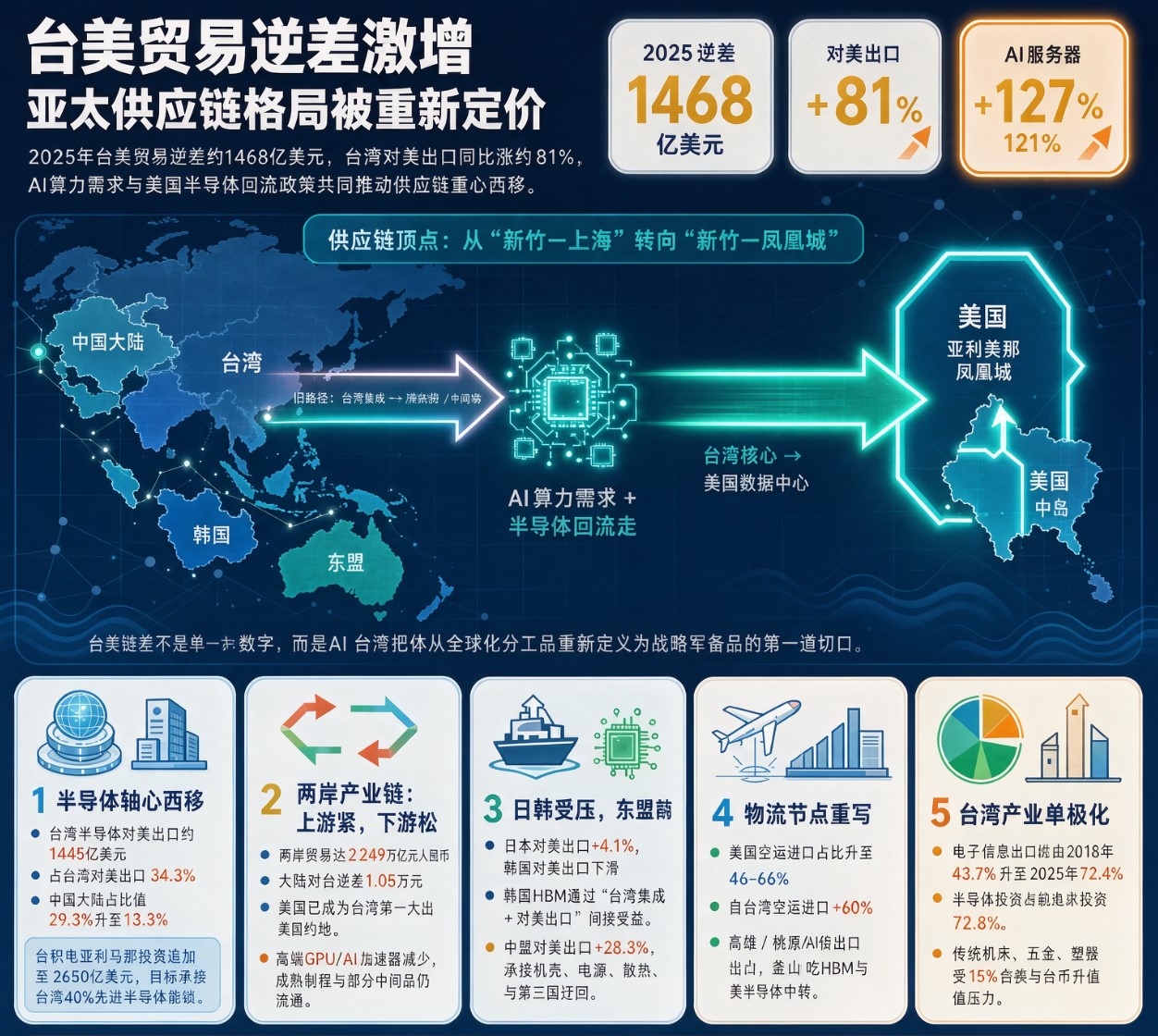
This is the most dramatic line. **US goods deficit with Taiwan widened to US146.8bnin2025∗∗,nearlydoublingYoY.Taiwan′sexportstotheUSsurged∗∗81189 bn and pushing Taipei past Japan and Korea to become the 4th largest source of US imports behind Mexico, Canada and China. For the first time in 26 years, the US (30.9%) overtook mainland China + Hong Kong (26.6%) as Taiwan's top export destination.
这是最戏剧性的一条。2025年美国对台货物逆差扩大到1468亿美元,同比几乎翻倍。 台湾对美出口同比飙涨81%(2025.4–2026.1窗口),达1890亿美元,把日本韩国甩在身后,成为美国第四大进口来源,仅次于墨西哥、加拿大、中国大陆。 26年来首次,美国(30.9%)超过大陆+香港(26.6%)成为台湾第一大出口去向。
The driver is singular: TSMC, AI accelerators, HPC servers. Taiwan makes ~90% of the world's advanced-logic chips and ~70% of AI servers. Washington's "reciprocal tariff" listed Taiwan at 32%, but semiconductors and servers were carved out — policy explicitly subsidized the shift. TSMC's Arizona bet plus NT$2.5 tn-class private investment commitments rewired the bottleneck from Hsinchu to Phoenix. 台美贸易不再是"小体量边角",而是AI军备竞赛的物理支点。
4. Mainland–Taiwan: the RMB 2.25 tn umbilical cord
大陆—台湾:2.25万亿元的脐带
Despite Taipei's "de-risking" rhetoric, mainland–Taiwan goods trade in 2025 reached RMB 2.249 tn (≈ US314bn)∗∗,up7.9147 bn), roughly the same order as Taiwan's surplus with the US.
尽管台北喊"去风险",2025年两岸货物贸易2.249万亿元人民币(约3140亿美元),同比增7.9%。 大陆对台出口5980亿、进口1.65万亿,大陆逆差1.05万亿元(约1470亿美元)——量级与台湾对美顺差相当。
Read the triangle correctly: Taiwan runs a huge surplus with both the mainland (chips, optics, intermediates) and the US (finished AI hardware), while the mainland absorbs Taiwanese upstream output and the US absorbs the downstream. The "Taiwan card" in US strategy is economically possible only because the cross-strait production chain was never severed. 拆开看三角:台湾对大陆(芯片、光学、中间品)和对美国(成品AI硬件)同时吃巨额顺差;大陆吃上游、美国吃下游。华盛顿的"台湾牌"在经贸上成立,正因为两岸生产链没断过。
5. China–Japan & China–Korea: the regional core that Washington cannot price out
中日、中韩:华盛顿标不掉价的区域核心
-
China–Japan: RMB 2.305 tn (≈ US$323 bn), +5.1%. Nearly balanced — Beijing imports Japanese capital goods, autos, chemicals; Tokyo imports Chinese intermediates and finished goods.
-
China–Korea: RMB 2.370 tn (≈ US$332 bn), +1.7%. China runs a deficit — Korean memory chips, displays, materials feed the Chinese electronics chain.
Put together, China's trade with Japan + Korea + Taiwan in 2025 ≈ RMB 6.93 tn (US$970 bn) — more than double the China–US line and the real gravity center of East Asian capitalism. No amount of "Indo-Pacific" framing erases that the PRC is the clearing house of the regional supply web. 中日韩台四边加总约6.93万亿元人民币(9700亿美元),是中美线的两倍多,这才是东亚资本主义真正的重力中心。
6. What the seven numbers actually say
七个数到底在说什么
-
The US–China line is falling but structural — 8.8% of China's trade, 7.8% of America's, too embedded to zero out.
-
Taiwan–US is the fastest-rising line in the Pacific, powered entirely by AI silicon, not by any broad-based liberalization.
-
Japan–US and Korea–US are politically privileged but economically exposed — tariffs bit their autos and steel while sparing Taiwanese chips.
-
Mainland–Taiwan trade at RMB 2.25 tn proves the strait is one factory, not two economies; the US–Taiwan surplus is the downstream realization of that same factory.
-
China–Japan–Korea form an RMB 4.68 tn bloc that no Washington coordinator can reroute overnight.
Seven digits, one map:
-
中美 4.01万亿人民币,在降但不崩;
-
台美 逆差1468亿美元,在翻倍;
-
日美、韩美 被关税啃名次;
-
中日 2.305万亿、中韩 2.370万亿,区域内核稳增;
-
两岸 2.249万亿,逆差1.05万亿人民币,证明海峡是同一座工厂。
Trade is not the soft underside of geopolitics; in East Asia it is the geopolitics. The wires of customs data show where the real levers are — and where they are not. 贸易不是地缘政治的软下腹,在东亚它就是地缘政治本身。海关数据的导线,标出了真正杠杆在哪、不哪。
Data basis: China Customs 2025 full-year bulletin; US Census/BEA 2025 partial-year releases; Taiwan Ministry of Finance 2025 annual; cross-figures reconciled at approximate USD/CNY 6.95.
此文由 怡心湖 编辑,若您觉得有益,欢迎分享转发!:首页 > 观·世界 » Trade as the Quiet Geopolitics: Reading the East Asian–Pacific Order Through Six Bilateral Numbers
 贸易围堵非宣战动员:中美“必有一战
 东亚安全十字路口:中日战争概率评