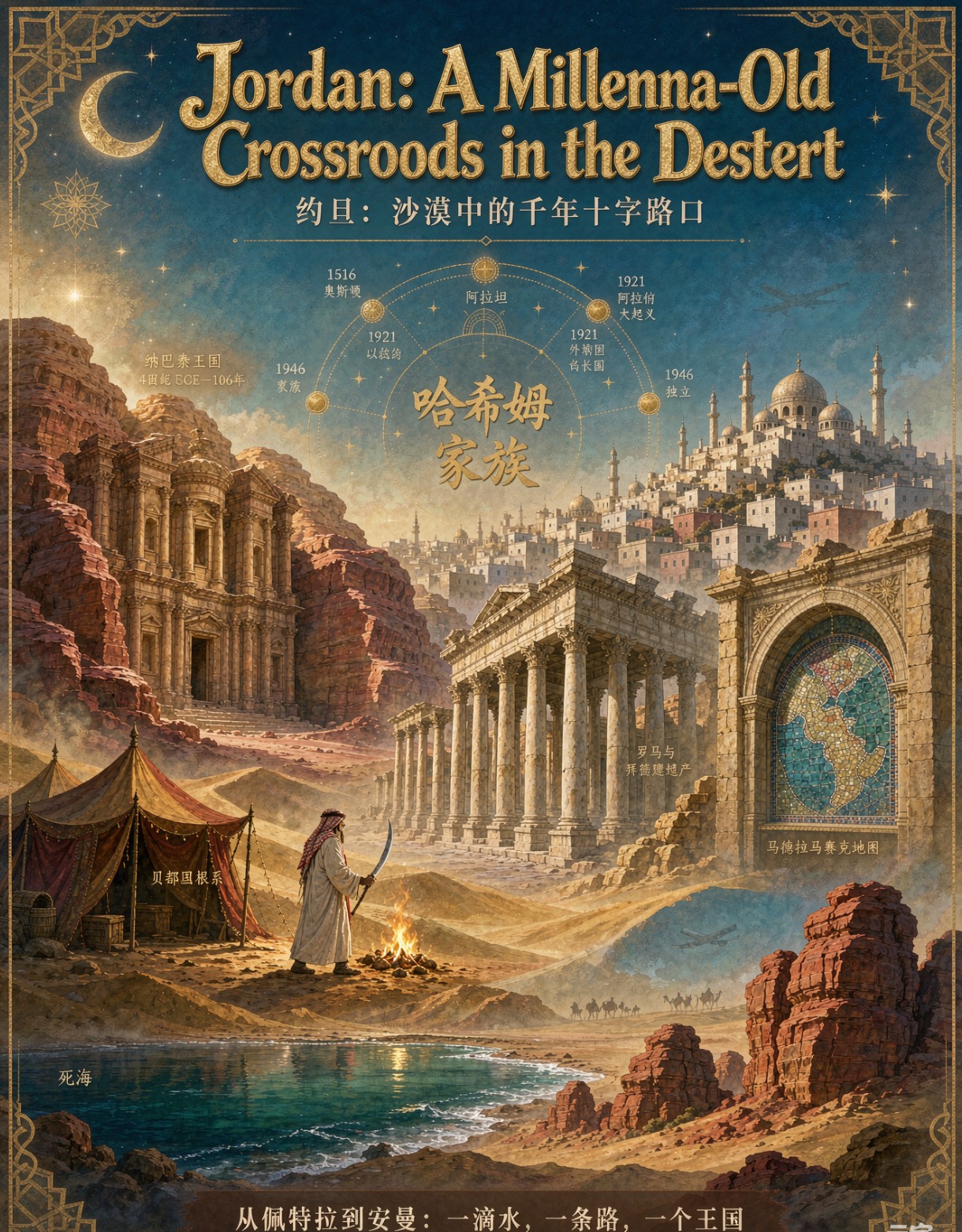

约旦:沙漠中的千年十字路口 Jordan: A Millennia-Old Crossroads in the Desert
"There is nothing in the desert, and no man needs nothing."
"沙漠里什么都没有,而没有人什么都不需要。"
—— T.E. Lawrence(阿拉伯的劳伦斯)
I. Before the Sands: The Nabataeans and the Rose City
一、沙丘之前:纳巴泰人与玫瑰红城
Long before borders were drawn, the land east of the Jordan River was already a corridor of empires. But the first people to truly build here were not conquerors from afar — they were Arab nomads who learned to read the desert.
早在国界线被画下之前,约旦河以东的土地已经是帝国往来的走廊。但第一个真正在这片土地上"建造"的,并非远方征服者——而是一群读懂了沙漠的阿拉伯游牧民。
The Nabataeans (c. 4th century BCE – 106 CE) carved their capital, Petra, out of rose-red sandstone cliffs. Half-built, half-born from the rock, the city sat at the intersection of frankincense and spice routes linking Arabia, Egypt, and the Mediterranean. They had no written law code, no standing army to speak of — yet they controlled the most lucrative trade in the ancient world through sheer hydrological genius: a system of cisterns, pipes, and ceramic channels that harvested every drop of rare desert rain.
纳巴泰人(约公元前4世纪—公元106年)将首都佩特拉凿进玫瑰红的砂岩峭壁。这座城市半是建造、半是从岩石中"生长"出来的,坐落在连接阿拉伯、埃及与地中海的乳香与香料商路交汇点上。他们没有成文法典,也没有正规军队——却凭借卓越的水利智慧掌控了古代世界最赚钱的贸易:一套由蓄水池、陶管和引水渠组成的水利系统,将沙漠中每一滴珍贵的雨水都收集起来。
In 106 CE, Rome annexed Nabataea as Arabia Petraea. The empire paved roads, built theaters, and turned Petra into a Roman provincial showpiece. But the desert always reclaims what it lends. By the 4th century, shifting trade routes and a series of earthquakes left the rose city silent — forgotten by the world for over a thousand years, until Swiss explorer Johann Ludwig Burckhardt rediscovered it in 1812.
公元106年,罗马将纳巴泰吞并为"阿拉伯佩特拉行省"。帝国铺设道路、建造剧场,把佩特拉变成了罗马行省的展示橱窗。但沙漠终会收回它借出的一切。到4世纪,商路转移与连串地震让这座玫瑰红城归于沉寂——被世界遗忘了千余年,直到1812年瑞士探险家约翰·路德维希·伯克哈特重新发现了它。
"A rose-red city half as old as time."
"一座与时光同寿的玫瑰红城。"
—— John William Burgon, Petra (1845)
II. The Ottoman Shadow and the Hejaz Railway
二、奥斯曼的阴影与汉志铁路
For nearly four centuries — from 1516 to 1918 — the land that would become Jordan lay under the long shadow of the Ottoman Empire. On paper, it belonged to the Province of Damascus. In practice, it was a patchwork of semi-autonomous Bedouin tribes who paid taxes when they felt like it and ignored the Sublime Porte the rest of the time.
近四个世纪——从1516年到1918年——这片后来成为约旦的土地,笼罩在奥斯曼帝国漫长的阴影之下。名义上它隶属大马士革省,实际上却是半自治贝都因部落的拼图:部落们高兴时交税,其余时候对伊斯坦布尔的高门(帝国政府)充耳不闻。
The Ottomans' most enduring physical legacy in Jordan was not a palace or a fort, but a railway. Completed in 1908, the Hejaz Railway was Sultan Abdulhamid II's pan-Islamic project: a narrow-gauge line from Damascus to Medina, meant to carry pilgrims to the holy cities and tighten imperial control over the Arab provinces. It also, inadvertently, gave T.E. Lawrence and the Arab Revolt of 1916 a very specific target to blow up — again and again.
奥斯曼在约旦留下的最持久的物质遗产不是宫殿或堡垒,而是一条铁路。1908年竣工的汉志铁路是苏丹阿卜杜勒·哈米德二世的泛伊斯兰工程:一条从大马士革到麦地那的窄轨铁路,旨在运送朝圣者前往圣城,同时加强对阿拉伯行省的控制。它也在无意中,给了1916年阿拉伯大起义中的T.E.劳伦斯一个非常具体的破坏目标——一次又一次地。
III. A Country Invented by Treaty
三、一个由条约"发明"出来的国家
When the Ottoman Empire collapsed after World War I, the victorious British and French redrew the Middle East with a ruler and a pen. The Sykes-Picot Agreement (1916) and the subsequent Mandate system sliced the region into shapes that had never existed before.
一战奥斯曼帝国崩溃后,胜利的英法用尺子和笔重新划定了中东版图。《赛克斯-皮科协定》(1916年)及随后的委任统治制度,将这片地区切割成此前从未存在过的形状。
Transjordan — the land east of the Jordan River — was not an afterthought. It was a solution.
外约旦——约旦河以东的土地——并非事后补丁,而是一个解决方案。
In 1920, the French expelled Emir Faisal from Damascus. His brother, Abdullah, marched north from Mecca with a Bedouin force, threatening to attack the French in Syria. The British, eager to avoid a war and honor their wartime promises to the Hashemite family, offered Abdullah a compromise: govern the territory east of the Jordan River, under British oversight. In 1921, the Emirate of Transjordan was born — a state with a ruler before it had borders, and borders before it had a national identity.
1920年,法国将埃米尔费萨尔逐出大马士革。他的兄弟阿卜杜拉从麦加率贝都因武装向北进军,威胁攻打在叙利亚的法国人。英国人急于避免战争、同时兑现对哈希姆家族的战时承诺,给阿卜杜拉开出了条件:在约旦河以东的领土上执政,但接受英国监督。1921年,外约旦酋长国诞生——一个先有统治者、后有国界,先有国界、后有国民认同的国家。
It was, in the words of historian James Barr, "a country invented by treaty." But inventions, given time, become real.
用历史学家詹姆斯·巴尔的话说,这是"一个由条约发明出来的国家"。但发明之物,假以时日,便会变成真实。
IV. The Two Banks and the Black September
四、两岸与"黑九月"
On May 25, 1946, Transjordan gained full independence from Britain and became the Hashemite Kingdom of Jordan. The name change was more than cosmetic: it signaled a kingdom that aspired to be more than a desert buffer state.
1946年5月25日,外约旦从英国获得完全独立,成为约旦哈希姆王国。更名不只是表面文章:它标志着一个不再甘于做沙漠缓冲国的王国。
The defining gamble of King Abdullah I — and later his grandson King Hussein — was the West Bank. After the 1948 Arab-Israeli War, Jordan held East Jerusalem and the West Bank, formally annexing them in 1950. For two decades, Jordan was a bridge between the desert and the Mediterranean, between Bedouin and Palestinian, between the east bank of the river and the west.
阿卜杜拉一世国王——以及后来他的孙子侯赛因国王——最关键的赌注是西岸。1948年阿以战争后,约旦控制了东耶路撒冷和西岸,并于1950年正式合并。二十年间,约旦成为沙漠与地中海之间、贝都因与巴勒斯坦人之间、约旦河东岸与西岸之间的桥梁。
But bridges can burn. In 1970, the contradiction between a Hashemite monarchy and a restive Palestinian guerrilla presence exploded into Black September — a civil war that ended with the PLO expelled from Jordan. In 1988, King Hussein formally severed legal and administrative ties with the West Bank, ceding Palestinian political representation to the PLO. Jordan became, once again, a country defined by its eastern bank alone.
但桥梁也会焚毁。1970年,哈希姆君主制与不安分的巴勒斯坦游击队之间的矛盾爆发为"黑九月"——一场内战,最终巴解组织被逐出约旦。1988年,侯赛因国王正式切断与西岸的法律和行政联系,将巴勒斯坦政治代表权交给巴解。约旦再次变回一个仅以东岸定义自身的国家。

V. The Quiet Peacemaker
五、安静的和平缔造者
On October 26, 1994, on the border between Israel and Jordan, Prime Minister Yitzhak Rabin and King Hussein signed the Israel-Jordan Peace Treaty at the Arava crossing. It was the second Arab-Israeli peace treaty after Egypt's, and it was different. There were no cheering crowds, no victory parades. Just two leaders in the desert, exhausted by decades of enmity, choosing a different path.
1994年10月26日,在以色列与约旦边境的阿拉瓦口岸,伊扎克·拉宾总理与侯赛因国王签署了《以约和平条约》。这是继埃及之后第二个阿以和平条约,但它有所不同——没有欢呼的人群,没有胜利游行。只有沙漠中两位被数十年敌意耗尽的领导人,选择了一条不同的路。
Hussein died in 1999. His son Abdullah II inherited a kingdom surrounded by fire: Iraq to the east, Syria to the north, Israel/Palestine to the west, and Saudi Arabia to the south. Through two Gulf Wars, the Arab Spring, the Syrian refugee crisis, and ISIS on the doorstep, Jordan has remained — improbably — stable. Not by accident, but by a century of careful, often painful, navigation.
侯赛因于1999年去世。他的儿子阿卜杜拉二世继承了一个被火焰包围的王国:东边伊拉克,北边叙利亚,西边以巴,南边沙特。经历了两次海湾战争、阿拉伯之春、叙利亚难民危机和ISIS兵临城下,约旦却——不可思议地——保持了稳定。这不是偶然,而是一百年来小心翼翼、往往伴随着痛苦的导航结果。
VI. What Remains
六、余韵
Today, Jordan is a country of contradictions that somehow hold together. It is a monarchy in a region of republics and theocracies. It is a majority-Palestinian population ruled by a Hashemite minority. It is a desert kingdom with no oil, yet it survives — through diplomacy, aid, tourism, and the quiet resilience of a people who have been at the crossroads for four thousand years.
今天的约旦是一个矛盾却奇妙地维系在一起的国家。它是君主制,周围却是共和国和神权政体。它的主体是巴勒斯坦人,统治者却是哈希姆少数。它是没有石油的沙漠王国,却靠着外交、援助、旅游业,以及四千年来始终站在十字路口的人民那份安静的韧性,活了下来。
Walk through the Roman columns of Jerash, touch the Byzantine mosaics of Madaba, stand at the edge of the Wadi Rum desert where Lawrence once camped — and you realize: Jordan's history is not a straight line. It is a palimpsest. Layer upon layer, empire upon empire, each leaving something behind and taking something away. The country we call Jordan today is young. But the land it sits on is as old as time.
走过杰拉什的罗马柱廊,触摸马代巴的拜占庭马赛克,站在瓦迪拉姆沙漠边缘——那里曾是劳伦斯的营地——你会意识到:约旦的历史不是一条直线,而是一份重写本。一层又一层,一个帝国接着一个帝国,每个都留下些什么,也带走些什么。今天被称为约旦的这个国家很年轻,但它脚下的土地,与时光同寿。
"The desert and the sown."
"沙漠与沃土。"
—— Gertrude Bell, The Desert and the Sown (1907)
Key Dates | 关键时间线
|
Year |
Event (EN) |
事件(中) |
|---|---|---|
|
c. 4th c. BCE |
Nabataean Kingdom rises |
纳巴泰王国兴起 |
|
106 CE |
Rome annexes Nabataea |
罗马吞并纳巴泰 |
|
1516 |
Ottoman rule begins |
奥斯曼统治开始 |
|
1908 |
Hejaz Railway completed |
汉志铁路竣工 |
|
1916 |
Arab Revolt |
阿拉伯大起义 |
|
1921 |
Emirate of Transjordan established |
外约旦酋长国建立 |
|
1946 |
Independence as Hashemite Kingdom |
独立为哈希姆王国 |
|
1948–50 |
West Bank annexed |
合并西岸 |
|
1967 |
Six-Day War; loss of West Bank |
六日战争;失去西岸 |
|
1970 |
Black September |
"黑九月"事件 |
|
1988 |
Ties with West Bank severed |
切断与西岸联系 |
|
1994 |
Peace treaty with Israel |
与以色列签署和平条约 |
|
1999 |
Abdullah II ascends the throne |
阿卜杜拉二世登基 |
此文由 怡心湖 编辑,若您觉得有益,欢迎分享转发!:首页 > 历史人文 » 约旦:沙漠中的千年十字路口 Jordan: A Millennia-Old Crossroads in the Desert
 塞尔维亚:巴尔干之心与历史的回响
  中国空军"全球第二":客观评估还是战