庞德公:鹿门深处的“造龙师”与汉末隐士的精神标高
Pang Degong: The "Dragon Maker" in the Depths of Mount Lumen and the Spiritual Benchmark of Late Han Recluses
摘要:在三国群英谱中,庞德公是一个未曾披甲、未列朝班的名字,却是那个时代最重要的“人才孵化器”。作为荆襄名士圈的“定海神针”,他以“卧龙”“凤雏”“水镜”三标签定义了三国的人才天花板,又以“拒刘表、隐鹿门”的姿态,树立了乱世知识分子的精神独立范式。本文通过梳理庞德公的生平、品评体系与人际网络,还原这位“造龙师”如何在汉末的暮色中,以隐逸之姿重塑了历史的走向。
Abstract: In the roster of Three Kingdoms luminaries, Pang Degong is a name unadorned by armor or courtly titles, yet he served as the era's most crucial "talent incubator." As the stabilizing anchor of the Jingxiang scholarly circle, he defined the pinnacle of Three Kingdoms talent with three labels: "Sleeping Dragon," "Young Phoenix," and "Water Mirror." Simultaneously, through his refusal of Liu Biao's summons and his reclusion in Mount Lumen, he established a paradigm of spiritual independence for intellectuals in turbulent times. This article reconstructs the life, evaluative system, and interpersonal networks of Pang Degong to reveal how this "Dragon Maker" reshaped the trajectory of history from a stance of reclusive detachment amidst the twilight of the Han dynasty.
一、引子:襄阳城外的“精神飞地”
I. Introduction: The "Spiritual Enclave" Beyond Xiangyang's Walls
东汉中平年间,中原板荡,白骨蔽野。唯有荆州牧刘表治下的襄阳,因地处腹地,暂得喘息,成了北方流民与士人的“诺亚方舟”。在这片乱世桃源中,有一处地方比州府衙门的权势更具吸引力——那就是庞德公的鹿门山居所。
During the Zhongping era of the Eastern Han, the Central Plains were in turmoil, littered with bleached bones. Only Xiangyang, under the governance of Jingzhou Governor Liu Biao, enjoyed a temporary respite due to its inland location, serving as a "Noah's Ark" for northern refugees and scholars. Within this "Shangri-La" of chaos, one place held more allure than the provincial government offices—the residence of Pang Degong on Mount Lumen.
这里没有刀光剑影,却有思想的锋芒;这里不议朝政得失,却在悄然间为未来的天下选定了掌舵人。庞德公,这位终生不仕的老者,以其独有的“月旦评”与人格魅力,在襄阳城外划出了一块独立于权力的精神飞地。
Here, there were no blades or shadows of war, yet the edge of thought was keen. Here, court politics were eschewed, yet the future helmsmen of the realm were quietly selected. Pang Degong, an elder who never served in office, carved out a spiritual enclave independent of power beyond Xiangyang's walls through his unique "monthly evaluations" (Yuedan Ping) and personal charisma.
二、品题之权:一言定乾坤的“造名”大师
II. The Power of Appraisal: The "Name-Making" Master Whose Words Determined Destinies
在汉代,一个人的名声往往比黄金更珍贵。特别是对于没有家世背景的年轻人,能否得到名士的“品题”(评价),直接决定了其仕途的起点。庞德公便是当时最具公信力的“品题权威”。
In the Han dynasty, a person's reputation was often more valuable than gold. Especially for young men lacking familial background, whether they received an appraisal (pinti) from a renowned scholar directly determined their starting point in officialdom. Pang Degong was the most credible authority in such appraisals of his time.
1. “卧龙”与“凤雏”:最高的战略估值
1. "Sleeping Dragon" and "Young Phoenix": The Highest Strategic Valuation
庞德公最脍炙人口的功绩,是为两位年轻人赋予了传奇的代号:
Pang Degong's most celebrated achievement was bestowing legendary codenames upon two young men:
-
诸葛亮为“卧龙”:彼时诸葛亮隐居隆中,躬耕陇亩。庞德公敏锐地捕捉到他“每自比于管仲、乐毅”的宏大志向,将其比作潜伏深渊、蓄势待发的巨龙。这个称号不仅肯定了诸葛亮的才华,更暗示了他“静以待时”的战略定力。
-
Zhuge Liang as the "Sleeping Dragon": At that time, Zhuge Liang lived in seclusion in Longzhong, tilling the fields. Pang Degong keenly perceived Liang's grand ambition of comparing himself to the ancient statesmen Guan Zhong and Yue Yi, likening him to a colossal dragon lurking in the deep abyss, gathering momentum. This title not only affirmed Liang's talent but also hinted at his strategic composure in "awaiting the opportune moment."
-
庞统为“凤雏”:庞统是庞德公的侄子,年少时朴钝,不为时人所识。唯独庞德公看到了他内藏的经纬之才,称其为羽毛未丰的凤凰雏鸟。事实证明,庞统后来的连环计与落凤坡之勇,不负此名。
-
Pang Tong as the "Young Phoenix": Pang Tong, Pang Degong's nephew, appeared plain and slow-witted in his youth, unrecognized by his contemporaries. Only Pang Degong discerned the brilliant talent hidden within, naming him a fledgling phoenix. History proved that Pang Tong's subsequent chain-links strategy and valor at the Battle of Fallen Phoenix Slope justified this name.
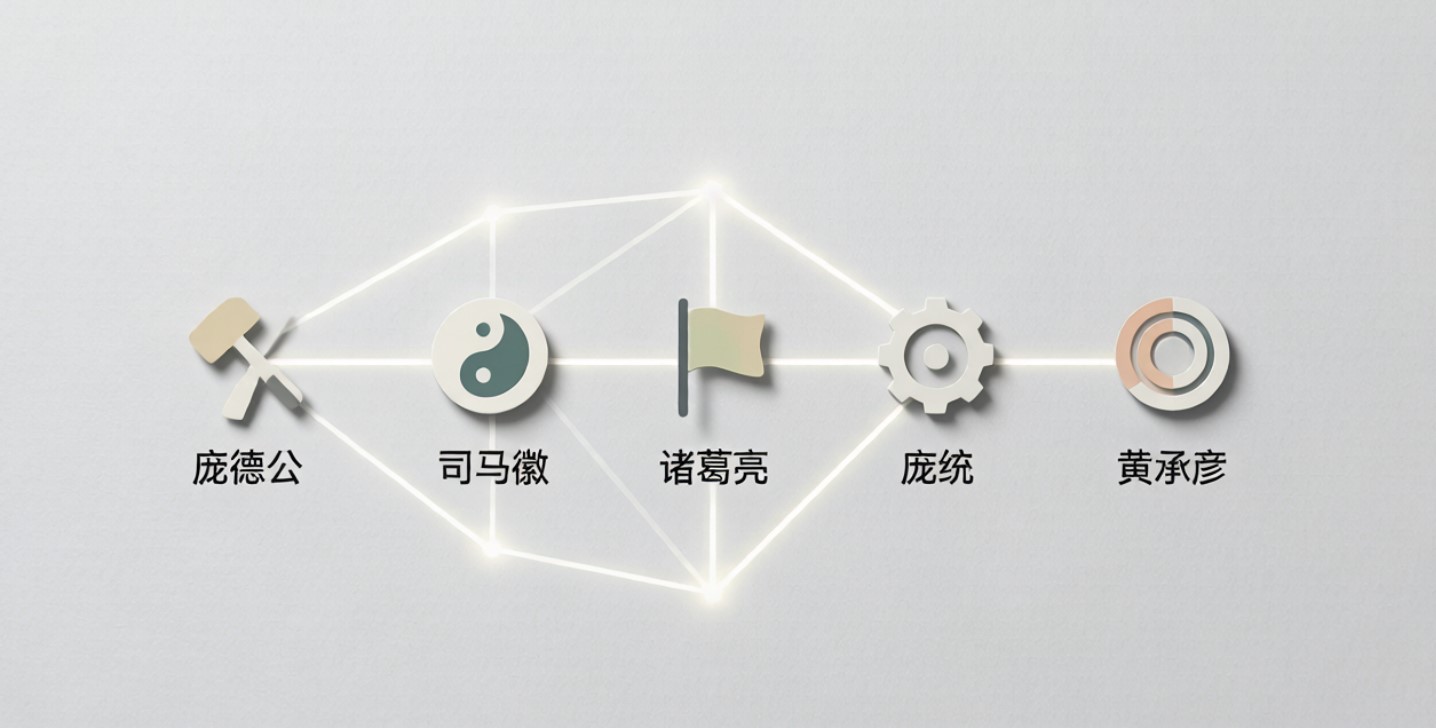
此外,他还称司马徽为“水镜”——意指其清澈如镜,能洞悉人心与世事。这三大名号的确立,实际上构成了后来蜀汉政权的人才顶层架构。
Furthermore, he referred to Sima Hui as the "Water Mirror"—implying his clarity and ability to perceive human nature and worldly affairs. The establishment of these three major epithets essentially constructed the top-tier talent framework of the subsequent Shu Han regime.
2. 诸葛亮的“床下拜”
2. Zhuge Liang's "Bow at the Bedside"
《襄阳记》记载,诸葛亮十分敬重庞德公,每次探访,都独自一人拜于床下。庞德公起初坦然接受,后来实在过意不去,才加以制止。这一细节极具象征意义:它标志着在乱世中,道统(学问与品德)的权威高于政统(官职与权势)。 庞德公不需要官印,仅凭德行与见识,便赢得了未来“武乡侯”的至高敬意。
The Xiangyang Jirecords that Zhuge Liang held Pang Degong in high esteem. Every time he visited, Liang would bow alone at the foot of Pang's bed. Initially, Pang accepted this nonchalantly, only stopping him later out of unease. This detail is deeply symbolic: it signifies that in turbulent times, the authority of the intellectual tradition (learning and virtue) superseded that of the political order (official rank and power). Pang Degong required no official seal; relying solely on virtue and insight, he earned the utmost reverence of the future "Marquis of Wuxiang."
三、人际网络:荆襄名士圈的“粘合剂”
III. The Interpersonal Web: The "Adhesive" of the Jingxiang Scholarly Circle
庞德公之所以能成为“造龙师”,不仅因为他有眼光,更因为他处于一个精密人际关系网络的中心。
Pang Degong's ability to be a "Dragon Maker" stemmed not only from his insight but also from his position at the center of a sophisticated interpersonal web.
1. 亦师亦友的司马徽
1. Sima Hui: Mentor and Friend
司马徽比庞德公年轻十岁,却视其为兄长。两人经常彻夜长谈,司马徽去庞家做客,甚至可以直接呼唤庞妻做饭,不分主客,亲如一家。庞德公将侄子庞统送到司马徽处深造,促成了“水镜”对“凤雏”的最终认可。这种毫无芥蒂的学术交流,是乱世中最珍贵的友谊。
Sima Hui, ten years younger than Pang Degong, regarded him as an elder brother. The two often conversed through the night. Sima Hui felt comfortable enough in Pang's home to call for meals directly from Pang's wife, blurring the lines between host and guest in a familial bond. Pang Degong sent his nephew Pang Tong to Sima Hui for further studies, facilitating the "Water Mirror's" eventual recognition of the "Young Phoenix." This unreserved academic exchange represented the most precious form of friendship amidst chaos.
2. 错综复杂的姻亲网
2. The Intricate Web of Marital Ties
庞德公巧妙地通过婚姻,将松散的名士群体联结成一个命运共同体:
Pang Degong skillfully wove disparate scholarly groups into a community of shared destiny through marital alliances:
-
其子庞山民娶了诸葛亮的二姐;
-
His son, Pang Shanmin, married Zhuge Liang's second sister.
-
其女嫁给了荆州望族蒯祺;
-
His daughter married Kuai Qi, a prominent figure from a leading Jingzhou clan.
-
其挚友黄承彦(蔡瑁姐夫)的女儿黄月英,嫁给了诸葛亮。
-
His close friend Huang Chengyan's (brother-in-law to Cai Mao) daughter, Huang Yueying, married Zhuge Liang.
这样一来,诸葛亮、庞统、司马徽、黄承彦等人,不仅在精神上志同道合,在血缘上也休戚与共。这个圈子后来几乎整体“转会”到了刘备阵营,成为蜀汉立国的基石。
Consequently, figures like Zhuge Liang, Pang Tong, Sima Hui, and Huang Chengyan were not only kindred spirits intellectually but also interconnected through blood ties. This circle largely "transferred" en masse to Liu Bei's camp, becoming the cornerstone of the Shu Han state's founding.

四、拒官与归隐:乱世中的清醒与抉择
IV. Refusal of Office and Return to Reclusion: Sobriety and Choice in Turbulent Times
庞德公最令人敬佩之处,在于他面对权力诱惑时的极度清醒。
What renders Pang Degong most admirable is his extreme sobriety when faced with the temptations of power.
1. 与刘表的辩论
1. The Debate with Liu Biao
荆州牧刘表曾亲自登门,试图说服庞德公出山:“先生苦居畎亩而不肯官禄,后世何以遗子孙乎?”(您辛苦耕作却不拿俸禄,拿什么留给子孙呢?)
Liu Biao, the Governor of Jingzhou, personally visited to persuade Pang Degong to join his administration: "Sir, you toil in the fields yet refuse official salary; what will you leave for your descendants?"
庞德公的回答堪称千古名对:“世人皆遗之以危,今独遗之以安。虽所遗不同,未为无所遗也。”(世人都留给子孙危险,我却唯独留给子孙安宁。虽然留下的东西不同,但不能说我没有留下。)
Pang Degong's reply stands as a timeless masterpiece: "The world leaves danger to its descendants; I alone leave them peace. Though what is left differs, it cannot be said that I leave nothing."
这一问一答,道尽了乱世生存的哲学。刘表看重的是物质的积累与权力的传递,而庞德公看重的是精神的自由与生命的保全。在即将到来的战火面前,后者显然更具远见。
This exchange encapsulates the philosophy of survival in troubled times. Liu Biao valued material accumulation and the transmission of power, whereas Pang Degong prioritized spiritual freedom and the preservation of life. Facing the impending conflagration of war, the latter perspective was demonstrably more farsighted.
2. 鹿门山的背影
2. The Silhouette of Mount Lumen
为了彻底摆脱刘表的纠缠,庞德公最终选择了“采药不返”。他带着家人登上了鹿门山,自此消失在官场的视野中。传说他最后不知去向,或许成了神仙,或许终老山林。无论哪种结局,他都保持了人格的完整与独立,没有像其他名士那样沦为军阀的点缀。
To completely evade Liu Biao's entanglements, Pang Degong ultimately chose to "gather herbs and never return." Taking his family with him, he ascended Mount Lumen, disappearing forever from the purview of officialdom. Legends suggest he vanished without a trace—perhaps becoming an immortal, perhaps living out his days in the mountains. Regardless of the outcome, he maintained the integrity and independence of his character, refusing to become a mere ornament to warlords like other scholars of his time.
五、结语:隐士的历史分量
V. Conclusion: The Historical Significance of the Recluse
三国时期,人们往往记住了冲锋陷阵的将军和运筹帷幄的丞相,却容易忽略庞德公这样的“扫地僧”。
In the Three Kingdoms period, people often remember the charging generals and the master-strategist chancellors, easily overlooking "hidden masters" like Pang Degong.
然而,没有庞德公的“品题”,诸葛亮和庞统或许要在历史的尘埃中多摸索许多年;没有庞德公的“拒官”,荆襄名士圈或许早已分崩离析。他用自己的隐逸,证明了知识分子不一定非要进入体制才能发挥作用,保持距离往往能拥有更客观的洞察力和更持久的道义力量。
However, without Pang Degong's "appraisals," Zhuge Liang and Pang Tong might have groped in the dust of history for many more years; without Pang Degong's "refusal of office," the Jingxiang scholarly circle might have fragmented long ago. Through his reclusion, he demonstrated that intellectuals need not enter the system to exert influence; maintaining distance often grants more objective insight and enduring moral authority.
庞德公隐居的鹿门山,后来成为了中国隐逸文化的圣地。他留给后世的,不仅仅是“卧龙凤雏”的传说,更是一种“遗安”于世的人格典范——在这个喧嚣的时代,或许我们更需要这种来自鹿门深处的清冷回响。
Mount Lumen, where Pang Degong resided, later became a sacred site of Chinese reclusive culture. What he bequeathed to posterity is not merely the legend of the "Sleeping Dragon and Young Phoenix," but a model of character that "leaves peace" to the world. In this clamorous age, we may have a greater need for this clear, resonant echo emanating from the depths of Mount Lumen.
关键词:庞德公;卧龙凤雏;荆襄名士;隐逸文化;汉末三国
Keywords: Pang Degong; Sleeping Dragon and Young Phoenix; Jingxiang Scholars; Reclusive Culture; Late Han and Three Kingdoms
此文由 怡心湖 编辑,若您觉得有益,欢迎分享转发!:首页 > 历史人文 » 庞德公:鹿门深处的“造龙师”与汉末隐士的精神标高
 水镜先生:乱世里的“人间清醒”与三
 灰度生存的艺术:论“同流而不合污”
 金无火 义不显