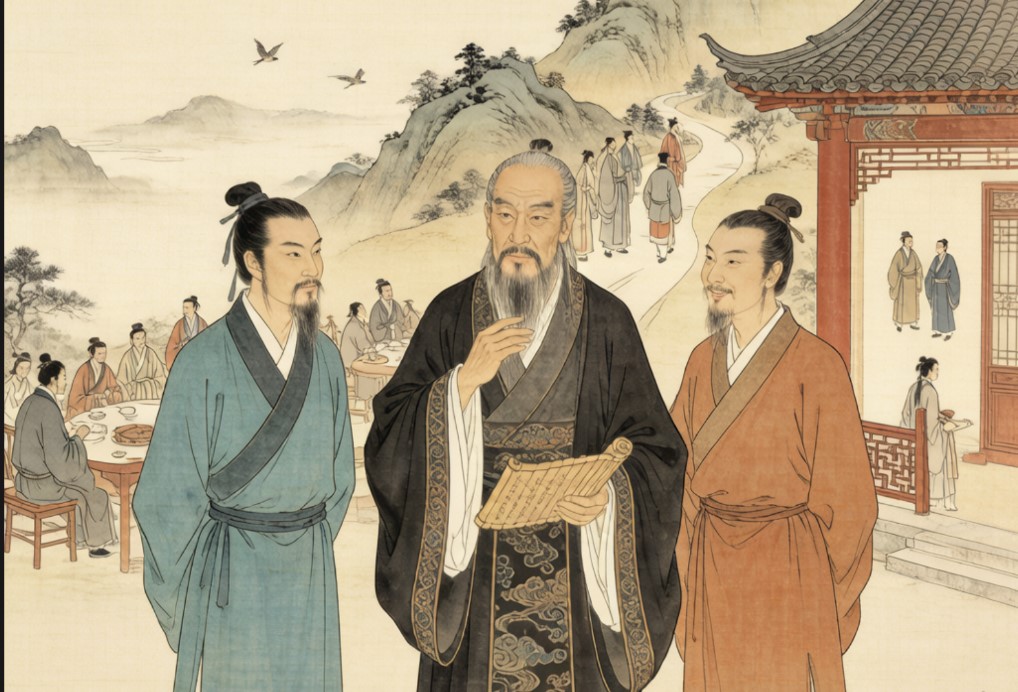
水镜先生:乱世里的“人间清醒”与三国人才的“终极推手”
Master Water Mirror: The "Ultimate Sober Mind" of Troubled Times and the "Ultimate Talent Broker" of the Three Kingdoms
摘要:在群雄逐鹿的三国舞台上,司马徽从未披甲上阵,也未曾位列公卿,却以“水镜先生”之名,成为改写历史走向的隐形操盘手。他凭“好好先生”的外壳藏锋,以“识人如镜”的眼光荐才,用“洞察天时”的通透预言,在刀光剑影中守住了一份超然与清醒。本文将以司马徽的人生轨迹为轴,解码这位隐士的能耐与智慧,探寻他在三国人才链条中的关键作用。
Abstract: On the tumultuous stage of the Three Kingdoms, where warlords vied for supremacy, Sima Hui never donned armor nor held high office, yet under the name "Master Water Mirror," he became an invisible power broker who altered the course of history. Cloaking his brilliance beneath the guise of a "Good-natured Gentleman," he recommended talents with his "mirror-like insight" and prophesied with a clarity that pierced the tides of time, preserving an air of detachment amidst the chaos of swords and shadows. This article traces Sima Hui's life trajectory to decode the capabilities and wisdom of this recluse, exploring his pivotal role in the talent network of the Three Kingdoms era.
一、引子:荆州城外的那面“镜子”
I. Introduction: The "Mirror" Outside the Walls of Jingzhou
东汉末年的荆州,是乱世里少有的“桃花源”。当北方烽火连天时,刘表治下的襄阳城却书声琅琅,名士云集。在这片文化绿洲中,有一位清瘦的老者,常年隐居在城外的檀溪畔,松形鹤骨,器宇不凡。他就是司马徽,时人尊称“水镜先生”。
The Jingzhou region during the late Eastern Han Dynasty served as a rare "Shangri-La" amidst the chaos. While the north was engulfed in flames of war, the city of Xiangyang under Liu Biao's governance echoed with the sound of reading, attracting flocks of renowned scholars. Within this cultural oasis resided a lean, elderly man by the Tan Stream outside the city walls—possessing a pine-like stature and crane-like bones, with an extraordinary bearing. He was Sima Hui, reverently called "Master Water Mirror" by his contemporaries.
他不像诸葛亮那样“躬耕陇亩”却心怀天下,也不像庞统那样“凤雏”其名而锋芒毕露。他更像一面镜子,静静映照着乱世的众生相,直到一位名叫刘备的落魄英雄路过,打破了这份宁静。
Unlike Zhuge Liang, who "tilled the fields" while harboring ambitions for the realm, or Pang Tong, whose reputation as the "Young Phoenix" masked sharp edges, Sima Hui resembled a mirror—silently reflecting the myriad faces of the chaotic era. That tranquility remained unbroken until a down-on-his-luck hero named Liu Bei passed by.

二、“好好先生”的伪装:明哲保身的顶级智慧
II. The Persona of the "Good-natured Gentleman": Supreme Wisdom in Self-Preservation
司马徽最广为人知的标签,是“好好先生”。《三国志》裴松之注引《襄阳记》中记载了一个经典故事:有人问他安否,他答“好”;有人说自己儿子死了,他也答“大好”。妻子责备他,他却说:“卿言亦大好。”
Sima Hui's most famous moniker is "Good-natured Gentleman" (Haohao Xiansheng). A classic anecdote recorded in the Xiangyang Ji, quoted in Pei Songzhi's annotations to the Records of the Three Kingdoms, illustrates this: When asked about his well-being, he replied, "Good." When told that someone's son had died, he again replied, "Very good." His wife reproached him, to which he responded, "Your words are also very good."
这种看似荒诞的“好好”,实则是乱世生存的最高哲学。
This seemingly absurd "goodness" was, in reality, the highest philosophy of survival in troubled times.
1. 避祸的“钝感力”
1. "Blunt Sensitivity" as a Means of Evasion
身处刘表治下,司马徽看透了这位“八俊”之一的州牧“外宽内忌,好谋无决”的本质。若直言其短,必遭祸端;若阿谀奉承,又有损名士风骨。于是,他用“好好”二字构筑了一道防火墙,让所有人都挑不出错处,既保全了自己,又维持了清誉。
Living under Liu Biao's rule, Sima Hui saw through the governor—one of the "Eight Elites"—discerning his nature as "outwardly tolerant but inwardly jealous, fond of scheming but indecisive." To criticize him openly would invite disaster; to flatter him would tarnish a scholar's integrity. Thus, he erected a firewall with the phrase "very good," ensuring no one could fault him, thereby preserving both his life and his reputation.
2. 清雅的“精神洁癖”
2. An "Intellectual Fastidiousness" Rooted in Elegance
他不屑于卷入世俗的纷争,却极重精神世界的丰盈。他精通奇门、兵法、经学,尤擅音律。据说他抚琴时,能令百鸟驻足。这种对艺术与学问的极致追求,让他在污浊的乱世中,守住了内心的一方净土。
He disdained entanglement in worldly strife, yet placed immense value on spiritual enrichment. He mastered the occult arts, military strategy, and Confucian classics, with a particular prowess in music. Legend has it that birds would halt their flight to listen when he played the zither. This relentless pursuit of art and scholarship allowed him to preserve a pure sanctuary within his soul amidst the mire of the era.
三、识人如镜:三国人才的“终极评委”
III. Insight Like a Mirror: The "Ultimate Judge" of Three Kingdoms Talent
司马徽真正的能耐,在于一双洞穿皮相、直抵灵魂的慧眼。庞德公评价他“如水之清,如镜之明”,这并非虚言。
Sima Hui's true prowess lay in his eyes—capable of piercing appearances to glimpse the soul. Pang Degong's assessment of him as "clear as water and bright as a mirror" was no exaggeration.
1. 发掘庞统:从“吴下阿蒙”到“凤雏”
1. Discovering Pang Tong: From "Unremarkable Nobody" to "Young Phoenix"
庞统年少时朴钝,不为时人所识。十八岁时拜访司马徽,两人从日出谈到日落。司马徽听完庞统的见解,惊为天人,盛赞其为“南州士之冠冕”(南方士人中的第一人)。正是在他的极力推崇下,庞统才得以进入荆襄名士圈,最终与诸葛亮并称“卧龙凤雏”。
Pang Tong was plain and slow-witted in his youth, unrecognized by his contemporaries. At eighteen, he visited Sima Hui, and the two conversed from sunrise to sunset. After hearing Pang Tong's insights, Sima Hui was astounded, praising him as the "Crown of the Southern Scholars." It was through his vigorous endorsement that Pang Tong entered the scholarly circles of Jingxiang, eventually earning the joint title "Sleeping Dragon and Young Phoenix" alongside Zhuge Liang.
2. 举荐诸葛:一句谶语定三分
2. Recommending Zhuge: A Prophecy that Sealed the Tripartite Division
这是司马徽最著名的“神来之笔”。刘备马跃檀溪,偶遇司马徽。当刘备叹息自己屡遭挫败、缺乏良才时,司马徽说出了那句流传千古的名言:
This was Sima Hui's most legendary stroke of genius. After Liu Bei's horse leaped across the Tan Stream and he encountered Sima Hui by chance, Liu Bei sighed over his repeated defeats and lack of capable advisors. Sima Hui then uttered the timeless prophecy:
“儒生俗士,岂识时务?识时务者在乎俊杰。此间自有卧龙、凤雏。”
"How can vulgar pedants comprehend the times? Those who understand the times are the true heroes. Here, there are the 'Sleeping Dragon' and the 'Young Phoenix.'"
他还补了一句:“卧龙虽得其主,不得其时。”这不仅是对诸葛亮命运的精准预判,更是对天下将三分、汉室难复兴的深刻洞察。可以说,没有水镜先生的这次“人才推介”,就没有后来的“三顾茅庐”与《隆中对》。
He added, "The Sleeping Dragon has found his lord, but not his time." This was not merely a precise prediction of Zhuge Liang's fate, but a profound insight into the imminent tripartite division of the empire and the irreversible decline of the Han dynasty. Arguably, without Master Water Mirror's "talent referral," there would have been no subsequent "Three Visits to the Thatched Cottage" or the Longzhong Plan.
四、洞察天机:悲剧色彩的清醒预言
IV. Piercing the Veil of Fate: Prophecies Marked by Tragic Clarity
司马徽的能耐,不止于识人,更在于知天命。他的预言,总带着一种“看透不说透”的无奈与悲悯。
Sima Hui's prowess extended beyond recognizing talent to understanding the Mandate of Heaven. His prophecies always carried a sense of helplessness and compassion born from "seeing through things without laying them bare."
1. 徐母之死的预判
1. Foretelling the Death of Xu Shu's Mother
徐庶辅佐刘备时,曹操囚禁了徐母,逼徐庶归曹。徐庶辞行时,司马徽一听便知其中有诈,断言:“元直(徐庶字)去,必困于曹氏,然纵一去,母必死矣!”后果如其言。这种对人性(曹操的奸诈)和局势的精准计算,令人咋舌。
When Xu Shu was assisting Liu Bei, Cao Cao imprisoned Xu Shu's mother to force Xu Shu to defect. Upon hearing of Xu Shu's departure, Sima Hui immediately sensed the ruse, asserting: "Yuanzhi (Xu Shu's style name) will surely fall into Cao Cao's trap. Even if he goes, his mother will die!" The outcome proved him right. Such precise calculation of human nature (Cao Cao's cunning) and the geopolitical situation remains astounding.
2. “不得其时”的叹息
2. The Sigh of "Missing the Time"
当诸葛亮满怀憧憬地准备出山时,司马徽却发出了那声著名的叹息:“孔明虽得其主,不得其时。”这短短十字,道尽了三国时代的宿命感——即使有千古良相,也难以逆转历史车轮。司马徽知道,他所推荐的人才,注定要在一场无法获胜的战争中耗尽心血。这是一种超越个人荣辱的、对历史规律的深刻敬畏。
As Zhuge Liang prepared to leave his seclusion with high hopes, Sima Hui let out that famous sigh: "Kongming has found his lord, but not his time." These ten characters encapsulate the sense of fate pervading the Three Kingdoms era—even a prime minister of unparalleled caliber could not reverse the wheel of history. Sima Hui understood that the talents he recommended were destined to exhaust their hearts and minds in a war that could not be won. This reflects a profound reverence for historical laws that transcended personal glory or disgrace.
五、历史的回响:功成身退的完美谢幕
V. Echoes in History: The Perfect Curtain Call of "Success and Withdrawal"
建安十三年(208年),曹操南征,刘琮投降。曹操久闻司马徽之名,欲征用之。然而,就在这一年,司马徽病逝,或说被曹操所害(正史多从病逝说)。
In 208 CE (the 13th year of the Jian'an era), Cao Cao launched a southern campaign, and Liu Cong surrendered. Having long heard of Sima Hui's reputation, Cao Cao sought to recruit him. However, in that very same year, Sima Hui fell ill and died—though some accounts suggest he was murdered by Cao Cao (official histories generally support the illness account).
他死得恰到好处。他没有看到赤壁的火,也没有看到三国的鼎立,更没有卷入曹魏政权的内部倾轧。他以一种近乎“神话”的方式,在历史的转折点抽身而去,留下了一个完美的背影。
His timing was impeccable. He did not witness the fires of the Red Cliffs, the tripartite stand-off of the Three Kingdoms, nor the internal strife within the Cao Wei regime. Exiting the stage at this historical turning point in an almost mythical manner, he left behind a flawless silhouette.
六、结语:隐士的能耐,在于“知止”
VI. Conclusion: The Recluse's True Prowess Lies in "Knowing When to Stop"
许攸死于居功自傲,杨修死于卖弄聪明,孔融死于口舌之利。相比之下,水镜先生司马徽的能耐,不在于他能出多少奇谋,而在于他知道自己何时该进,何时该退,何时该沉默,何时该发声。
Xu You died of arrogance regarding his merits; Yang Xiu perished by flaunting his cleverness; Kong Rong was killed for his sharp tongue. In contrast, the prowess of Master Water Mirror, Sima Hui, did not lie in devising brilliant strategies, but in knowing when to advance, when to retreat, when to remain silent, and when to speak out.
他是三国乱世里的“定海神针”,用一双冷眼旁观着英雄们的厮杀,用一次精准的举荐改变了历史的进程。他告诉我们:真正的智慧,有时不是去征服世界,而是在看清世界后,优雅地守住自己。
He was the "anchor" in the turbulent sea of the Three Kingdoms, observing the heroes' struggles with detached clarity, and altering the course of history with one precise recommendation. He teaches us that true wisdom sometimes lies not in conquering the world, but in gracefully preserving oneself after seeing the world clearly.
关键词:司马徽;水镜先生;卧龙凤雏;识人;三国人才学
Keywords: Sima Hui; Master Water Mirror; Sleeping Dragon and Young Phoenix; Insight into People; Three Kingdoms Talent Studies
此文由 怡心湖 编辑,若您觉得有益,欢迎分享转发!:首页 > 历史人文 » 水镜先生:乱世里的“人间清醒”与三国人才的“终极推手”
 许攸之死:功臣宿命与权力边界的政治
 官渡之战为何曹操能打败袁绍
 灰度生存的艺术:论“同流而不合污”
 金无火 义不显