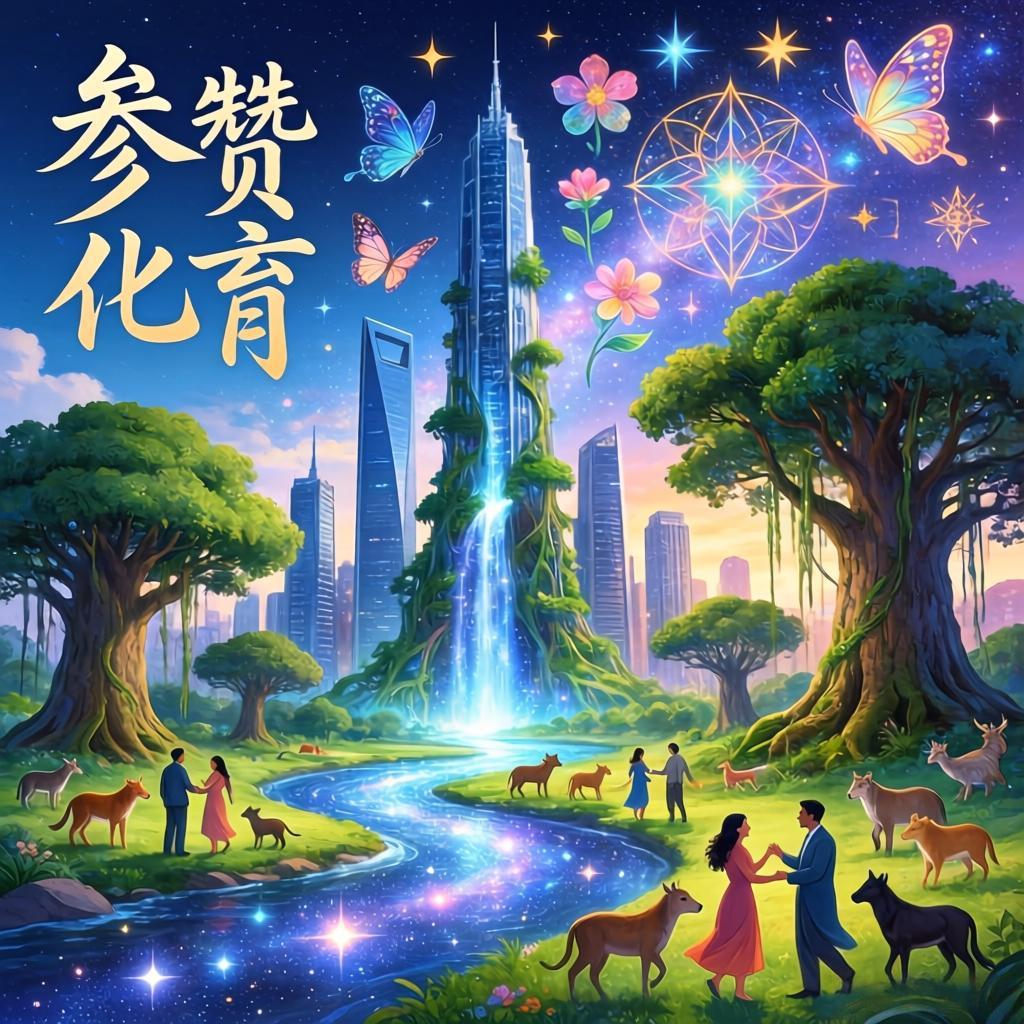

Assisting in the Transformation and Nourishment: An Ethical Poetics of Human-Nature Coevolution
一、“赞天地之化育”的宇宙论根基
1. The Cosmological Foundation of "Assisting Heaven and Earth in Transformation and Nourishment"
1.1 从“征服自然”到“参与创造”
1.1 From "Conquering Nature" to "Participating in Creation"
《中庸》言:“能尽物之性,则可以赞天地之化育。” 这句话包含革命性的世界观:人类不是自然的局外人或主宰者,而是宇宙化育过程的参与者和协作者。这种参与不是被动的顺应,而是主动的、创造性的协同。
西方近代的“征服自然”范式与东方传统的“参赞化育”形成鲜明对比:
|
征服自然范式 |
参赞化育范式 |
|---|---|
|
人类 vs. 自然 |
人类 within 自然 |
|
榨取资源 |
培育生机 |
|
线性进步观 |
循环生成观 |
|
人类中心主义 |
生态中心主义 |
|
机械隐喻 |
有机体隐喻 |
|
目标:控制 |
目标:和谐 |
关键转向:从“让自然为我所用”到“让我为自然所用”——人类成为自然实现自身潜能的中介。
The Doctrine of the Mean states: "He who can fully realize the nature of things can assist in the transforming and nourishing powers of Heaven and Earth." This contains a revolutionary worldview: Humans are not outsiders or rulers of nature, but participants and collaborators in the cosmic process of transformation and nourishment. This participation is not passive compliance but active, creative synergy.
The modern Western paradigm of "conquering nature" contrasts sharply with the Eastern tradition of "assisting transformation and nourishment":
|
Conquering Nature Paradigm |
Assisting Transformation Paradigm |
|---|---|
|
Humans vs. Nature |
Humans within Nature |
|
Extracting resources |
Cultivating vitality |
|
Linear progress view |
Cyclical generation view |
|
Anthropocentrism |
Ecocentrism |
|
Mechanical metaphor |
Organism metaphor |
|
Goal: Control |
Goal: Harmony |
Key shift: From "making nature serve me" to "making me serve nature"—humans become mediators through which nature realizes its own potential.
1.2 化的三重境界
1.2 Three Realms of Transformation (化)
“化”不仅指变化,更指有方向的、创造性的、向更丰富可能性开放的演进过程:
-
自化:万物依其本性自然演化,如种子发芽、四季更替
-
被化:被动接受外力改变,如岩石风化、被迫迁移
-
参赞化:有意识的、创造性的参与演化过程,如农业育种、生态修复
“参赞化育”位于第三境界:人类以其独特的意识能力,成为宇宙自我认知和自我创造的媒介。当园艺师帮助玫瑰开出更美的花朵,当生态学家修复受损湿地,当农夫按照节气耕作——他们都在“赞天地之化育”。
"Transformation" (化) means not merely change but directed, creative evolution toward richer possibilities:
-
Self-transformation: Natural evolution according to inherent nature, like seed germination, seasonal changes
-
Passive transformation: Passive alteration by external forces, like rock weathering, forced migration
-
Assisted transformation: Conscious, creative participation in evolutionary processes, like agricultural breeding, ecological restoration
"Assisting transformation and nourishment" belongs to the third realm: with their unique consciousness, humans become the medium through which the cosmos knows and creates itself. When gardeners help roses bloom more beautifully, when ecologists restore damaged wetlands, when farmers cultivate according to solar terms—they are all "assisting Heaven and Earth in transformation and nourishment."
二、从“越来越好”的时间哲学
2. The Temporal Philosophy of "Becoming Better and Better"
2.1 进步神话的反思与超越
2.1 Reflection and Transcendence of the Progress Myth
现代性的“进步”概念常陷入困境:线性的、单向度的、以人类欲望为中心的“进步”常导致生态灾难。我们需要重新定义“越来越好”:
-
非线性的好:允许回退、循环、螺旋上升
-
多维度好:不仅经济好,也要生态好、关系好、精神好
-
非人类中心的好:让非人类生命和非生命系统也“好”
“赞天地之化育”提供了一个生态时间性:好不是“更多”,而是“更和谐”;不是“更快”,而是“更合时宜”。
Modernity’s concept of "progress" often falls into traps: linear, unidirectional, human-desire-centered "progress" frequently causes ecological disasters. We need to redefine "better and better":
-
Nonlinear better: Allowing regression, cycles, spiral ascent
-
Multidimensional better: Not only economically, but ecologically, relationally, spiritually
-
Non-anthropocentric better: Enabling non-human life and non-living systems to also be "better"
"Assisting transformation and nourishment" offers an ecological temporality: better is not "more" but "more harmonious"; not "faster" but "more timely."
2.2 时间的三种节奏
2.2 Three Rhythms of Time
|
时间类型 |
节奏特征 |
人类角色 |
案例 |
|---|---|---|---|
|
自然时间 |
缓慢、循环、有耐心 |
观察者、学习者 |
森林演替、山脉形成 |
|
文化时间 |
中速、有方向、有记忆 |
参与者、创造者 |
文明发展、知识积累 |
|
技术时间 |
快速、线性、加速 |
驱动者、改变者 |
科技创新、互联网发展 |
“赞天地之化育”要求三种时间的交响而非独奏:
-
用技术时间解决紧迫问题
-
用文化时间建立长效机制
-
用自然时间校准最终方向
真正的“越来越好”是三声部的时间复调。
|
Time Type |
Rhythmic Features |
Human Role |
Examples |
|---|---|---|---|
|
Natural Time |
Slow, cyclical, patient |
Observer, learner |
Forest succession, mountain formation |
|
Cultural Time |
Medium-paced, directional, with memory |
Participant, creator |
Civilization development, knowledge accumulation |
|
Technological Time |
Fast, linear, accelerating |
Driver, changer |
Technological innovation, internet development |
"Assisting transformation and nourishment" requires a symphony rather than a solo of these three times:
-
Using technological time to address urgent problems
-
Using cultural time to establish long-term mechanisms
-
Using natural time to calibrate ultimate direction
True "better and better" is a three-voiced temporal polyphony.
三、参赞化育的实践生态学
3. Practical Ecology of Assisting Transformation and Nourishment
3.1 从掠夺性经济到生成性经济
3.1 From Predatory Economics to Generative Economics
传统经济模式本质是掠夺性的:从自然提取价值而不充分回馈。参赞化育的经济学是生成性的:
|
维度 |
掠夺性经济 |
生成性经济 |
|---|---|---|
|
资源观 |
消耗存量 |
培育流量 |
|
时间观 |
短期收益 |
多代际效益 |
|
价值衡量 |
金钱GDP |
生态、社会、文化综合福祉 |
|
成功标准 |
利润最大化 |
系统健康最优化 |
|
人类角色 |
自然的主宰 |
自然的园丁 |
生成性经济的核心原则:
-
产出不超过系统再生能力
-
废物成为另一种过程的营养
-
多样性增强系统韧性
-
价值分配考虑所有利益相关者(包括未来世代和非人类存在)
Traditional economic models are essentially predatory: extracting value from nature without adequate feedback. The economics of assisting transformation and nourishment is generative:
|
Dimension |
Predatory Economics |
Generative Economics |
|---|---|---|
|
Resource view |
Depleting stocks |
Cultivating flows |
|
Temporal view |
Short-term gains |
Multi-generational benefits |
|
Value measurement |
Monetary GDP |
Ecological, social, cultural well-being |
|
Success criteria |
Profit maximization |
System health optimization |
|
Human role |
Master of nature |
Gardener of nature |
Core principles of generative economics:
-
Output does not exceed system regeneration capacity
-
Waste becomes nutrients for other processes
-
Diversity enhances system resilience
-
Value distribution considers all stakeholders (including future generations and non-human beings)
3.2 生态农业:参赞化育的微观实验室
3.2 Ecological Agriculture: A Micro-laboratory of Assisting Transformation
传统工业农业是“征服自然”的缩影,而生态农业则是“参赞化育”的典范:
|
实践 |
工业农业 |
生态农业 |
|---|---|---|
|
种子 |
杂交/转基因,依赖农药 |
本地品种,自然抗性 |
|
土壤 |
化学肥料,逐年退化 |
有机肥,逐年肥沃 |
|
虫害 |
农药杀灭,破坏生态 |
天敌控制,生态平衡 |
|
产出 |
单一作物,高产但脆弱 |
多样化,产量稳定 |
|
时间观 |
季度收益 |
世代传承 |
在生态农场中,农民不是“种植作物”,而是“培育一个生态系统”——让土壤微生物、昆虫、植物、动物、人类共同繁荣。这正是“赞天地之化育”的具体实现。
Traditional industrial agriculture epitomizes "conquering nature," while ecological agriculture exemplifies "assisting transformation and nourishment":
|
Practice |
Industrial Agriculture |
Ecological Agriculture |
|---|---|---|
|
Seeds |
Hybrid/GMO, pesticide-dependent |
Local varieties, natural resistance |
|
Soil |
Chemical fertilizers, annual degradation |
Organic fertilizers, increasing fertility |
|
Pests |
Pesticide killing, ecological damage |
Natural predator control, ecological balance |
|
Output |
Monoculture, high but fragile yield |
Diversity, stable yield |
|
Time view |
Quarterly profits |
Generational inheritance |
In ecological farming, farmers do not "grow crops" but "cultivate an ecosystem"—enabling soil microbes, insects, plants, animals, and humans to thrive together. This is precisely the concrete realization of "assisting Heaven and Earth in transformation and nourishment."
四、让自然“越来越好”的四重路径
4. Fourfold Path to Making Nature "Better and Better"
4.1 修复之德:治愈创伤
4.1 The Virtue of Restoration: Healing Wounds
当自然已受伤,参赞化育的首要任务是修复:
-
生态修复:恢复退化的森林、湿地、草原
-
物种重引入:帮助濒危物种恢复种群
-
污染治理:清理土地、水体、空气
-
记忆修复:重建人与土地的情感连接
修复不是回到“原始状态”——这不可能——而是启动自然的自愈过程,然后退身为助手。如中医原则:扶正祛邪,激发人体自愈力。
When nature is wounded, the primary task of assisting transformation is restoration:
-
Ecological restoration: Rehabilitating degraded forests, wetlands, grasslands
-
Species reintroduction: Helping endangered species recover populations
-
Pollution remediation: Cleaning land, water, air
-
Memory repair: Rebuilding emotional connections between people and land
Restoration is not returning to a "pristine state"—impossible—but initiating nature’s self-healing process, then stepping back as assistants. Like traditional Chinese medicine principles: supporting the righteous, eliminating pathogens, stimulating the body’s self-healing capacity.
4.2 培育之德:增强生机
4.2 The Virtue of Cultivation: Enhancing Vitality
在健康基础上,进一步培育生机:
-
生物多样性:创造更多生态位,让更多物种安居
-
土壤健康:培育“活的土壤”,增强碳封存和水保持
-
生态廊道:连接孤立的生态岛屿,促进基因流动
-
城市荒野:在人类聚居地保留“野性”空间
培育不是控制,而是创造适宜条件,然后让自然自行繁荣。如同优秀园丁:准备好土壤、水分、阳光,然后让植物自由生长。
On a healthy foundation, further cultivate vitality:
-
Biodiversity: Creating more ecological niches for more species
-
Soil health: Cultivating "living soil," enhancing carbon sequestration and water retention
-
Ecological corridors: Connecting isolated ecological islands, promoting gene flow
-
Urban wilderness: Preserving "wild" spaces in human settlements
Cultivation is not control but creating suitable conditions, then letting nature flourish. Like an excellent gardener: preparing soil, water, sunlight, then letting plants grow freely.
4.3 适应之德:协同进化
4.3 The Virtue of Adaptation: Coevolution
在气候变化时代,帮助自然适应变化:
-
气候韧性:培育耐旱、耐涝、耐盐碱的生态体系
-
迁移走廊:帮助物种向适宜气候区迁移
-
遗传多样性:保护作物的野生近缘种,保留适应潜力
-
监测网络:建立早期预警系统,及时调整策略
适应不是被动忍受,而是主动转型。帮助森林从一种稳态过渡到另一种稳态,而非试图维持不再可能的旧状态。
In the era of climate change, helping nature adapt to change:
-
Climate resilience: Cultivating drought-tolerant, flood-tolerant, saline-alkali-tolerant ecosystems
-
Migration corridors: Helping species migrate to suitable climatic zones
-
Genetic diversity: Protecting wild relatives of crops, preserving adaptive potential
-
Monitoring networks: Establishing early warning systems, adjusting strategies timely
Adaptation is not passive endurance but active transformation. Helping forests transition from one stable state to another, not maintaining an impossible old state.
4.4 超越之德:共创未来
4.4 The Virtue of Transcendence: Co-creating the Future
最高境界的参赞化育是与自然共同创造前所未有的新可能性:
-
新生态系统:在废弃工业区创造新的生态模式
-
人与自然新关系:发展既能满足人类需求又能增强自然的新技术
-
生态艺术:用艺术唤醒生态意识,创造生态美学
-
跨物种沟通:发展理解非人类智能的新方式
这不是人类单方面的创造,而是邀请自然成为共同创造者。如某些生态建筑,不是建在自然中,而是与自然一起生长出来。
The highest level of assisting transformation is co-creating unprecedented new possibilities with nature:
-
New ecosystems: Creating novel ecological patterns in abandoned industrial areas
-
New human-nature relationships: Developing technologies meeting human needs while enhancing nature
-
Ecological art: Using art to awaken ecological awareness, creating ecological aesthetics
-
Cross-species communication: Developing new ways to understand non-human intelligence
This is not unilateral human creation but inviting nature as co-creator. Like some ecological architecture, not built in nature but grown with nature.
五、参赞化育的个体修炼
5. Individual Cultivation for Assisting Transformation
5.1 内功修炼:成为“好土壤”
5.1 Internal Cultivation: Becoming "Good Soil"
要有效参赞天地化育,个体自身需成为“好土壤”——有接收、转化、给予的能力:
-
接收能力:敏锐感知自然的信号,理解生态系统的需求
-
转化能力:将自然智慧转化为人类语言和文化形式
-
给予能力:以恰当方式回馈自然,促进系统健康
具体修炼方法:
-
自然观察:定期静观一片叶子、一条溪流、一朵云的变化
-
生态冥想:想象自己是森林、是山脉、是海洋
-
最小干预:在自然中行动时,问“我的行为是增加还是减少此地的生机?”
-
感恩实践:每天感谢三种自然馈赠(空气、水、食物等)
To effectively assist cosmic transformation, individuals must become "good soil"—capable of receiving, transforming, and giving:
-
Receiving capacity: Sensitively perceiving natural signals, understanding ecosystem needs
-
Transforming capacity: Translating natural wisdom into human language and cultural forms
-
Giving capacity: Repaying nature appropriately, promoting system health
Specific cultivation methods:
-
Nature observation: Regularly quietly observing a leaf, a stream, a cloud’s changes
-
Ecological meditation: Imagining oneself as forest, mountain, ocean
-
Minimal intervention: When acting in nature, asking: "Does my action increase or decrease vitality here?"
-
Gratitude practice: Daily gratitude for three natural gifts (air, water, food, etc.)
5.2 外在实践:日常生活中的参赞
5.2 External Practice: Assisting in Daily Life
|
生活领域 |
掠夺模式 |
参赞模式 |
|---|---|---|
|
饮食 |
加工食品、过度包装 |
本地时令、无包装、素食倾向 |
|
居住 |
空调依赖、资源浪费 |
自然采光通风、节能设计、雨水收集 |
|
出行 |
私家车独行 |
公共交通、步行骑行、拼车共享 |
|
消费 |
快时尚、一次性 |
品质耐用、修复再用、共享经济 |
|
休闲 |
封闭空间娱乐 |
自然体验、生态旅游、户外活动 |
微小选择中的生态智慧:每个消费行为都是对世界未来的一次投票。
|
Life Domain |
Predatory Mode |
Assisting Mode |
|---|---|---|
|
Diet |
Processed food, excessive packaging |
Local seasonal, unpackaged, plant-based |
|
Housing |
AC dependence, resource waste |
Natural lighting/ventilation, energy-saving design, rainwater harvesting |
|
Transport |
Private car solo trips |
Public transport, walking/biking, carpool sharing |
|
Consumption |
Fast fashion, disposable |
Quality durability, repair/reuse, sharing economy |
|
Leisure |
Enclosed space entertainment |
Nature experience, ecotourism, outdoor activities |
Ecological wisdom in small choices: Every consumption act is a vote for the world’s future.
六、参赞化育的社会建构
6. Social Construction of Assisting Transformation
6.1 从“我”到“我们”的生态自我
6.1 From "Me" to "We": The Ecological Self
深层生态学提出“生态自我”概念:当我们说“我”,不仅指这个身体-心理单元,而是扩展到包含森林、河流、整个生态系统的更大自我。参赞化育需要这种认同扩展:
-
认知扩展:理解个人福祉与生态健康不可分割
-
情感扩展:对非人类存在产生共情和关怀
-
道德扩展:将道德考量扩展到所有生命形式
-
实践扩展:在日常生活中体现这种扩展认同
“生态自我”的悖论:越是认同更大的生态整体,个体的独特性越得以实现而非消失。如同交响乐团中的乐器:只有融入整体,其独特音色才能完美展现。
Deep ecology proposes the concept of the "ecological self": when we say "I," it refers not only to this body-psyche unit but expands to a larger self including forests, rivers, the entire ecosystem. Assisting transformation requires this identity expansion:
-
Cognitive expansion: Understanding personal well-being and ecological health are inseparable
-
Emotional expansion: Developing empathy and care for non-human beings
-
Moral expansion: Extending moral consideration to all life forms
-
Practical expansion: Embodying this expanded identity in daily life
Paradox of the "ecological self": The more one identifies with the larger ecological whole, the more individual uniqueness is realized, not lost. Like instruments in an orchestra: only by integrating into the whole can their unique timbre be perfectly expressed.
6.2 生态公民与生态治理
6.2 Ecological Citizenship and Governance
参赞化育需要新的社会结构:
|
传统公民/治理 |
生态公民/治理 |
|---|---|
|
权利为中心 |
责任为中心 |
|
人类利益优先 |
生态整体利益优先 |
|
短期选举周期 |
多代际时间框架 |
|
经济增长导向 |
生态健康导向 |
|
国家边界限制 |
生态区域为基础 |
创新机制:
-
自然权利立法:赋予河流、森林法律人格
-
生态GDP:用生态健康指标补充经济指标
-
未来世代代表:在决策中纳入未出生者利益
-
生态修复义务:将生态修复纳入公民基本义务
Assisting transformation requires new social structures:
|
Traditional Citizenship/Governance |
Ecological Citizenship/Governance |
|---|---|
|
Rights-centered |
Responsibility-centered |
|
Human interests prioritized |
Ecological whole interests prioritized |
|
Short election cycles |
Multi-generational timeframes |
|
Economic growth oriented |
Ecological health oriented |
|
National borders limiting |
Ecological regions as basis |
Innovative mechanisms:
-
Rights of nature legislation: Legal personhood for rivers, forests
-
Ecological GDP: Supplementing economic indicators with ecological health metrics
-
Future generations representation: Including unborn interests in decision-making
-
Ecological restoration obligations: Making ecological restoration a basic civic duty
结语:作为宇宙艺术的参赞化育
Conclusion: Assisting Transformation as Cosmic Art
“赞天地之化育”本质上是一项宇宙艺术:人类以其独特的意识能力,成为宇宙自我认知、自我表达、自我创造的媒介。这项艺术的核心悖论是:我们越是帮助自然“越来越好”,我们自己就越是成为真正的“人”。
这项艺术的准则:
-
谦逊原则:认识到人类只是众多参与者之一
-
耐心原则:以自然的时间尺度思考行动
-
多样原则:保护并增强生物与文化多样性
-
循环原则:模仿自然的循环而非线性模式
-
适应原则:在变化中学习、调整、创新
-
整体原则:看到部分与整体的相互联系
-
感恩原则:对自然的馈赠保持感恩
最终,参赞化育的最高境界是成为自然的表达,就像花朵是植物的表达,歌声是鸟的表达。当我们的存在、我们的创造、我们的文明成为自然表达自身的一种方式,我们便真正实践了“赞天地之化育”。
在那时,人类不是地球的癌症,而是地球的意识;不是自然的异化,而是自然的自觉。我们让自然越来越好,自然也通过我们变得越来越有意识——这是一个共同进化的神圣舞蹈,一场持续数十亿年、刚刚开始有自觉参与者的宇宙庆典。
"Assisting Heaven and Earth in transformation and nourishment" is essentially a cosmic art: with their unique consciousness, humans become the medium through which the cosmos knows, expresses, and creates itself. The core paradox of this art: The more we help nature become "better and better," the more we become truly "human."
Principles of this art:
-
Humility principle: Recognizing humans as only one of many participants
-
Patience principle: Thinking and acting on nature’s timescales
-
Diversity principle: Protecting and enhancing biological and cultural diversity
-
Cycling principle: Mimicking nature’s cycles, not linear patterns
-
Adaptation principle: Learning, adjusting, innovating in change
-
Holism principle: Seeing interconnections between parts and whole
-
Gratitude principle: Maintaining gratitude for nature’s gifts
Ultimately, the highest level of assisting transformation is becoming nature’s expression, just as flowers are plants’ expression, songs are birds’ expression. When our existence, our creations, our civilization become a way for nature to express itself, we truly practice "assisting Heaven and Earth in transformation and nourishment."
Then, humans are not Earth’s cancer but Earth’s consciousness; not nature’s alienation but nature’s self-awareness. We make nature better and better; nature becomes more conscious through us—this is a sacred dance of coevolution, a cosmic celebration lasting billions of years, only just beginning to have conscious participants.
此文由 怡心湖 编辑,若您觉得有益,欢迎分享转发!:首页 > 赞·中华 > 儒释道 » 参赞化育:人与自然共舞的伦理诗学