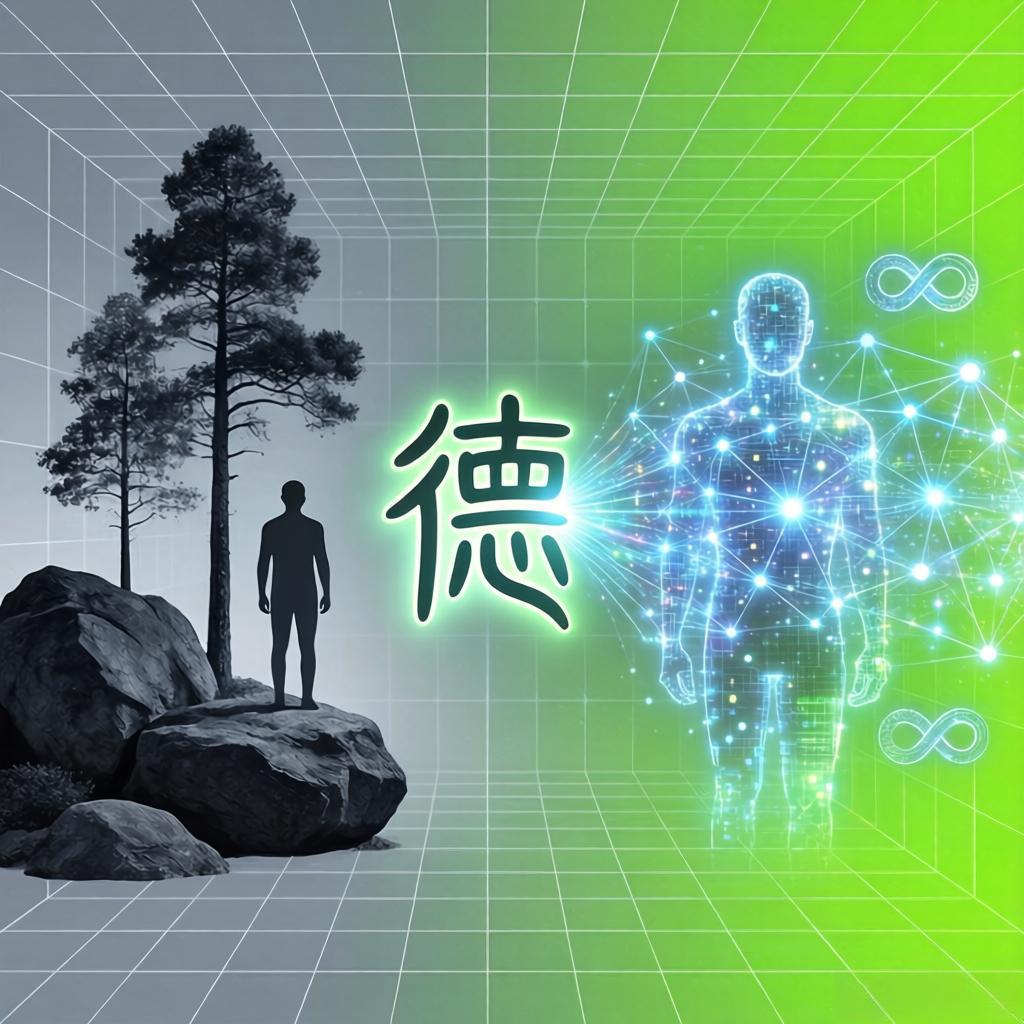

Deep Deconstruction of De: From Ontology to Systemic Wisdom
一、德的形而上学基础:宇宙间的“得”之场
1. The Metaphysical Foundation of De: The Field of "Obtaining" in the Cosmos
1.1 道家视角:德作为道的显现
1.1 Daoist Perspective: De as Manifestation of Dao
《道德经》提出“道生之,德畜之”,将“德”定位为“道”在具体存在中的体现。这里的“德”不是人类中心的概念,而是万物本然具有的“得之于道”的特性。当一棵树生长时,它让鸟类筑巢、让土壤稳固、让空气净化——这便是树的“德”。同理,人类的“德”是让周围系统因自己的存在而增强生命力的能力。在这种理解下,有德之人不是“给予者”,而是“通道”,让宇宙的创生能量通过自己流向他人。
"Dao gives birth, De nourishes" (Daodejing) positions "德" as the manifestation of "Dao" in concrete existence. Here, "德" is not an anthropocentric concept but the inherent quality of all things "obtained from Dao." When a tree grows, it allows birds to nest, soil to stabilize, and air to purify—this is the tree's "德." Similarly, human "德" is the ability to make surrounding systems more vital through one's existence. Under this understanding, a virtuous person is not a "giver" but a "conduit," allowing the creative energy of the cosmos to flow through them to others.
1.2 儒家深化:德作为关系性实在
1.2 Confucian Deepening: De as Relational Reality
荀子提出“群居和一之道”,将“德”置于社会关系的动态平衡中。真正的“德”不仅让个体“得”,更让关系本身变得更富有生成性。比如师生关系:老师“得”到教学相长的智慧,学生“得”到知识启蒙,而师生关系本身也“得”到深化与传承。这构成了“三重获得”的德性结构——任何真正的德性互动,都会产生至少三个受益方:给予者、接受者、以及连接他们的关系场。
Xunzi’s concept of "the way of harmonious community living" places "德" within the dynamic balance of social relations. True "德" not only enables individuals to "obtain" but makes the relationship itself more generative. For example, in a teacher-student relationship: the teacher "obtains" wisdom through teaching, the student "obtains" knowledge, and the relationship itself "obtains" depth and continuity. This forms a tripartite structure of virtue—any genuinely virtuous interaction benefits at least three parties: the giver, the receiver, and the relational field connecting them.
二、德的时间维度:在代际传递中的“得”
2. The Temporal Dimension of De: "Obtaining" Across Generations
2.1 纵向之德:祖先、自我、后裔的三体连接
2.1 Vertical De: The Triadic Connection of Ancestors, Self, and Descendants
中国传统中的“积德”观念蕴含着深刻的时间哲学。有德之人不仅让同代人有所得,更在时间纵轴上创造“得”的连续体:
-
对祖先之德:通过继承并转化其智慧,使祖先的精神生命在当下“复活”并获得新意义
-
对自己之德:在给予中实现自我完成,使当下的存在获得历史纵深感
-
对后裔之德:为尚未出生者预备更好的生存基础,使其“得”到更丰裕的可能性
这种“三代得”构成了德的时间厚度。当一个人修桥铺路时,他不仅让当下行人得便利,更让百年后的无名旅人“得”到荫庇——这便是德的时间超越性。
The traditional concept of "accumulating virtue" (积德) contains profound temporal philosophy. A virtuous person not only enables contemporaries to obtain but creates a continuum of "obtaining" along the temporal axis:
-
Virtue toward ancestors: By inheriting and transforming their wisdom, ancestral spiritual life is "revived" and gains new meaning
-
Virtue toward self: Achieving self-completion through giving, endowing present existence with historical depth
-
Virtue toward descendants: Preparing better foundations for the unborn, enabling them to "obtain" richer possibilities
This "three-generation obtaining" constitutes the temporal thickness of De. When someone builds a bridge, they not only provide convenience for present travelers but also offer shelter to unknown travelers a century later—this is the temporal transcendence of De.
2.2 德的滞后效应:延迟的回报与隐性的网络
2.2 The Lag Effect of De: Delayed Returns and Invisible Networks
现代研究发现,利他行为会激活大脑的奖赏中枢,但这种满足感往往是延迟的。传统文化中的“积阴德”概念与此惊人地契合——不为人知的善行,会像种子一样在不可见的网络中生发,最终以难以预测的方式回报。德的时间经济学表明:最高级的“得”往往不遵循即时交换逻辑,而是存在于复杂的时空调度中。
Modern research shows altruistic behavior activates the brain’s reward system, but this satisfaction is often delayed. The traditional concept of "accumulating hidden virtue" (积阴德) remarkably aligns with this—unknown good deeds germinate like seeds in invisible networks, eventually returning in unpredictable ways. The temporal economics of virtue suggests: The highest form of "obtaining" often defies immediate exchange logic, residing instead in complex spatiotemporal harmonies.
三、德的系统论重构:从二元给予到生态赋能
3. Systemic Reconstruction of De: From Binary Giving to Ecological Empowerment
3.1 传统“施-受”模型的局限
3.1 Limitations of the Traditional "Giver-Receiver" Model
传统理解常将“德”简化为“有德者给予,他人获得”的二元结构。这种模型隐含了三个问题:1) 预设了“给予者”的优越地位 2) 忽视了系统的复杂互动 3) 可能产生道德傲慢。在生态思维中,我们需要第三阶段的理解。
Traditional understanding often simplifies "德" to a binary structure: "virtuous person gives, others obtain." This model implies three issues: 1) presupposes the superiority of the "giver," 2) neglects complex systemic interactions, 3) may create moral arrogance. Ecological thinking requires a third-phase understanding.
3.2 德作为生态位优化过程
3.2 De as Niche Optimization Process
在系统论视野下,有德之人是生态位优化者:他们通过自身的存在和行动,改善其所处关系网络的整体质量,使网络中的每个节点(包括自己)都能更好地发挥功能。比如在团队中,有德之人会:
-
增强连接性:促进信息流动,打破信息孤岛
-
提升多样性容忍度:创造不同特质者都能贡献的环境
-
优化资源循环:让知识、机会、情感支持等资源在系统中有效流动
-
增强系统韧性:在压力下保持系统整合,而非各自为政
这种“德”不再是个体的道德属性,而是系统功能的涌现特征。当一个人让团队更聪明、更有创造力、更具韧性时,他就在实践系统意义上的“德”。
From a systems perspective, a virtuous person is a niche optimizer: through their existence and actions, they improve the overall quality of their relational network, enabling each node (including themselves) to function better. For example, in a team, a virtuous person will:
-
Enhance connectivity: Promote information flow, break down information silos
-
Increase diversity tolerance: Create environments where different traits can contribute
-
Optimize resource cycling: Enable effective flow of knowledge, opportunities, emotional support, etc.
-
Strengthen system resilience: Maintain integration under pressure rather than fragmentation
This "德" is no longer an individual moral attribute but an emergent characteristic of system function. When someone makes a team wiser, more creative, and resilient, they practice "德" in the systemic sense.
3.3 德的悖论:最大程度的“使人得”需要最小程度的“意图”
3.3 The Paradox of De: Maximum "Enabling Others to Obtain" Requires Minimum "Intention"
最精微的“德”往往发生在无意识层面。就像健康生态系统中的树木,它并不“想要”为鸟类提供栖息地,它只是“成为”一棵树,而鸟类自然得益。同样,当一个人完全沉浸于创造价值本身(而非“我要有德”的自我意识),其“德”的辐射力反而最大。这解释了为什么刻意“行善”有时会带来压力,而自然流淌的“德”却轻盈有力。德的最髙境界,是让“使人有所得”成为存在的自然呼吸,而非刻意行为。
The subtlest "德" often occurs at the unconscious level. Like a tree in a healthy ecosystem, it doesn’t "want" to provide habitat for birds; it simply "becomes" a tree, and birds naturally benefit. Similarly, when a person is fully immersed in creating value itself (rather than the self-awareness of "I must be virtuous"), their "德" radiates most powerfully. This explains why deliberate "doing good" can sometimes create pressure, while naturally flowing "德" feels light yet strong. The highest state of De is making "enabling others to obtain" the natural breath of existence, not a deliberate act.
四、德的阴暗面与解毒剂
4. The Shadow Side of De and Antidotes
4.1 德的异化形态
4.1 Alienated Forms of De
-
工具性德:将“使人有所得”作为控制手段,如“我对你好,所以你要听我的”
-
表演性德:在公开场合展示“有德”,实际为了社会资本积累
-
内殖民德:强迫他人接受自己认为的“好处”,忽视对方真实需求
-
自毁性德:过度“让利”导致自身系统崩溃,最终谁也无法“得”
-
Instrumental De: Using "enabling others to obtain" as a control mechanism, e.g., "I’m good to you, so you must obey me"
-
Performative De: Displaying "virtue" in public for social capital accumulation
-
Internal Colonial De: Forcing others to accept what one perceives as "benefit," ignoring their real needs
-
Self-Destructive De: Excessive "yielding benefit" leads to personal system collapse, ultimately benefiting no one
4.2 德的平衡艺术:太极图中的智慧
4.2 The Art of Balancing De: Wisdom from the Taiji Diagram
真正的德存在于动态平衡中,如同太极图的黑白流转:
-
予与受的平衡:健康的关系中,给予者和接受者的角色不断互换
-
公与私的平衡:在利他中完成自利,而非牺牲自我
-
显与隐的平衡:既有公开的善行,也有不为人知的“阴德”
-
刚与柔的平衡:有时是温柔支持,有时是严厉的爱(如“忠言逆耳”)
德的中道在于:既非自我牺牲的圣人幻想,也非精致利己的现代病,而是在关系中创造共同增值的智慧。
True De exists in dynamic balance, like the flow of yin-yang in the Taiji diagram:
-
Balance of giving and receiving: In healthy relationships, roles of giver and receiver constantly interchange
-
Balance of public and private: Fulfilling self-interest through benefiting others, not self-sacrifice
-
Balance of visible and hidden: Both public good deeds and unknown "hidden virtue"
-
Balance of firm and gentle: Sometimes tender support, sometimes tough love (e.g., "honest advice offends the ear")
The Middle Way of De lies in neither the saintly fantasy of self-sacrifice nor the modern disease of refined egoism, but the wisdom of creating mutual增值 in relationships.
五、后人类时代的德:超越人类中心主义
5. De in the Posthuman Era: Beyond Anthropocentrism
5.1 对非人类存在的“德”
5.1 De Toward Non-Human Existence
随着生态意识觉醒,“使人有所得”的“人”需要扩展。真正的德者会对所有生命甚至非生命系统体现“德”:
-
对动物:让它们“得”到应有的生存尊严
-
对植物:让自然生态系统“得”到恢复
-
对人工智能:让它们“得”到符合其存在目的的善用
-
对地球系统:让未来世代“得”到宜居环境
这种扩展的“德”重新定义人类的角色:我们不是地球的拥有者,而是生命网络的管家,职责是让网络中每个节点都“有所得”。
With ecological awakening, the "others" in "enabling others to obtain" must expand. A truly virtuous person shows "德" toward all life and even non-living systems:
-
Toward animals: enabling them to "obtain" deserved dignity of existence
-
Toward plants: enabling natural ecosystems to "obtain" restoration
-
Toward AI: enabling them to "obtain" proper use aligned with their purpose
-
Toward Earth systems: enabling future generations to "obtain" habitable environments
This expanded "德" redefines humanity’s role: we are not Earth’s owners but stewards of the life network, responsible for enabling each node to "obtain."
5.2 德在科技时代的特殊挑战
5.2 Special Challenges for De in the Technological Age
-
数字德性:在虚拟空间中如何“使人有所得”?匿名性是否消解了德的责任?
-
算法德性:当AI决定资源分配时,如何编程“使人有所得”的伦理?
-
跨物种德性:基因编辑技术中,如何让未来生命形式“得”到更好的设计而非伤害?
-
星际德性:如果发现外星生命,人类“德”的范畴是否需要再次扩展?
-
Digital Virtue: How to "enable others to obtain" in virtual spaces? Does anonymity dissolve responsibility for virtue?
-
Algorithmic Virtue: When AI allocates resources, how to program ethics of "enabling others to obtain"?
-
Trans-Species Virtue: In gene editing, how to enable future lifeforms to "obtain" better design rather than harm?
-
Interstellar Virtue: If extraterrestrial life is discovered, must the scope of human "德" expand again?
结论:德作为存在的诗意
Conclusion: De as the Poetry of Existence
“德”的最终奥秘或许在于:最大的“得”是成为这样一个存在——他人的生命因你的存在而变得更加可能。 这不是道德律令,而是存在论意义上的绽放:当一棵树让鸟儿歌唱,当一位老师让学生发现自己,当一个文明让后代有故事可讲——这些时刻,德就发生了。
德不需要纪念碑,它存在于:
-
那个让同事发光的眼神
-
那本传递时被翻旧的书
-
那条为百年后行人留下的林荫道
-
那个让AI学会尊重的算法设置
在这个意义上,德是最深刻的现实主义:因为让人有所得者,最终会发现自己得到了整个世界的回响。这种回响或许不会立即被听到,但就像山中的呼喊,它终将在某个时刻,以某种方式,回到呼喊者身边——带着整个山谷的共鸣。
The ultimate mystery of "德" may be this: the greatest "obtaining" is to become a being through whose existence others’ lives become more possible. This is not a moral imperative but an ontological blossoming: when a tree enables birds to sing, when a teacher helps students discover themselves, when a civilization leaves stories for descendants—in these moments, De happens.
De needs no monuments; it resides in:
-
The glance that lets a colleague shine
-
The book worn from being passed on
-
The shaded path left for travelers a century later
-
The algorithm that teaches AI respect
In this sense, De is the deepest realism: because those who enable others to obtain will ultimately find the entire world echoing back. This echo may not be heard immediately, but like a shout in the mountains, it will eventually return to the shouter—with the resonance of the whole valley.
最后的悖论:当你不再追求“有德”,而是单纯地让他人生命中多一些可能性时,你就住在德之中。
Final paradox: When you cease pursuing "having De" and simply add more possibilities to others’ lives, you dwell within De.
此文由 怡心湖 编辑,若您觉得有益,欢迎分享转发!:首页 > 赞·中华 > 儒释道 » 德的深层解构:从存在论到系统智慧的演进
 德:在给予中获得