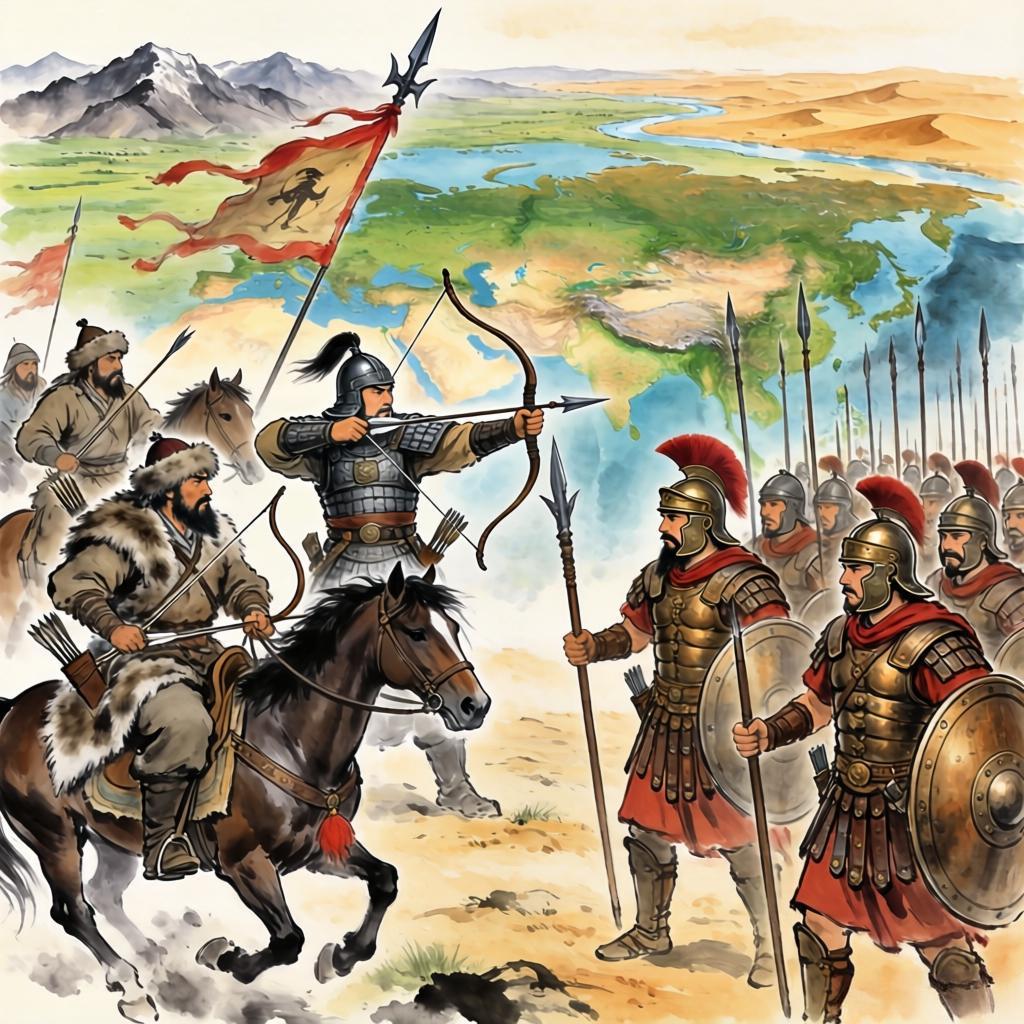
Title: Iron Horses Tread on Snow, Beacon Fires Along the Silk Road: Emperor Wu of Han's Expansion—A Strategic Gambit in Eurasian Resonance, or a Revelry of Imperial Inward Roll?
Part 1: The Eurasian Chessboard in the 2nd Century BCE
In the 2nd century BCE, the Eurasian continent witnessed a remarkable resonance among burgeoning empires. In the West, Rome was crushing Carthage, its gaze fixed on the Mediterranean; in the heart of Central Asia, the Parthian Empire deftly balanced diplomacy and warfare; while on the Mongolian plateau, the Xiongnu Confederacy sharpened its bows, casting a shadow over the Central Plains. The Han Empire, rising from the ruins of the Qin dynasty, faced a critical choice: to remain constrained within the passes or to stride onto the global stage. Emperor Wu of Han’s reign was not merely a domestic policy shift but a strategic response embedded in this grand interactive network.
公元前2世纪的欧亚棋局
公元前2世纪,欧亚大陆各大文明体不约而同地进入了扩张共振期。西方,罗马正将迦太基化为焦土,目光已投向整个地中海;中亚腹地,帕提亚帝国在刀尖上翩跹起舞;蒙古高原,匈奴联盟磨砺弓矢,将阴影投向中原。从秦朝废墟中崛起的汉帝国,走到了一个临界点:是继续蜷缩于关内,还是迈向世界的棋盘?汉武帝的登场,不仅是内政的转向,更是嵌入这张宏大互动网络的战略回应。
Part 2: The Snow-Storm Campaigns: Beyond the Great Wall, a Clash of Civilizations
When Wei Qing and Huo Qubing led their cavalry deep into the desert, it was more than a military expedition—it was a clash between two worlds. The Han army’s coordinated operations of infantry, cavalry, and chariots confronted the Xiongnu’s swift nomadic tactics. Each pursuit into the depths of the Gobi was a gamble: the goal was not merely to seize pasturelands but to dismantle the Xiongnu’s economic foundation. The captured “Golden Man for Worshiping Heaven” and the tears of the Chanyu were symbols of a collapsing nomadic faith. Yet, behind the triumphant battles lay an empire exhausting its resources: every liter of grain, every bolt of silk, and every arrowhead traveled thousands of miles, consuming the savings of the Wen-Jing era.
铁骑踏雪:塞北征伐背后的文明对决
当卫青、霍去病的铁骑冲向漠北,这不仅是军事行动,更是两个世界的对撞。汉军的车骑协同方阵与匈奴的疾风骤雨式游击,在草原上演绎着农耕文明与游牧势力的首次战略决战。每一道深入戈壁的蹄印,都是一场豪赌:目标已非单纯夺取草场,而是摧毁匈奴的再生产基础——被俘的“祭天金人”与单于的眼泪,成为游牧信仰崩塌的象征。然而,捷报背后,是帝国资源的惨痛透支:每一斛粮食、每一匹缣帛、每一支箭镞,都跋涉千里,吞噬着文景之治的积累。
Part 3: The Beacon Fires of the Silk Road: Where Geopolitics and Trade Intertwine
Zhang Qian’s journey to the Western Regions was no poetic odyssey but a meticulously calculated geopolitical maneuver. The information he brought back about Dayuan’s blood-sweating horses, Parthia’s poisoned arrows, and the Roman glassware made Emperor Wu realize that the Western Regions were not merely a “right arm” of the Xiongnu but a hub connecting the world. The establishment of the Four Commanderies of Hexi and the beacon fires stretching across the Pamirs were, in fact, the earliest “maritime and terrestrial Silk Road” controlled by the Han Empire. However, the cost of maintaining this corridor was staggering: the lives of Garrisons on the frontier, the treasury drained by envoys, and the rebellion of the Qiang people—all hidden behind the glamour of Hu silk and fine horses.
丝路烽烟:地缘与商贸的绞杀战场
张骞的凿空之行绝非浪漫史诗,而是一场精密计算的地缘博弈。他带回的大宛汗血马、安息毒矢、罗马玻璃器的信息,让武帝意识到西域不仅是匈奴的“右臂”,更是连接世界的枢纽。河西四郡的设置、烽燧绵延至葱岭,实则是汉帝国掌控的早期“海陆丝路”。然而,维系这条走廊的代价惊人:戍卒枯骨、使者掏空的国库、羌人的叛乱,都隐藏在胡锦宝马的华彩之下。
Part 4: The Southern Expansion: The Lust for Pearls and the Rebellion of the Mountains
While the war against the Xiongnu captivated attention, the Han armies were also advancing southward. The conquest of Nanyue opened up the Lingnan region, but the miasma-filled lands did not yield the expected gold and silver. Instead, garrisons were plagued by pestilence, and grain shipments were disrupted by mountain bandits. The campaigns against the Minyue and Dongou in the southeast, though victorious, triggered large-scale population migrations, uprooting ancient Baiyue communities. These southern expansions, seemingly “low-cost” compared to the northern campaigns, in fact sowed seeds of conflict that would simmer for centuries in the mountainous south.
南疆拓土:珠玑之欲与山林叛歌
当北击匈奴吸引所有目光时,汉军的战车也在向南滚动。南越的征服打开了岭南之门,但瘴疠之地并未涌出预期的金银,反而让戍卒病亡、漕粮断绝。东南的闽越、东瓯之役虽胜,却引发越人部族的大规模迁徙,瓦解了古老的百越生态。这些看似“低成本”的南征,实则在崇山峻岭中埋下了延续数百年的冲突火种。
Part 5: The Economic Mechanism: A Mirage of State Monopolies and People’s Livelihood
To sustain the war machine, Emperor Wu implemented salt and iron monopolies, issued white deer皮币, and levied heavy taxes. These measures seemingly created a “wartime economic miracle,” but behind it, the self-sufficient small-scale farming economy collapsed. The “people’s households were halved” was not merely a rhetorical device but a reality: displaced peasants either became refugees or were conscripted as soldiers, creating a vicious cycle. The算缗告缗令 (property reporting and confiscation decree) turned merchants into targets of plunder, severing the commercial circulation that had developed since the Warring States period.
经济机器:国家专营的幻象与民生的塌方
为支撑战争机器,武帝推行盐铁专营、发行白鹿皮币、算缗告缗。这些措施看似创造了“战时经济奇迹”,实则让小农经济濒临崩溃。“户口减半”并非修辞,而是现实:流民要么成为边塞枯骨,要么沦为新的兵源,形成死亡循环。而“算缗告缗”让商人成为掠夺对象,战国的商贸脉络被拦腰斩断。
Part 6: The Psychological Landscape: The Imperial Paranoia and the People’s Despair
Behind the expansion was Emperor Wu’s profound anxiety: fear of the Xiongnu’s revenge, fear of the people’s discontent, and fear of losing the Mandate of Heaven. The witchcraft scandal and the persecution of the crown prince were manifestations of this paranoia. On the other hand, folk songs like “A Fifteen-Year-Old Joins the Army, an Eighty-Year-Old Returns Home” circulated, and the ballad “The City of the East” lamented, “In the city of the east, they say there is no war; but the bones of the dead are piled like mounds.” The despair of the people formed a stark contrast with the emperor’s ambition.
人心图谱:帝王心术与黔首的呻吟
扩张的背后是武帝的深度焦虑:恐惧匈奴复仇、恐惧民变频仍、恐惧天命转移。巫蛊之祸与太子罹难,皆是这种焦虑的爆发。而民间,“十五从军征,八十始得归”的歌谣在流传,《东光》曲中“愿言思子,中心养养”的哀叹,百姓的绝望与帝王的雄心构成了刺眼反差。
Part 7: The Global Perspective: Resonance and Collapse in the Context of Eurasian Empires
Viewed from a broader Eurasian context, Emperor Wu’s expansion was not an isolated case. The Roman Republic was exhausting itself in the Punic Wars, the Parthian Empire was mired in conflicts with nomadic tribes, and the Mauryan Empire in India had already disintegrated. What these empires shared was a paradox: external expansion often triggered internal collapse. Emperor Wu’s晚年罪己诏 (repentance edict) and policy shift were, in a sense, a self-correction mechanism unique to Chinese civilization, allowing the Han dynasty to avoid the fate of rapid decline that befell other contemporary empires.
全球视野:欧亚帝国共振下的崩溃与独行
置于更广阔的欧亚语境,武帝的扩张并非孤例。罗马共和国在布匿战争中耗尽元气,帕提亚深陷与游牧部族的缠斗,印度孔雀王朝已先行瓦解。这些帝国的共性在于:对外扩张往往诱发对内崩塌。而汉武帝的《轮台罪己诏》与政策转向,某种意义上,正是华夏文明独有的纠偏机制,让汉朝避免了与其他帝国同频崩溃的命运。
Part 8: Legacy and Reflection: The Dual Heritage of Glory and Trauma
Today, when we gaze upon the ruins of the Hexi Corridor or examine Han-era coins excavated in Persia, we must recognize that Emperor Wu left a dual legacy: a geographical space defining “China” and a cultural psychological complex of “great unity,” but also a trauma of “exhausting the people for military glory.” This legacy continues to influence China’s foreign policy and national psychology. The question remains: in the face of external pressure, should a civilization choose to seal itself off or engage in strategic competition? The answer may lie not in the extremes of “isolation” or “expansion” but in finding a dynamic balance suited to the era.
历史回响:荣光与创伤的双重遗产
今天,当我们凝视河西走廊的残阳,或检视波斯出土的汉朝钱币,必须承认:汉武帝留下了双重遗产——一个定义了“中国”的地理空间,一种“大一统”的文化心理;同时也留下了“穷兵黩武”的创伤记忆。这份遗产至今仍在影响中国的对外政策与民族心理。而在新的国际格局中,一个文明面对外部压力时,究竟该选择封闭还是竞争?答案或许不在“孤立”与“扩张”的二元对立中,而在能否找到属于这个时代的、动态的平衡之道。
此文由 怡心湖 编辑,若您觉得有益,欢迎分享转发!:首页 > 历史人文 » 铁骑踏雪与丝路烽烟:汉武帝的扩张,是欧亚共振下的战略豪赌,还是帝国内卷的末日狂欢?