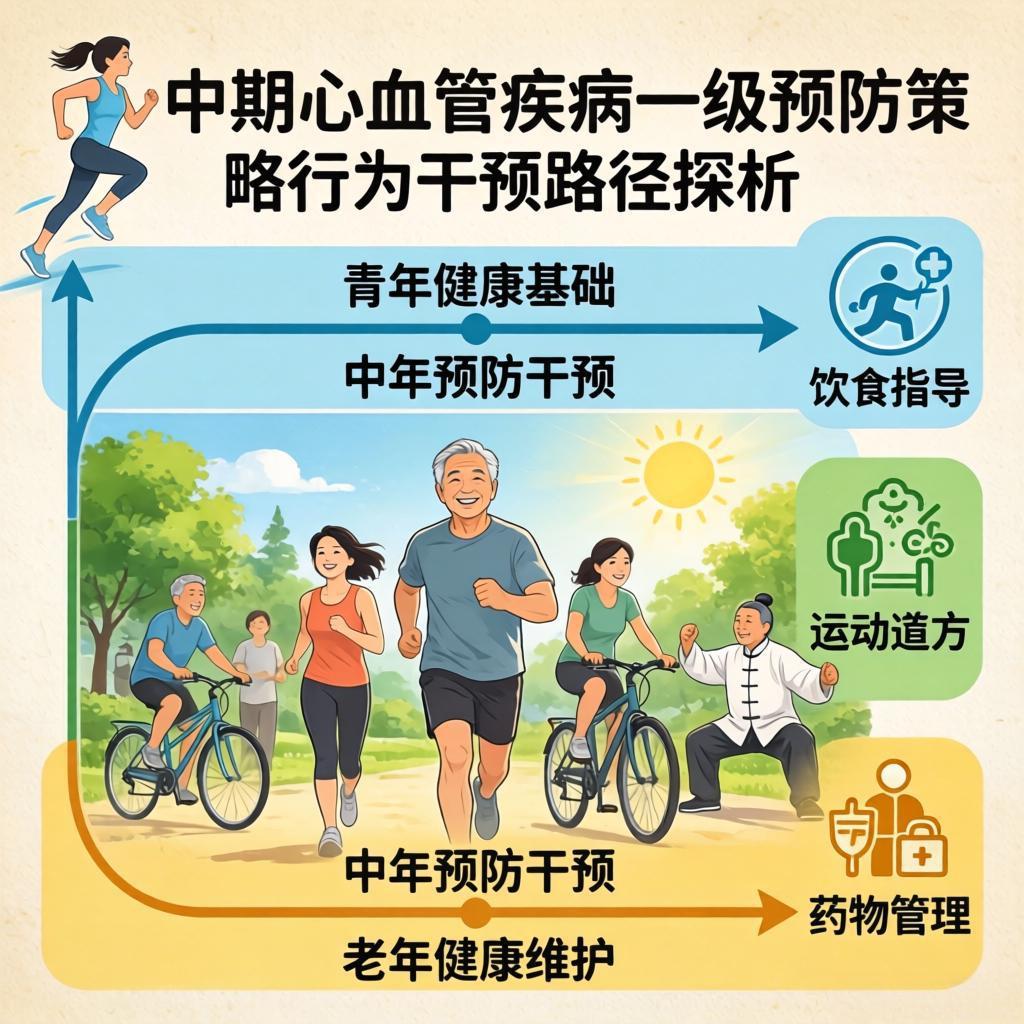

Based on the Life-Course Health Model: Primary Prevention Strategies and Behavioral Intervention Pathways for Cardiovascular Disease in Middle Adulthood
中年阶段是心血管健康轨迹形成的关键时期,其健康状况不仅受到遗传与胚胎发育的早期编程影响,更是成年期行为与环境因素长期累积作用的结果。全生命周期健康模型强调,健康是一个动态连续体,中年期作为连接早期风险与老年疾病爆发的核心枢纽,实施以证据为基础的一级预防,是阻断风险累积链、实现健康老龄化的最具成本效益的窗口。这一时期的干预,旨在从源头上避免或延迟动脉粥样硬化等病理进程的临床发病。
Middle adulthood represents a critical period for shaping the trajectory of cardiovascular health. This health status is influenced not only by early life programming, including genetic and embryonic development factors, but also by the cumulative long-term effects of behavioral and environmental factors in adulthood. The life-course health model emphasizes that health is a dynamic continuum. Middle adulthood serves as a central hub connecting early-life risks and the onset of disease in old age. Implementing evidence-based primary prevention during this life stage is the most cost-effective window for interrupting the chain of risk accumulation and achieving healthy aging. Interventions at this stage aim to prevent or delay the onset of clinical manifestations of pathological processes like atherosclerosis at their source.
一级预防的核心在于针对可改变的风险因素进行系统性管理。这超越了传统的单一危险因素干预,转向整合性的风险管理策略。其科学内涵包括:对高血压、高血脂、糖尿病、肥胖等传统生物医学指标进行严格的达标管理;同时,高度重视心理社会压力、睡眠质量、空气污染等非传统风险因素。现代健康养生学指出,需通过精准的风险评估(如使用汇集队列方程计算10年动脉粥样硬化性心血管疾病风险),对个体进行风险分层,从而制定差异化和个性化的预防强度与方案。
The essence of primary prevention lies in the systematic management of modifiable risk factors. This transcends traditional single-risk-factor intervention, moving towards an integrated risk management strategy. Its scientific foundation includes: strict target management of traditional biomedical indicators such as hypertension, dyslipidemia, diabetes, and obesity; concurrently, it places high importance on non-traditional risk factors like psychosocial stress, sleep quality, and air pollution. Modern health science indicates the need for precise risk assessment (e.g., using pooled cohort equations to calculate 10-year atherosclerotic cardiovascular disease risk) to stratify individuals, thereby developing differentiated and personalized prevention intensities and plans.
在行为干预路径上,认知行为策略扮演着主导角色。这涉及通过健康教育提升个体的健康素养,使其深刻理解行为与健康结局之间的因果关联,进而激发内在改变动机。关键路径包括:采用SMART原则设定具体的运动与饮食计划;运用自我监测技术(如饮食记录、可穿戴设备)增强行为反馈;以及通过认知重构来克服“没时间运动”、“健康饮食麻烦”等非适应性信念。干预的成功依赖于将健康行为无缝嵌入日常生活节奏,使之成为自动化习惯,而非依赖短期意志力。
In terms of behavioral intervention pathways, cognitive-behavioral strategies play a leading role. This involves improving individuals' health literacy through health education, enabling a deep understanding of the causal relationship between behavior and health outcomes, thereby stimulating intrinsic motivation for change. Key pathways include: applying the SMART principle to set specific exercise and dietary plans; utilizing self-monitoring techniques (e.g., food diaries, wearable devices) to enhance behavioral feedback; and employing cognitive restructuring to overcome maladaptive beliefs such as "no time for exercise" or "healthy eating is troublesome." The success of intervention relies on seamlessly integrating health behaviors into the rhythm of daily life, transforming them into automated habits rather than relying on short-term willpower.
营养干预需遵循膳食模式整体观,而非聚焦于单一营养素。推荐采用基于地中海饮食或DASH饮食原则的膳食结构,其特点是富含全谷物、蔬菜水果、坚果、豆类及鱼类,使用橄榄油等不饱和脂肪,并严格限制加工肉类、含糖饮料及高钠食品。这种饮食模式通过抗炎、抗氧化、改善内皮功能及肠道菌群等多重协同机制产生心血管保护效应。实践层面,需要提供具体的食物选择、份量控制及烹饪技巧指导,以应对快节奏生活中的实践挑战。
Nutritional intervention should adhere to a holistic view of dietary patterns rather than focusing on single nutrients. It is recommended to adopt a dietary structure based on the principles of the Mediterranean or DASH diets, characterized by an abundance of whole grains, vegetables, fruits, nuts, legumes, and fish; the use of unsaturated fats like olive oil; and strict limitations on processed meats, sugar-sweetened beverages, and high-sodium foods. This dietary pattern exerts cardioprotective effects through multiple synergistic mechanisms including anti-inflammation, antioxidation, improving endothelial function, and modulating gut flora. At the practical level, concrete guidance on food choices, portion control, and cooking techniques is essential to address the challenges of implementation in a fast-paced life.
体力活动干预应兼顾有氧运动、抗阻训练及柔韧性练习。世界卫生组织建议成年人每周至少进行150-300分钟中等强度有氧运动,或75-150分钟高强度有氧运动,并配合每周2次以上的主要肌群抗阻训练。最新的科学观点强调减少久坐行为的重要性,即每坐30-60分钟进行3-5分钟的轻度活动(如站立、慢走),其对于改善代谢指标具有独立益处。运动处方的制定需考虑个体的基础健康状况、兴趣与可行性,以促进长期坚持。
Physical activity intervention should incorporate aerobic exercise, resistance training, and flexibility exercises. The World Health Organization recommends that adults engage in at least 150-300 minutes of moderate-intensity aerobic activity, or 75-150 minutes of vigorous-intensity aerobic activity per week, combined with resistance training involving major muscle groups on two or more days per week. The latest scientific perspective emphasizes the critical role of reducing sedentary behavior. This involves incorporating 3-5 minutes of light activity (such as standing or slow walking) for every 30-60 minutes of sitting, which has independent benefits for improving metabolic markers. The formulation of an exercise prescription must consider the individual's baseline health status, interests, and feasibility to promote long-term adherence.
心理压力管理与睡眠优化是不可或缺的组成部分。长期慢性压力激活交感神经系统和下丘脑-垂体-肾上腺轴,导致炎症水平升高和代谢紊乱。干预手段包括正念冥想、放松训练及时间管理等。同时,睡眠不足与睡眠呼吸障碍是明确的心血管风险因素,应保证每晚7-9小时的高质量睡眠,并对打鼾严重、日间嗜睡者进行睡眠呼吸暂停筛查。心理与睡眠健康构成心血管保护的基础生理环境。
Psychological stress management and sleep optimization are indispensable components. Chronic long-term stress activates the sympathetic nervous system and the hypothalamic-pituitary-adrenal axis, leading to increased inflammation and metabolic dysregulation. Intervention methods include mindfulness meditation, relaxation training, and time management. Concurrently, insufficient sleep and sleep-disordered breathing are established cardiovascular risk factors. Ensuring 7-9 hours of high-quality sleep per night is crucial, and screening for sleep apnea should be conducted for individuals with severe snoring and daytime sleepiness. Psychological and sleep health constitute the foundational physiological environment for cardiovascular protection.
社区与政策层面的环境营造是支撑个体行为改变的宏观基础。这包括创建支持体力活动的建成环境(如公园、步行道)、推动食品环境健康化(如规范标签、限制不健康食品营销)、推行工作场所健康促进计划、以及通过公共卫生政策(如控烟、减盐)降低人群风险水平。全生命周期模型下的心血管健康促进,最终需要个体、家庭、社区和社会的多层次、多部门协同治理。
Creating supportive environments at the community and policy levels forms the macro-foundation supporting individual behavior change. This includes developing built environments that support physical activity (e.g., parks, walkways), promoting healthier food environments (e.g., standardized labeling, restricting marketing of unhealthy foods), implementing workplace health promotion programs, and reducing population-level risks through public health policies (e.g., tobacco control, salt reduction). Cardiovascular health promotion under the life-course model ultimately requires multi-level, multi-sectoral collaborative governance involving individuals, families, communities, and society.
综上所述,中年期心血管疾病的一级预防是一个整合生物医学、行为心理学、社会生态学等多维度的系统工程。在全生命周期健康模型的框架下,通过对可改变风险因素的早期、综合、个性化干预,并构建支持性健康环境,能够有效扭转心血管风险的上升轨迹,为实现高质量的健康老龄化奠定坚实的科学基础。这不仅是个体的健康投资,更是减轻未来社会疾病负担的战略性举措。
In summary, primary prevention of cardiovascular disease in middle adulthood is a systematic project integrating multiple dimensions including biomedicine, behavioral psychology, and socio-ecology. Under the framework of the life-course health model, early, comprehensive, and personalized intervention targeting modifiable risk factors, coupled with the construction of supportive health environments, can effectively reverse the upward trajectory of cardiovascular risk. This lays a solid scientific foundation for achieving high-quality healthy aging. This represents not only a personal health investment but also a strategic initiative to alleviate the future societal burden of disease.
此文由 怡心湖 编辑,若您觉得有益,欢迎分享转发!:首页 > 会·生活 » 基于全生命周期健康模型:中年期心血管疾病一级预防策略与行为干预路径探析