The Data Flywheel in Humanoids: How It Actually Spins
人形机器人的数据飞轮:它到底怎么转的
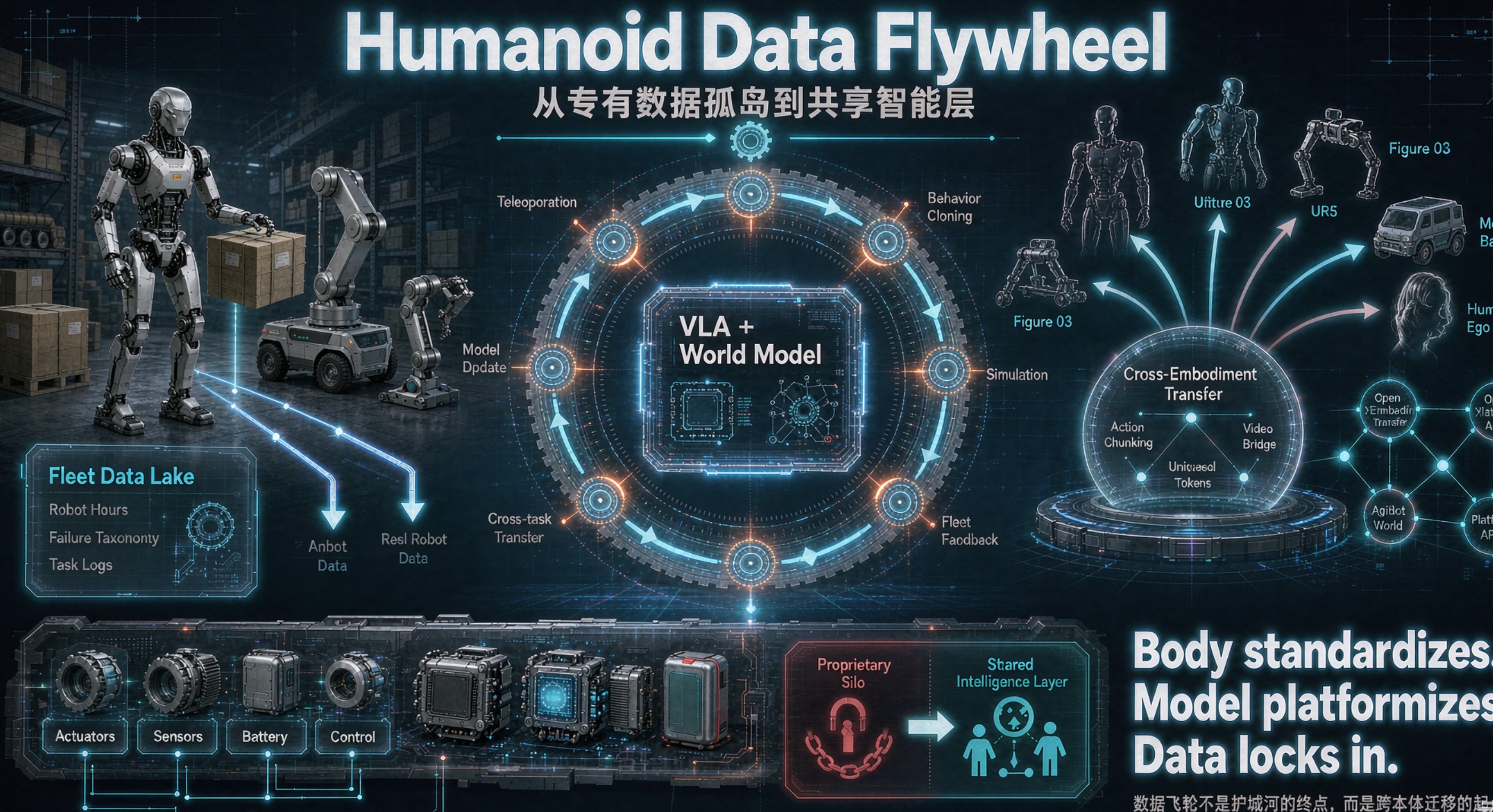
The data flywheel is the single most important concept in embodied AI—more important than any single model architecture, more important than any actuator breakthrough. Here's why, and exactly how it works in practice.
数据飞轮是具身 AI 最重要的单一概念——比任何模型架构、任何执行器突破都重要。原因和它在实践中到底怎么运转,下面拆透。
一、What "Data Flywheel" Means Here 飞轮到底指什么
In consumer software, a data flywheel is: more users → more usage data → better model → better product → more users. The loop is tight, digital, and nearly free to run.
消费软件的飞轮是:更多用户 → 更多使用数据 → 更好的模型 → 更好的产品 → 更多用户。环路紧凑、纯数字、跑起来几乎零边际成本。
Humanoids add three brutal physical constraints that software never had:
人形机器人多了三个软件从未有过的物理约束:
|
Software flywheel |
Humanoid flywheel |
|---|---|
|
Data is free (clicks, logs) |
Data costs real money (robot hours, operator wages, wear & tear) |
|
Infinite parallel streams |
Fleet size is capital-constrained |
|
Overnight model update |
Hardware drift + wear changes the action space daily |
|
软件飞轮 |
人形飞轮 |
|
--- |
--- |
|
数据免费(点击、日志) |
数据真金白银(机器人工时、操作员薪资、损耗) |
|
无限并行流 |
机队规模受资本约束 |
|
模型一夜更新 |
硬件漂移+磨损让动作空间每天都在变 |
So the humanoid flywheel is not a simple loop. It is a multi-stage compression engine that turns expensive, messy, physical interaction into cheaper, better, more general behavior—one turn at a time.
所以人形飞轮不是一个简单环路。它是一个多级压缩引擎,把昂贵、混乱、物理的交互,一次一圈地,压缩成更便宜、更好、更通用的行为。

二、The Flywheel Anatomy 飞轮的五个阶段
Let me trace one complete turn of the flywheel inside a real deployment—say, a Figure 03 or Apollo unit working a BMW or Mercedes line.
让我沿着一个真实部署的完整一圈来追踪——比如一台 Figure 03 或 Apollo 在宝马或奔驰产线上干活。
Stage 1: Cold Start — Teleoperation Harvesting 冷启动:遥操作收割
Week 1–4: Human operator wears VR + haptics, drives robot through task.
          ↓
          Every demo = ~50 GB multimodal trace:
          RGB-D video + joint angles + gripper force + IMU + language annotation
          ↓
          Stored in fleet data lake.
- 单小时有效数据成本:遥操作约 ¥275–¥1,000(取决于规模与标定复杂度)。
- 这一阶段产出的数据质量最高、与本体完全一致,但贵到无法靠它训出通用模型。
- 关键动作:任务拆解 + 失败标注("这里滑了""这里卡住了")。失败样本是金矿——它告诉模型"什么不能做",而成功样本只告诉它"怎么做一次"。
Stage 2: Imitation Warm-up — Behavioral Cloning 热身:行为克隆
Month 2: BC (Behavioral Cloning) on teleop data.
         Robot attempts task autonomously at ~40–60% success.
         ↓
         Human supervisor intervenes on failures (correction labels).
         ↓
         Correction data added to training set.
         ↓
         Success rate climbs to ~70–80%.
- 此时机器人能"大概做对",但遇到光照变化、物体位姿偏移、地面打滑就崩。
- 关键转折:从"全遥操作"切到"自主 + 人类接管修正",数据获取成本骤降 5–10×,因为大部分时间机器人自己跑,人类只在失败时介入。
- 这一阶段的数据叫 intervention data(干预数据),密度极高——全是模型最薄弱的边界案例。
Stage 3: RL Fine-tune in Simulation — 仿真强化微调
Month 3: Top-performing policies → transferred to high-fidelity sim (Isaac Lab / Genesis).
         ↓
         Domain randomization: vary friction, lighting, object mass, camera noise.
         ↓
         RL explores 10,000× more failure modes than real world allows.
         ↓
         Policy robustness improves; sim-to-real gap <5% on contact-rich tasks.
- 仿真在这里不是"替代真实数据",而是安全、廉价地放大失败空间。
- 真实世界里让机器人把杯子摔碎 10 万次不现实;仿真里一晚上跑完。
- 这一步把成功率从 80% 推到 90–95%——接近产线可用门槛。
Stage 4: Fleet Deployment → Automatic Data Return 机队部署 → 自动数据回流
Month 4+: Robot runs autonomously on production line.
          ↓
          Every shift generates:
          • Success trajectories (positive examples, auto-labeled by task completion)
          • Failure recoveries (negative examples, auto-detected by timeout/force anomaly)
          • Environmental variations (new pallet positions, lighting shifts, tool wear)
          ↓
          Data auto-uploads to cloud, auto-curates, auto-retrains model.
          ↓
          OTA model push → next shift starts smarter.
这是飞轮真正闭合的时刻。关键变化:
|
Before fleet loop |
After fleet loop |
|---|---|
|
Data collection is a project (planned, budgeted, scheduled) |
Data collection is a byproduct of doing the job |
|
1 robot-year of data = 1 robot × 1 year of dedicated demo |
1 robot-year of data = 100 robots × 1 month of paid shifts |
|
Model improves on a quarterly cycle |
Model improves on a weekly or daily cycle |
|
飞轮闭合前 |
飞轮闭合后 |
|
--- |
--- |
|
数据采集是一个项目(计划、预算、排期) |
数据采集是干活的副产品 |
|
1 robot-year 数据 = 1 台机器人 × 1 年专职演示 |
1 robot-year 数据 = 100 台机器人 × 1 个月带薪班次 |
|
模型按季度迭代 |
模型按周甚至天迭代 |
自变量机器人在宝马产线的案例:采集→训练→部署周期从 6 个月压缩到 3 天;每轮闭环推任务成功率 +5~10%。这就是飞轮转速。
Stage 5: Cross-Task & Cross-Scene Transfer 跨任务与跨场景迁移
Year 2: Model trained on "unload trailer" at BMW
        ↓
        Zero-shot or few-shot transfer to "pick pharmacy items" at Guoda
        ↓
        Why? VLA has learned a general representation:
        • "grasp cylindrical object with unknown mass"
        • "navigate around unexpected obstacle"
        • "recover from grip slip"
        ↓
        New task needs only 50–200 demos instead of 5,000.
- 这是飞轮的复利效应。每多一个场景、每多一种物体,基座模型的"通用物理直觉"就厚一层。
- 类比:GPT-3 在代码上预训练后,做翻译只需要极少样本。人形机器人的 VLA 在"搬箱子"上预训练后,学"拣药"也只需极少样本。
- 到这一阶段,新场景的边际数据成本指数级下降——这是飞轮最可怕的地方。
三、Why the Flywheel Creates a Moat 为什么飞轮是护城河
3.1 The "Impossible Catch-up" Math 追不上的数学
假设公司 A 有 1,000 台机器人在产线跑,每天每台产生 8 小时有效数据 → 每天 8,000 robot-hours 回流。
公司 B 从零起步,靠遥操作采集 → 每天最多攒 200 robot-hours(受操作员人数限制)。
|
Company A (fleet) |
Company B (teleop) |
|
|---|---|---|
|
Daily new data |
8,000 h |
200 h |
|
Model update freq |
Weekly |
Quarterly |
|
Task success (Month 6) |
94% |
72% |
|
Customer wins |
BMW, Mercedes, 顺丰 |
Pilot only |
A 的数据优势每天都在扩大,不是静态的。B 永远在追 A 六个月前的模型。这就是"数据护城河 > 模型护城河"的数学本质。
3.2 The "Embodiment Lock-in" 具身锁定
数据飞轮还有一个隐蔽效应:数据是与本体绑定的。
- 六维力传感器的噪声分布、关节 backlash 特性、电机温升曲线、触觉皮肤灵敏度——每台机器人的"身体感"都略有不同。
- 在 Robot-X 上采集的数据,直接搬到 Robot-Y 上训,性能会掉 15–30%(跨本体域偏移)。
- 所以 Tesla 的 FSD 数据不能直接喂给 Figure,Figure 的数据不能直接喂给宇树——飞轮是排他性的。
这意味着:谁先在特定本体上跑通飞轮,谁就锁定了那条数据管道。后来者不能"买"到这个优势,只能自己从头跑飞轮——而跑飞轮需要机队,机队需要钱,钱需要客户,客户需要好模型。死循环,对先行者有利。
3.3 The "Failure Taxonomy" Advantage 失败分类法的优势
飞轮跑得久的团队,积累的不是"更多成功轨迹",而是更完整的失败图谱:
- "在湿度 >70% 时光滑塑料瓶抓不住"
- "丝杠温升 40°C 后关节刚度下降导致定位偏差 3mm"
- "地毯边缘触发六维力异常导致步态切换失败"
这些长尾失败模式只有真实部署才能遇到。实验室永远复现不了。拥有最厚失败图谱的公司,其模型在真实世界里最"稳"——这不是论文指标能体现的,是客户用脚投票的。
四、What Breaks the Flywheel 什么会打断飞轮
飞轮不是自动转的。以下任一环节断裂,整个引擎停转:
|
Failure point |
Symptom |
Real-world example |
|---|---|---|
|
No fleet deployment |
Data stays expensive; model stagnates |
Startups with great demos but no paid shifts |
|
No auto-curation |
Data lake becomes a garbage dump; training hurts more than helps |
Early humanoid pilots that collected TBs but couldn't label |
|
Hardware inconsistency |
Model trained on Robot-v1 fails on Robot-v2 |
Batch-to-batch actuator drift in early mass production |
|
Task too narrow |
No cross-task transfer; no compounding |
Single-purpose bots that never leave their one workstation |
|
Privacy/regulation |
Data can't leave the facility; no central training |
Hospital/eldercare deployments with strict data residency |
|
断裂点 |
症状 |
真实案例 |
|
--- |
--- |
--- |
|
无机队部署 |
数据始终昂贵;模型停滞 |
有酷炫 Demo 但无付费班次的初创 |
|
无自动标注 |
数据湖变垃圾堆;训练反而有害 |
早期试点采了 TB 级数据但标不了 |
|
硬件不一致 |
v1 上训的模型在 v2 上失败 |
早期量产批次间执行器漂移 |
|
任务太窄 |
无跨任务迁移;无复利 |
永远离不开一个工位的单用途机器 |
|
隐私/监管 |
数据不能出厂;无法集中训练 |
医院/养老场景的数据驻留限制 |
最致命的是第一条:没有付费部署 → 没有机队 → 没有自动回流 → 永远靠遥操作烧钱 → 永远追不上先行者。这也是为什么 2026 年投资人从"整机"转向"底层数据/模型"——他们赌的是谁已经跑通了 Stage 4。
五、The Flywheel Speedometer 飞轮转速表
怎么判断一家公司飞轮转没转起来?看四个指标:
|
Metric |
Stalled |
Spinning |
|---|---|---|
|
Data acquisition cost per hour |
>$100 (pure teleop) |
<$10 (fleet byproduct) |
|
Model update cycle |
>3 months |
<2 weeks |
|
Task success improvement per cycle |
+1–2% |
+5–10% |
|
New-scene adaptation demos needed |
>2,000 |
<200 |
|
指标 |
停转 |
在转 |
|
--- |
--- |
--- |
|
每小时数据获取成本 |
>$100(纯遥操) |
<$10(机队副产品) |
|
模型更新周期 |
>3 个月 |
<2 周 |
|
每轮成功率提升 |
+1–2% |
+5–10% |
|
新场景适配所需 Demo 数 |
>2,000 |
<200 |
用这个表去审视 Figure(BotQ 工厂 + BMW 部署)、Tesla(Gigafactory 内部 + 车队回传方法论)、1X(Eve 在客户现场 + NEO 预购数据承诺)、智元(觅蜂全链路 + 顺丰/国网),你能清楚看到谁的飞轮在转,谁还在推。
六、The Bottom Line 一句话
The data flywheel is the difference between a 50,000demomachine∗∗anda∗∗5,000 productive worker. It is the only mechanism that can bridge the 10,000× data gap between where we are (~500k hours) and where we need to be (~10 billion hours). And once it spins, it is structurally unfair to anyone who hasn't started.
数据飞轮是5 万美元 Demo 机器和5 千美元生产力工人之间的唯一桥梁。它是唯一能跨越"当下 50 万小时"到"所需 100 亿小时"之间万倍数据鸿沟的机制。而且一旦转起来,对还没起步的人来说,结构性的不公平就已经形成了。
此文由 怡心湖 编辑,若您觉得有益,欢迎分享转发!:首页 > 常识论 » The Data Flywheel in Humanoids: How It Actually Spins 人形机器人的数据飞轮:它到底怎么转的
 人形机器人:从舞台炫技到具身智能的