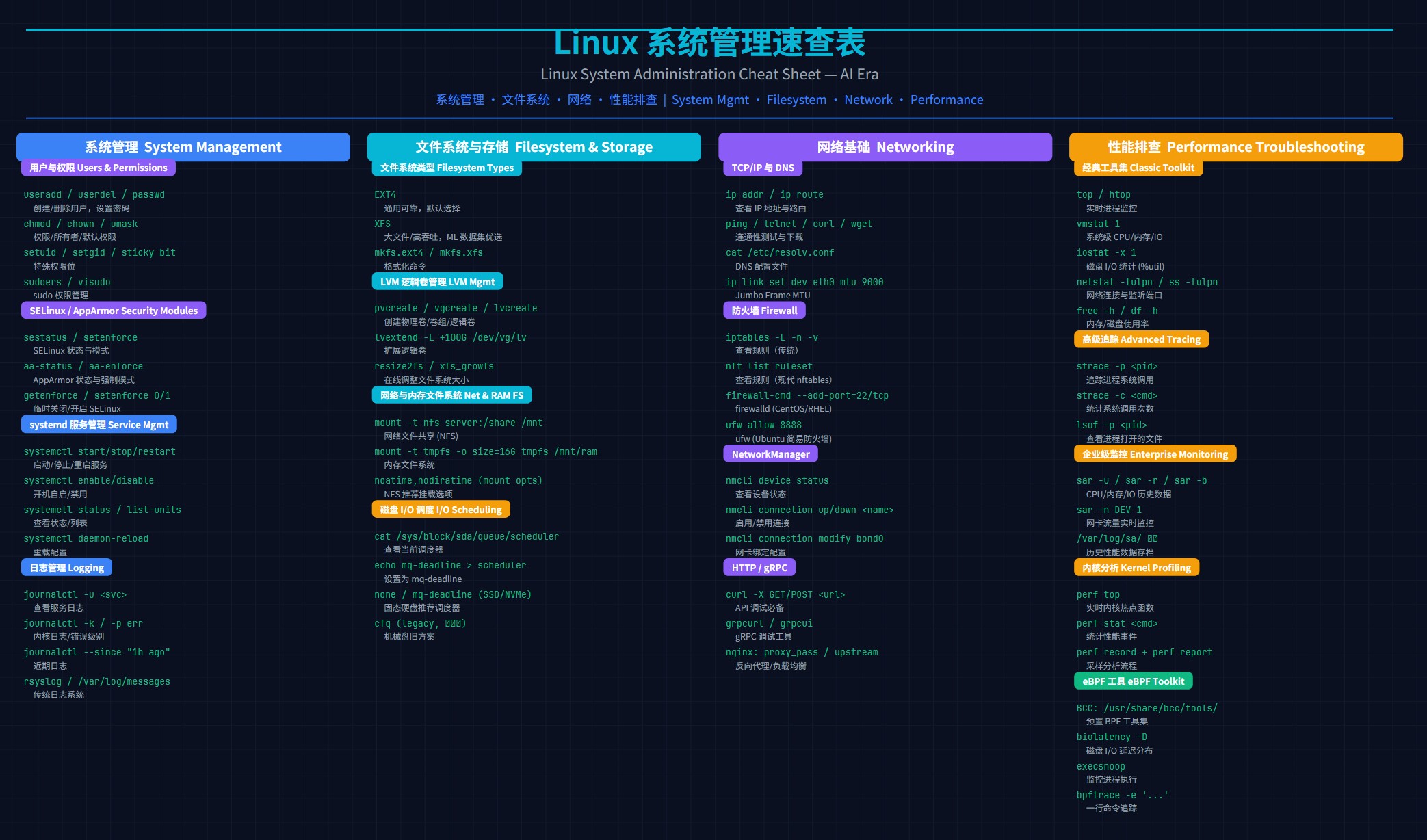
Linux System Administration in the AI Era: From Foundations to Performance Mastery
AI 时代的 Linux 系统管理:从基础到性能调优的完全指南
In the age of AI, where Large Language Models (LLMs) and high-performance computing converge, the Linux operating system remains the undisputed bedrock. While algorithms grab the headlines, it is the robustness of System Administration, Filesystem I/O, Networking, and Performance Troubleshooting that determines whether a training job succeeds or crashes. This article provides a deep dive into these core pillars, bridging the gap between traditional Ops and modern AI infrastructure.
在人工智能时代,大语言模型(LLM)与高性能计算深度融合,Linux 操作系统依然是无可争议的基石。尽管算法占据了头条新闻,但系统管理、文件系统 I/O、网络以及性能排查的稳健性,决定了训练任务是成功完成还是意外崩溃。本文将深入剖析这些核心支柱,打通传统运维与现代 AI 基础设施之间的壁垒。
1. System Management: The Control Plane
1. 系统管理:控制平面
Effective system management ensures that services run reliably and securely. In an AI cluster, where multi-tenancy is common, controlling access and process lifecycles is paramount.
高效的系统管理确保服务可靠且安全地运行。在普遍采用多租户的 AI 集群中,控制访问权限和进程生命周期至关重要。
Users, Permissions, and Security Modules
用户、权限与安全模块
Everything in Linux is a file, and permissions dictate who can touch them.
Linux 下一切皆文件,权限决定了谁能操作它们。
-
Users & Permissions: Beyond basic
chmodandchown, understanding special bits is crucial. Thesetuidbit allows a program to run as its owner (often root), whilesetgidensures files inherit a group ownership—useful for shared directories in data science teams.用户与权限:除了基础的
chmod和chown,理解特殊权限位至关重要。setuid位允许程序以所有者(通常是 root)身份运行;setgid则确保文件继承组所有权——这对数据科学团队的共享目录非常有用。 -
SELinux / AppArmor: These Mandatory Access Control (MAC) systems are your last line of defense. If a container or service is compromised, SELinux (common in RHEL/CentOS) or AppArmor (common in Ubuntu) prevents it from accessing unauthorized resources.
SELinux / AppArmor:这些强制访问控制(MAC)系统是防御的最后一道防线。如果容器或服务被攻破,SELinux(常用于 RHEL/CentOS)或 AppArmor(常用于 Ubuntu)会阻止其访问未授权的资源。
-
Command: Use
sestatusoraa-statusto check enforcement modes. -
命令: 使用
sestatus或aa-status检查执行模式。
-
systemd: The Init System
systemd:初始化系统
systemd is the suite of tools governing Linux services. For AI workloads, managing dependencies and resource limits via systemd units is standard practice.
systemd 是管理 Linux 服务的工具套件。对于 AI 工作负载,通过 systemd 单元管理服务依赖和资源限制是标准做法。
# Check the status of the NVIDIA persistence daemon
# 检查 NVIDIA 持久化守护进程状态
systemctl status nvidia-persistenced

# Enable a service to start at boot (critical for GPU nodes)
# 启用开机自启服务(对 GPU 节点至关重要)
systemctl enable docker
Logging: journalctl & rsyslog
日志管理:journalctl 与 rsyslog
Logs are the breadcrumbs of system behavior. journalctl queries the systemd-journald binary log, while rsyslog handles traditional text logs.
日志是系统行为的踪迹。journalctl 查询 systemd-journald 的二进制日志,而 rsyslog 处理传统的文本日志。
-
AI Context: When a GPU driver crashes,
journalctl -u kubeletorjournalctl -k(kernel logs) often reveals hardware errors before the application notices.AI 场景:当 GPU 驱动崩溃时,
journalctl -u kubelet或journalctl -k(内核日志)通常能在应用感知前揭示硬件错误。 -
Command:
journalctl --since "1 hour ago" -p err -
命令:
journalctl --since "1 hour ago" -p err(查看过去一小时的错误日志)
2. Filesystems and Storage: The Data Backbone
2. 文件系统与存储:数据主干
AI thrives on data. How this data is stored and retrieved directly impacts training time.
AI 依赖数据生存。数据的存储和检索方式直接影响训练时长。
EXT4 vs XFS
EXT4 与 XFS
While EXT4 is the reliable general-purpose filesystem, XFS is often preferred for large files and high-throughput scenarios common in ML datasets. XFS excels at parallel I/O, making it ideal for checkpointing large models.
虽然 EXT4 是可靠的通用文件系统,但在机器学习数据集中常见的大文件和高吞吐量场景下,XFS 往往更受青睐。XFS 在并行 I/O 方面表现出色,非常适合大型模型的检查点保存。
LVM: Logical Volume Management
LVM:逻辑卷管理
LVM adds a layer of abstraction over physical disks. It allows you to resize partitions online—a lifesaver when your dataset grows unexpectedly.
LVM 在物理磁盘之上增加了一层抽象。它允许在线调整分区大小——这在数据集意外增长时是救命稻草。
# Extend a logical volume when disk space runs low
# 当磁盘空间不足时扩展逻辑卷
lvextend -L +100G /dev/vg_data/lv_models
resize2fs /dev/vg_data/lv_models # For EXT4
xfs_growfs /dev/vg_data/lv_models # For XFS
Network and Memory Filesystems
网络与内存文件系统
-
NFS (Network File System): Essential for sharing datasets across a cluster. However, watch out for latency;
noatime,nodiratimemount options are recommended.NFS(网络文件系统):在集群间共享数据集的关键。但要注意延迟;建议使用
noatime,nodiratime挂载选项。 -
tmpfs: A RAM-based filesystem. It's perfect for temporary data that requires extreme speed, such as preprocessing caches.
tmpfs:基于内存的文件系统。非常适合需要极速读写的临时数据,例如预处理缓存。
-
Command:
mount -t tmpfs -o size=16G tmpfs /mnt/ramdisk -
命令:
mount -t tmpfs -o size=16G tmpfs /mnt/ramdisk
-
Disk I/O Scheduling
磁盘 I/O 调度
The I/O scheduler decides the order of block I/O requests. For SSDs and NVMe drives (standard in AI servers), the none or mq-deadline schedulers typically offer better performance than the older cfq.
I/O 调度器决定块 I/O 请求的顺序。对于 SSD 和 NVMe 硬盘(AI 服务器的标配),none 或 mq-deadline 调度器通常比旧的 cfq 性能更好。
3. Networking: The Neural Pathways
3. 网络:神经网络通路
In distributed training, networking is as important as computation. High-speed interconnects like InfiniBand require a solid grasp of Linux networking fundamentals.
在分布式训练中,网络与计算同等重要。像 InfiniBand 这样的高速互连技术,需要对 Linux 网络基础有扎实的理解。
TCP/IP, DNS, and HTTP/gRPC
TCP/IP、DNS 与 HTTP/gRPC
-
TCP/IP: The foundation of all communication. Understanding MTU sizes is critical for high-speed networks.
TCP/IP:所有通信的基础。理解 MTU(最大传输单元)大小对高速网络至关重要。
-
DNS: A misconfigured
/etc/resolv.confcan halt model downloads from Hugging Face or artifact repositories.DNS:配置错误的
/etc/resolv.conf可能导致无法从 Hugging Face 或制品库下载模型。 -
HTTP/gRPC: Modern microservices and inference APIs (like Triton Inference Server) rely heavily on gRPC for efficient inter-service communication.
HTTP/gRPC:现代微服务和推理 API(如 Triton Inference Server)严重依赖 gRPC 实现高效的服务间通信。
Firewalls: iptables vs nftables
防火墙:iptables 与 nftables
iptables has been the standard for decades, but nftables is the modern replacement offering better performance and syntax. Both control packet flow.
iptables 几十年来一直是标准,但 nftables 是现代替代品,提供了更好的性能和语法。两者都用于控制数据包流。
-
AI Context: Ensure ports for
ssh(22), Jupyter Notebooks (8888), and Ray/Dask clusters are open.AI 场景:确保
ssh(22)、Jupyter Notebooks (8888) 以及 Ray/Dask 集群的端口是开放的。-
Legacy:
iptables -L -n -v -
Modern:
nft list ruleset
-
NetworkManager
NetworkManager
While classicists use /etc/network/interfaces, most modern distros use NetworkManager. It simplifies bonding (teaming) multiple NICs for redundancy and throughput.
虽然传统主义者使用 /etc/network/interfaces,但大多数现代发行版使用 NetworkManager。它简化了多网卡绑定(聚合),以实现冗余和吞吐量提升。
4. Performance Troubleshooting: The Art of Diagnosis
4. 性能排查:诊断的艺术
When a training job is slow, you must know where to look. This is where the "Performance Triad" comes in: CPU, Memory, and I/O.
当训练任务变慢时,你必须知道从哪里入手。这就是“性能三元组”发挥作用的地方:CPU、内存和 I/O。
The Classic Toolkit
经典工具集
These tools are the first responders in any incident.
这些工具是所有故障排查的第一响应者。
|
Tool |
Purpose |
Chinese Context |
|---|---|---|
|
top / htop |
Real-time process monitoring |
实时进程监控 |
|
vmstat |
System-wide memory/swap stats |
系统级内存/交换分区统计 |
|
iostat |
Disk I/O statistics (Check |
磁盘 I/O 统计(关注 |
|
netstat / ss |
Network socket statistics |
网络套接字统计 |
-
ss vs netstat:
ssis faster and more informative. Usess -tulpnto see which processes are listening on which ports.ss 对比 netstat:
ss更快且信息更丰富。使用ss -tulpn查看哪些进程监听了哪些端口。
Advanced Tracing: strace
高级追踪:strace
strace traces system calls. If a Python script is hanging, strace -p <pid> can reveal if it's stuck on a read() from a network socket or a futex lock.
strace 追踪系统调用。如果一个 Python 脚本卡住了,strace -p <pid> 可以揭示它是阻塞在网络套接字的 read() 上,还是在 futex 锁上。
Enterprise Monitoring: sar
企业级监控:sar
sar (System Activity Reporter) collects historical data. If a server crashed overnight, sar -r (memory) or sar -u (CPU) from yesterday's logs tells you exactly what happened.
sar(系统活动报告器)收集历史数据。如果服务器在夜间崩溃,查看昨天的日志 sar -r(内存)或 sar -u(CPU)能精确告诉你发生了什么。
Kernel Profiling: perf
内核分析:perf
perf is a profiler for Linux. You can use perf top to see which kernel functions are consuming the most CPU cycles—crucial for identifying kernel-level bottlenecks during high-network traffic.
perf 是 Linux 的性能分析器。你可以使用 perf top 查看哪些内核函数消耗最多的 CPU 周期——这对于识别高网络流量期间的内核级瓶颈至关重要。
The Future: eBPF (bpftrace & BCC)
未来之选:eBPF(bpftrace 与 BCC)
eBPF (extended Berkeley Packet Filter) allows you to run sandboxed programs in the Linux kernel without changing source code or loading kernel modules.
eBPF(扩展伯克利包过滤器)允许你在 Linux 内核中运行沙盒程序,而无需更改源代码或加载内核模块。
-
BCC (BPF Compiler Collection): Provides ready-to-run tools.
biolatencyshows disk I/O latency distributions;execsnoopshows every process execution.BCC(BPF 编译器集合):提供开箱即用的工具。
biolatency显示磁盘 I/O 延迟分布;execsnoop显示每次进程执行。 -
bpftrace: A high-level tracing language. You can write one-liners to trace function calls, like tracking how long
open()syscalls take for a specific PID.bpftrace:一种高级追踪语言。你可以编写单行命令来追踪函数调用,例如跟踪特定 PID 的
open()系统调用耗时。
# Trace block I/O latency with BCC
# 使用 BCC 追踪块设备 I/O 延迟
/usr/share/bcc/tools/biolatency -D

# One-liner to count syscalls by process name using bpftrace
# 使用 bpftrace 按进程名统计系统调用次数
bpftrace -e 'tracepoint:raw_syscalls:sys_enter { @[comm] = count(); }'
 Mastering Linux in the AI era is not about memorizing commands; it is about understanding the interactions between hardware, the kernel, and applications. From securing access with SELinux, ensuring fast data access via XFS/LVM, routing packets with nftables, to diagnosing bottlenecks with eBPF, these skills form the invisible infrastructure that powers the AI revolution.
在 AI 时代掌握 Linux,并非死记硬背命令,而是要理解硬件、内核与应用之间的交互。从利用 SELinux 保障访问安全,通过 XFS/LVM 确保数据高速存取,使用 nftables 路由数据包,到借助 eBPF 诊断性能瓶颈,这些技能构成了支撑 AI 革命的无形基础设施。
As models grow larger and clusters become more complex, the Linux administrator evolves from a "server caretaker" to a "performance architect." Invest in these fundamentals, and you invest in the future of AI.
随着模型日益庞大、集群日趋复杂,Linux 管理员正从“服务器看护者”进化为“性能架构师”。深耕这些基础,即是投资于 AI 的未来。
登录会员查看高效速查表pdf文档:
此文由 怡心湖 编辑,若您觉得有益,欢迎分享转发!:首页 > 常识论 » AI 时代的 Linux 系统管理:从基础到性能调优的完全指南
 【怡心湖智库前瞻】Kimi K3与AI算
 【智库观察】Kimi K3 Moment:当开源
 深植民生,规制前行:人工智能赋能高质
 AI时代叠加经济萧条,中年人如何就业
 算法时代的“天人同构”:阴阳家系统
 Lattice OS与Shield AI的未来发展
 YFQ-44A的Lattice OS是否基于Linux