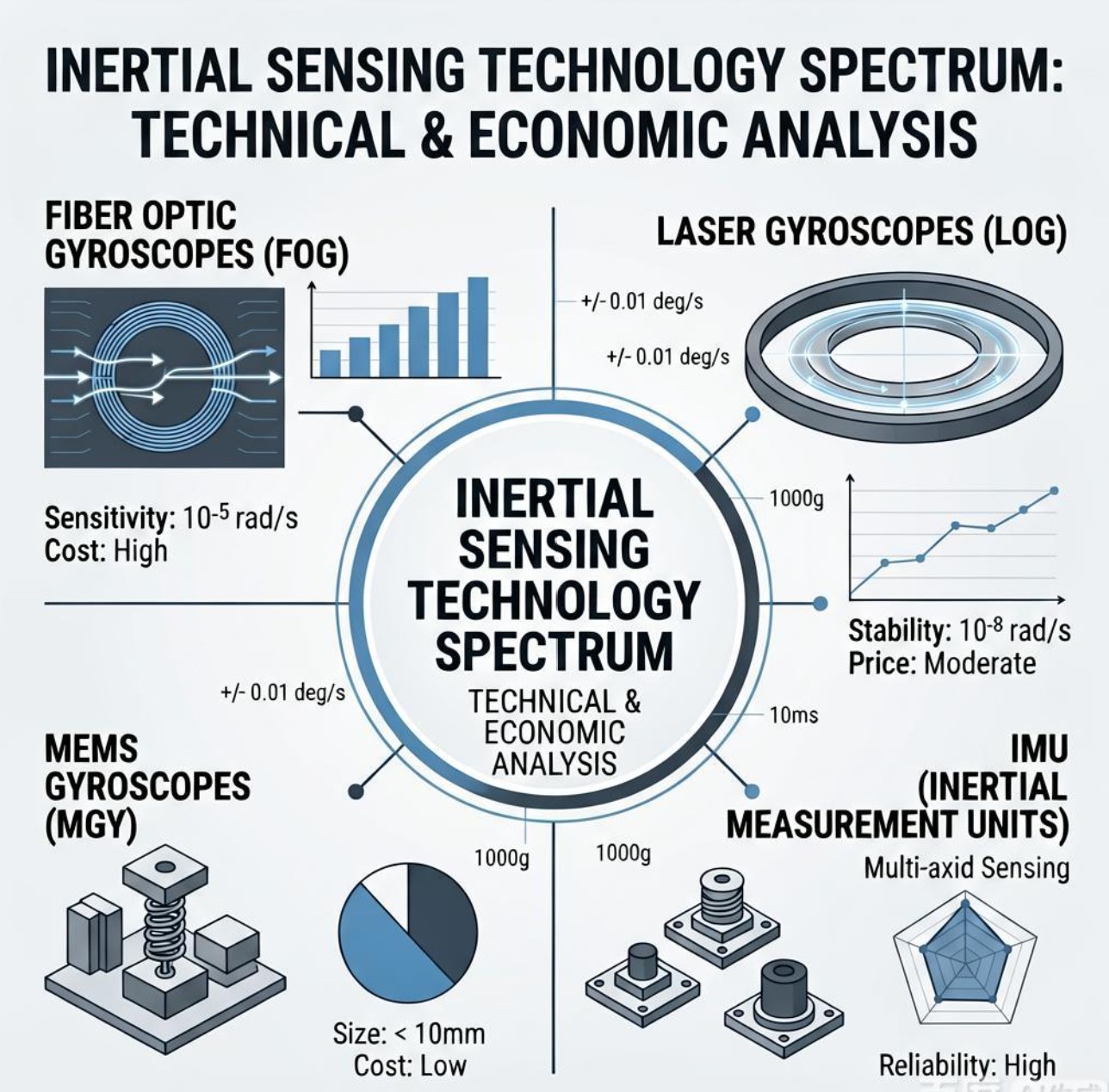

惯性传感核心技术谱系:光纤/激光/MEMS陀螺与IMU的技术经济分析及国产化前景
Inertial Sensing Core Technology Spectrum: Techno-Economic Analysis of FOG, RLG, MEMS Gyroscopes & IMU with China's Indigenous Substitution Outlook
机构/Institution: 全球宏观战略研究院(Global Macro Strategy Institute, GMSI)
日期/Date: 2026-07-08
分类/Classification: 国防科技与高端制造简报 Defense-Tech & Advanced Mfg. Brief No.2607-INR
密级/Clearance: 公开 Open Source
一、概述|Executive Summary
【中文】
惯性测量单元(IMU)由三轴陀螺仪与三轴加速度计构成,是飞行器、导弹、舰艇、无人平台及高阶智驾车辆在GPS拒止环境下实现自主导航的核心部件。陀螺仪按技术代际分为环形激光陀螺(RLG,第一代高精度光学陀螺)、光纤陀螺(FOG,第二代光学陀螺)及MEMS陀螺(微机电固态陀螺)。全球陀螺仪市场规模2025年约176亿美元,预计2034年达383亿美元(CAGR≈9%)。中国惯导系统市场规模2025年达404亿元,预计2026年增至453亿元,军用占比约67%。
【English】
An Inertial Measurement Unit (IMU)—comprising triaxial gyroscopes and triaxial accelerometers—is the core component enabling autonomous navigation for aircraft, missiles, ships, UAV/UGV platforms, and L3+ ADAS vehicles in GPS-denied environments. Gyroscope technologies are categorized as Ring Laser Gyro (RLG, 1st-gen precision optical), Fiber Optic Gyro (FOG, 2nd-gen optical based on Sagnac effect), and MEMS Gyro (micro-electromechanical solid-state). The global gyroscope market was ~USD 17.61 bn in 2025, projected to reach USD 38.29 bn by 2034 (CAGR≈9%). China's inertial navigation system market reached RMB 40.45 bn in 2025, forecast at RMB 45.26 bn in 2026, with ~67% defense/military share.
二、三大陀螺技术对比|Technology Comparison: RLG · FOG · MEMS Gyro
|
维度 Dimension |
环形激光陀螺 RLG (Ring Laser Gyro) |
光纤陀螺 FOG (Fiber Optic Gyro) |
MEMS陀螺 MEMS Gyro |
|---|---|---|---|
|
原理 Principle |
反向传播激光在闭合腔中的干涉频差 Sagnac effect in gas laser cavity |
千米级保偏光纤线圈中两束光的相位差干涉 Sagnac effect in km-length PM fiber coil |
微机械振动结构电容/压电检测科里奥利力 Micro-machined proof mass detecting Coriolis acceleration |
|
精度 Bias Stability |
0.001°~0.01°/h(导航级/战略级)Navigation/Strategic grade |
0.003°~0.1°/h(战术~导航级)Tactical~Navigation grade |
消费级1~100°/h;战术级0.5~5°/h Consumer to Tactical grade |
|
优势 Strengths |
成熟稳定、无磨损件、寿命长、空/海军标配套成熟 Proven, no moving parts, long life, airborne/naval heritage |
无锁定区(优于RLG)、抗电磁干扰、全固态、振动鲁棒、SWaP优 No lock-in, EMI immune, all-solid-state, vibration robust |
极小体积极低成本、可批量CMOS工艺、低功耗、耐冲击 Miniaturized, <10–500, mass-producible, high-shock tolerant |
|
劣势 Weaknesses |
"闭锁效应"需抖动偏置、体积大、成本高 Lock-in requires dither, bulky, expensive |
温漂需精密补偿、光纤绕制工艺壁垒高 Temp-drift compensation needed, coil winding IP barrier |
精度受限、温漂大、高动态性能弱(消费级)Lower precision, temp-sensitive (consumer grade) |
|
典型应用 Typical Apps |
战机/直升机/舰船主惯导、战略导弹 INS Fighter/helicopter/ship master INS, strategic missile |
无人机/UUV/地面战车/巡飞弹/卫星姿控 Tactical UAV, AUV/USV, guided munitions, satellite AOCS |
消费电子/车载智驾/人形机器人/微型弹载消费+战术 MEMS IMU Consumer electronics, ADAS/AV, humanoid robot, loitering munition (tactical) |
|
中国市场2025规模 Est.China 2025 |
≈46.7亿元 |
≈52.5亿元 |
≈68.1亿元(含消费+MEMS IMU) |
三、IMU产业链与中国国产化格局|IMU Industry Chain & China's Indigenous Substitution Landscape
【中文】
-
上游:光学器件(保偏光纤、激光管)——长飞、烽火通信参与;MEMS芯片——矽睿科技、深迪半导体、美泰电子(中电科13所)、芯动联科(688522);高端光学陀螺芯片——航天时代光电(航天电子600879子公司)、中航捷锐。
-
中游(IMU/惯导系统):航天电子(600879)、北方导航(600435,兵器工业唯一导航控制上市平台,FOG/激光陀螺IMU)、星网宇达(002829,FOG+组合导航)、晨曦航空(300581)、理工导航(688282)、七维航测等。
-
国产化率:中低端MEMS IMU国产化率已超65%–70%;军用战术级FOG国产化率>80%;导航级高精度FOG/RLG基本实现自主可控(航天科技、中航工业、兵器工业院所),但部分高端低损耗保偏光纤、宇航级光源仍有进口依赖。
-
市场驱动:国防现代化(巡飞弹/无人平台放量)、低空经济(eVTOL/工业无人机)、高阶智驾(城市NOA标配MEMS IMU)、人形机器人(姿态感知),推升IMU需求。预计2027年中国IMU市场达75.5亿元。
【English】
-
Upstream: Optical components (PM fiber, laser diode)—Changfei, FiberHome; MEMS chips—QST (SiRui), Deepmentum, MTMicro (CETC-13), Sciyon Microsystem (688522); High-end optical gyro cores—CASC Times Electronics (sub. of 600879), AVIC Jierui.
-
Midstream (IMU/INS Systems): CASC Electron (600879), North Navigation (600435 – only Norinco listed inertial platform co., FOG/RLG IMU), StarNet-UDA (002829 – FOG + GNSS/INS fusion), Chenxi Aviation (300581), Liyuan Nav (688282).
-
Localization Rate: Low-to-mid tier MEMS IMU >65%–70%; tactical-grade FOG >80%; navigation-grade FOG/RLG largely self-sufficient though ultra-low-loss PM fiber & space-grade sources still partially imported.
-
Demand Drivers: PGM/loitering munition procurement, low-altitude economy (eVTOL/drones), L3+ ADAS (MEMS IMU standard in urban NOA), humanoid robots. China's IMU market projected at RMB 7.55 bn by 2027.
四、前沿趋势与战略含义|Emerging Trends & Strategic Implications
【中文】
-
MEMS上探战术级:高端MEMS零偏稳定性突破1°/h以下,开始蚕食低端FOG在微型制导弹药、单兵导航市场份额。
-
FOG增长最快:无人平台(UAV/UUV/UGCV)放量驱动FOG为全球增速最高光学陀螺细分(CAGR>10%),抗振与无锁定优势适配军工。
-
多源融合+AI滤波:紧耦合GNSS/INS、视觉-惯性里程计(VIO)、地形匹配+深度学习标定算法成主流,延长GPS拒止导航时长。
-
量子/冷原子惯性传感:中美欧布局下一代无漂移冷原子陀螺,潜在用于战略潜艇、长航时UUV,目前处实验室-验证阶段。
-
地缘含义:中东冲突常态化+美军推动GPS抗干扰/拒止作战条令,刺激各国(含中国)加速高精度INS自主化,利好本土FOG/IMU产业链。
【English】
-
MEMS Pushing into Tactical Grade: High-end MEMS bias instability <1°/h now challenges low-end FOG in miniaturized PGMs and dismounted soldier nav.
-
FOG = Fastest-Growing Optical Segment: UAV/UUV/UGV proliferation drives FOG CAGR >10% globally; vibration immunity & no lock-in favor military unmanned platforms.
-
Multi-Sensor Fusion + AI Filtering: Tightly-coupled GNSS/INS, Visual-Inertial Odometry (VIO), terrain-aided nav with ML-based calibration extend GPS-denied endurance.
-
Cold Atom / Quantum Inertial Sensing: Next-gen drift-free atomic gyros under R&D in CN/US/EU for strategic submarine & long-endurance UUV—still pre-commercial.
-
Geostrategic Implication: Normalized Middle East tension + EW/GPS jamming doctrine accelerates sovereign high-precision INS programs—positive for domestic FOG/IMU supply chains.
五、结论|Conclusion
【中文】
光纤陀螺与激光陀螺构成中国军工导航级INS基石,MEMS陀螺是民用与战术无人系统爆发增长引擎。中国在高精度光学陀螺领域已实现实质性自主可控,MEMS中低端国产化率高,未来竞争焦点在于:①高端MEMS陀螺精度上探与车规/军规认证;②超低损耗保偏光纤与光子集成芯片自主;③多源融合算法与AI在线标定软件生态。惯性传感是国防信息化与新质战斗力建设的核心底层器件,也是自动驾驶、低空经济、具身智能的交叉受益赛道。
【English】
FOG and RLG form the backbone of China's defense-grade INS, while MEMS gyros drive the explosive growth in civilian and tactical unmanned systems. China has achieved substantive indigenous control over high-precision optical gyros; MEMS IMU localization is advanced at the consumer-tactical tier. Forward-looking competitive focus: (i) pushing MEMS gyro bias stability into tactical-navigation grades with AEC-Q100 / mil-spec certification; (ii) domesticating ultra-low-loss PM fiber and photonic integrated chips; (iii) building multi-sensor fusion algorithms and AI-based in-run calibration IP. Inertial sensing sits at the nexus of defense informatization, new-quality combat power, ADAS/autonomous vehicles, the low-altitude economy, and embodied AI—making it a structurally important dual-use technology sector.
⚠️ 本分析基于2025–2026年公开行业数据与文献,不构成投资建议。This analysis is based on open-source industry data (2025–2026) and does not constitute investment advice.
此文由 怡心湖 编辑,若您觉得有益,欢迎分享转发!:首页 > 常识论 » 惯性传感核心技术谱系:光纤/激光/MEMS陀螺与IMU的技术经济分析及国产化前景