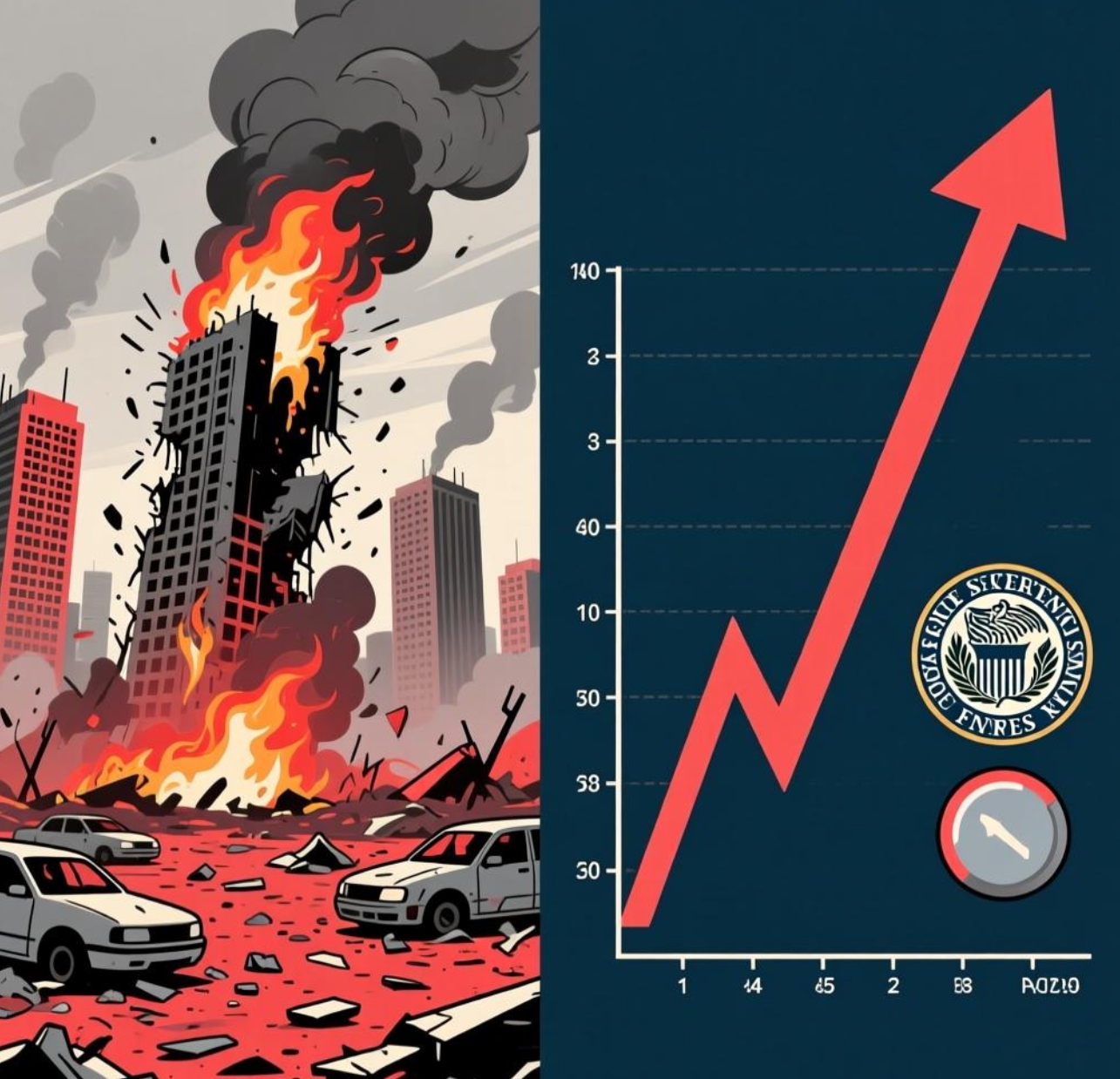
The Middle East in Flames: Will Oil Prices "Detonate" the Fed's Rate Cut Plans?
中东战火再燃:美联储的降息按钮会被油价“引爆”吗?
1. The Geopolitical Tinderbox: Why Markets Hold Their Breath
1. 地缘政治的火药桶:市场为何屏息凝神
The Middle East has long been the world’s most volatile geopolitical tinderbox. When conflicts ignite, global markets don’t just watch—they react, and often violently. From the oil shocks of the 1970s to the Gulf War turbulence, history shows that instability in this region rarely stays local. Today, as fresh flames leap across the desert, the same haunting question returns: Will this fire spread to the global economy, and could it scorch the Federal Reserve’s carefully laid plans for interest rate cuts?
中东长期是全球地缘政治最不稳定的火药桶。当冲突爆发,全球市场不会仅仅旁观——它们会做出反应,且往往是剧烈的反应。从1970年代的石油危机到海湾战争的动荡,历史一再证明,这个地区的不稳定很少能仅仅局限在当地。如今,当新的战火在沙漠上燃起,那个令人不安的疑问再次浮现:这场大火会蔓延至全球经济吗?它是否会烧毁美联储精心制定的降息计划?
2. The Oil Factor: More Than Just a Number on a Screen
2. 石油因素:不只是一个屏幕上的数字
Crude oil is the lifeblood of modern industrial society. When Middle East tensions spike, the first domino to fall is usually the price of a barrel. But this isn’t just about traders reacting to headlines; it’s about real physical supply chains. The Strait of Hormuz, a narrow maritime chokepoint, sees 20% of global oil shipments pass through daily. Any disruption there doesn’t just nudge prices—it can trigger a supply shock.
原油是现代工业社会的命脉。当中东紧张局势升级,倒下的第一张多米诺骨牌通常是每桶原油的价格。但这不仅仅是交易员对新闻头条的反应,它关乎真实的实体供应链。霍尔木兹海峡,一条狭窄的海上咽喉要道,每日承载着全球20%的石油运输。那里的任何中断都不仅仅是推高价格,它可能引发一场供应冲击。
And here’s the Fed’s dilemma: oil prices feed directly into transportation, manufacturing, and eventually, consumer prices. The "second-round effects" — where businesses pass on higher costs, and workers demand higher wages — are what the central bank fears most. A sustained oil price surge could re-anchor inflation expectations upward, making the "last mile" of inflation fighting much harder.
而这就是美联储的两难困境:石油价格直接传导至运输、制造业,并最终影响消费者价格。其“第二轮效应”——即企业转嫁更高的成本,工人要求更高的工资——正是央行最担心的。持续的油价飙升可能重新推高通胀预期,使得抗击通胀的“最后一英里”更加艰难。
3. The Fed’s Tightrope: Data-Dependent, but Crisis-Aware
3. 美联储的走钢丝艺术:依赖数据,但警惕危机
The Federal Reserve’s mantra has been "data-dependent." But what happens when the data itself gets clouded by a geopolitical storm? Chair Jerome Powell has repeatedly stated that the Fed can look through "temporary" supply shocks, but the definition of "temporary" is key. A few weeks of elevated oil prices? Likely overlooked. Months of structural supply fears and spiking global risk premiums? That changes the calculus.
美联储的口头禅一直是“依赖数据”。但是,当数据本身被地缘政治风暴所笼罩时,会发生什么?主席杰罗姆·鲍威尔多次表示,美联储可以“看穿”“暂时的”供应冲击,但“暂时”的定义是关键。几周的高油价?很可能被忽略。持续数月的结构性供应担忧和飙升的全球风险溢价?这将改变整个计算。
Market whispers are already growing louder. The famed "Fed Put" — the notion that the central bank will ease policy to support markets — might be challenged by an "Oil Put," where soaring energy costs force the Fed to stay hawkish even as growth slows. It’s a brutal trade-off: fight inflation fueled by oil, or rescue an economy buckling under high rates.
市场的窃窃私语已经越来越响。著名的“美联储看跌期权”——即央行将放松政策以支持市场的观念——可能会受到“石油看跌期权”的挑战,即飙升的能源成本迫使美联储在经济放缓时仍保持鹰派立场。这是一个残酷的权衡:是抗击由石油推高的通胀,还是拯救一个在高利率下步履蹒跚的经济。
4. Beyond the Barrel: The Ripple Effects
4. 超越油桶:涟漪效应
The impact channels extend far beyond gasoline pumps. Consider a stronger US dollar as investors flock to safety. While this might dampen import prices, it hammers American exporters and multinationals, squeezing corporate earnings. Global trade routes could be disrupted, reigniting supply chain bottlenecks that seemed healed from the pandemic. Emerging markets, heavily dependent on energy imports, could face balance-of-payments crises, creating a new wave of global financial instability.
影响渠道远不止加油站。考虑一下随着投资者涌向安全资产而走强的美元。虽然这可能抑制进口价格,但它会重创美国出口商和跨国公司,挤压企业盈利。全球贸易路线可能中断,重新点燃看似已从疫情中愈合的供应链瓶颈。严重依赖能源进口的新兴市场可能面临国际收支危机,引发新一轮全球金融不稳定。
In this fragile environment, the Fed’s models — built on decades of relative global stability — may struggle to capture the new reality of polycrisis. A single spark in the desert can now ignite fires in currency markets, bond vigilantes, and the political calculus of every major economy.
在这种脆弱的环境中,建立在数十年相对全球稳定基础上的美联储模型,可能难以把握多重危机交织的新现实。如今,沙漠中的一点火星就可以在货币市场、债券市场以及每个主要经济体的政治盘算中引发燎原之火。
5. The Verdict: Not a Determinant, But a Powerful Disruptor
5. 最终判断:非决定性因素,却是强大的颠覆者
So, will Middle East flames "detonate" the Fed’s rate cut button? The answer is nuanced.
那么,中东的战火会“引爆”美联储的降息按钮吗?答案很微妙。
In the short term: A major, sustained oil price shock (say, Brent above $100 for months) would almost certainly delay the first cut. Inflation fears would trump growth concerns. The Fed’s narrative would shift from "when to cut" to "how long to hold."
短期来看: 一场重大、持续的油价冲击(例如,布伦特原油价格持续数月高于100美元)几乎肯定会推迟首次降息。对通胀的担忧将压倒对增长的忧虑。美联储的叙事将从“何时降息”转变为“维持高利率多久”。
In a prolonged, expanding conflict: The calculus grows darker. Stagflation risks rise — the toxic mix of high inflation and stagnant growth. The Fed might be forced into a "volatility management" mode, prioritizing financial system stability over precise inflation targeting. Rate cuts could still happen, but they’d be later, slower, and explicitly framed as crisis response, not a soft landing victory lap.
在一场旷日持久、不断扩大的冲突中: 局势会变得更加黯淡。滞胀风险上升——这是高通胀与增长停滞的致命组合。美联储可能被迫进入“波动性管理”模式,将金融体系稳定置于精确通胀目标之上。降息仍可能发生,但会更晚、更慢,并且被明确界定为危机应对,而非软着陆的胜利庆典。
The most likely scenario (for now): The Fed pauses, watches, and stresses its uncertainty. Every speech will include the phrase "we are closely monitoring geopolitical developments." Data will be scrutinized for any sign of oil inflation seeping into core services. The "dot plot" of future rate projections will show wider dispersion among officials, reflecting the profound uncertainty.
最可能的情景(目前来看): 美联储将选择暂停、观望,并强调其不确定性。每一次演讲都会包含“我们正在密切关注地缘政治事态发展”这句话。将仔细审查数据,寻找石油通胀渗入核心服务的任何迹象。预示未来利率走势的“点阵图”将显示官员们更广泛的意见分歧,反映出深刻的不确定性。
Final Thought: The Unquantifiable Variable
最后的思考:不可量化的变量
In the end, the Middle East conflict is the ultimate unquantifiable variable in the Fed’s complex equation. The central bank fights with economic models, but geopolitics is driven by human decisions, miscalculations, and chance. One thing is certain: in the age of polycrisis, the Fed is no longer just a central bank — it’s a frontline institution in a global war for economic stability. And sometimes, the most powerful button is the one you’re afraid to press.
最终,中东冲突是美联储复杂方程中最终极的不可量化变量。央行用经济模型作战,但地缘政治是由人类的决策、误判和偶然性驱动的。有一件事是确定的:在多重危机的时代,美联储不再仅仅是一个中央银行,它已成为全球经济稳定之战中的前线机构。而有时候,最强大的按钮,正是你不敢按下的那个。
此文由 怡心湖 编辑,若您觉得有益,欢迎分享转发!:首页 > 观·世界 » 中东战火再燃:美联储的降息按钮会被油价“引爆”吗?
 中东战火点燃铜价“炸药桶”:全球供
 千年对局:当欧洲堡垒遭遇新月——文
 中东炮火推高油价,你家超市账单“默
 2027年房价潜在上涨因素的多维分析