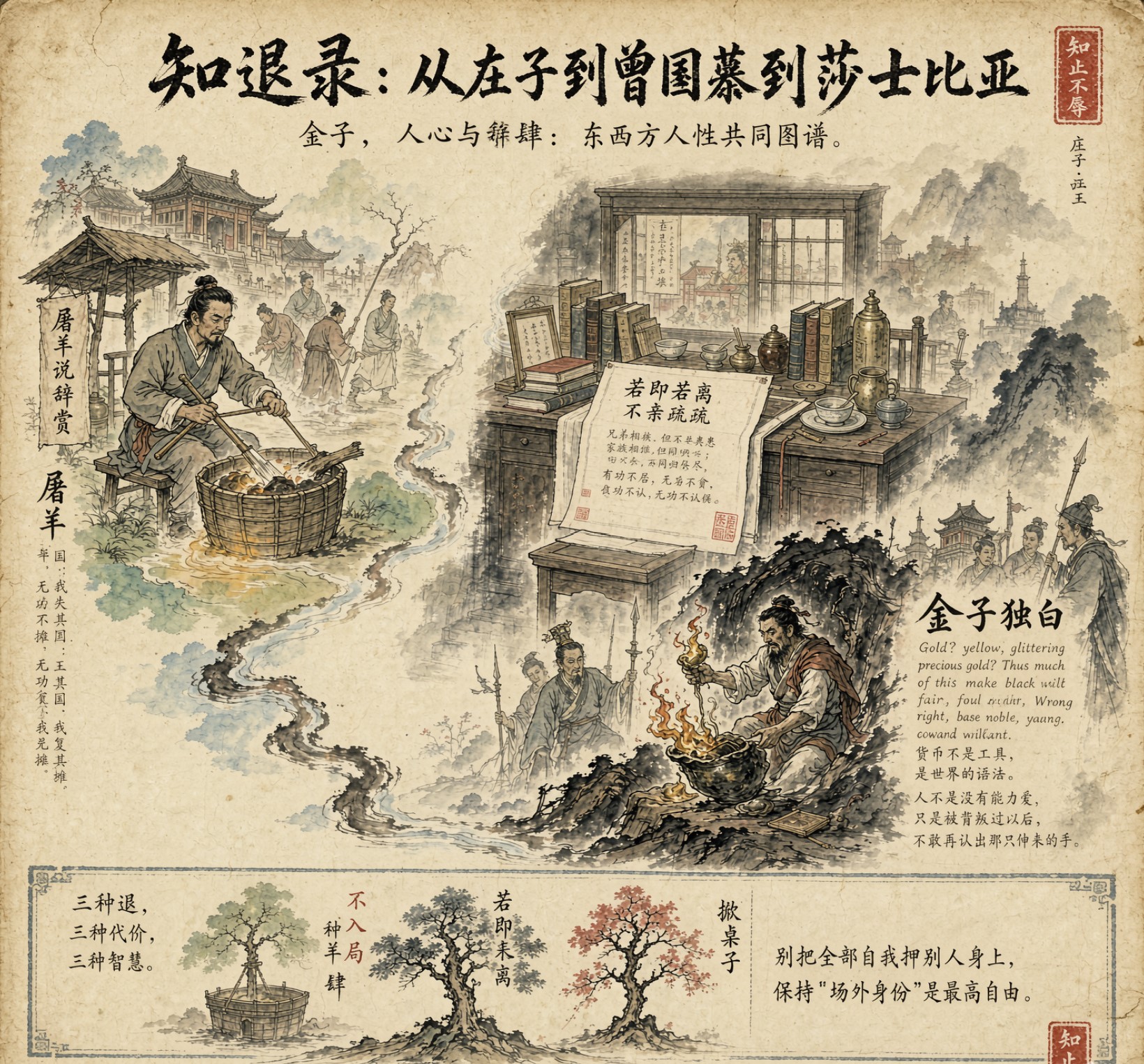
金子、人心与荒野:
Timon of Athens 里东西方共通的人性解剖
Gold, the Human Heart, and the Wilderness:
A Human Nature Common to East and West in Timon of Athens
一、雅典不是雅典,是人间
Athens is not Athens; it is the human world
泰门起初不是恶人。他有钱,也肯给。
朋友欠债,他替还;诗人来献媚,他赏银;将军被逐,他设宴;仆人想娶亲,他出嫁妆。
他以为“我以朋友为富”,却不知道朋友是被金价标出来的。
Timon is not wicked at first. He has money and he gives.
He pays a friend’s debt, rewards flatterers, banquets generals, funds a servant’s marriage.
He says, “I am wealthy in my friends”—not seeing that his “friends” were only the shadow cast by his gold.
东方人说“富在深山有远亲,贫在闹市无人问”。
西方雅典人说同样的真理,只是换成了元老院、妓女、诗人和债主。
The Chinese say:
When you are rich, relatives flock from remote mountains; when you are poor, no one greets you in the busiest street.
Athens says the same, only with senators, whores, poets, and creditors.
人性的第一层:关系常常不是关系,而是价格。
The first layer of human nature: a relation is often not a relation, but a price.
二、借钱那一刻,众神退场
When the loan is called in, the gods leave
钱花完以后,泰门派仆人去找“兄弟们”。
卢修斯装不在,卢库路斯塞几个小钱打发来人,文提狄斯低头不语。
昨天还喊“my lord”的人,今天连门都不开。
When the treasury empties, Timon sends servants to his “brothers.”
Lucullus bribes the messenger; Lucius hides; Ventidius, once ransomed from prison by Timon, says nothing.
Those who cried my lord yesterday will not open the door today.
这不是雅典的堕落,这是人的常态:
顺境里的爱,很多是预付;逆境里的冷淡,才是结算。
This is not the fall of Athens alone. It is the ordinary arithmetic of mankind:
Love in prosperity is often advance payment; coldness in adversity is the settlement.
《庄子》里屠羊说早就看穿:
“大王失国,说失屠羊;大王反国,说亦反屠羊。”
我不欠你,你也不欠我。
泰门却曾以为:我给过,所以他们该还。
Zhuangzi’s sheep-butcher saw it earlier:
The king lost his state, I lost my stall; the king regained his state, I regained my stall.
No debt, no credit.
Timon believed otherwise: I gave, therefore they must give back.
人性的第二层:施恩者容易发明“情义”,受恩者只想尽快结清账目。
The second layer: the giver invents “gratitude”; the receiver only wants the account closed.
三、冷水宴:把文明掀开给人看
The banquet of warm water: civilization turned inside out
泰门再开一次宴。
盖子掀开,不是山珍海味,是石头与温水。
他把水泼在客人脸上,用碗碟砸走他们。
Timon holds one more feast.
The covers lift: not meat, not wine—stones and lukewarm water.
He dashes water in their faces and drives them out with dishes.
这一场是仪式,也是解剖:
礼貌、友谊、宴饮、称兄道弟,底下都是交换。
一旦没有可换的东西,文明立刻现出荒野。
This scene is ritual and dissection at once:
Politeness, friendship, banqueting, brotherhood—underneath, all are exchange.
When there is nothing left to exchange, civilization reveals the wilderness beneath.
孔子讲“礼云礼云,玉帛云乎哉”;莎士比亚让泰门把玉帛换成石头。
Confucius asked: Rites, rites—do they mean mere jade and silk?
Shakespeare answers by replacing jade and silk with stones.
四、金子独白:货币不是工具,是神明
The gold soliloquy: money is not a tool, it is a god
泰门在荒野挖树根,挖出金子。他本该高兴,却发出文学史上最冷的咒:
Gold? yellow, glittering, precious gold?
Thus much of this will make black white, foul fair,
Wrong right, base noble, old young, coward valiant.
This yellow slave
Will knit and break religions, bless the accursed,
Make the hoar leprosy adored, place thieves
And give them title… with senators on the bench.
译:
金子!黄黄的、发光的、宝贵的金子!
只这一点点儿,就可以使黑的变成白的,丑的变成美的,
错的变成对的,卑贱变成尊贵,老人变成少年,懦夫变成勇士。
这黄色的奴隶,会缔结宗教,又会打破宗教;
祝福被诅咒的人;叫麻风病人受崇拜;
给强盗地位、官衔和元老的赞许。
Marx read this and said: Shakespeare depicts the real nature of money admirably.
因为金钱最恐怖的不是“能买东西”,而是——
它把“人本来是什么”替换成“人值多少”。
The horror of money is not that it buys things.
It is that money replaces what a person is with what a person is worth.
- 勇气,可以雇来;
- 青春,可以买来;
- 清白,可以包装;
- 罪人,可以坐上元老院;
- 真理,可以在账本上改一行。
Courage can be hired.
Youth can be purchased.
Innocence can be laundered.
A thief can sit with senators.
Truth can be rewritten as a single ledger entry.
东方有鲁褒《钱神论》:“钱之所在,危可使安,死可使活。”
西方有泰门:“Gold makes base noble, old young, coward valiant.”
两句话隔千年、隔万里,却像同一个人在两间屋子里说话。
China had Lu Bao’s Discourse on the God of Money:
Where money is, danger becomes safety, death becomes life.
Athens had Timon: base noble, old young, coward valiant.
A thousand years apart, ten thousand miles apart—yet the same voice in two rooms.
人性的第三层:人恨金钱,但更恨自己没有金钱。
The third layer: men hate money, but hate even more that they do not have it.
五、三种厌世者:哲人、复仇者、疯子
Three misanthropes: the philosopher, the avenger, the broken man
莎士比亚了不起的地方,是没把“看透人性”写成一种答案。
Shakespeare’s greatness: seeing through human nature is not given as one answer.
1. 艾帕曼特斯 Apemantus
他一开始就骂:别信人,别信誓,别信妓女的眼泪,别信睡觉的狗。
他是天生的犬儒:用嘲讽活下去。
He mocks from the start: trust no man, no oath, no weeping whore, no sleeping dog.
He is a born cynic: he survives by sneering.
2. 艾西巴第斯 Alcibiades
他被元老院驱逐,带兵回来攻雅典。
他恨制度,但不恨人类;他最后只罚敌人,不屠全城。
他是有界限的复仇者。
Banished by the Senate, he marches on Athens.
He hates the institution, not mankind; in the end he punishes enemies, not the whole city.
He is the avenger with boundaries.
3. 泰门 Timon
他被恩将仇报后,从“爱人类”跳到“恨人类”。
他给强盗金子,叫他们放火;给妓女金子,叫她们腐化城邦;给将军金子,叫他用血涂地。
他不是哲学家,也不是革命家,而是一个被人心咬碎的人。
Betrayed, Timon leaps from love of mankind to hatred of mankind.
He gives gold to thieves to burn houses, to whores to corrupt the city, to the general to paint the ground with blood.
He is neither philosopher nor revolutionary—he is a man chewed to pieces by other men.
艾帕曼特斯说:你现在的样子,不过是在学我。
Timon replies, in effect: I lost the world as my confectionary in one hour. You never had it. Don’t compare your coldness to my wound.
Apemantus says: you are only imitating me.
Timon’s answer is roughly: I lost the whole world in an hour. You never owned it. Do not confuse your chill with my wound.
人性的第四层:看透人性的人,也可能被看透这件事毁掉。
The fourth layer: he who sees through human nature may also be destroyed by seeing it.
六、唯一没演戏的人:弗莱维斯
The only man not acting: Flavius
所有人都戴着面具:
朋友戴“义气”,诗人戴“才华”,元老戴“公道”,妓女戴“多情”,泰门自己戴“慷慨”。
Everyone wears a mask:
friends wear loyalty, poets wear genius, senators wear justice, whores wear tenderness, and Timon himself wears generosity.
只有管家弗莱维斯早就在劝:老爷,钱没了。
最后他还来荒野找泰门,哭着说:你完了,可我还认你。
Only Flavius, the steward, warned early: my lord, the money is gone.
At the end he comes to the wilderness and weeps: you are ruined, but I still know you.
泰门被这一刻打动了一瞬,又马上把人推开:
“去吧,恨所有的人,包括我。”
For one moment Timon softens; then he pushes him away again:
Go, hate all men, and hate me too.
这比金子独白更狠。
因为莎士比亚在说:
人不是没有能力爱。
人只是被背叛过以后,不敢再认出那只伸来的手。
This cuts deeper than the gold soliloquy.
Shakespeare is saying:
Man is not unable to love.
He has only been betrayed, and no longer dares to recognize the hand held out to him.
东方讲“滴水之恩,涌泉相报”,也讲“一朝被蛇咬,十年怕井绳”。
弗莱维斯是前者,泰门是后者。
两部人性同时住在一个故事里。
The East says a drop of grace deserves a spring in return, but also once bitten by a snake, one fears the rope for ten years.
Flavius is the first sentence; Timon is the second.
Both sentences of human nature live inside one play.
七、从雅典到伦敦,从长安到华尔街
From Athens to London, from Chang’an to Wall Street
《雅典的泰门》写的是古希腊,其实是詹姆士一世时代的英国:
圈地、物价飞涨、官位可买、友谊标价。
Timon of Athens dresses antiquity in rags, but it is really Jacobean England:
enclosure, inflation, offices for sale, friendship priced like groceries.
我们今天读它,也不会过时:
We read it now and nothing has aged:
- 饭局上喊你“兄弟”的人,可能正在群聊里估价你。
The man who calls you brother over dinner is pricing you in another group chat. - 你红时,缺点叫“真性情”;你垮时,真性情叫“精神病”。
When you rise, your flaws are authenticity; when you fall, authenticity is instability. - 资本、流量、粉丝、期权、人脉、头衔——名字换了,金子没换。
Capital, traffic, followers, stock options, networks, titles—the names change, the gold does not. - AI 时代,“个人品牌”不过是新的元老院门票。
In the age of AI, “personal brand” is only the new ticket to the Senate.
泰门恨的不是金子。
泰门恨的是:金子替人做了判断。
Timon does not hate gold.
Timon hates that gold makes the judgments human beings should make.
八、曾国藩与泰门:退与疯,是同一道伤口的两种结痂
Zeng Guofan and Timon: retreat and madness are two scabs on the same wound
前面我们写曾国藩:“若即若离,不亲不疏。”
他选择在局中留距离。
Earlier we wrote of Zeng Guofan: neither too close nor too distant, neither intimate nor estranged.
He chose distance while staying inside the game.
泰门选的是另一边:把桌子掀了,去荒野挖树根。
Timon chose the other shore: overturn the table, go to the wilderness, dig for roots.
曾国藩保住家族,赔上失眠。
Timon保住清白,赔上整个人类。
Zeng kept the family and paid with sleepless nights.
Timon kept his purity and paid with all mankind.
一个说:我还在人间,但我不信人间。
一个说:我还在人间,可我再不愿是人。
One says: I remain among men, but I no longer believe in them.
The other says: I am still a man, yet I can no longer bear to be one.
东西方最深的英雄,往往不是战胜人性的人,
而是被人性打穿以后,还留下一句话的人。
The deepest heroes of East and West are rarely those who conquer human nature.
They are those pierced by human nature, yet left behind one sentence.
屠羊说说:我回我的摊。
泰门说:你们都去死。
曾国藩说:万事浮云过太虚。
The sheep-butcher says: I return to my stall.
Timon says: let mankind be devoured.
Zeng Guofan says: all things pass like clouds over the void.
三句话,三种伤口,一种病:
人想用“信”活下去,世界却用“价”回答他。
Three sentences, three wounds, one sickness:
Man wants to live by trust; the world answers him with price.
九、结尾:荒野里还有没有另一种人?
Ending: is there a third kind of man in the wilderness?
莎士比亚没给泰门救赎。
他让泰门死在海岸洞穴,墓碑自题:
Here lie I, Timon, who alive all living men did hate.
Pass by and curse thy fill, but pass and stay not here thy gait.
他没让泰门变成圣人。
他只让弗莱维斯留下一滴泪,让艾西巴第斯最后收住刀。
Shakespeare gives Timon no salvation.
He dies in a seaside cave, and writes his own epitaph:
Here lie I, Timon, who alive all living men did hate.
Pass by and curse thy fill, but pass and stay not here thy gait.
He does not make Timon a sage.
He lets Flavius shed one tear, and lets Alcibiades lower the sword.
所以这出戏真正的教训不是“别信人”,也不是“人皆畜生”。
而是:
如果你看透了人性还愿意递一杯水,
你不是傻,你是荒野里剩下的神。
So the play’s real lesson is neither trust no one nor all men are beasts.
It is:
If you have seen through human nature and still hand someone a cup of water,
you are not a fool—you are the god left standing in the wilderness.
东方叫它“仁”。
西方荒野里,它没有一个好听的名字,只占三行:
Flavius weeps. Timon flinches.
The drum goes on.
The East calls it ren—humaneness.
In the Western wilderness it has no fine name. It takes only three lines:
Flavius weeps. Timon flinches.
The drum goes on.
**金子会过去。元老院会过去。雅典会过去。
但那个在冷水宴后还肯哭的人,不会过去。**
Gold passes. The Senate passes. Athens passes.
But the one who can still weep after the banquet of warm water does not pass.
此文由 怡心湖 编辑,若您觉得有益,欢迎分享转发!:首页 > 历史人文 » 金子、人心与荒野: Timon of Athens 里东西方共通的人性解剖 Gold, the Human Heart, and the Wilderness
 屠羊说:功成不居,知止不辱——从《庄
 以六养修身:道家智慧中的生命秩序
  贪惧二蛇绕金瓶:论金钱恐惧与贪婪的