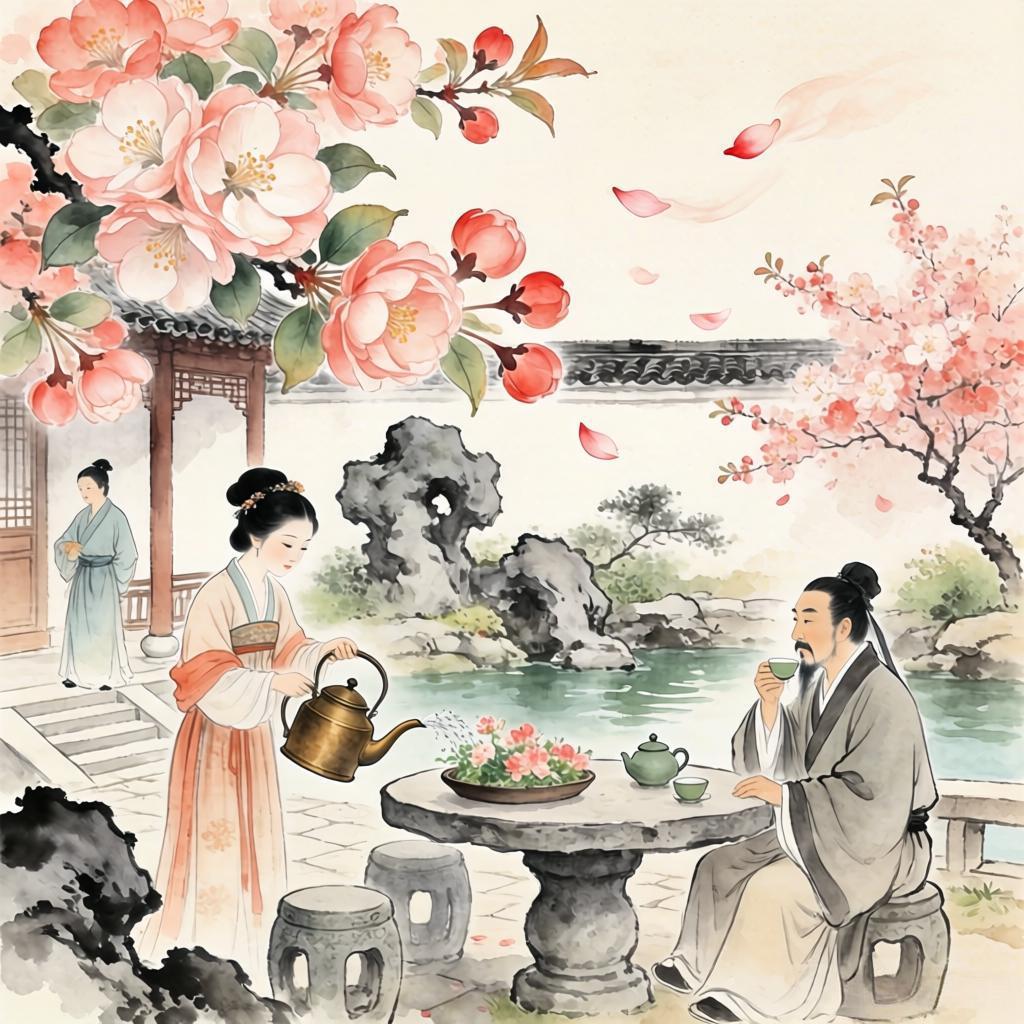
“国艳”海棠史:一朵花如何征服了唐宋庭园
"The History of the 'National Beauty' Crabapple: How a Flower Conquered the Gardens of Tang and Song"
海棠,原是一种蔷薇科乔木,在汉魏之前多被视为山野寻常之花。然而,正是从唐代开始,它的命运发生了戏剧性转折。随着社会经济繁荣和造园艺术的兴盛,宫廷与贵族对观赏植物的追求达到新高度,花色娇媚、风姿潇洒的海棠,以其独特的“花中神仙”气质,开始从乡野步入朱门,奠定了其“名花”地位的基石。
The crabapple, originally a common wild tree of the Rosaceae family, was often seen as an ordinary mountain flower before the Han and Wei dynasties. However, beginning in the Tang Dynasty, its fate took a dramatic turn. With socio-economic prosperity and the flourishing of garden art, the imperial court and aristocracy pursued ornamental plants with unprecedented fervor. The crabapple, with its delicate blossoms and elegant, graceful demeanor—often described as the "celestial being among flowers"—began its journey from the countryside into the courtyards of the elite, laying the foundation for its status as a "celebrated flower."
唐人对海棠的痴迷,始于宫廷。唐明皇曾将海棠比作善舞的杨贵妃,一句“岂妃子醉,直海棠睡未足耳”的戏言,将美人、名花与帝王恩宠巧妙相连,赋予了海棠浓丽的宫廷传奇色彩。自此,皇家园林广植海棠,其“国艳”之名初现端倪。文人如贾耽著《百花谱》,更誉其为“花中神仙”,将其推向审美圣殿。
The Tang people's fascination with crabapple began in the imperial palace. Emperor Xuanzong of Tang once compared the crabapple to the gracefully dancing Consort Yang Guifei. A playful remark—"Is the consort merely drunk? It seems more like the crabapple hasn't slept enough"—ingeniously linked the beauty, the famous flower, and imperial favor, endowing the crabapple with a rich, legendary aura of the court. From then on, crabapples were widely planted in imperial gardens, and its title "National Beauty" began to emerge. Literati like Jia Dan, in his Register of a Hundred Flowers, further praised it as the "celestial being among flowers," elevating it to the pinnacle of aesthetic admiration.
然而,真正将海棠推上文化巅峰的,是宋代。这是一个审美极度精致化、文人广泛参与造园的时代。海棠契合了宋人崇尚的“格韵”之美:其花色“秾丽”却不失“清淑”,其姿态“娇柔”而内含“劲骨”,这种矛盾而和谐的特质,令追求“理趣”的宋人深深着迷。上至皇室,下至士庶,植海棠、赏海棠、咏海棠成为全国性的风雅之事。
However, it was the Song Dynasty that truly elevated the crabapple to its cultural peak. This was an era of extremely refined aesthetics and widespread literati involvement in garden design. The crabapple perfectly embodied the Song ideal of "elegant charm" (geyun): its blossoms were "richly gorgeous" yet retained a "pure and gentle" quality; its posture appeared "delicate and soft" yet contained an inner "strength of bone." This paradoxical yet harmonious nature deeply fascinated Song people, who sought "principle and interest" (liqu) in all things. From the imperial family down to common scholars and citizens, planting, appreciating, and composing poetry about crabapples became a nationwide pursuit of refinement.
皇家园林的推崇起到了决定性作用。宋太宗曾御赐海棠与宰相,真宗、仁宗朝宫廷诗中海棠已是常客。至北宋末年,徽宗建艮岳,广罗天下奇花,海棠位列其中,其皇家象征意义得以巩固。南渡后,临安(杭州)皇家与贵邸园林继续大量种植,西湖周边“海棠极盛”,形成了著名的观赏胜地。
The promotion by royal gardens played a decisive role. Emperor Taizong of Song once bestowed crabapple trees upon his chancellor. By the reigns of Emperor Zhenzong and Emperor Renzong, crabapples had become a frequent subject in palace poetry. In the late Northern Song, Emperor Huizong, constructing the Genyue Imperial Garden, gathered rare flowers from across the land, with crabapple among them, solidifying its imperial symbolic significance. After the southward move of the court, royal and aristocratic gardens in Lin'an (modern Hangzhou) continued to plant crabapples extensively. The area around West Lake became "abundant with crabapples," forming a famous scenic spot for appreciation.
文人士大夫的集体吟咏,则为海棠注入了灵魂。从王禹偁、晏殊到苏轼、陆游,巨匠辈出,杰作不断。苏轼被贬黄州,见海棠杂生于山野,感怀自身而作《海棠》诗,“只恐夜深花睡去,故烧高烛照红妆”成为千古绝唱,将海棠的幽独之美与士人的精神坚守融为一体,极大提升了其文化品格。
The collective poetic chants of literati and scholar-officials infused the crabapple with its soul. From Wang Yucheng and Yan Shu to Su Shi and Lu You, masters emerged one after another, producing timeless works. When Su Shi was exiled to Huangzhou and saw crabapples growing wild in the mountains, he projected his own feelings onto them, composing his famous poem "Crabapple." The lines, "I only fear the flowers fall asleep in the deep of night, / So I light a tall candle to shine on their crimson attire," became an immortal masterpiece, merging the flower's secluded beauty with the scholar's spiritual resilience, vastly elevating its cultural character.
园艺技术的突破,直接加速了海棠的普及。宋代嫁接技术(特别是贴接法)成熟,使得垂丝海棠、西府海棠等优良观赏品种得以大规模繁育。同时,盆栽艺术的兴起,让“盆池海棠”进入寻常书斋,实现了“小景之中,得见大千”的审美意趣,海棠真正走进了宋人生活的每一个角落。
Breakthroughs in horticulture directly accelerated the crabapple's proliferation. The maturation of grafting techniques (especially approach grafting) in the Song Dynasty enabled the large-scale propagation of superior ornamental varieties like the weeping crabapple and the midget crabapple. Meanwhile, the rise of potted plant art allowed "crabapples in potted pools" to enter ordinary studies, achieving the aesthetic delight of "seeing the universe within a miniature landscape." Thus, the crabapple truly entered every corner of Song life.
在唐宋庭院中,海棠的种植已极具章法。或临水而植,花枝照影,取其灵动;或倚石而栽,红白掩映,衬其风骨;或成片栽种,形成“锦绣谷”般的绚烂效果。它常与玉兰、牡丹、桂花搭配,寓意“玉堂富贵”,其应用已深度融入园林美学与吉祥文化之中。
In the gardens of Tang and Song, the planting of crabapples was already highly artistic. They were planted by ponds, with flowering branches reflecting in the water, capturing their liveliness; or nestled against rocks, with red and white blossoms intermingling, highlighting their graceful strength; or planted in clusters, creating dazzling effects like a "brocade valley." They were often paired with magnolias, peonies, and osmanthus, symbolizing "wealth and nobility in the Jade Hall" (yutang fugui). Their use was deeply integrated into both garden aesthetics and auspicious culture.
海棠的征服史,本质上是一场由权力、审美与技术共同驱动的文化运动。皇家为其赋权,文人为其赋格,工匠为其赋能。这朵原本寻常的山花,最终在唐宋的庭院中,完成了从“物”到“灵”的升华,成为一种承载着时代精神、审美理想与生命哲思的文化符号。
The history of the crabapple's conquest was, in essence, a cultural movement driven collectively by power, aesthetics, and technology. The imperial court endowed it with status, the literati endowed it with character, and the craftsmen endowed it with accessibility. This once-ordinary mountain flower ultimately completed its transformation from a mere "object" to a "spiritual entity" within Tang and Song gardens, becoming a cultural symbol承载着 the spirit of the era, aesthetic ideals, and philosophical reflections on life.
其影响绵延至今。每当春日海棠盛开,我们仍能透过那如霞般的花云,窥见一个时代的风雅与执着。它不仅仅是一种植物,更是一扇通往唐宋精神世界的花窗,记录着那个伟大时代对美至死不渝的追求与创造。
Its influence extends to this day. Whenever crabapples bloom in spring, we can still glimpse, through their cloud-like profusion of blossoms, the elegance and dedication of that era. It is not merely a plant, but a floral window into the spiritual world of Tang and Song, recording that great age's unwavering pursuit and creation of beauty.
此文由 怡心湖 编辑,若您觉得有益,欢迎分享转发!:首页 > 花·烟火 » “国艳”海棠史:一朵花如何征服了唐宋庭园
 海棠花适合白天浇水还是晚上?
 海棠花的花语?风水中有何妙用?